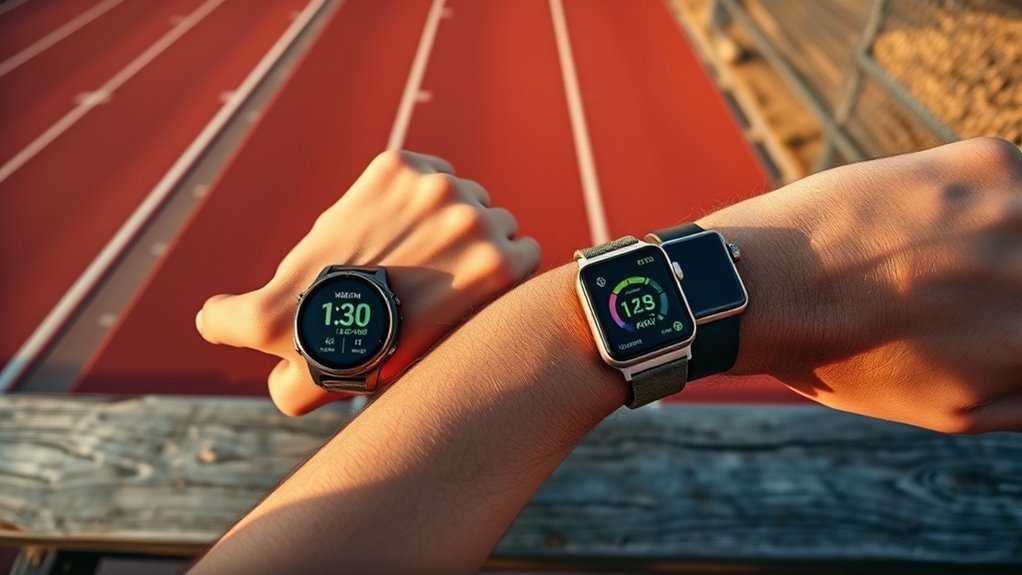
In this side-by-side test, the Garmin Forerunner 265 finished closer to the manual step count than the Apple Watch Series 10. Garmin was short by 86 steps, while the Apple Watch was short by 465. Garmin also showed 2.00 miles on a route treated as two miles, compared with 2.02 miles on the Apple Watch. Those results favor Garmin in this specific test, but they should not be treated as proof that Garmin is always the more accurate watch.
Quick Answer
In this single side-by-side test, the Garmin Forerunner 265 was closer to the manual step count, missing 86 steps versus 465 for the Apple Watch Series 10. It also matched the stated 2.00-mile route while Apple logged 2.02 miles. Useful result—but one test cannot prove Garmin is universally more accurate.
Key Takeaways
- In the test described here, the Garmin Forerunner 265 missed 86 steps and the Apple Watch Series 10 missed 465.
- Garmin displayed 2.00 miles on the stated two-mile route; Apple displayed 2.02 miles, a difference of only 0.02 mile.
- The result should be treated as a single-test observation because the article does not include repeated trials, the full manual step total, or the method used to establish the reference distance.
- The Forerunner 265 officially offers up to 13 days of smartwatch battery life and supports multi-band GPS; Series 10 is rated for up to 18 hours of normal use and uses L1 GPS/GNSS.
- Both watches provide extensive sleep and health data, but consumer sleep-stage estimates should be used for trends rather than treated as clinical measurements.
Which Watch Tracks Steps More Accurately?
For the walk test described in this article, the Garmin Forerunner 265 produced the closer step total. It was 86 steps below the manual count, compared with a 465-step shortfall from the Apple Watch Series 10.
That makes Garmin the better performer in this particular session. It does not establish that every Forerunner 265 will outperform every Series 10 under every walking condition. Step-count accuracy can change with walking speed, wrist placement, arm movement, watch fit, terrain, and the algorithms running on each device.
Research reinforces that caution. A 2025 peer-reviewed study of slow and altered walking found strong performance from an older Apple Watch Series 5 and different results from older Garmin devices. Those were not the Forerunner 265 and Series 10 tested here, so the study cannot decide this matchup directly. It does show why results from one watch model or one walking test should not automatically be applied to another.
The defensible conclusion is narrow: Garmin recorded fewer missed steps in this test. Broader claims about which brand is always more accurate require repeated, controlled testing.
Garmin Connect remains useful for reviewing steps, activities, heart rate, training data, VO2 max, recovery information, and other fitness metrics. That depth is a strong reason to consider a Forerunner, but the amount of data an app provides should not be confused with measurement accuracy.
How We Tested Apple Watch vs Garmin
The comparison used a manual clicker counter while the Garmin Forerunner 265 and Apple Watch Series 10 recorded the same walking sessions. The route included city walking and a hike, giving the watches exposure to changes in pace, surface, and surroundings.
The watches were worn at the same time on opposite wrists. The device totals were then compared with the manually counted steps and with a route described as two miles.
Note: Opposite-wrist testing is convenient, but it does not eliminate placement bias. Dominant-hand movement, watch fit, arm swing, pace, and wrist assignment can affect a wrist-worn tracker. A stronger comparison would repeat the test several times and swap the devices between wrists.
The original test record reports the size of each step-count error, but it does not provide the full manual step total. Because that reference total is missing, a percentage step-count error cannot be calculated reliably from the available data.
The method used to establish the two-mile reference distance is also not documented. Therefore, the 2.00-mile and 2.02-mile results are best interpreted as a comparison against the stated route distance rather than a laboratory-grade GPS validation.
What Would Make the Test Stronger?
- Run several trials instead of relying on one result.
- Record the exact manual step total and each watch’s raw step total.
- Swap watches between the dominant and nondominant wrists.
- Keep watch fit and placement consistent.
- Use a professionally measured route or another documented distance reference.
- Test slow walking, normal walking, running, hills, tree cover, and open-sky conditions separately.
Garmin vs Apple Watch Step Count Results
The available results show a meaningful difference in step-count error but only a small difference in the displayed two-mile distance.
| Device | Reported step-count error | Displayed distance |
|---|---|---|
| Garmin Forerunner 265 | 86 steps low | 2.00 miles |
| Apple Watch Series 10 | 465 steps low | 2.02 miles |
Step Count Accuracy
Against the manual tally used for this test, the Forerunner 265 had the smaller absolute step error. Garmin’s 86-step shortfall was 379 steps closer to the reference count than Apple’s 465-step shortfall.
Because the full reference count was not recorded in the article, however, it would be misleading to convert these figures into percentage accuracy or claim a precise percentage advantage for Garmin.
Step-count results should also be considered separately from heart-rate, calorie, GPS, and sleep accuracy. A watch that performs better for one metric does not automatically perform better for every sensor-derived measurement.
Real-World Walk Testing
The city and wooded-route testing provides useful real-world context because wrist wearables must cope with changing pace, arm movement, surface, and satellite conditions outside a laboratory.
In this test, Garmin stayed closer to the manually counted number of steps. The Apple Watch’s 2.02-mile reading, however, was only 0.02 mile above the stated two-mile route, so its distance result was still very close.
That distinction matters: step counting and GPS distance are different measurements. A device can miss steps while still producing a close GPS distance, particularly during an outdoor activity where satellite positioning contributes to distance measurement.
Why Garmin Was More Accurate in This Test
The safest explanation is simply that the Forerunner 265’s output happened to align more closely with the reference measurements used in this test. The available test data do not reveal exactly which sensor, algorithm, calibration setting, or movement pattern produced the difference.
The Forerunner 265 does have a notable GPS hardware feature: Garmin lists multi-band GPS for the watch. Multi-band reception can help a compatible device handle difficult satellite environments, such as areas where signals reflect from buildings or terrain. The Apple Watch Series 10 specification lists L1 GPS together with GNSS, Galileo, and BeiDou.
That gives Garmin a technical advantage for some challenging positioning situations, but it still does not guarantee that every recorded route will be more accurate. Satellite visibility, software, fit, activity mode, and environmental conditions all matter.
Calibration Can Change the Results
Apple recommends calibrating Apple Watch by completing about 20 minutes of an Outdoor Walk or Outdoor Run in an open area with good GPS reception. Apple says this helps the watch learn stride and improves distance, pace, and calorie estimates, particularly when GPS is limited.
Pro Tip: Before comparing two watches, update personal information, wear both securely, allow each device to establish GPS, use the correct activity mode, and complete any manufacturer-recommended calibration. Then repeat the same route more than once.
Garmin also relies on a correctly configured user profile for several fitness calculations. For a fair comparison, both devices should be fully set up before testing.
GPS and Distance Accuracy: Do Not Confuse It With Steps
The two-mile result is much closer between the devices than the step-count result. Garmin displayed exactly 2.00 miles, while Apple displayed 2.02 miles.
A difference that small should be interpreted cautiously because the article does not state how the reference route was measured. GPS distance can also vary between repeated attempts because of satellite geometry, buildings, trees, turns, and the smoothing algorithms used by the watch.
The Forerunner 265’s multi-band capability may be especially attractive to runners who regularly train around tall buildings, dense tree cover, mountains, or other difficult GPS environments. Series 10 still provides dedicated onboard GPS and a broad set of running, hiking, cycling, swimming, and other workout tools.
Sleep Tracking and Other Health Metrics
Both watches provide substantially more health information than step counts. The Forerunner 265 records sleep duration, sleep stages, sleep movement, sleep score, HRV-related information, recovery metrics, and training-readiness data through Garmin’s ecosystem.
Apple Watch Series 10 also tracks sleep stages and other health information. With supported newer watchOS software, Apple has added a Sleep Score based on factors such as sleep duration, bedtime consistency, and interruptions. This makes the original claim that organized sleep scoring clearly favors Garmin outdated.
More importantly, neither watch’s sleep-stage graph should be treated as equivalent to a clinical sleep study. Research comparing consumer wearables with polysomnography has found that wearables are often good at detecting that someone is asleep but are less dependable at distinguishing specific sleep stages.
Warning: Do not use a smartwatch’s deep-sleep, REM, oxygen, breathing, or recovery readings to diagnose or rule out a medical condition. Persistent sleep problems, breathing concerns, unusual heart symptoms, or other health issues should be discussed with a qualified healthcare professional.
This also means statements such as “Garmin recorded more deep sleep, therefore Garmin was more accurate” are not justified without a reference measurement such as polysomnography. How rested a person feels after waking can be useful personal context, but it is not a scientific reference for identifying sleep stages.
Battery Life and Everyday Use
Battery life is one of the clearest practical differences between these two models.
| Feature | Garmin Forerunner 265 | Apple Watch Series 10 |
|---|---|---|
| Normal smartwatch battery claim | Up to 13 days | Up to 18 hours |
| GPS | Multi-band GPS supported | L1 GPS/GNSS |
| Primary emphasis | Running, training, recovery, endurance | Smartwatch, health, fitness, and iPhone integration |
The earlier 23-day Garmin figure was not a Forerunner 265 specification. Garmin rates the standard Forerunner 265 for up to 13 days in smartwatch mode; the Forerunner 965 is the model associated with an up-to-23-day smartwatch claim.
Apple rates Series 10 for up to 18 hours of normal use or up to 36 hours in Low Power Mode. Real battery life on either device varies with GPS use, display settings, music, sensors, notifications, and other features.
Which Watch Should You Buy?
The better choice depends on what you want the watch to do. The results of this test support Garmin for step counting in the specific sessions performed here, but a purchase decision should also consider GPS features, battery life, training tools, phone compatibility, health features, and smartwatch functions.
Apple is not the only comparison worth making. If you are weighing tracking accuracy against price rather than ecosystem, Garmin against Fitbit is the closer contest.
| Priority | Garmin Forerunner 265 | Apple Watch Series 10 |
|---|---|---|
| This article’s step test | Closer to manual count | Larger shortfall in this test |
| Battery endurance | Major advantage: up to 13 days | Up to 18 hours normal use |
| GPS hardware | Multi-band GPS | L1 GPS/GNSS |
| Training and recovery | Strong running-focused metrics, training readiness, recovery data | Strong workout tracking, training load, heart-rate zones, and health integration |
| Phone ecosystem | Garmin Connect supports compatible iOS and Android devices | Designed around the iPhone ecosystem |
| Smartwatch integration | Notifications, music, Garmin Pay, Connect IQ features | Deeper iPhone, app, messaging, calling, safety, and Apple-service integration |
Choose the Forerunner 265 when long battery life, running-focused training data, multi-band GPS, and Garmin’s fitness ecosystem matter most. The step result in this article is another point in its favor, but it should remain a secondary data point rather than the sole reason to buy.
Choose the Apple Watch Series 10 when close integration with an iPhone, smartwatch apps, communication features, Apple Health, safety functions, and Apple’s wider ecosystem matter more. Its larger step-count error in this test does not mean it is broadly inaccurate.
Frequently Asked Questions
Which is better for me, an Apple Watch or a Garmin?
A Garmin Forerunner 265 is a strong fit if you prioritize long battery life, running and training metrics, multi-band GPS, and compatibility with both major phone platforms. Apple Watch Series 10 makes more sense if you prioritize iPhone integration, smartwatch apps, communication, Apple Health features, and Apple’s broader device ecosystem.
What can a Garmin Forerunner 265 do that an Apple Watch Series 10 can’t?
The Forerunner 265 offers multi-band GPS, an official smartwatch battery rating of up to 13 days, and Garmin’s running-focused training tools such as Training Readiness and extensive recovery metrics. Garmin Connect also works with compatible Android phones, while Apple Watch is built around iPhone.
Why do many runners choose Garmin over Apple Watch?
Common reasons include long battery life, physical buttons, multi-band GPS on models such as the Forerunner 265, structured workouts, training-readiness and recovery metrics, and an interface designed heavily around endurance training. Apple Watch also offers advanced running metrics, so the better fit depends on the runner’s priorities.
Which smartwatch is most accurate?
There is no single smartwatch that is most accurate for every metric and activity. Accuracy varies by model, firmware, sensor, activity, skin contact, walking or running speed, environment, and the metric being measured. Evaluate step counting, GPS, heart rate, sleep, and calorie estimates separately rather than treating accuracy as one universal score.
Can I calibrate an Apple Watch Series 10 for better accuracy?
Yes. Apple recommends wearing the watch for an Outdoor Walk or Outdoor Run for about 20 minutes in a flat, open location with good GPS reception. This helps calibrate the accelerometer and learn your stride for improved distance, pace, and related calculations.
Can I trust Garmin or Apple Watch sleep stages?
Use them mainly to watch long-term sleep patterns. Consumer wrist wearables estimate sleep stages from sensors and algorithms rather than directly measuring brain activity like clinical polysomnography. A single night’s deep-sleep or REM estimate should not be treated as a medical diagnosis.
Sources
- Garmin Forerunner 265 Battery Life Information — supports the official Forerunner 265 battery specifications.
- Apple Watch Series 10 Technical Specifications — supports battery life, GPS/GNSS, workout, health, and hardware information.
- Apple Watch Calibration Guidance — explains Apple’s recommended outdoor calibration procedure.
- PLOS One Wearable Step-Count Accuracy Study — demonstrates how step-count accuracy can vary by device, placement, and walking conditions.
- Wearable Sleep-Tracking Validation Study — compares consumer sleep trackers with polysomnography and supports caution when interpreting sleep stages.
- Apple watchOS 26 Updates — supports current Sleep Score capabilities and other newer health features.
Conclusion
The Garmin Forerunner 265 performed better in the step-count test described here: it missed 86 steps compared with 465 for the Apple Watch Series 10. Garmin also displayed 2.00 miles while Apple displayed 2.02 miles on the stated two-mile route.
That is useful evidence about this particular test, not a universal verdict on Garmin versus Apple accuracy. Independent research shows that wearable performance varies with the metric, device generation, movement pattern, placement, and testing conditions.
The broader buying differences are clearer. The Forerunner 265 offers multi-band GPS, running-focused training tools, and up to 13 days of smartwatch battery life. Apple Watch Series 10 offers deep iPhone integration, extensive smartwatch and health features, and up to 18 hours of normal-use battery life. For step tracking, GPS, sleep, or any other health metric, the most useful approach is to look at repeated trends rather than treating a single reading as perfectly accurate.
