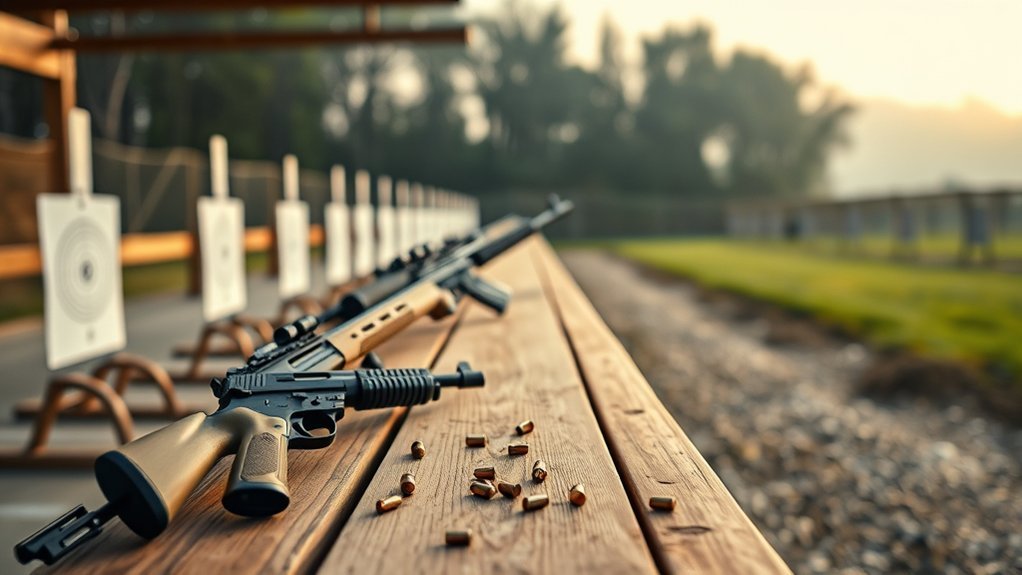
Firearm effective range is not one fixed number for every rifle, pistol, or shotgun. It describes the distance at which a particular firearm, ammunition load, target, sighting system, and shooter can meet a defined accuracy or performance standard. Published figures are useful reference points, but they should not be treated as universal limits.
Quick Answer
Effective range is the distance at which a specific firearm and ammunition combination can reliably meet its intended accuracy and performance standard. Rifles normally reach farther than handguns or shotguns, but caliber alone does not determine range. Barrel length, ammunition, target size, sights, conditions, and shooter consistency all matter.
Key Takeaways
- Effective range and maximum projectile range are different measurements.
- A cartridge does not have one universal effective range independent of the firearm and ammunition load.
- Official specifications for the M4/M4A1 and M16A4 show how two 5.56 mm weapon systems can have different published ranges.
- Shotgun performance depends heavily on the individual load, barrel, choke, sights, and actual pattern or accuracy results.
- For hunting or sporting use, stay within distances at which you have demonstrated consistent accuracy and the ammunition maker documents suitable performance.
Warning: A projectile can travel far beyond the distance at which accurate shooting is practical. Use only lawful shooting areas with an adequate backstop, know your target and what is beyond it, and follow all range rules and local firearm laws.
What Effective Range Means
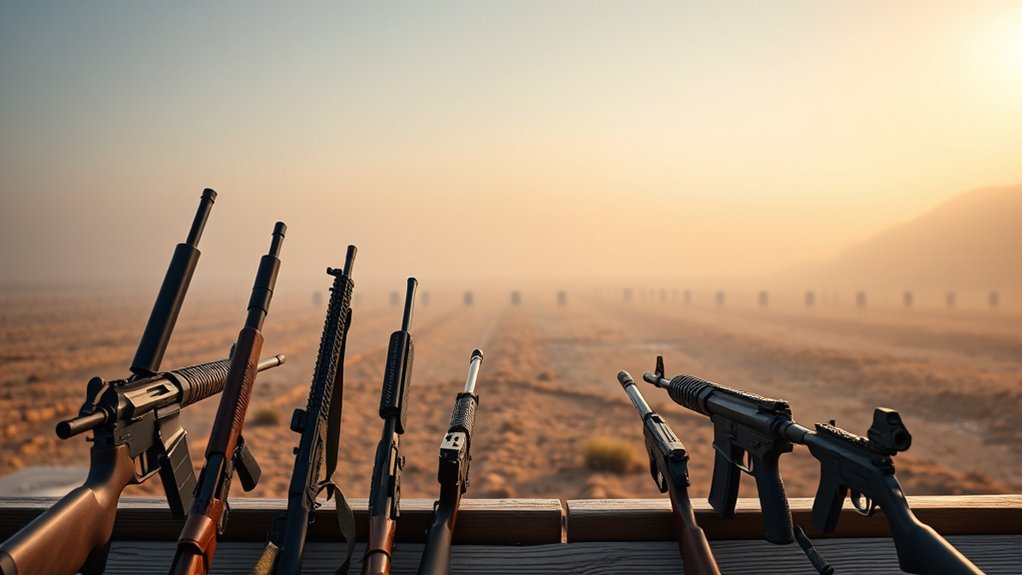
In firearms terminology, effective range is a practical performance measure rather than a statement about how far a projectile can physically travel. It normally refers to the distance at which a particular firearm and ammunition system can still meet a defined accuracy or performance requirement.
That definition matters because maximum range and effective range are not the same. A projectile may continue traveling for a considerable distance after accurate, predictable use has become impractical. The National Shooting Sports Foundation therefore stresses knowing both the target and what lies beyond it because bullets, slugs, and pellets can travel much farther than ordinary shooting distances.
Effective range can be influenced by firearm design, barrel length, ammunition, projectile construction, sights or optics, target size, environmental conditions, and shooter consistency. A published distance should therefore be read as a specification or reference for a particular setup rather than a guarantee that every firearm using the same cartridge will perform identically.
Note: Military manuals often specify different effective ranges for point targets and area targets. Those figures describe particular weapon systems and military standards; they are not universal sporting specifications for an entire cartridge.
Effective Range by Firearm Type
Rifles generally support longer practical distances than handguns or shotguns because rifle cartridges and platforms commonly provide higher velocity, longer sighting systems, shoulder support, and better stability. Even so, broad category ranges should be treated as approximate context rather than hard limits.
| Firearm type | General range characteristic | Important limitation |
|---|---|---|
| Rifle | Typically offers the longest practical range | Varies greatly by cartridge, firearm, ammunition, target, sights, and conditions |
| Pistol | Generally used at shorter sporting distances than rifles | Short sight radius, platform stability, sights, and shooter ability strongly affect results |
| Shotgun | Highly load-dependent | Shot patterns and slug accuracy must be evaluated with the actual firearm and ammunition |
A useful real-world example comes from 5.56 mm U.S. service weapons. The U.S. Army lists the M4/M4A1 carbine with a 500-meter range, while Marine Corps training material lists a 550-meter maximum effective range for individual or point targets with the M16A4. The difference illustrates why an effective-range figure belongs to a weapon system, not simply to the cartridge name.
Rifle Effective Range by Cartridge
Rifle range is strongly influenced by cartridge design, but the cartridge is only one part of the system. Barrel length, projectile weight and shape, ammunition consistency, firearm accuracy, sights, target dimensions, weather, and the shooter’s demonstrated ability all affect practical results.
Intermediate cartridges such as 5.56 NATO are widely used in relatively light rifles and carbines. Official examples include the M4/M4A1’s published 500-meter range and the M16A4’s 550-meter point-target specification. Those figures should not be interpreted as a universal maximum effective range for every 5.56 firearm or ammunition load.
Long-range sporting cartridges such as 6.5 Creedmoor, .300 Winchester Magnum, .300 PRC, and .338 Lapua Magnum can support much greater distances in appropriate rifles. However, stating that every rifle in one of those chamberings is automatically “effective” to a particular distance would ignore the firearm, ammunition, target, and conditions.
At the extreme end, Lapua describes the .338 Lapua Magnum as a cartridge commonly used in long-range sporting disciplines when targets are beyond 1,500 meters. That is evidence of the cartridge’s long-range capability, not a guarantee of accuracy or suitability at that distance for every rifle or shooter.
Intermediate Cartridge Range
Intermediate rifle cartridges are designed to balance firearm size, recoil, ammunition weight, and useful range. The 5.56 NATO is one of the best-known examples, but its effective range cannot be reduced to one number without identifying the firearm and performance standard.
7.62 NATO is sometimes compared with 5.56 NATO because it can retain performance differently at distance, but it is normally classified as a full-power rifle cartridge, not an intermediate cartridge.
The .300 Blackout has different design priorities from 5.56 NATO and is commonly associated with shorter-range sporting applications, especially when different bullet weights and velocities are compared. Its practical range therefore depends heavily on the specific ammunition and firearm.
The .224 Valkyrie was developed around efficient, relatively high-ballistic-coefficient projectiles intended to retain velocity and resist wind effects better than many traditional intermediate-cartridge combinations. As with any cartridge, however, practical results remain firearm- and load-specific.
These examples show why caliber charts should be used as comparison tools rather than guarantees of what a particular rifle can accomplish.
Full-Power Rifle Reach
Full-power and long-range rifle cartridges can extend practical sporting distances, but no single number describes every rifle chambered for a given cartridge.
- .300 Winchester Magnum: A well-established long-range sporting and hunting cartridge whose usable distance depends on the rifle, projectile, ammunition, target, conditions, and shooter.
- .338 Lapua Magnum: Designed for very long-range performance; Lapua specifically discusses sporting targets beyond 1,500 meters.
- 6.5 Creedmoor: Popular in long-range target shooting because suitable projectiles can combine good aerodynamic efficiency with moderate recoil.
- .300 PRC: A newer long-range cartridge designed around modern, high-ballistic-coefficient projectiles, but its effective range remains setup- and application-specific.
Compared with lighter intermediate cartridges, these cartridges can retain velocity and energy differently over distance. That does not eliminate the need to verify the performance of the exact rifle and ammunition combination being used.
Pistol Effective Range by Caliber
Pistol effective range is especially difficult to express as a caliber-only number. Handgun dimensions, sight design, barrel length, trigger characteristics, shooter stability, target size, and ammunition can matter as much as the cartridge itself.
Standard cartridges such as 9mm and .40 S&W are commonly used for short- and moderate-distance handgun practice, but there is no authoritative rule stating that either cartridge has a universal 50-yard effective limit.
Smaller cartridges such as .25 ACP and .380 ACP are frequently chambered in compact pistols. In practice, the small size and sighting systems of those firearms can be a more important limitation on practical accuracy than caliber alone.
More powerful handgun cartridges, including .357 Magnum and 10mm Auto, may be used at longer sporting distances in appropriate handguns. Optics, firearm configuration, ammunition, and shooter skill can change the result substantially, so a fixed 100-yard rule would be misleading.
The most useful approach is therefore to evaluate a handgun as a complete system rather than assuming its caliber determines a guaranteed effective range.
Shotgun Effective Range With Buckshot and Slugs
Shotgun range varies sharply with ammunition type. Buckshot sends multiple pellets toward the target, while a slug uses a single projectile. Their practical limits therefore arise for different reasons.
Buckshot becomes less predictable as the pattern expands. How quickly that happens depends on the shotgun, choke or barrel configuration, ammunition design, and individual load. A commonly quoted distance such as 35 or 50 yards can be a useful reference, but only actual patterning shows how a particular shotgun and load behave.
Slugs can remain accurate at substantially greater distances than buckshot. Current ammunition catalogs publish trajectory and energy data for some shotgun slug loads through 100, 150, or even 200 yards. Those tables describe ballistic performance under test conditions; they do not guarantee that every shotgun, slug, or shooter is practically effective at the farthest listed distance.
Buckshot Effective Distance
Buckshot is primarily associated with relatively short shotgun distances because pellet patterns generally spread as range increases. Wider patterns reduce pellet density on the intended target and increase the importance of a safe backstop.
- Buckshot pattern size varies by firearm and ammunition load.
- Choke and barrel configuration can affect pattern behavior.
- Two loads of the same nominal buckshot size may pattern differently in the same shotgun.
- A shotgun should be patterned only at a lawful shooting range or other authorized location with a proper backstop.
Birdshot contains smaller pellets and is designed primarily for appropriate sporting and small-game applications. It should not be treated as interchangeable with buckshot simply because both are shotshell loads.
Pro Tip: When evaluating a shotgun for lawful sporting use, rely on the actual pattern produced by your specific shotgun and ammunition rather than a generic internet distance chart.
Slug Range Limits
Shotgun slugs concentrate the payload into a single projectile, allowing a shotgun to maintain useful accuracy farther than typical shot loads when the firearm, sights, barrel, and ammunition are suited to the task.
| Load | Typical use characteristic | Range consideration |
|---|---|---|
| Birdshot | Multiple small pellets | Pattern and intended sporting target determine practical distance |
| Buckshot | Multiple larger pellets | Pattern must be verified with the actual load and shotgun |
| Rifled slug | Single projectile, often used in smoothbore barrels | Trajectory and accuracy vary by firearm and load |
| Sabot slug | Often intended for rifled slug barrels | Some manufacturers publish ballistic tables to extended distances |
Federal’s 2026 ammunition catalog, for example, publishes velocity, energy, and trajectory information for selected slug loads at multiple distances. It also cautions that actual trajectories can differ because of atmospheric conditions, firearm, sights, and ammunition variation. That is why a trajectory table should not be converted directly into a universal effective-range claim.
How to Find Your Maximum Effective Range
For lawful target shooting or hunting, a personal practical range should be based on demonstrated accuracy rather than the farthest distance printed on an ammunition box or online chart.
A published ballistic distance describes what a firearm or cartridge may be capable of under defined conditions; your practical sporting limit should be based on repeatable, safe performance with your actual equipment.
- Use only a lawful shooting range or shooting area with a suitable backstop.
- Follow the range’s distance limits, target rules, and firearm-safety procedures.
- Evaluate accuracy with the exact firearm and ammunition you intend to use.
- Judge performance using a target size appropriate to the sporting activity rather than assuming that a cartridge’s published range guarantees a hit.
- For hunting ammunition, consult the ammunition manufacturer’s recommendations because projectile expansion and other terminal characteristics are bullet-specific.
- Reduce your practical limit when field position, visibility, weather, or other conditions make consistent accuracy harder.
A fixed impact-velocity number such as 1,600 fps should not be treated as a universal expansion threshold. Different hunting bullets use different constructions and can have different manufacturer-specified operating windows.
This approach separates three different ideas: what a projectile can physically reach, what a firearm system can accomplish under controlled conditions, and what the individual shooter can safely and consistently achieve during lawful sporting use.
Frequently Asked Questions
How Far Can Different Guns Shoot?
There is no single distance for rifles, pistols, or shotguns. A projectile’s maximum travel distance can be far greater than its practical effective range. Firearm design, ammunition, sights, target size, conditions, and shooter consistency all affect useful range.
What Is the 26 Pistol Rule?
There is no recognized 26-yard “pistol rule” that defines handgun effective range. In U.S. federal firearms law, 26 inches appears in certain firearm-classification provisions involving overall length. It is a legal measurement, not an accuracy or shooting-distance standard. Firearm laws vary by jurisdiction, so current official guidance should be checked before relying on any legal classification.
Which Gun Has the Longest Effective Range?
There is no universal answer because effective range depends on the firearm, ammunition, target standard, sights, and conditions. Very-long-range cartridges such as .338 Lapua Magnum and .50 BMG are associated with extended-distance shooting, but declaring one firearm universally “longest” oversimplifies the comparison.
What Gun Will Shoot 1,000 Yards?
Many purpose-built long-range sporting rifles and cartridges are used on 1,000-yard target ranges. Whether a particular rifle is suitable depends on the firearm, ammunition, target discipline, sights, range rules, environmental conditions, and the shooter’s demonstrated accuracy.
What Is the Difference Between Maximum Range and Effective Range?
Maximum range describes how far a projectile may travel, while effective range describes a distance at which a firearm system can meet a defined accuracy or performance standard. Maximum projectile range can be much farther, which is why an adequate backstop remains essential.
Does Caliber Alone Determine Effective Range?
No. Cartridge choice matters, but barrel length, firearm accuracy, projectile design, ammunition consistency, sights, target size, atmospheric conditions, and shooter performance can all change the practical result.
Conclusion
Effective range is best understood as a property of a complete firearm system operating under defined conditions, not as a fixed number attached to a caliber name. Rifles usually provide greater practical reach than handguns and shotguns, but firearm design, ammunition, sights, target size, conditions, and shooter consistency can change the result substantially.
Published specifications are still useful when their context is preserved. The M4/M4A1’s 500-meter figure, the M16A4’s 550-meter point-target figure, long-range .338 Lapua sporting applications, and shotgun-slug trajectory tables all describe specific systems or test conditions rather than universal limits.
For lawful sporting or hunting use, rely on the exact firearm and ammunition combination, stay inside demonstrated accuracy limits, follow ammunition-manufacturer guidance, and always use a safe shooting area with a proper backstop.
Sources
- U.S. Army PEO Soldier — M4/M4A1 Carbine — supports the current 500-meter published range for the M4/M4A1 weapon system.
- U.S. Marine Corps — M16A4 Service Rifle Training Material — supports the 550-meter individual/point-target specification and distinction between target types.
- Lapua — .338 Lapua Magnum — supports discussion of the cartridge’s use in extreme-long-range sporting applications.
- Federal Premium — 2026 Ammunition Catalog — supports shotgun-slug trajectory examples and the limits of standardized trajectory data.
- National Shooting Sports Foundation — Firearm Safety Rules — supports target, backstop, ammunition, and projectile-travel safety guidance.
- Bureau of Alcohol, Tobacco, Firearms and Explosives — National Firearms Act Questions and Answers — supports the explanation of the U.S. 26-inch firearm-classification issue.
