
A well-maintained Toyota RAV4 Hybrid can exceed 200,000 miles, although no manufacturer promises a fixed maximum lifespan. Current iSeeCars longevity data estimates an average RAV4 Hybrid lifespan of about 170,110 miles and a 28.9% chance of reaching at least 200,000 miles. Those figures describe a population of vehicles, not a limit for an individual RAV4 Hybrid. Maintenance history, climate, corrosion, driving load, repair quality, and the condition of the engine, hybrid system, brakes, suspension, and body still matter more than the odometer alone.
Last Updated: September 19, 2026
Quick Answer
A Toyota RAV4 Hybrid can last beyond 200,000 miles (about 322,000 kilometers) when it is maintained well, but that is a realistic possibility rather than a guaranteed lifespan. Current population-level data estimates average lifespan at roughly 170,110 miles, with 28.9% projected to reach at least 200,000 miles. Service history, corrosion control, prompt warning-light diagnosis, correct fluid maintenance, and a clean hybrid-battery cooling path are more useful longevity indicators than mileage alone.
Key Takeaways
- Current population-level data estimates an average RAV4 Hybrid lifespan of about 170,110 miles, while well-maintained individual vehicles can exceed 200,000 miles.
- Treat 200,000 miles as a possible planning milestone, not a promised lifespan.
- Follow the maintenance schedule and fluid specifications for your exact model year, engine, drivetrain, and market.
- Do not replace the high-voltage battery on mileage alone; test it when symptoms, fault codes, or inspection results justify action.
- Certain 2019–2024 RAV4 Hybrid AWD vehicles are covered by a Toyota customer-support program addressing rear-motor high-voltage cable corrosion; verify eligibility by VIN.
- Check the door-jamb placard for tire pressure instead of using a generic PSI figure.
- For a used RAV4 Hybrid, service records, corrosion, campaign and recall status, diagnostic results, and an independent inspection matter more than a low asking price.
How Long Can a Toyota RAV4 Hybrid Last?

Toyota does not publish a maximum lifetime mileage for the RAV4 Hybrid. In practical terms, a carefully maintained vehicle may remain useful beyond 200,000 miles, but its actual lifespan depends on condition and operating history.
As a population benchmark, iSeeCars currently estimates an average RAV4 Hybrid lifespan of about 170,110 miles or 13.9 years and a 28.9% chance of reaching at least 200,000 miles. The estimate is based on the site’s large vehicle dataset and should be treated as a statistical benchmark rather than a prediction for one specific vehicle.
Claims of 300,000 to 500,000 kilometers or more should be treated as exceptional outcomes or owner anecdotes rather than the expected lifespan of every RAV4 Hybrid. A single high-mileage example cannot predict how another vehicle will age.
The strongest indicators of remaining life include consistent service records, low corrosion, normal fluid condition, even tire wear, a healthy cooling system, no unresolved warning lights, and a hybrid system that passes a professional diagnostic check.
2026 model note: The redesigned 2026 RAV4 HEV uses Toyota’s fifth-generation hybrid system. Because this generation is new, it does not yet have the long-term field history of earlier RAV4 Hybrid generations. Toyota’s current U.S. warranty covers the hybrid battery for 10 years or 150,000 miles, whichever comes first. See Toyota’s 2026 RAV4 information for current-generation details.
| Mileage | What to Focus On |
|---|---|
| Under 100,000 miles | Maintenance history, tire and brake wear, recalls, campaign status, accident history, and signs of neglected fluids. |
| 100,000 to 200,000 miles | Suspension wear, cooling-system condition, wheel bearings, 12-volt battery health, leaks, corrosion, high-voltage cable condition where applicable, and hybrid-system diagnostics. |
| Over 200,000 miles | Overall condition, repair history, oil consumption, rust, diagnostic codes, traction-battery performance, and whether upcoming repairs still make financial sense. |
Common Issues and Prevention
The RAV4 Hybrid is not immune to age, mileage, climate, or deferred maintenance. Problems reported for older gasoline-only RAV4s should not automatically be assigned to hybrid models, and model-year-specific Toyota campaigns should be checked separately.
- Rear-motor high-voltage cable corrosion: Toyota Customer Support Program 22TE09 covers certain 2019–2024 RAV4 Hybrid AWD vehicles for excessive corrosion at the HV floor-under-wire and rear traction-motor cable connector. Toyota’s current U.S. program documentation says coverage can expand to 10 years/unlimited miles when Limited Service Campaign 25TD01 is completed by September 30, 2028; otherwise applicable vehicles may revert to the program’s shorter coverage after the campaign period. Check VIN eligibility and current terms with a Toyota dealer. See the Toyota/NHTSA program document.
- Cooling-path restriction: Keep the hybrid-battery air intake unobstructed and free of lint, pet hair, and debris. Follow the cleaning guidance in your owner’s manual.
- 12-volt battery weakness: Slow accessory startup, repeated no-start conditions, or unusual electronic warnings can come from the smaller 12-volt battery rather than the traction battery.
- Brake and suspension wear: Inspect pads, rotors, calipers, bushings, struts, bearings, and alignment as mileage rises. Regenerative braking reduces friction-brake use, but it does not eliminate inspection needs.
- Corrosion: Road salt and coastal exposure can damage the body, brake hardware, fasteners, underbody components, and electrical connections. Wash the underbody and inspect it regularly.
- Air-conditioning problems: Weak cooling can come from low refrigerant, a blocked cabin filter, damaged components, or an electrical fault. Have hybrid-compatible air-conditioning equipment used because the system may require specific service procedures.
- Warning lights or reduced fuel economy: Diagnose the vehicle instead of guessing. Engine, emissions, cooling, sensor, tire, 12-volt, and hybrid-system faults can create similar symptoms.
- Open recalls or campaigns: Check the VIN through the NHTSA recall lookup and ask a Toyota dealer about manufacturer campaigns that may not appear as safety recalls.
Warning: The high-voltage hybrid system can cause severe injury. Do not open the traction-battery case, probe orange high-voltage cables, or attempt hybrid electrical repairs without proper training, equipment, and service information.
Importance of Regular Maintenance for Your RAV4 Hybrid

Regular maintenance protects the gasoline engine, hybrid components, cooling systems, brakes, tires, suspension, and electrical system. It also creates records that help a technician spot a developing pattern before it becomes an expensive failure.
Use the schedule and specifications for your exact RAV4 Hybrid. Toyota provides model-specific manuals and warranty guides through its manuals and warranties portal.
Routine Oil Changes
Change the engine oil and filter at the interval required by your model-year maintenance guide. Some operating schedules allow longer intervals with the specified synthetic oil, while severe use may require earlier service. For a model-specific overview, see the RAV4 Hybrid oil-change interval guide.
Short trips, repeated cold starts, dusty roads, heavy idling, towing, and extreme temperatures can increase engine stress. Check the oil level between services, especially on a high-mileage vehicle.
Use the viscosity and specification shown in the owner’s manual and on the oil-filler cap. Do not assume every RAV4 Hybrid uses the same grade. The U.S. Department of Energy also recommends using the manufacturer-specified motor-oil grade rather than substituting a thicker or thinner oil.
Tire Maintenance Practices
Check tire pressure at least monthly when the tires are cold. Use the pressure printed on the driver-side door-jamb placard, not a generic 32-to-35 PSI recommendation and not the maximum pressure molded into the tire sidewall.
Rotate the tires at the interval and pattern specified for your vehicle. Inspect tread depth, sidewall damage, uneven wear, vibration, and alignment. The NHTSA TireWise guide recommends regular pressure checks and following the vehicle manufacturer’s rotation guidance.
Fluid Level Checks
Inspect engine oil, engine coolant, hybrid-system coolant where applicable, brake fluid, and windshield-washer fluid. Look for leaks, contamination, repeated level loss, or warning messages.
The hybrid transaxle is not the same as a conventional stepped automatic transmission. Use the correct Toyota-specified fluid and follow the service guidance for your model rather than applying a generic “transmission flush” schedule.
Hybrid Battery Cooling and Electrical Care
Keep the traction-battery cooling intake clear, especially if you carry pets, blankets, or loose cargo. A blocked intake can raise battery temperature and reduce efficiency.
Have persistent fan noise, rapid battery-gauge changes, hybrid warnings, or a sudden fuel-economy drop diagnosed. These symptoms do not prove the battery has failed, but they justify testing. For battery-specific warranty, lifespan, and replacement guidance, see how long a Toyota RAV4 Hybrid battery lasts.
Best Practices for Extending Lifespan
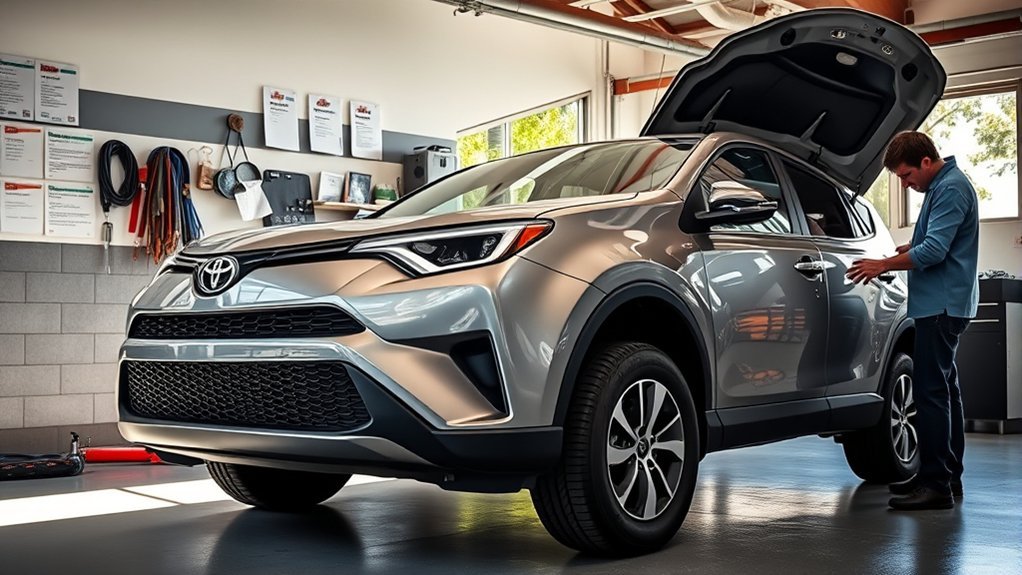
A long-lasting RAV4 Hybrid usually comes from consistent, ordinary care rather than a special product or one-time service. Preventive work is most effective when it follows the owner’s manual and responds to the vehicle’s actual condition.
| Maintenance Practice | Why It Helps |
|---|---|
| Follow the model-specific maintenance guide | Prevents skipped service and avoids applying the wrong fluid, interval, or procedure. |
| Check fluids and warning lights promptly | Catches leaks, overheating, lubrication problems, and electronic faults before damage spreads. |
| Maintain tires, brakes, and alignment | Improves safety, efficiency, tire life, and suspension durability. |
| Clean the underbody in salted areas | Reduces corrosion risk around structural, brake, exhaust, and electrical components. |
| Keep the hybrid-battery intake clear | Supports proper battery cooling and stable hybrid performance. |
| Use smooth acceleration and avoid overloading | Reduces heat and stress on tires, brakes, suspension, engine, and drivetrain components. |
Pro Tip: Keep dated invoices and record the mileage for every service. A complete maintenance history helps diagnose problems, supports warranty or goodwill requests, and can increase buyer confidence when you sell.
What Can High-Mileage RAV4 Hybrid Stories Tell You?
High-mileage owner stories can show what is possible, but they are not controlled reliability studies. Vehicles that reach exceptional mileage often receive frequent maintenance, accumulate steady highway miles, avoid severe corrosion, and get repairs before small problems become major failures.
Exceptional mileage is evidence of what one carefully maintained vehicle achieved, not a warranty that every RAV4 Hybrid will do the same.
Reports of vehicles exceeding 400,000 or 500,000 kilometers should be treated as individual experiences. When evaluating an owner report, confirm the model year, market, odometer units, maintenance records, battery history, and whether major repairs were excluded from the story.
Toyota introduced the first U.S.-market RAV4 Hybrid for the 2016 model year. Therefore, an alleged 2009 U.S.-market “RAV4 Hybrid” should not be used as RAV4 Hybrid longevity evidence; it may refer to a different Toyota hybrid, a RAV4 EV, or a gasoline-only RAV4. Toyota’s 2016 RAV4 Hybrid launch information confirms the model’s introduction.
How Driving Conditions Affect Your RAV4 Hybrid’s Longevity
Driving conditions affect different parts of the vehicle in different ways. Stop-and-go traffic adds heat cycles and suspension use, while high-speed driving adds sustained load. Climate, road quality, trip length, payload, and maintenance response usually matter more than a simple city-versus-highway label.
Urban vs. Highway Driving
Urban driving can increase brake, tire, steering, and suspension wear because of frequent stops, potholes, curbs, and short trips. However, the hybrid system can recover energy through regenerative braking, so city driving is not automatically harmful.
Highway driving provides steady operating temperatures and fewer stop-start cycles, but sustained speed, heat, heavy loads, and long-distance towing can still accelerate wear. Smooth driving and correct maintenance help in either setting.
Seasonal Weather Impacts
Cold weather can temporarily reduce fuel economy and battery output, while extreme heat can increase cooling demands. Road salt can cause long-term corrosion if it remains on the underbody, brake hardware, and exposed electrical components.
Use the correct seasonal tires, keep the cooling intake clear, check the 12-volt battery before winter, and wash the underbody after salt exposure. Owners of applicable AWD models should also verify Toyota campaign and support-program status for the rear-motor high-voltage cable. Address rust early rather than waiting for perforation or seized fasteners.
Off-Road Driving Stress
Rough roads and trails can increase tire, wheel, alignment, suspension, splash-shield, and underbody wear. The RAV4 Hybrid is a crossover, so ground clearance and traction aids do not make it immune to rocks, deep water, mud, or impact damage.
- Inspect tires and the underbody after rough-road travel.
- Remove packed mud and debris that can hold moisture.
- Repair loose shields or damaged fasteners promptly.
- Avoid modifications that reduce cooling, overload the suspension, or interfere with safety systems.
Towing and Heavy Loads
Towing within the rated limit does not automatically shorten the vehicle’s life, but it increases heat and load on the engine, cooling system, brakes, tires, wheel bearings, and suspension. The rating varies by model year, drivetrain, and trim, so verify the exact limit in the owner’s manual.
Reduce speed, distribute cargo correctly, maintain tire pressure for the loaded condition, and use the required hitch and trailer equipment. Never use a newer or different trim’s tow rating for your vehicle.
Tips for Buying a High-Mileage Toyota RAV4 Hybrid
A high-mileage RAV4 Hybrid can be a sound purchase when its condition and history justify the price. Mileage alone cannot tell you whether the vehicle was maintained, overheated, flooded, crashed, overloaded, or exposed to heavy corrosion. The broader RAV4 Hybrid reliability guide can help put individual model-year concerns in context.
- Verify the VIN and history: Check recalls, title status, ownership history, accident records, maintenance documentation, and Toyota customer-support or service-campaign eligibility.
- Inspect it cold: A cold start can reveal warning lights, unusual noises, smoke, rough running, or weak 12-volt battery behavior that a warmed vehicle may hide.
- Request a full diagnostic scan: A hybrid-trained technician should check current, pending, and history codes across the engine, hybrid, battery, brake, and body-control systems.
- Evaluate the traction battery: Use diagnostic data and a road test rather than relying only on the dashboard battery graphic.
- Inspect corrosion and leaks: Look under the vehicle, around brake lines and hardware, at suspension mounting points, and near electrical connections.
- Check the rear-motor HV cable on applicable AWD models: For certain 2019–2024 RAV4 Hybrid AWD vehicles, verify CSP 22TE09/LSC 25TD01 status by VIN and have the cable/connector area inspected by a hybrid-qualified technician where appropriate.
- Check wear items: Tires, brakes, struts, bushings, bearings, cooling components, and the 12-volt battery can change the real purchase cost.
- Get an independent pre-purchase inspection: Use a shop that understands Toyota hybrid systems and has no financial interest in the sale.
Is It Time to Sell Your RAV4 Hybrid?
No single mileage means you must sell. Compare the vehicle’s safety, reliability, corrosion, repair forecast, insurance value, and your transportation needs.
- Consider keeping it when it remains safe, dependable, rust-controlled, and affordable to maintain.
- Consider selling it when structural corrosion, repeated overheating, major unresolved hybrid faults, chronic oil loss, or multiple expensive repairs make ownership unpredictable.
- Use a repair-to-value comparison carefully. A repair can still make sense when replacing the vehicle would cost much more.
- Do not sell only because it passed 200,000 kilometers or miles. Condition is more meaningful than a round odometer number.
Understanding RAV4 Hybrid Resale Value
RAV4 Hybrid resale value depends on model year, trim, drivetrain, location, mileage, battery and mechanical condition, accident history, corrosion, service records, tire condition, recalls, campaign status, and current market demand.
A fixed claim such as “50% to 60% retained value after three years” can become inaccurate quickly and may not apply to your market. Use current local listings, trade-in estimates, and completed-sale data for a comparable year, trim, mileage, and condition.
Before listing the vehicle, resolve warning lights, gather service records, check recall and campaign status, clean the interior and exterior, and describe known defects honestly. Documentation often supports value better than broad reliability claims.
Frequently Asked Questions
Can a Toyota RAV4 Hybrid last 300,000 miles?
Yes, an individual RAV4 Hybrid can reach 300,000 miles, but that should be treated as an exceptional outcome rather than the expected lifespan of every vehicle. Current iSeeCars data estimates average RAV4 Hybrid lifespan at about 170,110 miles and a 28.9% chance of reaching at least 200,000 miles. Maintenance history, corrosion, driving conditions, and repair quality determine whether a specific vehicle can go much farther.
What oil should I use in my RAV4 Hybrid?
Use the viscosity and specification listed in the owner’s manual and on the oil-filler cap for your exact model year. Do not assume 0W-20, 0W-16, or another grade applies to every RAV4 Hybrid. Use a filter that meets Toyota’s requirements and follow the correct normal- or severe-service interval.
How often should I replace the hybrid battery?
The traction battery has no routine mileage-based replacement interval. Replace or repair it only after proper diagnosis shows a fault or unacceptable deterioration. Toyota’s U.S. hybrid-battery warranty is 10 years or 150,000 miles for model-year 2020 and newer hybrids, while earlier coverage differs.
Can I use regular gasoline in a RAV4 Hybrid?
Use the fuel grade specified in your owner’s manual. U.S.-market RAV4 Hybrid models generally call for regular unleaded gasoline, so premium fuel is not normally required and should not be presented as a guaranteed efficiency upgrade.
What are the signs of a weak or failing hybrid battery?
Possible signs include a hybrid-system warning, diagnostic trouble codes, rapid state-of-charge changes, unusual battery-cooling fan noise, reduced fuel economy, or the gasoline engine running more often. These symptoms can have other causes, so confirm the fault with diagnostic testing.
What should I check on a 2019–2024 RAV4 Hybrid AWD?
In addition to normal service history, recalls, corrosion, fluids, brakes, tires, and hybrid diagnostics, verify the VIN’s status for Toyota Customer Support Program 22TE09 and Limited Service Campaign 25TD01. These programs address rear-motor high-voltage cable connector corrosion on certain RAV4 Hybrid AWD vehicles. Ask a Toyota dealer to confirm current eligibility and completion status for the specific VIN.
How does towing affect a RAV4 Hybrid’s lifespan?
Towing adds load and heat, especially to the engine, cooling system, tires, brakes, and suspension. Stay within the exact rating for your model year and trim, use the correct equipment, and follow any severe-service maintenance guidance. Overloading or using the wrong rating can accelerate wear and create a safety risk.
Is a RAV4 Hybrid with more than 150,000 miles worth buying?
It can be, but only after a hybrid-aware pre-purchase inspection. Compare service records, corrosion, fluid condition, warning history, battery diagnostic data, tires, brakes, suspension, leaks, recalls, campaign status, and the likely repair budget. A well-documented higher-mileage vehicle may be a better buy than a neglected lower-mileage one.
Conclusion
A Toyota RAV4 Hybrid can remain useful well past 200,000 miles when it receives correct maintenance and timely repairs, but current population-level data puts the average lifespan lower and extreme mileage should never be treated as guaranteed. Protect the vehicle by following its model-specific manual, checking fluids and tires, keeping the battery-cooling path clear, controlling corrosion, checking applicable Toyota campaigns, and diagnosing warning lights promptly.
When buying, keeping, or selling a high-mileage RAV4 Hybrid, judge the complete vehicle rather than one number on the odometer. Condition, records, safety, diagnostic results, corrosion, and upcoming repair needs provide the clearest picture of its remaining life.
Sources
- Toyota Manuals and Warranties: model-specific manuals, maintenance schedules, warranty terms, and hybrid-battery coverage.
- Toyota USA Newsroom: 2026 RAV4: fifth-generation HEV system, current-generation specifications, and warranty information.
- Toyota Customer Support Program 22TE09: rear-motor HV cable corrosion coverage and LSC 25TD01 requirements for applicable vehicles.
- iSeeCars: Toyota RAV4 Hybrid Reliability and Lifespan: current population-level lifespan and 200,000-mile estimates.
- NHTSA Recall Lookup: VIN-based safety recall information.
- NHTSA TireWise: tire pressure, rotation, tread, aging, and safety guidance.
- U.S. Department of Energy and EPA: Keeping Your Vehicle in Shape: manufacturer-specified oil grade, tire pressure, and maintenance guidance.
