
How long a Toyota RAV4 lasts depends on its maintenance history, operating conditions, rust exposure, previous repairs, and how its owner responds to early warning signs. Current model-level research estimates an average RAV4 lifespan of about 170,762 miles, or 274,800 kilometers. Some well-maintained examples travel much farther, but no mileage figure guarantees how long one specific RAV4 will remain safe and economical to repair.
Quick Answer
A Toyota RAV4 has no official expiration mileage. Current model-level analysis estimates an average lifespan of about 274,800 kilometers, while roughly 29.9% may reach 321,900 kilometers. Strong maintenance can push some vehicles beyond 400,000 kilometers, but 500,000-kilometer examples are exceptional, not a typical expectation or guarantee.
Key Takeaways
- Current third-party analysis estimates the RAV4’s average lifespan at about 274,800 kilometers, not 400,000 kilometers.
- Reaching 300,000 kilometers is realistic for many carefully maintained examples, while 400,000 to 500,000 kilometers represents a high or exceptional outcome.
- Follow the maintenance guide for your exact model year, powertrain, mileage, time interval, and operating conditions.
- Service records, corrosion, previous collisions, fluid loss, warning lights, and repair quality matter more than the odometer alone.
- Before buying a high-mileage RAV4, arrange an independent inspection and check its VIN for open recalls.
Real-World Experiences From RAV4 Owners

Owner experiences help show what a Toyota RAV4 can achieve, but they do not establish a typical lifespan. A single vehicle that reaches 250,000 miles, or about 402,000 kilometers, may have benefited from gentle highway use, limited corrosion, complete service records, and repairs that another owner would not have funded.
When you read high-mileage owner reports, look for details that make the example useful. Helpful reports identify the model year, engine, drivetrain, climate, maintenance history, oil-consumption rate, major repairs, and whether the engine or transmission is original.
A high-mileage owner story proves that a result is possible. It does not prove that the same result is normal for every RAV4.
Service documentation is more valuable than an unsupported mileage claim. A RAV4 with 280,000 kilometers and complete records may be a safer choice than one with 180,000 kilometers, severe corrosion, irregular oil changes, and no repair history.
How Many Kilometers Can a Toyota RAV4 Last?
Toyota does not publish an official expiration mileage for the RAV4. It publishes inspection and maintenance requirements that vary by model year and powertrain.
A current iSeeCars model-level analysis estimates the RAV4’s average lifespan at 170,762 miles, or approximately 274,800 kilometers. The same analysis estimates a 29.9% chance of reaching at least 200,000 miles, or approximately 321,900 kilometers. These are statistical estimates based on a proprietary model, not promises for an individual vehicle.
| Odometer reading | How to interpret it |
|---|---|
| About 274,800 km | Current third-party estimate of the model’s average lifespan. It is not a failure deadline. |
| About 321,900 km | Equivalent to 200,000 miles. Reaching it is a meaningful high-mileage result. |
| 400,000 km | Possible with strong maintenance and favorable conditions, but above the current estimated average. |
| 500,000 km | An exceptional result that may require major repairs or component replacement along the way. |
Note: “Lasting” can mean different things. A RAV4 may remain drivable after it stops being economical to repair, or it may have a healthy engine while structural rust makes the vehicle unsafe.
Gas vs. Hybrid RAV4 Longevity
Gas and hybrid RAV4 models can both achieve high mileage. The better choice depends more on the individual vehicle than on the badge on the liftgate.
A gas RAV4 has a conventional engine and transmission or transaxle. A hybrid adds a high-voltage battery, inverter, electric motor-generators, cooling components, and hybrid controls. However, the hybrid system can also reduce the amount of time the gasoline engine runs and use regenerative braking to reduce friction-brake wear.
When evaluating an older RAV4 Hybrid, review hybrid-system warnings, battery-cooling maintenance, diagnostic history, battery health, and evidence of water or collision damage. Do not assume that the hybrid battery must fail at a specific mileage or that warranty length equals expected service life.
Essential Factors for Extending Your RAV4’s Lifespan
The strongest predictors of long service life are consistent maintenance, early diagnosis, controlled corrosion, correct parts and fluids, and driving within the vehicle’s limits.
Regular Maintenance Schedules
Use the Toyota maintenance guide for your exact model year instead of following a universal interval from an online article. You can locate older and current documents through the Toyota manuals and warranties portal.
For example, the 2025 gas RAV4 Warranty and Maintenance Guide schedules maintenance every 5,000 miles or six months, whichever comes first. Its normal-use chart replaces the engine oil and filter at 10,000-mile increments, while listed special operating conditions can require oil and filter replacement at 5,000 miles.
- Use both time and mileage: A low-mileage vehicle still ages and may require service based on months.
- Follow special-condition notes: Towing, heavy loading, dirt roads, repeated short cold-weather trips, and extensive idling can change requirements.
- Keep receipts: Record the date, odometer reading, fluid specification, filter or part number, and work performed.
- Investigate changes: A new leak, noise, warning light, vibration, or increase in fluid use deserves diagnosis before it causes secondary damage.
Pro Tip: Create a simple maintenance log and photograph every invoice. A complete record improves diagnosis, helps you spot recurring problems, and adds credibility when you sell the vehicle.
Driving Habits Impact
Your driving habits influence heat, brake wear, tire wear, drivetrain loads, and how quickly fluids become contaminated. Smooth acceleration and progressive braking reduce unnecessary stress without requiring you to drive unusually slowly.
- Avoid repeated full-throttle acceleration when the engine is cold.
- Do not exceed the vehicle’s published towing, cargo, roof-load, or tongue-weight limits.
- Reduce speed on broken roads to protect tires, wheel bearings, bushings, struts, and alignment.
- Use the correct drive mode and follow Toyota’s instructions for towing, off-road use, and hybrid operation.
- Address overheating immediately instead of trying to complete the trip.
Highway driving is not automatically harmless, and city driving does not automatically ruin a vehicle. What matters is the combination of temperature, load, trip length, road condition, traffic, maintenance, and driving technique.
Rust Prevention Techniques
Corrosion can end a RAV4’s useful life even when its engine and transmission still run well. Road salt, trapped mud, blocked drains, damaged paint, coastal air, and poorly repaired collision damage increase the risk.
- Wash the underbody: Remove road salt and packed mud, especially after winter driving or off-road use.
- Repair paint damage: Treat chips and scratches before exposed metal develops spreading corrosion.
- Inspect structural areas: Check subframes, suspension mounting points, rocker panels, brake lines, fuel lines, and the spare-tire area.
- Keep drains open: Clear debris from body, door, sunroof, and cowl drains where applicable.
- Evaluate rustproofing carefully: A proper treatment may help in severe climates, but coating over existing scale or trapped moisture can conceal damage.
The Importance of Regular Maintenance for Your RAV4
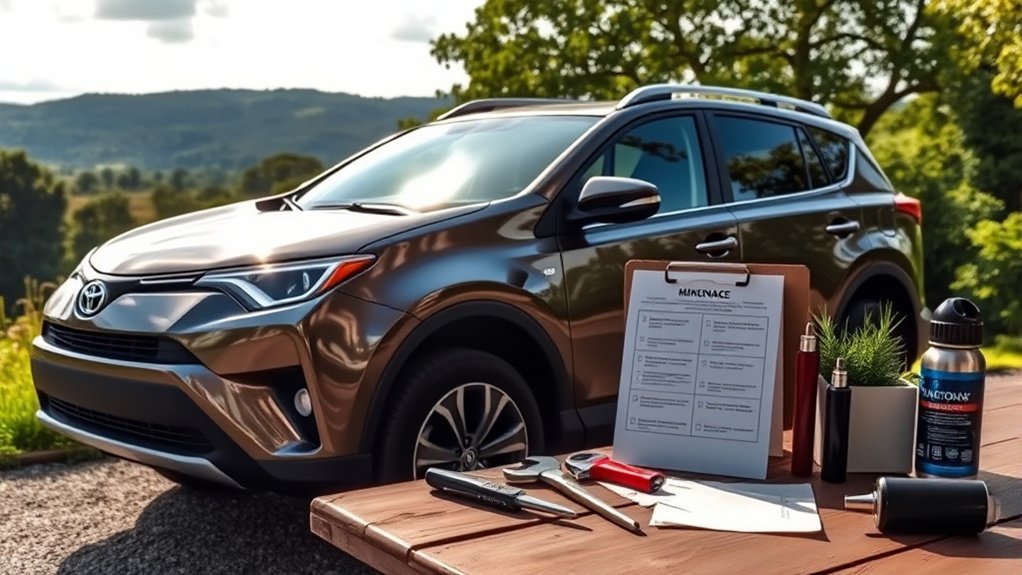
Routine maintenance cannot prevent every failure, but it reduces avoidable wear and gives you opportunities to find leaks, loose components, damaged boots, worn brakes, deteriorated tires, and fluid changes before they become major repairs.
Routine Oil Changes
Engine oil intervals differ across RAV4 generations. Some models use a 10,000-mile normal-use oil interval, while older engines or vehicles operated under special conditions may require shorter intervals. Use the oil grade, viscosity, filter, mileage interval, and time interval specified for your vehicle.
Between services, check the oil level on level ground using the procedure in the owner’s manual. An oil-change reminder does not measure the oil level, and a vehicle can lose or consume oil before the reminder appears.
Track any increase in oil consumption. Record how much oil you add and over how many kilometers. A documented pattern helps a technician distinguish an external leak, incorrect reading, PCV-system problem, internal consumption, or another fault.
Tire Maintenance Importance
Tires affect braking, steering, fuel use, wheel-bearing loads, suspension wear, and all-wheel-drive operation. Check pressure when the tires are cold and use the specification on the vehicle’s driver-door placard, not the maximum pressure molded into the tire sidewall.
- Rotate tires at the interval specified for your model. The 2025 gas RAV4 chart uses 5,000-mile intervals.
- Inspect tread depth, sidewall damage, punctures, cracking, and uneven wear at least monthly and before long trips.
- Correct alignment or suspension faults that cause rapid edge wear.
- Use compatible tire sizes and closely matched tread depths on all-wheel-drive models.
- Have persistent vibration diagnosed instead of repeatedly rebalancing a damaged tire or wheel.
Regular Fluid Inspections
Do not use one universal replacement schedule for every RAV4 fluid. The correct work depends on the model year, engine, drivetrain, component, operating conditions, and inspection results.
- Engine oil: Check the level and investigate unexpected consumption or contamination.
- Engine and inverter coolant: Check the correct reservoir only when it is safe to do so. Never open a hot pressurized cooling system.
- Brake fluid: Inspect its level and condition. A falling level may reflect pad wear or a leak and requires diagnosis.
- Transmission or transaxle fluid: Follow the model-specific inspection or replacement procedure. Incorrect fluid or fill level can cause damage.
- Differential and transfer-case oil: Service where applicable and when specified for the drivetrain and operating conditions.
- Washer fluid: Maintain a suitable seasonal mixture so visibility systems remain usable.
Common Problems That Can Affect RAV4 Lifespan
RAV4 problems differ by generation, engine, transmission, drivetrain, trim, production date, market, and VIN. A bulletin does not mean every vehicle in the listed model year has the condition.
| Vehicle or condition | What to watch for | Best response |
|---|---|---|
| Certain 2006–2008 RAV4s covered by Toyota’s oil-consumption program | Oil level dropping between services, low-oil warnings, smoke, fouled components, or a documented need to add oil frequently | Measure consumption accurately and have leaks and engine condition diagnosed. Review the Toyota warranty enhancement bulletin for historical applicability. |
| Some 2019 RAV4s covered by T-SB-0107-19 | Hesitation while accelerating from a slow roll or rolling stop under the bulletin’s specific conditions | Ask a Toyota-qualified technician to confirm calibration and VIN applicability using the Toyota technical service bulletin. |
| Higher-mileage suspension, steering, and wheel components | Clunks, wandering, uneven tire wear, vibration, looseness, poor body control, or wheel-bearing noise | Inspect the complete system instead of replacing a single guessed component. |
| Vehicles exposed to salt, flooding, or poor collision repairs | Structural rust, electrical faults, water intrusion, corroded connectors, or uneven panel and tire alignment | Arrange a body, underbody, electrical, and mechanical inspection before investing in major repairs. |
Check the vehicle’s 17-character VIN with the NHTSA recall lookup tool. A make-and-model search shows general information, while a VIN search identifies unrepaired recalls associated with that specific vehicle.
How Driving Habits Affect RAV4 Durability
Driving conditions influence the type of wear your RAV4 experiences. They should also influence inspections and maintenance.
- Short trips: Repeated trips that do not fully warm the engine can increase moisture and fuel contamination in the oil.
- Stop-and-go traffic: Frequent acceleration and braking increase brake, tire, and cooling-system demands.
- Highway travel: Steady cruising may reduce brake wear, but high speed, heat, heavy loading, and neglected tires still create risk.
- Towing and heavy cargo: Added weight increases drivetrain, cooling, brake, tire, and suspension loads.
- Dirt roads and off-road use: Dust, impacts, mud, water, and reduced airflow can shorten inspection and service intervals.
- Winter operation: Cold starts, salt, snow, ice, and potholes increase battery, corrosion, tire, and suspension demands.
You do not need to avoid using the RAV4 for its intended work. You need to stay within its ratings and match maintenance to how the vehicle is actually driven.
Comparing RAV4 Longevity With Other SUVs

The RAV4 has a strong long-term reputation, but no credible dataset proves that every RAV4 will outlast every Honda CR-V, Mazda CX-5, Subaru Forester, or Hyundai Tucson. Lifespan studies also use different definitions, samples, mileage thresholds, and prediction methods.
When comparing used compact SUVs, focus on the individual vehicles rather than choosing solely by brand reputation.
- Compare equivalent years and powertrains: A newer model with an unresolved problem should not be compared loosely with an older, proven generation.
- Review maintenance records: Missing oil changes, overheating events, or delayed repairs can erase a model’s statistical advantage.
- Inspect for corrosion and collision damage: Structural condition may matter more than a small mileage difference.
- Compare diagnostic results: Warning codes, transmission behavior, fluid condition, charging performance, and hybrid data provide vehicle-specific evidence.
- Price future work: Tires, brakes, suspension, leaks, air conditioning, and scheduled services can materially change the real purchase cost.
The best high-mileage SUV is usually the one with the strongest documentation, cleanest inspection, safest structure, and most realistic asking price.
Tips for Extending the Life of Your Toyota RAV4
A long-lasting RAV4 is usually the result of ordinary tasks performed consistently rather than one expensive upgrade.
Regular Maintenance Schedule
- Download the correct guide: Match it to the model year and powertrain.
- Use time and mileage: Perform whichever service threshold arrives first.
- Identify severe use: Record towing, off-road travel, extensive idling, heavy loading, and repeated short trips.
- Inspect between services: Check oil, tires, lights, leaks, coolant reservoirs, wipers, and visible damage.
- Keep records: Document work even when you perform it yourself.
Quality Parts Usage
Use genuine Toyota parts or reputable aftermarket parts that meet the correct dimensions, material requirements, electrical ratings, and performance specifications. A higher price or “performance” label does not automatically make a part better for long service life.
Use the exact fluid specification listed for the component. Do not substitute transmission, differential, brake, coolant, or engine-oil products based only on color or viscosity. Use the fuel octane specified in the owner’s manual rather than assuming premium fuel will extend engine life.
Brake, steering, wheel, suspension, airbag, and high-voltage hybrid repairs deserve particular care because poor-quality parts or installation can create safety problems beyond shortened component life.
Monitor Driving Habits
Watch for patterns that indicate your use is harder on the vehicle than the standard schedule assumes.
- Track oil additions and fuel-economy changes.
- Note whether warning lights appear only during towing, heat, cold, rain, or long climbs.
- Inspect after deep water, rough-road impacts, or off-road trips.
- Reduce unnecessary idling and repeated hard acceleration.
- Allow extra braking distance when carrying passengers or cargo.
- Investigate new sounds before compensating for them with changes in driving style.
Recognizing Signs of Wear and When to Seek Repairs
Small changes can provide early warning of a larger problem. Record when a symptom occurs, whether the engine is hot or cold, vehicle speed, road conditions, warning lights, and any recent work.
| Sign of wear or failure | Recommended action |
|---|---|
| Oil-pressure warning, knocking, or sudden major oil loss | Stop the engine as soon as it is safe and arrange diagnosis or towing. |
| Overheating warning, steam, or rapid coolant loss | Stop safely, shut the vehicle down, and do not open a hot cooling system. |
| Grinding, clunking, humming, or vibration that changes with speed | Inspect the drivetrain, wheel bearings, brakes, tires, and suspension promptly. |
| Delayed engagement, slipping, harsh shifting, or repeated hesitation | Obtain a scan and drivetrain diagnosis before authorizing a fluid service or major repair. |
| Brake warning, soft pedal, pulling, fluid loss, or severe grinding | Do not continue normal driving until the braking system is inspected. |
| Hybrid-system warning or reduced-power mode | Use a scan tool capable of reading Toyota hybrid modules and follow high-voltage safety procedures. |
| Severe rust near suspension, steering, seat-belt, or subframe mounting points | Arrange a structural inspection before driving further or investing in mechanical repairs. |
Warning: Do not keep driving to “see whether it clears” when the oil-pressure warning appears, the engine overheats, braking becomes unsafe, or structural corrosion affects a mounting point. Continuing can turn a repairable fault into engine damage, loss of control, or a crash risk.
Why a Well-Maintained RAV4 Is a Smart Used Car Buy
A well-maintained RAV4 can be a sensible used-vehicle choice because the model has strong high-mileage potential, broad parts availability, and a large service network. However, reputation should never replace inspection.
Buy the maintenance history and present condition, not merely the RAV4 name or a low odometer reading.
Before buying a high-mileage RAV4, complete these checks:
- Verify the VIN: Confirm the year, trim, drivetrain, title history, and open recalls.
- Review records: Look for consistent oil changes, coolant work, brake service, tire replacement, major repairs, and repeated complaints.
- Request a cold start: Listen for abnormal rattles, knocks, smoke, belt noise, rough running, or delayed warning-light shutdown.
- Scan every available module: Do not rely only on whether the dashboard warning light is currently off.
- Inspect the underbody: Check structural rust, leaks, impact damage, missing shields, damaged boots, and poor previous repairs.
- Road-test it fully: Include low-speed turns, stops, highway speed, hills, rough pavement, parking maneuvers, heating, and air conditioning.
- Check tire consistency: Confirm compatible sizes, reasonable tread matching, and even wear.
- Arrange an independent inspection: Use a technician who is not financially connected to the sale and who understands the relevant RAV4 generation.
A major repair does not automatically make a high-mileage RAV4 a bad investment. Compare the repair cost with the vehicle’s structural condition, maintenance history, remaining needs, local replacement cost, and your ability to tolerate future downtime.
Sources
- iSeeCars Toyota RAV4 Reliability for 2026 — model-level average lifespan and probability of reaching 200,000 miles.
- Toyota Manuals and Warranties — year-specific owner manuals and maintenance documents.
- 2025 Toyota RAV4 Warranty and Maintenance Guide — scheduled maintenance, oil-service conditions, tire rotations, and inspection items.
- Toyota Warranty Enhancement Program ZE7 — excessive engine-oil-consumption coverage for certain vehicles, including certain 2006–2008 RAV4s.
- Toyota T-SB-0107-19 — hesitation from a slow roll or rolling stop on some 2019 RAV4s.
- NHTSA Recall Lookup — VIN-based checks for unrepaired vehicle safety recalls.
Frequently Asked Questions
What Is the Average Cost of Repairs for a High-Mileage RAV4?
No reliable annual figure applies to every high-mileage RAV4. Costs depend on labor rates, model year, drivetrain, rust, previous maintenance, tire and brake condition, and whether a major component fails. Use an inspection to build a 12-month repair forecast instead of relying on a generic online average.
How Does Climate Affect the Lifespan of a Toyota RAV4?
Road salt and coastal air increase corrosion risk. Extreme heat stresses batteries, cooling systems, tires, seals, and interior materials. Severe cold increases starting loads and can make repeated short trips harder on the engine. Climate does not set a fixed lifespan, but it changes inspection and maintenance needs.
Are There Specific RAV4 Models Known for Better Longevity?
No model year is automatically the best choice for every buyer. Compare generation-specific bulletins, recalls, powertrains, rust exposure, service history, collision repairs, and diagnostic results. A carefully maintained vehicle from a year with a known issue can be better than a neglected example from a highly rated year.
What Are the Best Aftermarket Parts for Enhancing RAV4 Durability?
Choose genuine Toyota or reputable OE-equivalent parts that meet the correct specification. Prioritize proven filters, seals, brake components, suspension parts, fluids, belts, hoses, and electrical components. Heavy-duty or performance parts are useful only when they match the vehicle’s use and do not introduce unwanted noise, stiffness, electrical load, or safety concerns.
How Can I Find a Reliable Mechanic for My RAV4?
Look for a shop that regularly services Toyota vehicles, provides written findings, explains diagnostic steps, and separates urgent work from optional maintenance. Ask who will perform the work, which scan tools the shop uses, whether it can read Toyota-specific systems, and whether it guarantees parts and labor.
Is 300,000 Kilometers High for a Toyota RAV4?
Yes. At 300,000 kilometers, a RAV4 is a high-mileage vehicle even though many examples can continue beyond that point. Evaluate oil use, leaks, rust, transmission behavior, suspension wear, cooling-system condition, service history, and upcoming repairs before deciding whether it remains a good vehicle.
Does a RAV4 Hybrid Last as Long as a Gas RAV4?
Both can achieve high mileage. A hybrid adds a traction battery, inverter, electric motors, and related cooling and control systems, but it may reduce engine run time and friction-brake use. Judge an older hybrid by its maintenance history, diagnostic data, warning lights, cooling-system condition, battery health, rust, and collision history.
Conclusion
A Toyota RAV4 can provide a long service life, but 400,000 or 500,000 kilometers should be treated as an excellent outcome rather than a guaranteed norm. Current model-level analysis points to an average near 274,800 kilometers, with a meaningful share reaching about 321,900 kilometers.
Your best strategy is straightforward: follow the correct Toyota maintenance guide, check fluid levels and tires between services, control corrosion, repair warning signs early, use correctly specified parts and fluids, and keep complete records. When buying used, let an independent inspection and the vehicle’s documented condition carry more weight than reputation alone.
