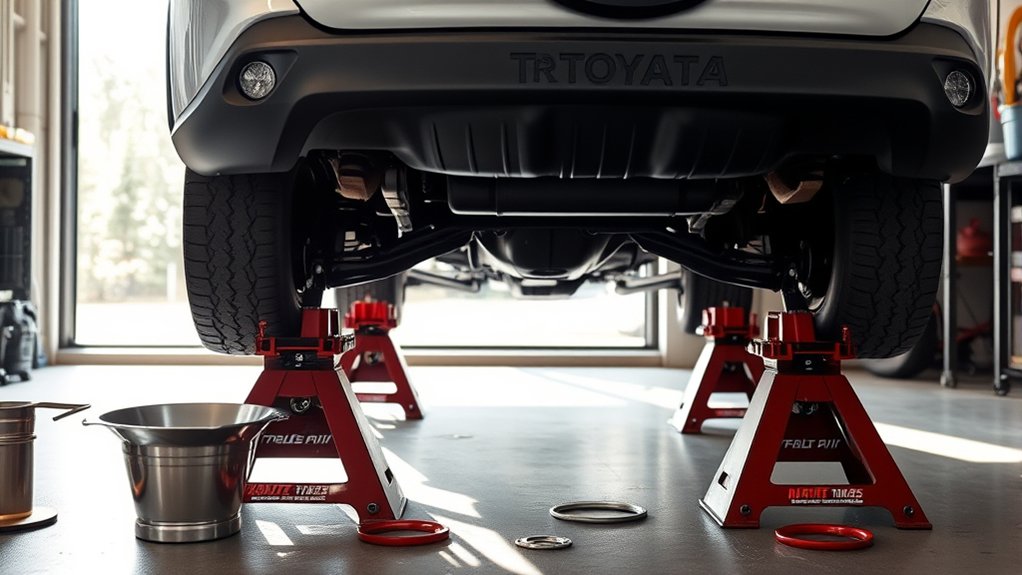
Changing the differential and transfer-case oil on a Toyota RAV4 can be a manageable DIY job, but the correct procedure depends on the model year and drivetrain. This guide applies to gasoline AWD models that have a separate transfer case and rear differential. Do not use these specifications for a FWD, Hybrid, Plug-in Hybrid, or electronic-AWD RAV4 without checking its exact service information.
Quick Answer
Park your gasoline AWD RAV4 on a level surface, support it safely, and loosen each fill plug before opening the drain plug. Drain the old oil, inspect the fluid and magnet, install new plug gaskets, refill with the exact Toyota-specified gear oil to the correct level, and torque each plug to its model-specific specification.
Key Takeaways
- Confirm that your RAV4 is a gasoline AWD model with a conventional transfer case and rear differential before buying fluid.
- Use the viscosity, API rating, Toyota formulation, capacity, gasket, and torque specified for your exact model year and AWD unit.
- Loosen the fill plug first so you know the component can be refilled before you drain it.
- Keep the vehicle level during filling because the fill-opening height usually controls the final fluid level.
- A light gray paste on a magnetic plug can be normal. Shiny flakes, chunks, milky oil, severe noise, or a recurring leak require further diagnosis.
At a Glance
| Time Required | About 60 to 90 minutes for both components |
| Difficulty | Intermediate DIY maintenance |
| Tools Needed | Correct sockets or hex bits, breaker bar, torque wrench, drain pan, fluid pump, wheel chocks, and rated lifting equipment if needed |
| Cost | Varies by fluid and model; budget for the required gear oil, new plug gaskets, and cleaning supplies |
Why Gear-Oil Maintenance Matters for Your RAV4
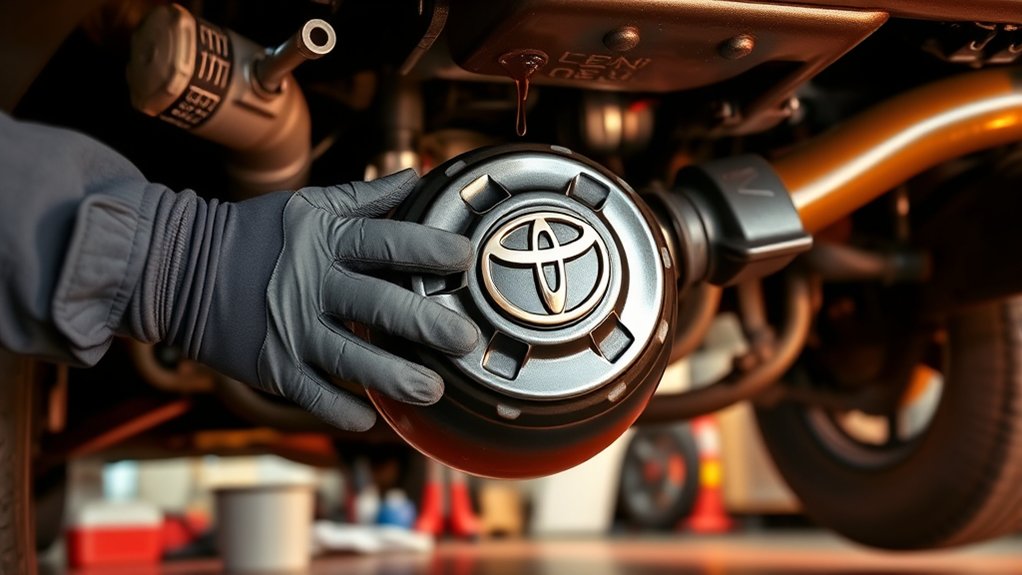
The transfer case sends power toward the rear axle on an applicable gasoline AWD RAV4. The rear differential then allows the rear wheels to rotate at different speeds while turning. Both assemblies depend on a small quantity of lubricant, so a leak or incorrect fill level can matter quickly.
Do not use one replacement interval for every RAV4. Toyota’s schedule changes by model year and operating conditions. For example, the 2025 gasoline RAV4 Warranty & Maintenance Guide calls for regular rear-differential inspections and transfer-case oil replacement at 30,000-mile intervals under its standard schedule. Towing, heavy loading, and using a car-top carrier can require shorter replacement intervals.
Older maintenance guides may list different intervals. Check the guide supplied with your model year rather than relying on a universal 20,000-, 30,000-, or 50,000-mile rule.
Your RAV4’s maintenance guide, drivetrain, and operating conditions determine the service interval. Fluid color alone does not.
Confirm Which RAV4 Drivetrain You Have
Before ordering oil or removing a plug, confirm the drivetrain. The word “AWD” does not guarantee that every RAV4 uses the same hardware or fluid.
| RAV4 configuration | Use this procedure? | What to check |
|---|---|---|
| Gasoline FWD | No | It does not use the same rear differential and AWD transfer assembly. |
| Applicable gasoline AWD | Generally yes | Verify model year, AWD system, fluid formulation, capacity, plug design, and torque. |
| RAV4 Hybrid or Plug-in Hybrid | No | Use the hybrid transaxle and rear electric-drive service information for that vehicle. |
| 2026 RAV4 | No for this conventional procedure | Toyota moved the 2026 lineup to Hybrid and Plug-in Hybrid powertrains. |
Use Toyota’s manuals and warranties portal to find the publications for your model year. When two AWD systems were available in the same year, confirm the unit by VIN or equipment code before buying fluid.
Note: Some newer gasoline RAV4s use Dynamic Torque Vectoring AWD hardware that may require a different Toyota 75W-85 formulation from a standard Dynamic Torque Control AWD unit. Similar viscosity numbers do not always mean the oils are interchangeable.
Choose the Correct Gear Oil
Select fluid by specification rather than brand popularity. The bottle must match the viscosity, API service category, and any Toyota-specific formulation required for the exact component.
As one manufacturer-backed example, the Toyota RAV4 Owner’s Manual OM42809U lists Toyota Genuine Differential Gear Oil LT 75W-85 GL-5, or an equivalent of matching quality, for both the rear differential and transfer on the AWD model covered by that manual.
| Component | Example from OM42809U | Important limitation |
|---|---|---|
| Rear differential | 0.5 qt. reference capacity; LT 75W-85 GL-5 | Do not apply this capacity or oil to another generation without verification. |
| Transfer | 0.48 qt. reference capacity; LT 75W-85 GL-5 | Newer AWD units may specify another Toyota 75W-85 formulation. |
| Plug torque | Not provided in this owner’s-manual specification table | Use the repair-manual value for the exact component and plug. |
Do not assume that 75W-90 is automatically an acceptable replacement for 75W-85. Older RAV4 generations, standard AWD units, and torque-vectoring units can have different requirements. A fluid advertised as “GL-5” still may not match every Toyota formulation.
Essential Tools and Supplies
Gather everything before opening a drain plug:
- The owner’s manual, maintenance guide, and correct repair specification for your model
- The exact gear oil required for each component
- New Toyota-specified sealing gaskets or washers for every removed plug
- The correct sockets, hex bits, or Allen bits for the plugs and splash shields
- A breaker bar for a tight fill plug
- A calibrated torque wrench covering the required range
- A drain pan with enough capacity
- A hand pump or fluid syringe that fits the gear-oil bottle
- Wheel chocks, rated ramps, or rated jack stands if additional clearance is required
- Safety glasses, oil-resistant gloves, shop towels, and a suitable parts cleaner
- A clean, sealable container for transporting used oil
Warning: Never work beneath a RAV4 supported only by its emergency jack or a hydraulic floor jack. Use a hard, level surface, approved lift points, rated stands or ramps, and wheel chocks. Keep the vehicle level from front to rear and side to side so the final fluid level is accurate.
Pro Tip: Test-fit the fill tool and confirm that you can pump oil into each opening before draining anything. Access around the transfer case can be tight.
Prepare the RAV4 for Service
- Warm the oil slightly. A short drive can help the gear oil drain, but allow the exhaust and drivetrain to cool enough to touch safely.
- Park on a solid, level surface. Shift into Park, apply the parking brake, switch the vehicle off, and chock the wheels that remain on the ground.
- Raise the vehicle only if needed. Support it at Toyota-approved points and keep the body level. Never crawl under it until you have confirmed that it is stable.
- Remove the required splash shields. Fastener sizes vary by model, so do not assume every shield uses a 10 mm socket.
- Identify the plugs. Confirm the fill and drain plugs for one component before loosening either one. Do not confuse them with transmission, engine-oil, or cooling-system plugs.
- Clean the area. Remove dirt from around both plugs so contamination cannot fall into the housing.
How to Drain the Old Gear Oil
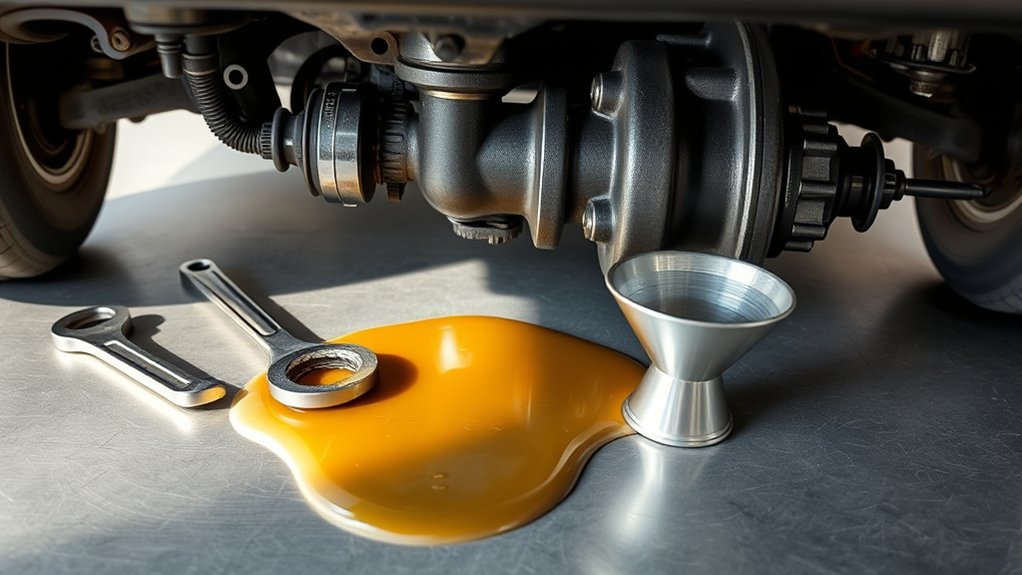
Loosen the Fill Plug First
Place the correct tool fully into the fill plug and loosen it before touching the drain plug. This confirms that you will be able to refill the housing after it is empty. Opening the fill port also allows air into the housing as the old oil drains.
If the fill plug is seized, rounded, or damaged, stop. Do not drain the component until the fill plug can be removed and replaced correctly.
Step-by-Step Draining Process
- Place the drain pan beneath the component.
- Loosen the drain plug carefully while keeping pressure on the tool to prevent rounding.
- Finish removing the plug by hand and move it away quickly when the oil begins to flow.
- Allow the oil to drain until it slows to an occasional drip.
- Inspect the drained fluid and the magnetic plug, if the plug is magnetic.
- Clean the plug without leaving lint, grit, or cleaner inside the housing.
- Install the drain plug with the correct new gasket or washer.
- Tighten it to the Toyota repair-manual specification for that component. Do not reuse a torque value from another year or another plug.
| What you find | What it can mean | Next step |
|---|---|---|
| Thin gray paste on the magnet | Fine wear material can accumulate during normal use. | Clean the magnet and compare it at the next service. |
| Shiny flakes, needles, or chunks | Possible abnormal gear, bearing, or internal-component wear | Save a fluid sample and have the unit inspected. |
| Milky or foamy fluid | Possible water contamination | Inspect the vent and seals and arrange further diagnosis. |
| Strong burnt odor or very dark fluid | Possible overheating, extended service, or incorrect level | Check for leaks, noise, loading history, and the correct fluid specification. |
How to Fill the Differential and Transfer Case
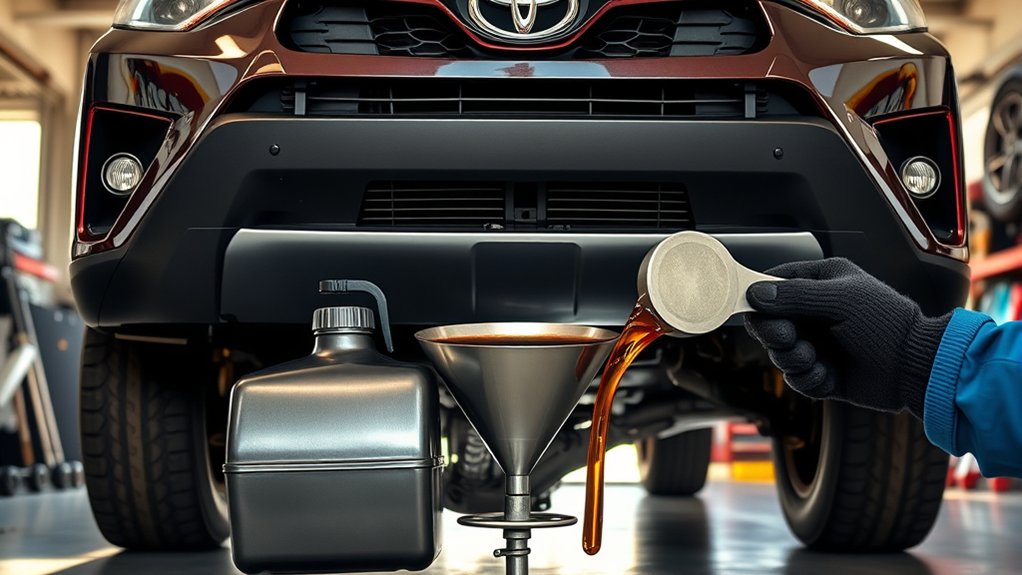
- Confirm the vehicle is level. A vehicle raised only at the front or rear can produce an incorrect fill level.
- Check the drain plug. Make sure it is installed with the correct gasket and tightened to the proper specification.
- Pump in the correct oil. Keep the pump hose and bottle clean to prevent dirt from entering the housing.
- Watch the fill opening. On units that use the fill opening as the level reference, add oil until it reaches the specified lower edge and begins to form a slow dribble. Follow the exact repair procedure if Toyota lists another level method.
- Allow the oil to settle. Wait briefly, then add a small amount if the level drops below the specified point.
- Install a new fill-plug gasket. Thread the plug in by hand to prevent cross-threading.
- Torque the fill plug correctly. Use the specification for that model, component, and plug.
- Clean the housing. Remove spilled oil so a fresh leak will be easy to identify.
- Reinstall the splash shields. Replace damaged clips or fasteners rather than leaving a panel loose.
Note: Published capacities are reference quantities. Do not force the entire listed amount into a housing that has already reached its specified level, and do not refill only by matching the amount that drained out.
Check for Leaks After Filling
Lower the vehicle, remove the wheel chocks, and drive a short distance at moderate speed. Park on a clean, level surface and inspect both plugs, the housing seams, axle seals, and nearby areas for fresh oil.
Check again after several drives. A wet plug may indicate a damaged gasket, dirt on the sealing surface, cross-threading, or incorrect torque. A leak from a case seam, axle seal, or vent needs separate diagnosis.
Top Mistakes to Avoid
- Applying one specification to every RAV4: Fluid, capacity, plug design, and torque vary by generation and AWD system.
- Using this procedure on a Hybrid or Plug-in Hybrid: Electronic AWD hardware requires different service information.
- Removing the drain plug first: A seized fill plug can leave you with an empty unit that cannot be refilled.
- Working under a jack: A jack lifts the vehicle but is not a safe substitute for rated support equipment.
- Filling while the vehicle is tilted: The final level can be too high or too low.
- Substituting fluid by viscosity alone: A 75W-85 or 75W-90 label does not confirm Toyota formulation compatibility.
- Reusing damaged gaskets: A flattened, corroded, or incorrect gasket can leak.
- Over-tightening the plugs: Excess torque can damage threads or the housing.
- Adding thread tape or sealant without instructions: Unapproved material can affect torque, sealing, or contaminate the housing.
- Ignoring abnormal debris: Shards, chunks, or heavy metallic glitter deserve diagnosis rather than a routine refill.
The safest specification is the one tied to your exact RAV4, not the most common number repeated online.
Maintenance and Troubleshooting Tips
- Inspect the housings and plug areas during routine service, even when replacement is not yet due.
- Shorten the interval only when your Toyota maintenance guide calls for it or inspection results justify it.
- Record the date, mileage, fluid specification, quantity used, gasket part numbers, and torque values.
- Investigate recurring wetness instead of repeatedly topping off the unit.
- Keep transfer-case, differential, transmission, and hybrid-transaxle fluids in separate, clearly labeled containers.
- Check the driveline after off-road driving, deep-water exposure, towing, or an underbody impact.
When to Stop and Use a Professional
Arrange professional diagnosis if you cannot support the vehicle safely, cannot identify the plugs, cannot confirm the fluid, or encounter a seized or damaged fill opening. You should also stop if the drained oil contains chunks, the housing is milky inside, a severe howl or grinding sound is present, or the component continues leaking after new gaskets and correct torque.
Do not drive far with a rapid leak, severe binding, overheating, or loud drivetrain noise. Continued operation can turn a seal or plug problem into internal damage.
Dispose of Used Gear Oil Correctly
Transfer the old oil into a clean, sealed container and take it to a used-oil collection site, participating repair shop, or local household hazardous-waste facility. Do not mix it with coolant, solvents, fuel, or brake cleaner. The U.S. Environmental Protection Agency warns against pouring household hazardous waste onto the ground, into drains, or into storm sewers.
Related Guides
Frequently Asked Questions
How often should I change the gear oil in my RAV4?
Follow the maintenance guide for your exact model year. As one current example, Toyota’s 2025 gasoline RAV4 schedule lists regular rear-differential inspections and transfer-case oil replacement at 30,000-mile intervals under the standard schedule. Towing, heavy loading, or car-top-carrier use can require shorter intervals. Older years may differ.
Can I use a different oil weight from 75W-85?
Use another viscosity only when Toyota lists it for your exact year and component or confirms an equivalent. Do not assume that 75W-90 can replace 75W-85 solely because both are GL-5 gear oils.
What are the symptoms of low differential or transfer-case oil?
Possible signs include visible leakage, a howl or whine that changes with road speed, rumbling, overheating odor, or abnormal binding. These symptoms can have other causes, so inspect the fluid level and obtain a proper diagnosis rather than adding oil blindly.
Is it safe to drive with old gear oil?
Being overdue for service does not automatically create an immediate emergency, but contaminated oil, a low level, or a leak can damage the unit. Service it promptly. Stop driving and investigate if you notice rapid fluid loss, severe noise, binding, or overheating.
Can I change RAV4 gear oil without a lift?
You may be able to reach the plugs with the vehicle resting on level ground. When extra clearance is required, use rated ramps or jack stands at approved points and keep the vehicle level. Never work underneath it while it is supported only by a jack.
Does this procedure apply to a RAV4 Hybrid or Plug-in Hybrid?
No. Hybrid and Plug-in Hybrid models use different AWD and rear-drive hardware. Use the owner’s manual and repair information for the hybrid transaxle and rear electric-drive unit instead of applying gasoline-AWD gear-oil specifications.
Is gray paste on the magnetic drain plug normal?
A thin coating of fine gray paste can be normal wear material. Large flakes, sharp pieces, needle-like fragments, bronze-colored debris, or an unusually heavy buildup can point to internal wear and should be inspected by a qualified technician.
Conclusion
A successful Toyota RAV4 differential and transfer-case oil change starts with identifying the correct drivetrain. Verify the fluid, capacity, gaskets, fill method, and torque for your exact model before opening a plug. Work on a level, securely supported vehicle, inspect the drained oil carefully, refill to the specified level, and check for leaks after driving.
When the vehicle is a Hybrid, Plug-in Hybrid, torque-vectoring model with uncertain specifications, or shows abnormal debris or drivetrain noise, use Toyota repair information or a qualified technician instead of guessing.
Sources
- Toyota Manuals and Warranties — model-year-specific owner and maintenance publications
- 2025 Toyota RAV4 Warranty & Maintenance Guide — standard and special-condition maintenance schedules
- Toyota RAV4 Owner’s Manual OM42809U — example differential and transfer oil specifications and capacities
- Toyota: The Next Adventure Begins, 2026 RAV4 — 2026 Hybrid and Plug-in Hybrid lineup information
- OSHA Standard 1926.305 — securing and supporting a raised load
- EPA Household Hazardous Waste Guidance — safe handling and disposal guidance
