A Toyota RAV4 can still have fuel in the tank when the Distance-to-Empty display reaches zero, but Toyota does not promise a fixed number of extra miles. The estimate changes with recent fuel use, terrain, speed, temperature, and model year. Treat zero as the point to refuel, not as a reserve you can safely plan to use.
Quick Answer
When your RAV4’s DTE reaches zero, refuel as soon as you safely can. Zero does not necessarily mean the tank is physically empty, but it is not a guaranteed reserve. Toyota says the estimate is based on average fuel consumption, so the actual distance can be shorter or longer than the display suggests.
Warning: Do not deliberately drive after the DTE reaches zero to test your RAV4’s limit. A change in traffic, weather, road grade, or fuel pickup can make the engine or hybrid system stop sooner than expected.
Key Takeaways
- DTE is an estimate based largely on recent fuel consumption, not a direct measurement of guaranteed miles.
- The low fuel light and a DTE reading of zero are different events. Do not use one as a substitute for the other.
- A 2025 U.S.-market RAV4 Hybrid manual lists the low fuel warning at approximately 2.2 gallons or less, but thresholds vary by model year and powertrain.
- Resetting the average MPG display can help you track a trip, but Toyota does not describe it as a way to calibrate the DTE system.
- Smooth driving, correct tire pressure, lighter loads, and prompt refueling reduce uncertainty and help protect your travel plans.
Understanding Distance-to-Empty (DTE) Calculators in the Toyota RAV4
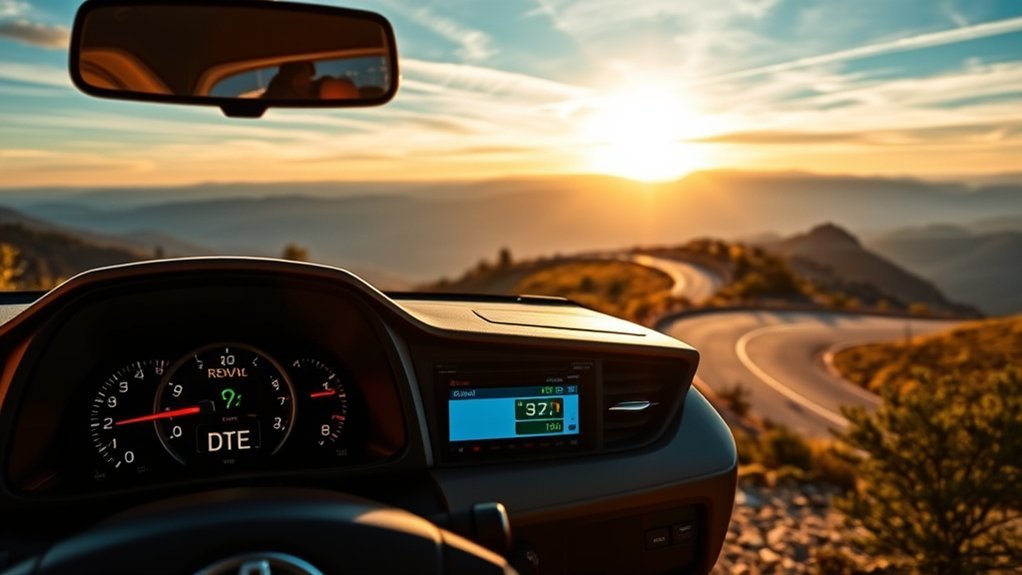
The DTE display estimates how far you may be able to drive with the fuel remaining. In Toyota’s 2025 RAV4 Hybrid owner’s manual, Toyota explains that the distance is calculated from average fuel consumption and that the actual distance may differ.
The system responds to recent driving. A long highway trip may raise the estimate, while short trips, heavy traffic, hills, cold weather, idling, or strong acceleration may lower it. The number can change quickly when your current conditions no longer match the driving pattern used for the earlier estimate.
DTE is a planning estimate, not a promise that a specific number of miles remains in the tank.
| Display or Warning | What It Means | Best Action |
|---|---|---|
| Low fuel light | The fuel level has reached the warning threshold for your model. A 2025 RAV4 Hybrid manual lists approximately 2.2 gallons or less. | Find a nearby station and refuel promptly. |
| DTE at 0 or “Refuel” | The system can no longer provide a useful remaining-distance estimate. It does not confirm an exact amount of usable fuel. | Refuel as soon as it is safe to do so. |
| Gauge near E | Fuel is low. Slopes, curves, and small fuel additions can affect the displayed level. | Do not wait for the gauge or DTE to fall farther. |
Note: Model year matters. Toyota’s 2026 U.S. RAV4 lineup uses hybrid and plug-in hybrid powertrains, so older gas-model MPG figures and display behavior should not be applied automatically to the newest vehicles. Check the manual for your VIN and model year.
How Does Driving Style Impact Your RAV4’s Fuel Consumption?
Your RAV4’s recent fuel use affects the DTE estimate. When your driving becomes less efficient, the vehicle may reduce the estimated range even when the fuel gauge has barely moved.
Aggressive Acceleration Effects
Rapid acceleration, high speeds, and hard braking require more energy. The U.S. Department of Energy’s efficient-driving guidance recommends smoother acceleration and steady speeds to reduce fuel use.
| Driving Pattern | Likely Effect on Fuel Use and DTE |
|---|---|
| Rapid acceleration and hard braking | Higher fuel use and a faster drop in estimated range |
| Smooth acceleration and early coasting | Lower fuel use and a steadier estimate |
| Long idling or stop-and-go traffic | Fuel is used while little distance is covered, reducing DTE |
Highway vs. City Driving
Highway driving often improves fuel economy for conventional gas models because speed is steadier. Hybrid results can differ because regenerative braking and electric assistance may help in city traffic. Do not assume one city or highway figure applies to every RAV4 trim.
Use the EPA ratings for your exact model year, drivetrain, and trim as a comparison point, then expect real-world results to change with speed, weather, traffic, cargo, and road grade.
Eco Mode Benefits
Eco mode can make accelerator response more gradual and may adjust climate-control operation, depending on the model. This can make smooth driving easier, but it does not add fuel, recalibrate DTE, or guarantee a set MPG improvement.
Use Eco mode when it feels appropriate, but focus first on safe traffic flow. Pressing the accelerator deeply or driving at high speed can still use substantial fuel while Eco mode is selected.
Factors That Influence Your RAV4’s Fuel Efficiency
DTE can move because of more than throttle input. Temperature, tire pressure, cargo, wind, hills, maintenance, and fuel blend can all change how far a gallon takes you.
Driving Habits Impact Efficiency
- Speed: Aerodynamic drag rises as speed increases, so fast highway driving can reduce range.
- Traffic and idling: The engine may use fuel while the odometer adds few or no miles.
- Road grade: Long climbs use more energy. A downhill return trip may not fully recover the difference.
- Weather and climate control: Cold starts, cabin heating, air conditioning, rain, snow, and headwinds can lower efficiency.
- Weight and roof cargo: Passengers, gear, trailers, and rooftop carriers increase the energy needed to move the vehicle.
- Tire pressure: Underinflated tires increase rolling resistance and can reduce fuel economy.
Fuel Quality Variability Effects
Use the fuel grade and ethanol limit listed in your owner’s manual and on the fuel door. The 2025 RAV4 Hybrid manual specifies unleaded gasoline with an octane rating of 87 or higher. Premium fuel does not automatically increase range when the engine does not require it.
Fuel blend can also influence mileage. The U.S. Department of Energy notes that ethanol contains less energy per gallon than gasoline, with the effect depending on the percentage in the blend. Buy fuel from a busy, reputable station and use only blends approved for your vehicle.
How Accurate Is the DTE Reading for Your Toyota RAV4?
DTE is usually useful for general trip planning, but it becomes less dependable when conditions change quickly or the fuel level is very low. Toyota specifically warns that the actual distance may differ from the display.
The estimate may be less stable in these situations:
- You switch from highway driving to heavy city traffic, steep hills, or towing.
- The temperature changes sharply or you use more heating or air conditioning.
- You add only a small amount of fuel.
- You refuel without turning the vehicle off.
- The RAV4 is parked or driven on a steep slope.
- Tire pressure, vehicle load, or driving speed changes.
Toyota’s manual says a small fuel addition may not update the display and advises turning the power switch off while refueling. If the display repeatedly behaves abnormally after a normal fill-up on level ground, check the manual and have the vehicle inspected.
What Should You Do When the Low Fuel Light Activates?

When the low fuel warning appears, treat it as an instruction to refuel, not an invitation to calculate the maximum possible reserve.
- Choose the nearest practical station. Avoid passing a safe station to chase a lower price when fuel is already very low.
- Drive smoothly. Avoid unnecessary acceleration, high speeds, and long idling while you head to fuel.
- Watch for power loss. If the engine hesitates, warning messages appear, or propulsion drops, signal and move to a safe location.
- Do not stop in an unsafe place. If you cannot reach fuel safely, use roadside assistance rather than walking along a highway.
- Turn the vehicle off before refueling. Add enough fuel for the gauge and warning system to update normally.
Warning: A stalled vehicle can lose normal propulsion in traffic. Move off the roadway if possible, turn on the hazard lights, and request roadside help when you cannot refuel safely.
Driving Range After the Fuel Light Comes On
No single mileage figure is safe for every RAV4. The low fuel threshold, current MPG, road angle, weather, and usable fuel around the pickup all affect what happens next.
Driving Distance Estimates
A 2025 RAV4 Hybrid manual states that its low fuel warning comes on at approximately 2.2 gallons or less. That number is a warning threshold, not a promise that all of the listed fuel is usable in every condition. It also does not tell you how much remains later when DTE reaches zero.
For this reason, reports of “35 to 40 miles after zero” should be treated as individual experiences, not a specification. Another vehicle can stop much sooner under different conditions.
Factors Affecting Range
- Recent average fuel consumption
- Gas, hybrid, or plug-in hybrid powertrain
- Model year, trim, and drivetrain
- Road slope, curves, and fuel movement in the tank
- Traffic, speed, wind, temperature, and precipitation
- Passenger, cargo, roof-rack, and trailer load
- Tire pressure and vehicle condition
The practical rule is simple: once the warning appears, plan in minutes to the nearest station, not in a fixed number of remaining miles.
User Experiences With DTE Accuracy and Fuel Range
Owner reports can help you understand that DTE is conservative or inconsistent in some situations, but they cannot establish a safe reserve. Two drivers can record different post-zero distances because their RAV4s have different model years, powertrains, tires, routes, temperatures, and filling habits.
Fill-up comparisons can also mislead. Fuel pumps click off at slightly different points, the vehicle may not be level, and topping off can change the gallons shown on the receipt. Compare several full tanks instead of drawing a conclusion from one fill-up.
For your own tracking, reset the trip odometer when you fill the tank. At the next fill, divide miles driven by gallons added. This gives you calculated MPG for that tank. It helps you understand your real use, but it does not manually calibrate Toyota’s DTE algorithm.
Tips for Maximizing Your RAV4’s Fuel Range
Good fuel management reduces surprises even when the DTE estimate changes.
- Keep a practical buffer. Refueling near one-quarter tank is a useful planning habit for remote travel, severe weather, or heavy traffic. It is not a Toyota-required calibration step.
- Track several tanks. Use miles divided by gallons to identify trends instead of relying on one unusually good or bad trip.
- Check the exact manual. Warning thresholds and restart instructions can vary by model year and powertrain.
- Do not top off. Stop after the pump automatically clicks off unless the station or manual directs otherwise.
- Plan remote routes. Save fuel stops before entering areas with weak cellular service or long distances between stations.
Pro Tip: Record the odometer, gallons added, weather, and driving type for three to five tanks. That simple log gives you a more useful personal range estimate than a single DTE reading.
How Can You Maximize Your RAV4’s Fuel Range?
You can improve useful range by reducing avoidable fuel use and keeping the vehicle in good condition.
- Accelerate and brake smoothly. Look ahead so you can coast early instead of rushing toward stops.
- Use a steady, legal speed. High speeds usually increase aerodynamic drag and fuel use.
- Check tire pressure cold each month. Use the pressure on the driver-door placard, not the maximum printed on the tire sidewall. NHTSA recommends monthly cold-tire checks.
- Remove unnecessary cargo. Take off unused roof carriers when practical because weight and aerodynamic drag reduce efficiency.
- Use climate control thoughtfully. Keep safety first, including windshield defogging, but avoid extreme settings when they are not needed.
- Use Eco mode when helpful. It can support gentler inputs, but your right foot and traffic conditions still matter.
- Address warning lights and maintenance issues. Low tires, brake drag, alignment problems, and engine faults can reduce efficiency.
Common Mistakes to Avoid for RAV4 Fuel Management
- Treating DTE as guaranteed mileage: It is an estimate that can change as conditions change.
- Confusing the low fuel light with DTE zero: The warning normally appears before the display reaches zero.
- Resetting average MPG to “fix” DTE: Reset it for your records, not as a calibration procedure.
- Assuming premium fuel adds range: Use the grade required by your manual.
- Using another owner’s reserve as your limit: Their route, vehicle, fill level, and weather are not yours.
- Testing the tank by running it dry: The safety risk and inconvenience outweigh any useful information.
- Applying one model year’s numbers to every RAV4: Gas, hybrid, and plug-in hybrid versions can behave differently.
Frequently Asked Questions
Can I rely solely on the DTE reading for fuel management?
No. Use DTE as a planning aid alongside the fuel gauge, low fuel warning, route, weather, and distance to the next station. Refuel before the display reaches zero whenever practical.
Does zero miles to empty mean the tank is completely empty?
Not necessarily. It means the system is no longer giving a useful remaining-distance estimate. Some fuel may remain, but Toyota does not guarantee a fixed number of drivable miles after zero.
What happens if I run out of gas in my RAV4?
The engine or hybrid system can stop and may not restart until enough fuel is added. Toyota’s 2025 RAV4 Hybrid manual says about 2.3 gallons may be needed on level ground when the hybrid system will not start after running out. Follow the instructions for your exact model.
How often should I reset the DTE calculator?
Toyota does not provide a normal owner reset procedure for calibrating DTE. You may reset the trip or average MPG display for recordkeeping, but the vehicle continues to estimate range from its own fuel-use data.
Why did the DTE not increase after I added fuel?
A small fuel addition may not update the display. Refuel with the vehicle turned off and parked on level ground. If the gauge and DTE still do not update after a normal fill, consult the owner’s manual or a Toyota service department.
Are aftermarket devices useful for fuel tracking?
A compatible OBD-II reader or fuel-tracking app can help you log trips and consumption, but it cannot guarantee the usable fuel remaining. Do not let an aftermarket estimate replace the factory warning light or safe refueling habits.
Does driving on hills or rough terrain affect DTE accuracy?
Yes. Climbs increase energy use, while slopes and curves can move fuel inside the tank and affect the gauge. Refuel earlier when traveling in mountains, on remote roads, or where stations are far apart.
Conclusion
Your Toyota RAV4 may continue moving after DTE reaches zero, but no verified universal mileage applies. Toyota describes DTE as an estimate based on average fuel consumption and instructs drivers to refuel when the remaining distance can no longer be calculated. Use the display for planning, keep a sensible fuel buffer, and never depend on anecdotal post-zero mileage.
Sources
- Toyota 2025 RAV4 Hybrid Owner’s Manual — DTE calculation, low fuel warning, fuel capacity, refueling, and out-of-fuel guidance
- Toyota Dashboard Warning Lights — official instruction to refuel when the low fuel warning appears
- Toyota 2026 RAV4 Announcement — current U.S. powertrain and fuel-economy context
- U.S. Department of Energy: Efficient Driving — driving and maintenance factors that affect fuel use
- NHTSA Tire Safety Guidance — monthly cold-tire pressure checks
- FuelEconomy.gov Vehicle Search — official model-year and trim-specific fuel-economy ratings