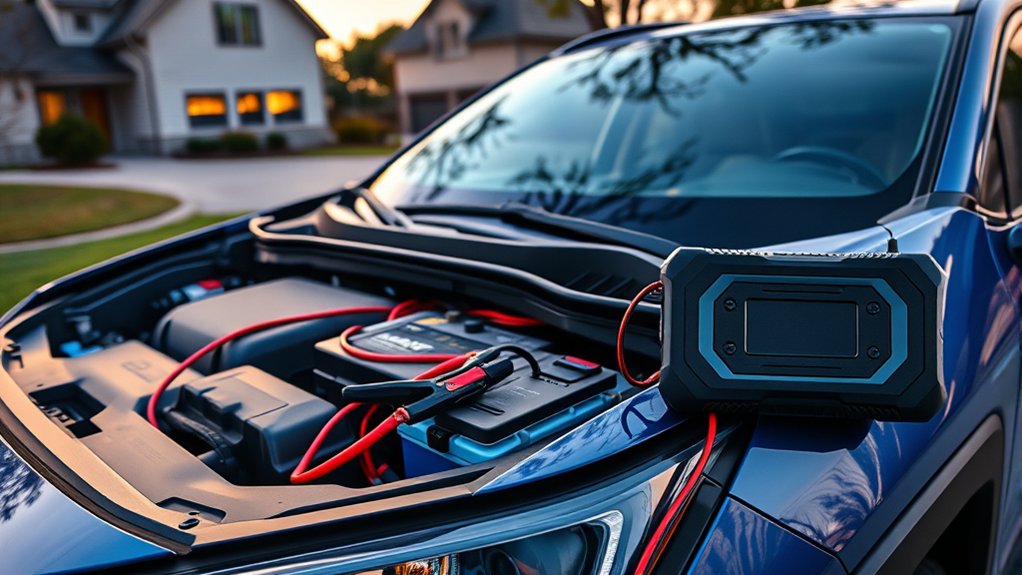
Charging a dead 12-volt battery in a 2023 Toyota RAV4 Hybrid requires the correct battery access point, a compatible charger, and careful cable handling. Unlike the gas-only RAV4, the Hybrid stores its 12-volt battery in the rear cargo area. You can recharge it with a suitable 12-volt smart charger or use the under-hood jump-start terminal for emergency starting.
Quick Answer
To charge a 2023 RAV4 Hybrid’s 12-volt battery, access it behind the right-side rear cargo trim. Turn the vehicle off, disconnect the battery’s negative ground cable as Toyota directs, and connect a compatible smart charger to the battery posts. Charge in a ventilated area, reconnect everything safely, and confirm the vehicle enters READY mode.
At a Glance
| Time Required | Several hours or longer, depending on battery condition and charger output |
| Difficulty | Moderate; involves battery access and terminal disconnection |
| Tools Needed | 12-volt smart charger, safety glasses, gloves, suitable wrench, and optional multimeter |
How to Charge a RAV4 Hybrid 12-Volt Battery
)
The safest approach is to follow Toyota’s battery-service precautions and use a charger designed for the battery installed in your vehicle. Toyota requires disconnecting the negative ground cable when recharging the battery while it remains installed.
The procedure below applies to the auxiliary 12-volt battery, not the high-voltage hybrid traction battery. You can find the model-specific instructions in the 2023 RAV4 Hybrid owner’s manual.
Warning: Batteries can release explosive hydrogen gas and contain corrosive acid. Charge only in a suitably ventilated open area. Never charge a damaged, leaking, swollen, or frozen battery. Keep sparks and flames away, and never connect a charger to the hybrid vehicle’s high-voltage components.
- Turn the vehicle off. Park on a level surface, select Park, apply the parking brake, and confirm that the READY indicator is off. Switch off all electrical accessories.
- Access the battery. Open the rear cargo floor and remove the right-side battery access cover. Leave enough ventilation around the battery.
- Inspect the battery. Look for cracked casing, leaks, corrosion, damaged cables, and loose terminal clamps. Stop if you find serious damage.
- Disconnect the negative ground cable. With the vehicle fully off, loosen the negative terminal connection and move the vehicle’s ground cable away from the battery post. Do not let the loose cable contact the positive terminal. If you are unsure about disconnecting it, use a qualified technician.
- Connect the charger. Keep the charger unplugged or switched off. Attach its red positive clamp to the battery’s positive (+) post, then its black negative clamp to the battery’s negative (-) post. The vehicle’s negative ground cable must remain disconnected during charging.
- Select the charging program. Match the charger to the battery chemistry shown on its label. Choose the correct 12-volt lead-acid setting and a charging current supported by the battery and charger instructions.
- Charge the battery. Power the charger on and follow its progress indicators. Allow an automatic smart charger to complete its charging program. Do not start the hybrid system during external charging.
- Disconnect and restore the battery. Turn the charger off and unplug it. Remove the black clamp, then the red clamp. Reconnect the vehicle’s negative ground cable last and secure the terminal.
- Check operation. Refit the battery cover and cargo trim. Start the hybrid system normally and confirm that the READY indicator appears without an electrical warning.
Disconnecting the 12-volt battery may reset stored vehicle settings. Toyota also notes that some smart-key functions may not work immediately after reconnection.
Where the RAV4 Hybrid 12-Volt Battery Is
The 2023 Toyota RAV4 Hybrid’s auxiliary battery is on the right-hand side of the luggage compartment, behind an interior trim cover. It is not mounted under the hood like the battery in the conventional gasoline RAV4.
The under-hood fuse box contains a separate positive terminal for emergency jump-starting. Understanding the difference prevents you from mistaking the jump connection for the physical battery.
Battery Location
Open the rear hatch and lift the cargo deck board. The battery sits behind the right-side luggage compartment cover, near the vehicle’s passenger-side rear corner on US models.
Its job is to supply power to the vehicle’s low-voltage electronics, including the systems needed to activate the hybrid powertrain. The much larger traction battery is a separate high-voltage component.
Toyota specifies a suitable ventilated lead-acid battery for this application. Do not assume every RAV4 Hybrid uses an AGM battery, since battery specifications can differ by configuration and replacement history.
Access Panel Removal
Removing the 12-volt battery cover requires access through the luggage compartment. Toyota’s corresponding battery-service instructions describe lifting the deck board and releasing the retaining claws on the side cover.
- Open the rear hatch and clear the luggage area.
- Lift the cargo deck board to expose the compartment underneath.
- Release the retaining claws securing the right-side luggage cover. Toyota describes 12 retaining claws for this panel.
- Pull the cover away gently to reveal the battery and its securing hardware.
- After servicing, reinstall the cover and make sure every retaining claw is engaged.
A plastic trim tool is preferable to forcing the panel with a metal screwdriver. Avoid pulling against any wiring or damaging the surrounding trim.
The related Toyota battery location and access instructions also explain the necessary charging precautions.
Tools to Charge the 12-Volt Battery
You need a compatible 12-volt battery charger, basic safety equipment, and the tools required to access the battery. A multimeter is helpful for diagnosing a weak battery, but it cannot replace a proper battery load or conductance test.
A portable jump starter is useful for roadside recovery. However, it is not a substitute for fully charging and testing the auxiliary battery.
Essential Charging Equipment
The charger must support the installed battery’s chemistry, voltage, and charging-current requirements. Automatic smart chargers are generally easier to manage because they adjust charging current and voltage through different charging stages.
- 12-volt smart charger: Select a model compatible with the battery label. Chargers offering 1–10 amp settings may be suitable, depending on the battery’s approved charging rate.
- Multimeter: Measures battery voltage before charging, after charging, and while the vehicle is in READY mode.
- Wrench: Allows safe removal and reconnection of the negative terminal clamp.
- Plastic trim tool: Helps release the cargo-area access cover without damaging nearby panels.
- Portable jump starter: Provides temporary 12-volt power for emergency starting when used according to Toyota’s instructions.
A basic trickle charger supplies relatively low current over a longer period. A smart charger with automatic maintenance mode can reduce the risk of leaving a charged battery connected to an unsuitable continuous charging source.
A charger should never be treated as universally compatible just because it has 12-volt output. Its AGM, flooded lead-acid, calcium, and other modes can use different charging profiles.
Safety Gear Needed
Wear safety glasses and chemical-resistant gloves whenever you handle the 12-volt battery. Remove metal jewelry, keep tools away from exposed terminals, and work where gases cannot build up.
The battery may contain sulfuric acid, which can injure your eyes and skin. Keep clean water nearby and avoid leaning over the battery while making connections.
Follow the charger’s instructions for cable connection, ventilation, and emergency shutdown. NOCO’s lead-acid battery charging precautions cover these hazards in detail.
If battery acid enters your eyes, rinse with clean running water immediately and seek urgent medical attention. Do not continue charging a battery that overheats, leaks, or produces unusual odors.
How Long to Charge the 12-Volt Battery
Charging a 2023 RAV4 Hybrid’s 12-volt battery can take several hours or longer. The actual duration depends on the battery’s capacity, its remaining charge, the charger’s current output, and the battery’s condition.
A 6–12 hour charging period may be reasonable in some situations, but it is not guaranteed. A deeply discharged battery connected to a low-current maintainer can take considerably longer.
- Low-current maintenance charging: Useful for gradual charging, but recovery from a deep discharge may take a day or longer.
- Moderate-current smart charging: Often restores a partly discharged battery within several hours, depending on its capacity.
- Emergency jump-starting: Can provide enough power to enter READY mode quickly, but it does not fully recharge the battery.
CTEK explains the effects of battery capacity, charging current, and initial state of charge in its battery charging time guide.
Use the smart charger’s completed-charge indication rather than stopping solely because a certain number of hours has passed.
How to Tell if the 12-Volt Battery Is Bad
A failing RAV4 Hybrid 12-volt battery may cause dim interior lights, unreliable door locks, warning messages, or an inability to enter READY mode. Repeated discharge after a full charge is another reason to investigate its condition.
Unlike a conventional vehicle, a hybrid does not depend on the 12-volt battery to crank the gasoline engine with a traditional starter motor. The auxiliary battery primarily powers the electronic systems needed to start the hybrid system.
You can begin diagnosis by measuring the battery’s resting voltage with the vehicle completely off. Allow the battery to rest after charging or driving so the reading is not distorted by surface charge.
| Resting Voltage | Likely Battery Condition | Recommended Action |
|---|---|---|
| 12.6V or higher | Fully or nearly fully charged | Check battery performance if symptoms remain |
| 12.5V | Somewhat reduced charge | Monitor and recharge if needed |
| 12.1–12.4V | Partially discharged | Recharge and retest |
| 12.0V or lower | Severely discharged | Charge only if safe; arrange battery testing |
These approximate resting-voltage guidelines come from Yuasa’s lead-acid battery testing guidance. Temperature, battery type, recent charging, and electrical loads can affect readings.
A voltage reading alone cannot confirm battery health. A battery can display normal voltage while lacking enough usable capacity to operate reliably under load.
If the battery repeatedly discharges, have its capacity tested and check for electrical accessories or faults that draw power while the vehicle is parked.
How to Jump-Start a 2023 RAV4 Hybrid
You can jump-start a 2023 RAV4 Hybrid using Toyota’s dedicated positive jump terminal under the hood and a suitable metal ground point. This provides temporary low-voltage power without opening the rear battery compartment.
Toyota specifies using a second vehicle with a 12-volt battery or suitable emergency equipment. Keep the vehicles from touching and ensure their electrical systems are correctly connected.
Warning: Use only the designated 12-volt jump-start connections. Never connect jumper cables to orange high-voltage wiring, hybrid battery components, or an unidentified electrical terminal. Keep cables clear of cooling fans and other moving parts.
- Prepare the vehicles. Park both vehicles securely, apply their parking brakes, and turn off electrical accessories. Keep the RAV4’s electronic key available.
- Open the RAV4 hood. Locate the engine-compartment fuse box and remove its cover.
- Expose the positive jump terminal. Open the dedicated terminal cover inside the fuse box.
- Connect the first red clamp. Attach it to the RAV4’s dedicated positive (+) jump terminal.
- Connect the second red clamp. Attach it to the donor vehicle battery’s positive (+) terminal.
- Connect the first black clamp. Attach it to the donor battery’s negative (-) terminal.
- Connect the final black clamp. Attach it to the solid, stationary, unpainted metal ground point specified by Toyota on the RAV4, away from moving parts.
- Start the donor vehicle. Maintain a slightly increased engine speed for approximately five minutes, as Toyota describes.
- Start the RAV4 Hybrid. Press the brake pedal and activate the hybrid system. Confirm that the READY indicator illuminates.
- Remove the cables. Disconnect them in the exact reverse order, keeping the clamps separated. Reinstall the jump terminal and fuse-box covers.
If you use a portable 12-volt jump starter instead, follow its manufacturer-specific instructions while using Toyota’s designated jump terminal and ground point.
The earlier-model Toyota RAV4 Hybrid emergency starting instructions illustrate the same general connection sequence.
Do not use the RAV4 Hybrid’s dedicated jump terminal to jump-start another vehicle. Toyota identifies this connection for receiving emergency power, not supplying it to another car.
If the READY indicator does not appear after the recommended procedure, stop and contact a Toyota dealer or qualified repair shop. A discharged 12-volt battery is not the only possible reason the hybrid system may fail to start.
How to Check Charging Voltage After Restart
Once the RAV4 Hybrid enters READY mode, its DC-DC converter normally supports the 12-volt electrical system and recharges the auxiliary battery. This converter performs the charging function that an alternator handles in many conventional vehicles.
A charging-system voltage near 14 volts is common, but it is not a fixed value. The reading changes with electrical load, battery condition, temperature, and converter control.
Seeing the READY indicator confirms that the hybrid system has started. It does not prove that the 12-volt battery is healthy or can hold a charge.
For an initial voltage check:
- Reconnect the battery and confirm that all charging equipment has been removed.
- Set your multimeter to measure DC voltage.
- With the vehicle off, measure voltage across the battery’s positive and negative posts.
- Start the hybrid system and confirm that READY appears.
- Measure the battery voltage again while READY is active, keeping probes and cables secure.
- Compare the readings and check for warning messages or other signs of charging failure.
A READY-mode reading around 13.5–14.5 volts is commonly consistent with active charging. However, Toyota’s service diagnostic conditions allow a wider operating range, so a reading slightly outside this example does not by itself prove converter failure.
If voltage remains near the discharged battery’s resting value, falls while electrical loads are active, or triggers a charging warning, have the DC-DC converter and related connections checked professionally.
Never attempt to repair or test high-voltage hybrid components using an ordinary 12-volt battery procedure.
Common RAV4 Hybrid Battery Charging Mistakes
Most avoidable battery-charging problems come from incorrect equipment, unsafe terminal handling, or confusion between the rear battery and the under-hood jump terminal. These mistakes can damage electrical components or create a battery safety hazard.
Watch for these common errors:
- Looking for the battery under the hood: The 2023 Hybrid’s physical 12-volt battery is in the rear luggage compartment.
- Using the wrong charger mode: Select a charging program compatible with the battery chemistry shown on its label.
- Leaving the vehicle connected to an unsuitable charger: Follow Toyota’s requirement to disconnect the negative ground cable during in-vehicle charging.
- Charging while READY is active: External charging must take place with the hybrid system off.
- Reversing charger polarity: Incorrect positive and negative connections can damage equipment or cause sparks.
- Assuming a jump-start fully recharges the battery: Emergency power restores startup ability but does not necessarily replace the missing charge.
- Ignoring corrosion: Loose or corroded terminals can create resistance and unreliable electrical connections.
- Assuming every low voltage reading means a bad battery: Charging faults and excessive parked-vehicle electrical drain can produce similar symptoms.
Never attempt to recharge the high-voltage traction battery with an ordinary automotive battery charger. That system requires specialized equipment and service procedures.
When to Replace the 12-Volt Battery
Replace the RAV4 Hybrid’s 12-volt battery when testing confirms that it can no longer hold sufficient charge or provide dependable low-voltage power. A repeated no-start condition after proper charging is a strong reason to have it tested.
Many automotive 12-volt batteries last approximately three to five years, although operating conditions and battery construction can change that lifespan. Extreme temperatures, repeated deep discharges, and long periods without use can shorten service life.
Consider replacement when:
- The battery repeatedly loses charge after being fully recharged.
- A professional load or conductance test shows inadequate capacity.
- The battery case is cracked, leaking, swollen, or otherwise damaged.
- Electrical symptoms return despite clean, secure connections and a functioning charging system.
- The battery is several years old and increasingly unreliable.
Before purchasing a replacement, identify the original battery’s physical dimensions, capacity, cold-cranking rating, terminal layout, and venting requirements.
The 2023 RAV4 Hybrid manual describes different battery configurations, including LN1 and LN2 case sizes. It specifies appropriate minimum capacity and performance ratings for each configuration, so selecting a battery by model year alone is not sufficient.
Because the battery is installed inside the luggage area, the exhaust hose and vent plug must be correctly installed with the replacement battery. This prevents released battery gases from entering the passenger compartment.
Note: Toyota recommends battery inspection after a discharge. If you are unsure about battery compatibility, terminal disconnection, vent routing, or electrical-system testing, have a Toyota dealer or qualified hybrid technician perform the work.
Replacing a battery that still tests healthy creates unnecessary cost and waste. However, keeping a damaged or unreliable battery can leave the vehicle unable to enter READY mode when you need it.
Key Takeaways
- The 2023 RAV4 Hybrid uses a rear-mounted auxiliary battery and a separate under-hood emergency jump terminal.
- Toyota instructs owners to disconnect the negative ground cable when externally charging the installed battery.
- A resting voltage reading indicates charge level, but battery health requires additional testing.
- The hybrid DC-DC converter supplies low-voltage charging power while the vehicle is in READY mode.
- Correct replacement-battery fitment and vent-hose installation are essential because the battery sits inside the vehicle.
Frequently Asked Questions
How Do I Charge the 12V Battery on My RAV4 Hybrid?
Use a compatible 12-volt smart charger connected to the auxiliary battery in the right rear cargo area. Turn the vehicle off, disconnect its negative ground cable as Toyota directs, and follow the charger’s connection and operating instructions. Reconnect the ground cable after charging is complete.
What Happens When a 12V Battery Dies in a Hybrid Toyota?
A dead 12-volt battery can prevent the hybrid system from entering READY mode. You may notice inactive dashboard displays, weak interior lights, or door-lock problems. The high-voltage traction battery may still contain energy, but the vehicle needs sufficient low-voltage power to activate its systems.
Can a Dead Hybrid Battery Be Recharged?
A discharged 12-volt auxiliary battery can often be recharged if it remains in good condition. The high-voltage hybrid traction battery is different and must never be connected to a conventional 12-volt charger. A suspected traction-battery failure requires diagnosis by a qualified hybrid technician.
How Long Does the 12V Battery Last in a Toyota RAV4 Hybrid?
A Toyota RAV4 Hybrid 12-volt battery commonly lasts around three to five years, but actual life varies. Climate, vehicle usage, electrical accessories, and repeated discharges affect its condition. If problems begin, test the battery before replacing it based only on age.
Can I Charge the RAV4 Hybrid 12V Battery From Under the Hood?
Toyota provides an under-hood positive terminal for emergency jump-starting. For a full external battery recharge, follow Toyota’s battery-service instructions at the rear battery itself, including disconnecting the negative ground cable. Do not assume the emergency jump terminal is interchangeable with the battery connections for every charger.
Does Leaving a RAV4 Hybrid in READY Mode Charge the 12V Battery?
Yes. When the hybrid system is operating in READY mode, its DC-DC converter normally supplies electrical power and recharges the auxiliary battery. However, recovery time varies, and READY mode cannot repair a damaged battery. Do not leave the vehicle running unattended or in an enclosed space.
Conclusion
Charging a dead 12-volt battery in a 2023 Toyota RAV4 Hybrid starts with identifying the correct rear battery location and using compatible charging equipment. Follow Toyota’s terminal-disconnection and ventilation precautions, then verify normal READY-mode operation. If the battery repeatedly loses charge, arrange a proper battery and charging-system test before choosing a replacement.
Sources
- Toyota — 2023 RAV4 Hybrid Owner’s Manual: Model-specific battery location, service precautions, emergency starting, and replacement requirements.
- Toyota — RAV4 Hybrid 12-Volt Battery Instructions: Battery cover removal, ground-cable disconnection, ventilation, and charging precautions.
- Toyota — RAV4 Hybrid Emergency Starting Instructions: Dedicated jump terminal, correct cable connection order, READY indicator, and emergency safety steps.
- NOCO — Precautions to Take Before Charging: Lead-acid battery handling, terminal safety, personal protection, and ventilation.
- CTEK — How Long Does It Take to Recharge a Car Battery?: Factors affecting charging duration, battery capacity, state of charge, and charger output.
- Yuasa Batteries — How to Test a Lead-Acid Battery: Resting-voltage interpretation, battery charge levels, and the limits of voltage-only testing.