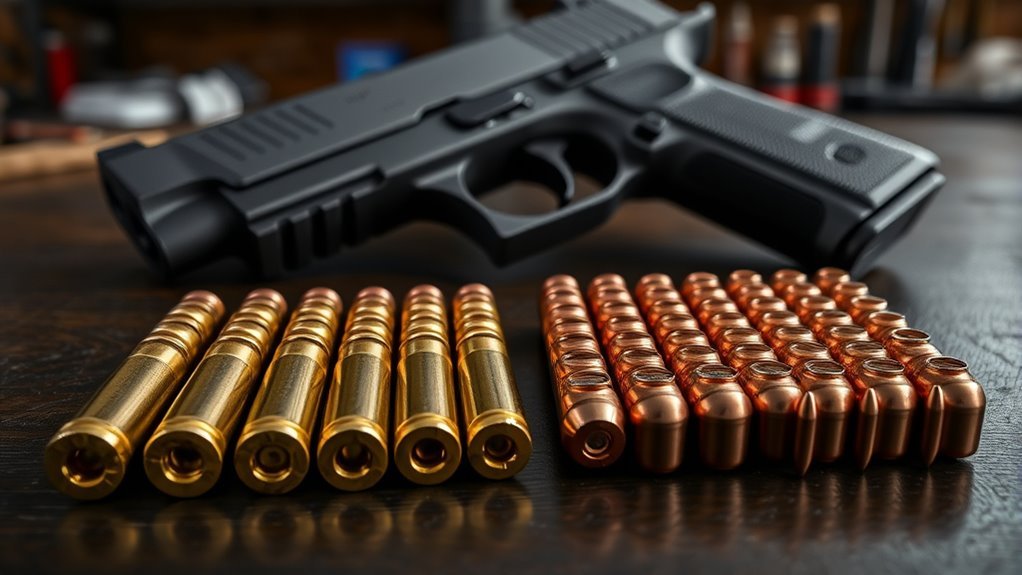
FMJ rounds use a soft lead core inside a metal jacket, which promotes reliable feeding, stable flight, and low cost for training. Hollow point rounds are built with a nose cavity that expands on impact, creating a larger wound channel and controlled penetration, often suited to self-defense. Actual performance depends on firearm, magazine geometry, and load quality. Legal limits also vary by jurisdiction. The next section explains the practical differences in more detail.
Key Takeaways
- FMJ rounds are best for training because they’re cheaper, feed reliably, and provide consistent accuracy for high-volume practice.
- Hollow points are designed for self-defense, expanding on impact to create a larger wound channel and reduce over-penetration.
- FMJ typically penetrates deeper but expands less, while hollow points usually target about 12–18 inches of penetration.
- Ammunition performance depends on firearm, magazine, and load, so test self-defense rounds for reliable feeding before use.
- Always match caliber exactly and check local laws, since hollow point legality and hunting rules vary by jurisdiction.
What Are FMJ and Hollow Point Rounds?
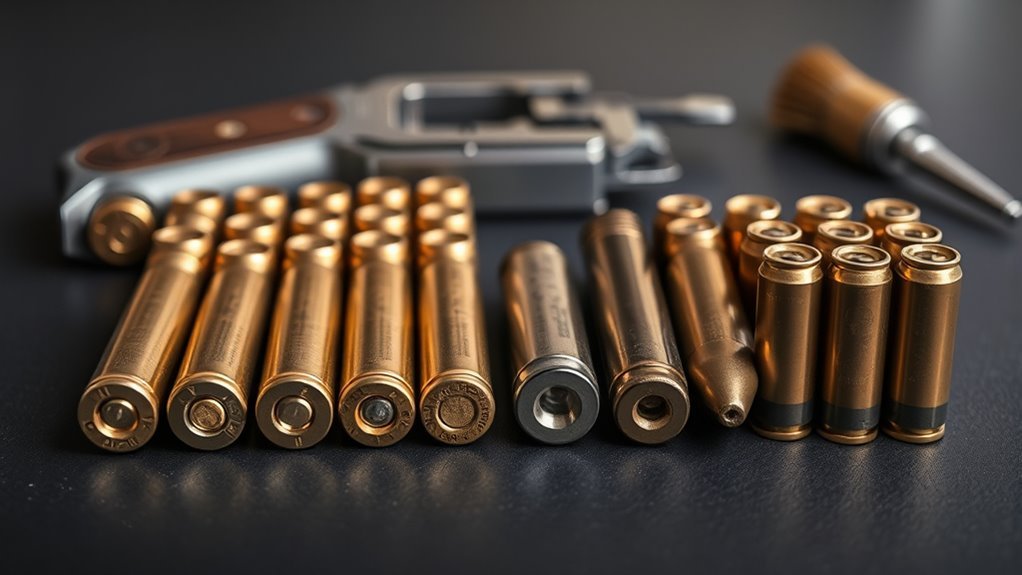
Full metal jacket (FMJ) and hollow point rounds differ primarily in projectile construction and terminal behavior.
FMJ ammunition uses a soft lead core enclosed by a hard metal jacket, a design that supports reliable feeding and lower cost in target practice.
Hollow Point ammunition includes a cavity in the nose, engineered to promote expansion on impact. That expansion increases energy transfer and produces a wider wound channel, which is why it is commonly selected for self-defense.
FMJ generally emphasizes penetration and consistency in training contexts, while Hollow Point prioritizes controlled deformation and reduced over-penetration risk.
FMJ favors penetration and consistency in training, while Hollow Point offers controlled expansion and reduced over-penetration risk.
Both serve distinct operational roles within ammunition choice, and neither should be treated as interchangeable.
A liberated and informed user must also account for local laws, since some jurisdictions restrict Hollow Point use for civilians.
Proper selection depends on purpose, legal status, and the intended balance between reliability, penetration, and terminal effect.
FMJ vs Hollow Point Performance Differences
Performance differences between FMJ and Hollow Point rounds are primarily driven by terminal behavior and intended use. FMJ favors reliable feeding, stable trajectory, and lower cost, which suits target practice and training. Hollow Point prioritizes expansion and penetration control, increasing stopping power and a wider wound channel for self-defense.
| Round | Primary strength | Main limitation |
|---|---|---|
| FMJ | Consistent cycling | Over-penetration |
| Hollow Point | Greater stopping power | Cost variation |
| Hollow Point | Optimized penetration depth | Quality dependence |
FMJ often delivers deep penetration, yet that depth can exceed what is desirable in populated settings. Hollow Point loads are commonly tuned for 12 to 18 inches of penetration depth, balancing reach and restraint. Their effectiveness, however, depends on brand quality and impact conditions. For those seeking defensive readiness and autonomy, Hollow Point performance is usually preferred when disciplined terminal effect matters most, while FMJ remains efficient for economical repetition and skill development.
How Hollow Points Expand and Penetrate
Hollow-point bullets use a cavity at the tip to trigger controlled expansion on impact, and that expansion typically increases diameter to about 1.5 to 1.7 times the original size.
The hollow point is engineered so the surrounding metal mushrooms outward, allowing the projectile to expand reliably in soft tissue. This deformation enlarges the wound channel, improves energy transfer, and raises stopping power by disrupting more tissue in a shorter path.
Properly designed loads aim for ideal penetration of 12 to 18 inches, a range that can reach crucial organs while limiting collateral damage from over-penetration.
Expansion and penetration are linked: as the bullet expands, drag increases, slowing the projectile and shaping its terminal behavior. Thick clothing can reduce or delay expansion, which may alter penetration depth and diminish performance.
In practical terms, the mechanism is a balance between controlled expansion, sufficient penetration, and controlled terminal effect.
Why FMJ Rounds Are Best for Training
FMJ rounds are well suited to training because their lower cost supports high-volume practice without excessive expense.
Their smooth profile promotes reliable feeding in semi-automatic firearms, reducing interruption during repetitive drills.
They also produce consistent flight characteristics, which helps shooters develop accuracy and precision under controlled conditions.
Cost-Effective Practice
For training and high-volume practice, full metal jacket rounds offer a clear cost advantage over hollow point ammunition, allowing shooters to maintain frequent range sessions without excessive expense.
Their cost-effective pricing makes FMJ rounds the affordable choice for repeated training sessions, especially when volume matters. The solid design supports reliable feeding and consistent performance in semi-automatic firearms, helping reinforce sound technique under repeatable conditions.
Because hollow point bullets are engineered for expansion, FMJ projectiles provide deeper penetration, a useful trait when evaluating marksmanship and point-of-impact control. Reduced fouling also extends session length and limits maintenance interruptions.
Across common calibers, FMJ rounds remain broadly accessible, giving disciplined shooters a practical pathway to skill development, precision, and greater independence from unnecessary cost.
Reliable Feeding
Beyond cost advantages, training ammunition is often evaluated by how consistently it feeds through a firearm. FMJ rounds answer this requirement through a solid lead core and jacketed exterior that support reliable feeding in semi-automatic firearms.
Their smooth bullet profile promotes consistent cycling, reducing stoppages that disrupt training and undermine performance. The non-expanding design preserves shape during chambering and extraction, improving reliability across multiple platforms.
For shooters pursuing marksmanship skills without unnecessary cost concerns, FMJ offers a practical baseline.
- Smooth bullet profile
- Consistent cycling
- Lower maintenance burden
- High-volume training efficiency
The result is a cartridge suited to disciplined practice, where mechanical predictability matters more than terminal effect. In that context, FMJ remains the standard choice for efficient, repeatable training.
Consistent Accuracy
Consistent point of impact is one of the main reasons FMJ rounds are preferred for training, as their jacketed lead-core construction produces predictable flight characteristics and stable cycling in semi-automatic firearms.
FMJ rounds support reliable feeding and reduce variables that can distort accuracy during repeated training sessions. Their non-expanding design limits barrel fouling, preserving cleaner bore conditions and more uniform performance across strings of fire.
Because they are affordable, shooters can maintain consistent training without sacrificing volume or cadence. The result is a practical platform for developing marksmanship skills, since attention remains on sight alignment, trigger control, and follow-through rather than expansion dynamics.
In technical terms, FMJ ammunition offers repeatable external and internal behavior, making it a disciplined choice for shooters seeking measurable, transferable precision.
Why Hollow Points Work for Self-Defense
Hollow point rounds are designed to expand on impact, often increasing to roughly 1.7 times their original diameter and creating a larger wound channel than FMJ ammunition. In self-defense, this expansion supports controlled energy transfer, improving stopping power while reducing over-penetration.
- The enlarged wound channel accelerates blood loss and raises the probability of rapid incapacitation.
- High-quality hollow point loads are engineered for 12 to 18 inches of penetration, helping reach essential organs without excessive pass-through.
- By expending momentum in tissue, Hollow Points limit collateral risk in confined environments where liberated movement matters.
- Law enforcement adoption reflects measured confidence in expansion, penetration, and terminal performance.
The technical balance is clear: effective penetration to essential organs, but not beyond them. A high-quality hollow point consequently offers a disciplined defensive profile, aligning damage with immediate threat cessation rather than uncontrolled travel.
What Your Handgun Feeds Most Reliably
FMJ rounds often provide the most consistent feeding because their rounded profile moves more smoothly through the magazine and into the chamber.
Many semi-automatic handguns are engineered and tested around FMJ ammunition, which can make it the baseline for reliability.
Hollow point performance is more variable and should be verified through careful testing in the specific handgun with the intended carry load.
FMJ Feeding Consistency
Among the most reliable choices for semi-automatic handguns, full metal jacket ammunition is often favored for its smooth nose profile and consistent construction, which help cartridges feed, chamber, and eject with fewer stoppages.
FMJ’s stable dimensions support reliability and consistent cycling across many platforms, especially during target practice and training. Its solid jacket can reduce chamber friction, improving compatibility in pistols engineered around this standard load.
- Feeding: smooth profile promotes dependable chamber entry.
- Cycling: uniform weight aids repeatable operation.
- Ballistic performance: predictable shape supports accuracy.
- Compatibility: testing specific FMJ loads confirms handgun reliability.
For practitioners seeking practical freedom through competence, regular function checks remain essential.
Multiple brands should be evaluated, since minor design differences can affect performance under stress.
Hollow Point Reliability
Although hollow point ammunition is engineered for controlled expansion and reduced over-penetration, its reliability is ultimately firearm-specific.
Hollow point reliability depends on bullet design, magazine geometry, and chamber tolerance, so expanding bullets should be tested in the exact handgun intended for self-defense. A high-quality hollow point typically delivers ideal penetration and expansion, often 12 to 18 inches in calibrated media and 1.5 to 1.7 times original diameter.
Even so, some pistols, especially older models, can exhibit feeding issues with certain loads. Ammunition for concealed carry should thus be verified through live-fire testing, not assumed.
Law enforcement often selects hollow points because stopping power and reduced collateral risk align with operational needs. The best load is the one that feeds consistently.
Legal Restrictions on Hollow Point Ammo
Legal restrictions on hollow point ammunition vary widely across jurisdictions, with some states permitting civilian possession and use without limitation while others impose specific restrictions or prohibitions. The legal status of hollow point ammunition consequently demands exact review of local regulations before possession or transport.
Law enforcement agencies commonly use expanding ammunition for self-defense, which has influenced public perceptions of its legitimacy; however, that usage does not override civilian legal limits. Where hollow points are restricted, FMJ ammunition may remain lawful, though its greater risk of over-penetration must be recognized.
Some hunting rules also mandate expanding ammunition for ethical reasons, reflecting a separate regulatory logic. Ammunition types are hence governed by context, not preference alone.
- Confirm state and municipal statutes.
- Verify transport and storage rules.
- Compare permitted ammunition types with intended use.
- Record compliance before acquisition or travel.
Violations can trigger severe penalties, so disciplined legal review supports lawful autonomy.
How to Pick the Right Round for Your Gun
Selecting the right round for a firearm requires aligning ammunition type with the intended application: FMJ rounds are generally suited to target practice and range use, while hollow points are typically chosen for self-defense because of their controlled expansion.
Caliber matching is nonnegotiable; the ammunition must exactly match the firearm caliber to avoid feeding issues and preserve reliability. For Hollow Point loads, testing several reputable brands in the specific gun is prudent, because chamber geometry, magazine design, and ramp angles can produce misfeeds.
Local laws also govern lawful possession and carry, so compliance is part of responsible selection. High-quality ammunition from established manufacturers should be prioritized, since consistent primers, case dimensions, and bullet profiles reduce malfunction risk under stress.
A disciplined owner evaluates purpose, caliber, reliability, and legal constraints before deciding which FMJ or Hollow Point cartridge best supports safe, precise, and effective use.
Frequently Asked Questions
Are Hollow Tips Better Than FMJ?
Hollow point is generally superior for defensive use, offering higher expansion rate and safer penetration depth. Terminal ballistics improve, though ammunition cost rises; accuracy comparison and range performance favor FMJ. Recoil management, hunting effectiveness, law enforcement preferences vary.
Do Police Use FMJ or Hollow?
Police departments mostly use hollow points; roughly 70% of U.S. agencies favor them. In ballistics comparison, law enforcement weighs penetration depth, expansion characteristics, terminal performance, ammunition types, training ammunition, cost analysis, recoil differences, legal considerations.
Does the Military Use FMJ or Hollow Point?
The military generally uses FMJ military ammunition, not hollow points, because bullet design favors combat effectiveness, ballistic performance, and legal implications. Historical context, ammunition regulations, tactical applications, training rounds, and wound characteristics reinforce that standard.
Why Is FMJ Not Recommended for Self-Defense?
FMJ is not recommended for self defense because limited expansion properties reduce self defense effectiveness, increase bullet penetration, and lessen wound trauma. Technical ammunition choices favor hollow points, despite cost differences, legal considerations, and recoil management.
Conclusion
In conclusion, FMJ and hollow point ammunition serve distinct roles. FMJ rounds typically offer deeper penetration and lower cost, making them well suited to practice and high-volume training. Hollow points are designed to expand on impact, improving terminal performance and reducing over-penetration risk in defensive use. Remarkably, some tests show hollow points can expand to nearly twice their original diameter, a statistic that underscores their engineered energy transfer and defensive intent.
