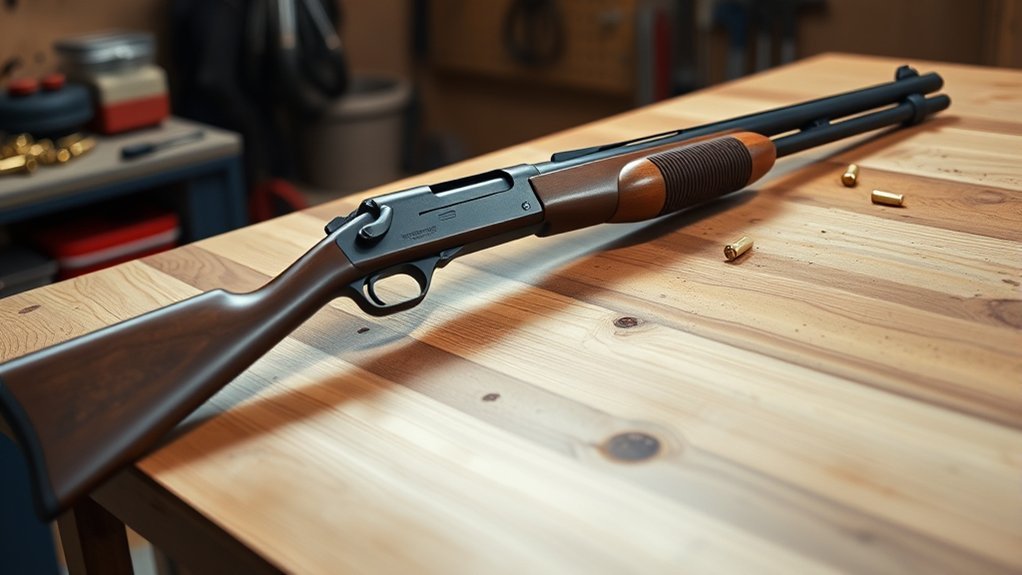
The main difference in a lever action vs pump action carbine is how you cycle the gun. A lever gun is worked by a lever that wraps the trigger guard. A pump gun is worked by sliding the forend back and forward. Most lever guns feed from a tube under the barrel. Most centerfire pump rifles feed from a box magazine. Many shooters find a pump a little faster to cycle, while lever guns are easier to find new and have a classic feel.
This guide compares how each one works, its speed, handling, calibers and basic safety rules. Last checked: October 2026
How a Lever Action Carbine Works
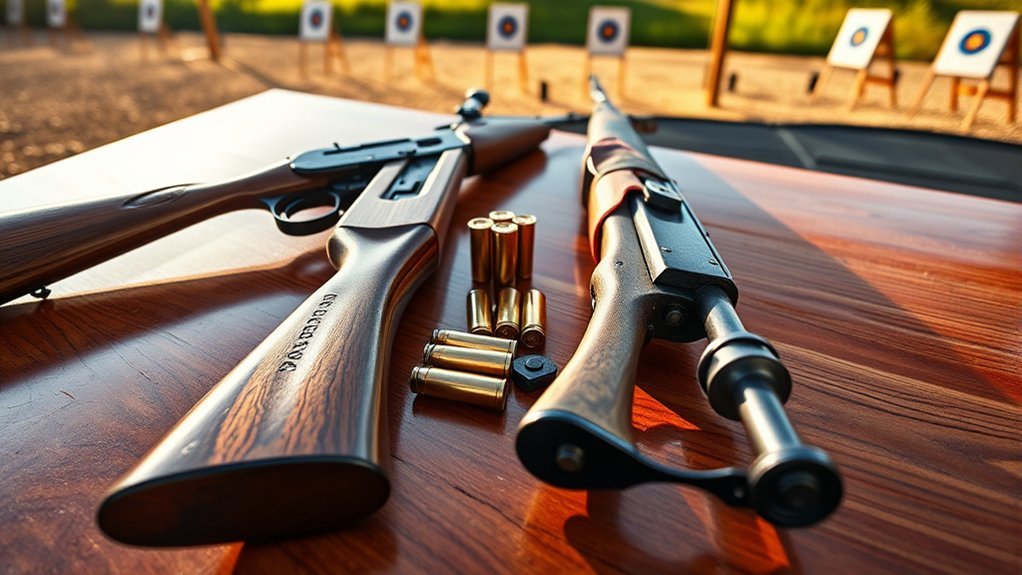
You push the lever down and forward. This opens the action, ejects the empty case and cocks the hammer. Pulling the lever back up loads the next round and closes the action. The design dates to the 1860s.
Most lever guns keep cartridges in a tube under the barrel, lined up nose to tail. Centerfire models are loaded through a gate on the side of the receiver. A Marlin 336 holds about 6 rounds in the tube, and the number varies by model. A Winchester 1894 carbine with a 20-inch barrel holds 7. Some rimfire models, such as Henry’s .22 lever actions, load through the end of the magazine tube.
A few lever guns use a detachable box magazine. The Henry Long Ranger is one. It comes in .223 Remington, .243 Winchester, .308 Winchester and 6.5 Creedmoor.
Common lever-action models include:
- Marlin 336: usually in .30-30 Winchester. Ruger now makes Marlin rifles and announced new 336 production in 2023.
- Marlin 1895: a large-bore model in .45-70 Government.
- Winchester Model 94 and Model 1894: the Model 94 was made until 2006. The similar Model 1894 is made today in Japan and sold under the Winchester name.
- Henry Big Boy: a tube-fed rifle in .357 Magnum, .44 Magnum and .45 Colt.
How a Pump Action Carbine Works
You slide the forend back to unlock the bolt and eject the empty case. You slide it forward to load the next round and lock the bolt. Your trigger hand stays on the grip, and the rifle can stay at your shoulder.
The best-known centerfire pump rifles are the Remington Model 760 and its newer version, the Model 7600. The 7600 has a 4-round detachable box magazine and a rotating two-lug bolt. It was sold in calibers such as .243 Winchester, .270 Winchester, .308 Winchester and .30-06 Springfield. Remington stopped making the 7600 in 2020, so most buyers now look for used guns.
Rimfire pumps are still in production. The Rossi Gallery is a .22 LR with a 15-round tube magazine. It is a copy of the old Winchester Model 61 and 62 design. The Henry H3 Frontier comes in .22 Short/Long/Long Rifle and .22 WMR.
Lever Action vs Pump Action Carbine: Side-by-Side
| Feature | Lever action | Pump action |
|---|---|---|
| How you cycle it | Lever under the stock | Slide the forend |
| Usual magazine | Tube under the barrel. A few models use a box magazine. | Box magazine (Remington 7600) or tube (.22 pumps) |
| Typical calibers | .30-30, .357 Magnum, .44 Magnum, .45 Colt, .45-70, .22 rimfire | .243, .270, .308, .30-06 (centerfire). .22 LR and .22 WMR (rimfire). |
| Cycling speed | Fast with practice | Often a little faster |
| New models today | Many (Marlin, Winchester, Henry) | Mostly rimfire. Centerfire pumps are mostly used. |
| Ammo caution | Pointed bullets in tube magazines | Not an issue with box magazines |
Which Cycles Faster, a Lever or a Pump?
Both must be worked by hand for every shot. Neither is a semi-auto. Most shooters find a pump faster. The pump hand moves a short, straight distance, and the rifle stays at the shoulder. With a lever, many shooters have to shift the rifle or reach around the lever loop.
Skill matters more than the action. Practice with an unloaded gun until the motion is smooth. On a pump, slide the forend all the way back each time. If you stop short, the gun can jam. This is called short-stroking.
Accuracy depends on the barrel, the sights or scope and the shooter. The action type does not make one more accurate than the other.
Handling and Ergonomics
- Weight and feel: lever carbines are slim and light, which makes them easy to carry in brush. Pump rifles have a longer forend that gives a firm forward grip.
- Hand size: fit depends on your hand size and arm length. Try both at a gun store before you buy.
- Scopes: some lever guns, such as older Winchester 94s, eject from the top of the receiver, which makes a centered scope harder to mount. Side-ejecting models like the Marlin 336 take a scope more easily.
Calibers and Typical Uses
- .30-30 Winchester (lever): a classic deer cartridge for short to medium range.
- .357 Magnum, .44 Magnum and .45 Colt (lever): handgun cartridges that also fit rifles like the Henry Big Boy.
- .45-70 Government (lever): for large game, in rifles like the Marlin 1895.
- .243, .270, .308 and .30-06 (pump): deer-class cartridges in the Remington 760 and 7600.
- .22 rimfire (lever or pump): small game, plinking and training.
Some places limit which cartridges you may use to hunt deer and other game. Check your local hunting rules before you choose a caliber.
Safety and Legal Basics
- Treat every gun as loaded. Keep the muzzle pointed in a safe direction. Keep your finger off the trigger until you are ready to shoot. Know your target and what is behind it.
- On a lever gun, your fingers sit inside the lever loop. Keep them off the trigger while you work the lever.
- Learn how your model’s hammer and safety work. Many lever guns have an exposed hammer, and some have a cross-bolt safety. Never rely on a safety alone.
- With a tube magazine, use flat-nose or round-nose bullets, or soft-tipped ammo made for lever guns, such as Hornady LEVERevolution. With a hard pointed bullet, recoil can push the tip into the primer of the round ahead of it.
- Unload the magazine and chamber when you finish shooting. Store guns unloaded and locked, away from children.
- Laws differ by country, state and province. Many places set rules on buying, carrying and storing guns, and some set limits on barrel length or magazine size. Check your local law before you buy.
How to Choose Between a Lever Action and a Pump Action
- Deer in brush at short to medium range: a .30-30 lever gun such as the Marlin 336 or Winchester 1894.
- Large game: a .45-70 lever gun such as the Marlin 1895.
- Longer shots with a scope and a box magazine: a used Remington 7600 or a Henry Long Ranger.
- Small game, plinking and training: a .22 lever gun from Henry, or a .22 pump such as the Rossi Gallery or Henry H3.
- Fastest manual cycling: a pump.
- Classic looks and the most new models: a lever gun.
Frequently Asked Questions
Which Is Better, a Lever-Action Rifle or a Pump-Action Rifle?
Neither is better for everyone. Pumps are usually a bit faster to cycle. Lever guns are lighter, have more new models and come in more calibers. Pick by the game you hunt, the range and how the gun fits you.
What Are the Main Types of Rifle Actions?
The common repeating actions are bolt, lever, pump and semi-automatic. Single-shot rifles, such as break-action and falling-block rifles, are also common.
What Is the Difference Between a Carbine and a Rifle?
A carbine is a shorter, lighter version of a rifle, usually with a shorter barrel. There is no single length that applies everywhere, and legal definitions differ by country.
What Are the Disadvantages of Pump-Action Rifles?
You must slide the forend fully back and forward for each shot, or the gun can jam. Also, new centerfire pump rifles are hard to find now that Remington has ended the 7600.
Conclusion
Both actions are simple, proven and slower than a semi-auto. A pump is usually a bit faster. A lever gun is slim and easier to find new. Handle both, follow the safety rules, and check your local laws before you buy.