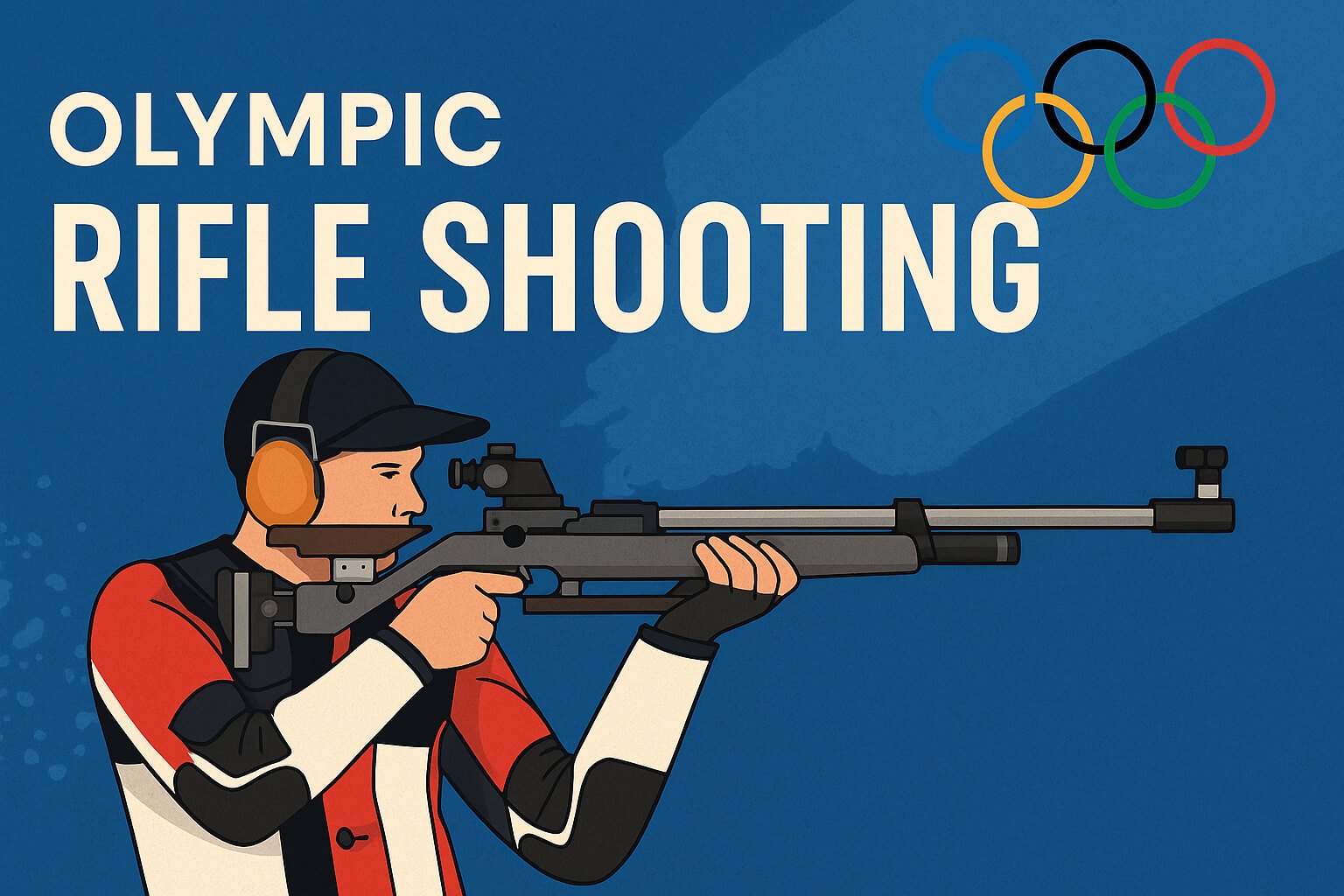
Olympic rifle shooting currently consists of five Olympic medal events: men’s and women’s 10m Air Rifle, men’s and women’s 50m Rifle Three Positions, and 10m Air Rifle Mixed Team. Athletes compete for extremely small scoring differences using controlled posture, sight alignment, trigger control, breathing, and repeatable routines. The current ISSF rules also distinguish clearly between 10m Air Rifle qualification, which uses decimal scoring, and 50m Rifle Three Positions qualification, which uses full-ring integer scoring.
Last updated: September 21, 2026 — checked against the current ISSF 2026 Rule Book and confirmed LA28 shooting formats.
Quick Answer
Olympic rifle shooting has five medal events: individual men’s and women’s 10m Air Rifle, individual men’s and women’s 50m Rifle Three Positions, and 10m Air Rifle Mixed Team. In individual 10m Air Rifle, athletes fire 60 qualification shots from standing. In 50m Rifle Three Positions, they fire 20 shots each from kneeling, prone, and standing. The best eight individual athletes advance to finals, where qualification scores do not carry forward. Mixed Team pairs one male and one female athlete from the same nation.
Key Takeaways
- Olympic shooting has been part of the modern Games since Athens 1896.
- The Olympic rifle program has men’s and women’s 10m Air Rifle, men’s and women’s 50m Rifle Three Positions, and a 10m Air Rifle Mixed Team event.
- Individual 10m Air Rifle qualification uses 60 shots and decimal scoring; 50m Rifle Three Positions uses 60 shots split across kneeling, prone, and standing with full-ring qualification scoring.
- The top eight athletes in the individual rifle events advance to the final, where scoring restarts from zero.
- ISSF’s 2026 rules and confirmed LA28 formats introduced important finals updates, especially for 50m Rifle Three Positions and Mixed Team competition.
What Are the Olympic Rifle Shooting Events?
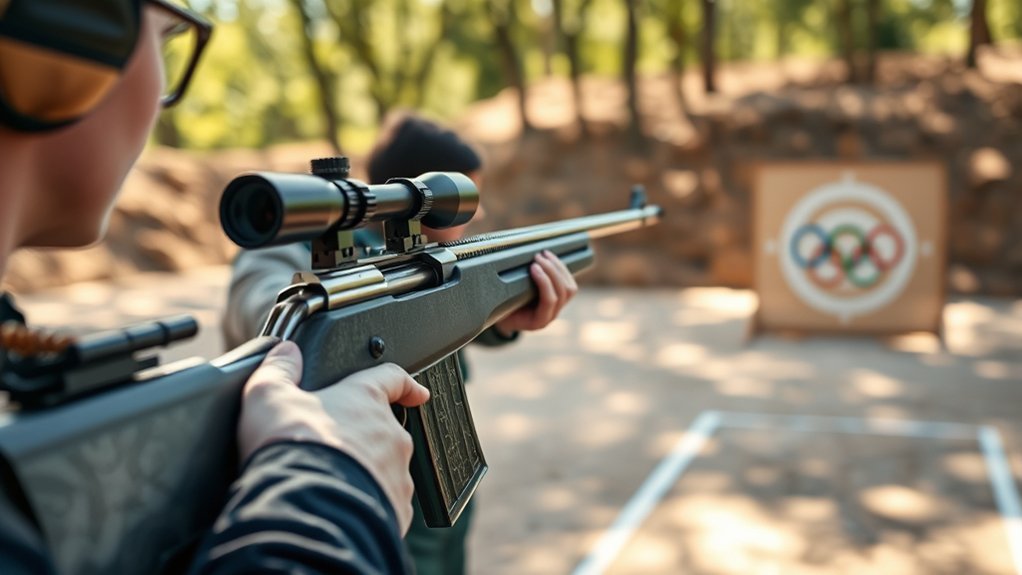
The Olympic rifle program is built around two disciplines: 10m Air Rifle and 50m Rifle Three Positions. The 10m event is also contested as a Mixed Team competition. Current ISSF rules define the qualification course, scoring method, time limits, and finals procedures for each event.
| Olympic rifle event | Position | Qualification | Qualification scoring | Who advances |
|---|---|---|---|---|
| 10m Air Rifle Men | Standing | 60 shots in 75 minutes | Decimal | Top 8 to final |
| 10m Air Rifle Women | Standing | 60 shots in 75 minutes | Decimal | Top 8 to final |
| 50m Rifle Three Positions Men | Kneeling, prone, standing | 20 shots per position, 60 total | Full-ring integer | Top 8 to final |
| 50m Rifle Three Positions Women | Kneeling, prone, standing | 20 shots per position, 60 total | Full-ring integer | Top 8 to final |
| 10m Air Rifle Mixed Team | Standing | 30 shots per athlete | Decimal | Top 4 teams to final |
The 10m Air Rifle event is fired at a target 10 meters away. Athletes shoot from standing, where small changes in balance or sight alignment can affect the score. The Olympic program includes separate men’s and women’s individual events plus 10m Air Rifle Mixed Team.
The 50m Rifle Three Positions event tests athletes in kneeling, prone, and standing. Qualification consists of 20 match shots in each position. The different positions place different demands on stability and position-building, while the athlete still has to reproduce the same basic shot process.
Note: There is no separate 50m Rifle Prone event in the current Olympic program. Prone remains one of the three positions in 50m Rifle Three Positions.
Mixed Team pairs one male and one female athlete from the same nation. Under the current ISSF format, each athlete fires 30 qualification shots and the four highest-ranked teams progress to one medal final.
The History of Olympic Rifle Shooting
When you explore the history of Olympic rifle shooting, you find a sport shaped by technology, military tradition, and changing ideas about athletic performance. Shooting was included in the first modern Olympic Games in Athens in 1896.
Early Olympic shooting events looked different from today’s program. Rules, distances, targets, equipment, and event formats changed repeatedly as international competition became more standardized. The modern Olympic rifle program is now centered on highly controlled 10m and 50m precision events.
Women first competed alongside men in Olympic shooting events in 1968, and women’s-specific shooting events were introduced in 1984. The current Olympic program includes equal men’s and women’s individual rifle events plus the 10m Air Rifle Mixed Team event.
What Are the Current Olympic Rifle Shooting Rules?
The International Shooting Sport Federation sets the technical rules used for international rifle competition. The current ISSF Rule Book 2026, second print effective July 1, 2026, defines equipment limits, scoring, range procedures, qualification courses, safety requirements, and finals procedures.
In individual 10m Air Rifle, competitors fire 60 match shots in 75 minutes after preparation and sighting time. Qualification uses decimal scoring, and the eight highest-ranked athletes advance to the final.
In 50m Rifle Three Positions, qualification contains 20 shots each in kneeling, prone, and standing. Qualification uses full-ring integer scoring. The top eight advance to the final, and qualification scores do not carry into the medal final.
You’ll also need to understand the scoring system. Olympic rifle competition uses both full-ring and decimal scoring depending on the event and stage, so checking the correct rule for the correct event matters.
2026 / LA28 update: ISSF has confirmed a revised LA28 final format for 50m Rifle Three Positions in which the kneeling and prone stages are managed within one combined phase before the standing and elimination stages. The LA28 Mixed Team format also sends four teams from qualification into one medal final instead of separate gold- and bronze-medal matches.
Warning: Rifle shooting should only be practiced in approved training environments under qualified supervision. Always follow local laws, range rules, firearm handling procedures, and coach or range-officer instructions.
Safety regulations are strict. Athletes must obey range commands, keep equipment directed safely, and handle rifles only when authorized. Equipment control also ensures that every competitor stays within the same technical limits.
What Equipment Is Used in Olympic Rifle Shooting?
Olympic rifle equipment is highly specialized for precision, stability, and repeatability. Equipment must comply with the current ISSF rules, and athletes also adjust permitted components so the rifle and clothing fit their position consistently.
Rifles and Sights
In 10m Air Rifle, athletes use competition air rifles for indoor target shooting. In 50m Rifle Three Positions, athletes use smallbore competition rifles. The sighting systems are built around precise target alignment rather than hunting-style magnified optics.
Shooting Clothing and Support Gear
Shooting jackets, trousers, gloves, boots, and slings help athletes build repeatable positions within the rule limits. A sling is used as permitted in kneeling and prone, while standing depends more heavily on balance and body position. The current ISSF rules also regulate clothing dimensions, stiffness, and equipment control.
Targets and Electronic Scoring
Current ISSF Olympic rifle formats use Electronic Scoring Targets. They measure shot placement and display results quickly to athletes, officials, and spectators. Electronic scoring also allows the decimal values used in 10m Air Rifle qualification and rifle finals to be displayed immediately.
How Does Olympic Rifle Shooting Scoring Work?
Olympic rifle scoring depends on both the event and the competition stage. In 10m Air Rifle qualification, shots are scored in decimal values. The center can therefore separate two shots that would otherwise fall inside the same traditional scoring ring. The 60-shot qualification determines which eight athletes reach the final.
In 50m Rifle Three Positions qualification, shots use full-ring integer scoring. Athletes fire 20 shots in kneeling, 20 in prone, and 20 in standing. The combined 60-shot result determines qualification for the final.
Rifle finals use decimal scoring. Qualification results only earn a place in the final; the eight finalists start again from zero. Eliminations then remove lower-ranked athletes at defined stages until the medal positions are decided.
This distinction is important: a qualification score is not carried into the Olympic rifle final. A strong qualification secures a finals place, but medals are decided by the separate final.
Training and Preparation for Competitors
To excel in Olympic rifle shooting, a well-structured training regimen is essential. Training develops repeatable movement patterns, physical endurance, and the ability to execute the same routine under competition pressure.
Training commonly combines supervised live shooting with dry-fire or aiming practice where permitted by the range and governing rules. These sessions can help athletes work on position, sight alignment, trigger control, breathing, and follow-through without treating every repetition as a scored competition shot.
Focus on mastering your breathing techniques and trigger control. Competitive shooters learn to recognize when the position and sight picture are ready for a controlled shot and when they should reset rather than force the attempt.
Incorporate strength and flexibility training to support posture and stability. Rifle shooting does not depend on explosive strength, but core control, shoulder endurance, mobility, and balance can support consistent positions.
Regularly analyze your performance through coaching feedback, shot notes, video review, and training logs. Tracking the conditions around good and poor sequences can help identify repeatable patterns rather than relying on memory alone.
Pro Tip: Keep a simple shooting journal after each session. Record your position setup, mental state, strongest sequence, recurring errors, and one clear focus for the next supervised practice.
Mental Strategies for Success
Mental routine matters because Olympic rifle competition requires athletes to reproduce precise movements despite time limits, ranking pressure, and changing scores.
- Visualization: Mentally rehearse building a stable position and completing the normal shot sequence.
- Breathing Techniques: Use a consistent breathing routine to control tension and avoid rushing.
- Process Cues: Use short cues such as “smooth” or “follow through” to bring attention back to the routine.
- Goal Setting: Set specific training goals such as improving position consistency or reducing rushed attempts.
- Mindfulness: Keep attention on the current shot rather than replaying the previous score.
A useful mental routine is short enough to repeat consistently: build the position, settle, confirm the sight picture, complete the trigger action, follow through, and reset. The purpose is to keep attention on controllable actions rather than the scoreboard alone.
Common Mistakes Beginners Should Avoid
New rifle shooters often pay too much attention to the score and too little attention to a repeatable process. That can create rushed decisions and inconsistent technique. Beginners should learn in a supervised, rule-compliant environment and make safety automatic before focusing on performance.
- Chasing the target: Trying to force the sights into the exact center can create extra movement instead of a repeatable hold.
- Holding too long: If the normal shot process breaks down, reset rather than forcing the attempt.
- Ignoring follow-through: Maintain the normal position through the completion of the shot.
- Changing too many things at once: Adjust one part of your technique at a time so you can judge the result.
- Skipping safety habits: Safe handling and range commands take priority over scoring.
How Do You Follow Olympic Rifle Shooting as a Spectator?
If you are new to Olympic rifle shooting, the sport is easier to follow once you know the event format. Watch the athlete’s position, the displayed decimal score, the cumulative ranking, and where the competition is in the qualification or elimination sequence.
In 10m Air Rifle, remember that qualification is a 60-shot standing event and the top eight move to a separate final. In 50m Rifle Three Positions, watch the transition between kneeling, prone, and standing and how the standings change across the positions.
Mixed Team adds another layer because the two athletes’ results combine into one team score. Under the current LA28-format rules, the four best teams from qualification enter the medal final together and are progressively eliminated.
What Is Changing for LA28 Olympic Rifle Shooting?
The Los Angeles 2028 Olympic shooting program retains 15 medal events across rifle, pistol, and shotgun, including the same five rifle medal events: men’s and women’s 10m Air Rifle, men’s and women’s 50m Rifle Three Positions, and 10m Air Rifle Mixed Team.
The most important rifle changes are in the finals. ISSF has confirmed that the 50m Rifle Three Positions final will use a combined early phase for kneeling and prone, giving athletes control over the transition within the allotted time. Standing and progressive eliminations continue to decide the medals.
The 10m Air Rifle Mixed Team final also changes from the Paris-era medal-match structure. Four teams advance from qualification into one medal final, with progressive eliminations deciding fourth place, bronze, silver, and gold.
The individual 10m Air Rifle final remains based on the familiar 24-shot elimination format. These confirmed changes make the 2026 ISSF rule set directly relevant to athletes entering the LA28 qualification cycle.
Olympic Rifle Shooting FAQ
How many Olympic rifle shooting events are there?
There are five Olympic rifle medal events in the confirmed LA28 program: men’s 10m Air Rifle, women’s 10m Air Rifle, men’s 50m Rifle Three Positions, women’s 50m Rifle Three Positions, and 10m Air Rifle Mixed Team.
How many shots are fired in Olympic 10m Air Rifle?
Individual 10m Air Rifle qualification consists of 60 match shots fired in 75 minutes. The top eight athletes advance to the final, where scores restart from zero.
How is 50m Rifle Three Positions scored?
Qualification consists of 60 shots: 20 kneeling, 20 prone, and 20 standing. Current ISSF qualification uses full-ring integer scoring. The top eight athletes advance to a separate final that uses decimal scoring.
Is 50m Rifle Prone still an Olympic event?
No. There is no separate 50m Rifle Prone medal event in the current Olympic program. Prone remains one of the three positions used in 50m Rifle Three Positions.
What changes in Olympic rifle shooting for LA28?
LA28 retains the same five rifle medal events, but ISSF has revised important finals procedures. The 50m Rifle Three Positions final combines the kneeling and prone phase under one overall time period, while the 10m Air Rifle Mixed Team event sends four teams into one medal final.
Conclusion
Olympic rifle shooting is a precision sport built around five current medal events and two main rifle disciplines. The clearest way to understand it is to separate 10m Air Rifle from 50m Rifle Three Positions: their positions, qualification scoring, and courses of fire differ, even though both lead into high-pressure elimination finals.
For current competition details, use the latest ISSF rulebook rather than relying on an older Olympic-cycle format. The 2026 rules and confirmed LA28 updates now provide the most relevant reference for event formats, scoring, Mixed Team competition, and finals.
Sources
- Olympic shooting history reference document — supports Olympic shooting history and the women’s participation timeline.
- ISSF Rule Book 2026 — current source for rifle qualification courses, scoring, safety, equipment, and finals rules.
- ISSF: shooting sport programme for Los Angeles 2028 — supports the confirmed LA28 Olympic shooting event program.
- ISSF: new 50m Rifle Three Positions final format for LA28 — supports the confirmed LA28 50m final changes.
- ISSF: LA28 Mixed Team finals format — supports the four-team medal-final format.
- Olympics Paris 2024 10m Air Rifle Mixed Team results — historical reference for the Olympic Mixed Team event.