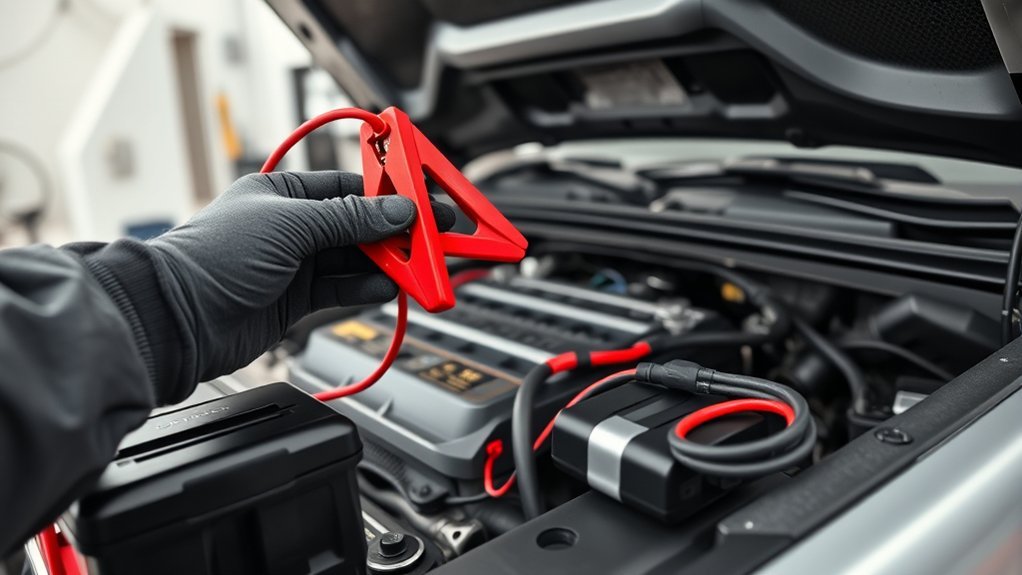
A discharged 12-volt battery can prevent your Toyota Tundra Hybrid from entering READY mode, even when the high-voltage traction battery has energy. You can usually restart the truck with a second 12-volt vehicle and jumper cables, but you must use the Tundra’s designated under-hood jump terminal and grounding point. Always confirm the procedure in the owner’s manual for your exact model year before connecting a cable.
Quick Answer
To jump-start a Toyota Tundra Hybrid, connect the red cable to the exclusive under-hood positive jump terminal and then to the donor battery. Connect the black cable to the donor battery’s negative terminal and the Tundra’s specified metallic ground point. Run the donor vehicle for about five minutes, start the hybrid system, confirm READY, and disconnect in reverse order.
Key Takeaways
- Jump only the 12-volt system. Never connect jumper cables to the high-voltage traction battery or orange high-voltage components.
- Use the exclusive positive jump terminal inside the under-hood fuse box and the exact metallic ground point shown in your model-year manual.
- Toyota instructs you to run the donor vehicle at a slightly increased engine speed for approximately five minutes before attempting the restart.
- A steadily illuminated READY indicator confirms that the hybrid system has started. The gasoline engine may remain off.
- Have the 12-volt battery inspected after the jump, especially if it has discharged more than once.
At a Glance
| Time Required | About 10–20 minutes, including Toyota’s five-minute donor-vehicle step |
| Difficulty | Moderate; cable placement must be exact |
| Tools Needed | Jumper cables, a second vehicle with a 12-volt battery, safety glasses, and protective gloves |
| Cost | Usually no additional cost when cables and a donor vehicle are available; roadside-assistance charges vary |
Warning: Do not attempt a jump-start if the 12-volt battery appears frozen, swollen, cracked, leaking, unusually hot, or strongly smells like sulfur. Keep flames, sparks, cigarettes, jewelry, and metal tools away from the battery system. Call roadside assistance when you cannot identify the correct jump points.
Understanding the Toyota Tundra Hybrid Battery System
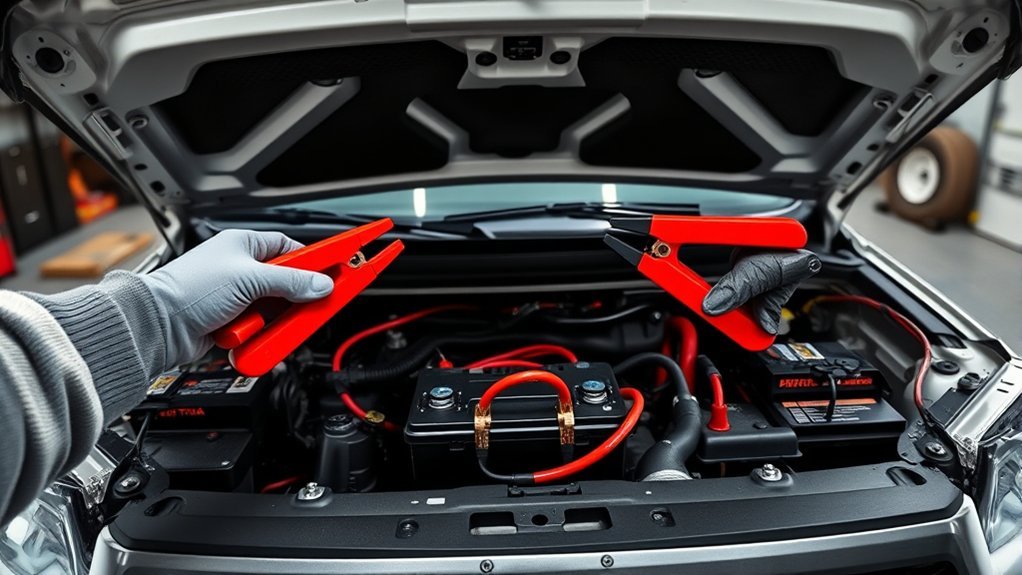
Your Toyota Tundra Hybrid uses two different electrical systems. The high-voltage traction battery supports the electric motor and hybrid powertrain. A separate 12-volt auxiliary battery powers computers, control modules, locks, lights, and the electronics needed to start the hybrid system.
On the 2025 Tundra Hybrid, Toyota locates the physical 12-volt battery under the left-hand side of the rear seat. You normally do not access that under-seat battery for a roadside jump. Toyota provides an exclusive positive jump-starting terminal in an under-hood fuse box and a separate metallic grounding point in the engine compartment.
The National Highway Traffic Safety Administration states that a hybrid’s high-voltage battery cannot be jump-started. Only the 12-volt system should receive a conventional jump, and the vehicle-specific owner’s manual should control the procedure.
Note: Fuse-box layouts, illustrations, and access steps can vary by model year. Use the Toyota manuals and warranties page to select the manual for your exact Tundra Hybrid.
What You Need Before Jump-Starting
Gather the correct equipment before opening the hood. Stop and call a professional if the cables are frayed, the battery looks damaged, or you cannot positively identify the Toyota grounding point.
- A second vehicle equipped with a 12-volt battery
- Jumper cables long enough to reach the specified connection points
- Safety glasses and protective gloves
- Your Tundra’s electronic key
- The owner’s manual for your exact model year
Park the vehicles on a firm, level surface without allowing them to touch. Shift both vehicles into Park, apply both parking brakes, and switch off lights, climate controls, audio equipment, chargers, and other unnecessary accessories.
Step-by-Step Guide to Jump-Starting Your Tundra Hybrid
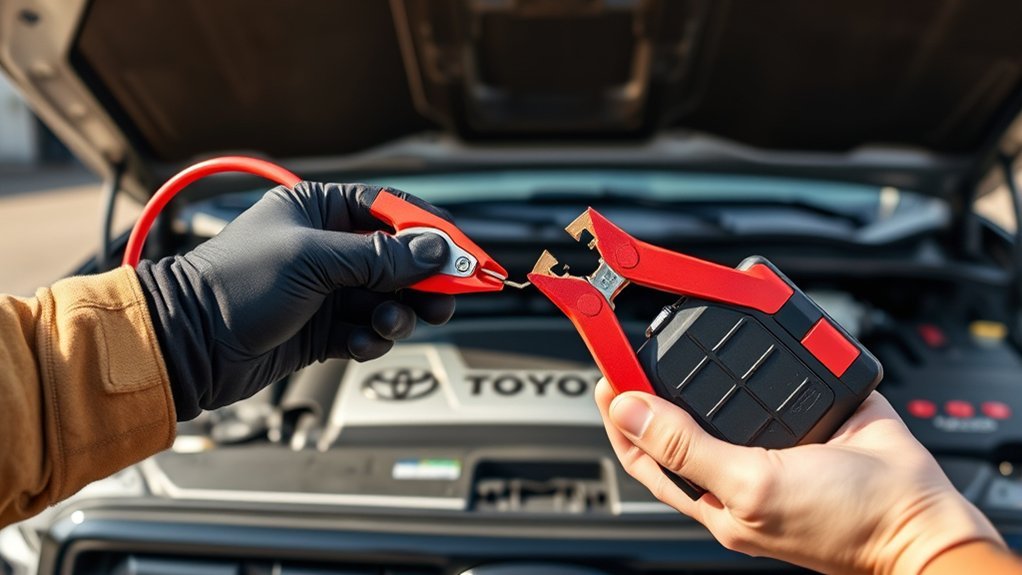
The following sequence follows the procedure in the 2025 Toyota Tundra Hybrid Owner’s Manual. Check your own manual before beginning because Toyota may revise illustrations or access details between model years.
1. Park and Power Down Both Vehicles
- Confirm that the Tundra’s electronic key is with you.
- Shift both vehicles into Park and apply their parking brakes.
- Turn the Tundra’s power switch off.
- Turn off the donor vehicle.
- Switch off all unnecessary electrical accessories in both vehicles.
- Open the Tundra’s hood.
The Tundra’s alarm may sound or its doors may lock while you connect the cables. Keep the electronic key outside the cab and within reach.
2. Locate the Correct Jump Points
- Open the under-hood fuse-box cover shown in your owner’s manual.
- Open the small cover over the exclusive positive jump-starting terminal.
- Remove the engine cover as directed by Toyota to access the specified metallic ground point.
- Match the terminal and ground point to the illustrations in the manual before attaching a clamp.
Do not connect the black clamp to a random bracket, painted panel, fuel-system component, moving part, or orange high-voltage cable. Use only the metallic point Toyota identifies for jump-starting.
3. Connect the Jumper Cables in the Correct Order
- Connect the first red positive clamp to the Tundra’s exclusive positive jump-starting terminal.
- Connect the second red positive clamp to the donor vehicle’s positive battery terminal.
- Connect the first black negative clamp to the donor vehicle’s negative battery terminal.
- Connect the remaining black negative clamp to the specific metallic grounding point shown in the Tundra manual.
Check every clamp before continuing. The positive and negative clamps must not touch each other, nearby metal, cooling-fan blades, belts, or other moving parts.
Pro Tip: Compare the under-hood layout with the owner’s-manual illustration before bringing the donor vehicle close. This reduces the chance of stretching cables across a fan or placing a clamp on the wrong metal point.
4. Start the Donor Vehicle and Wait Approximately Five Minutes
Start the donor vehicle. Toyota instructs you to increase its engine speed slightly and maintain that level for approximately five minutes. This supplies power to the Tundra’s discharged 12-volt system before you attempt to start the hybrid system.
After the five-minute period, leave the Tundra’s power switch off and open and close one of its doors. This is a Tundra-specific step included in Toyota’s procedure.
5. Start the Tundra Hybrid System
- Keep the donor vehicle running at the slightly increased engine speed.
- Enter the Tundra with the electronic key.
- Confirm that the transmission is in Park.
- Depress the brake pedal firmly.
- Press the Tundra’s power switch briefly and firmly.
- Check that the READY indicator becomes steadily illuminated.
The gasoline engine does not need to run continuously for the hybrid system to be ready. The READY indicator, not engine sound, confirms that the truck can operate.
6. Disconnect the Cables in Reverse Order
Once the READY indicator is on, remove the cables in the exact reverse order:
- Remove the black clamp from the Tundra’s metallic grounding point.
- Remove the black clamp from the donor vehicle’s negative terminal.
- Remove the red clamp from the donor vehicle’s positive terminal.
- Remove the red clamp from the Tundra’s exclusive positive jump terminal.
Reinstall the engine cover, close the positive terminal cover, and reinstall the fuse-box cover. Keep each loose cable end away from metal and moving parts while removing the other clamps.
Common Mistakes to Avoid When Jump-Starting Your Hybrid
- Reversing polarity: A positive-to-negative connection can damage electrical components and create sparks.
- Jumping the traction battery: Never touch orange high-voltage cables, connectors, covers, or service plugs.
- Using a generic ground: Use the exact metallic point shown in the Tundra manual.
- Skipping the five-minute donor step: Toyota includes this period before the Tundra restart attempt.
- Letting cables contact a fan: Toyota warns that jumper cables must not become entangled in the cooling fan.
- Using damaged cables: Exposed conductors, loose clamps, or overheated insulation make the procedure unsafe.
- Assuming a successful jump repairs the battery: A weak battery may start once and discharge again.
- Relying on a universal 20–30-minute rule: Toyota’s Tundra Hybrid manual does not state that every jumped battery will recover after that amount of time.
Post-Jump Care Tips
Keep the Tundra in READY mode while you check the instrument panel and arrange the next step. Toyota explains that the 12-volt battery charges automatically while the hybrid system is operating, but the manual does not promise that a fixed period of operation will restore a damaged or deeply discharged battery.
- Confirm that READY remains illuminated.
- Check the dashboard for battery, hybrid-system, charging-system, or check-engine warnings.
- Turn off unnecessary accessories while the battery is recovering.
- Do not assume the truck will restart after you switch it off.
- Have the 12-volt battery and related system inspected as soon as practical.
A jump-start restores enough 12-volt power to start the hybrid system. It does not prove that the battery is healthy or capable of holding a charge.
How to Recognize Signs of a Failing 12-Volt Battery
A Tundra Hybrid with a weak 12-volt battery may behave differently from a conventional truck. Instead of obvious engine cranking, you may see dim displays, clicking relays, delayed electronic responses, or a failure to enter READY mode.
- The instrument panel or interior lights appear unusually dim.
- The power locks, windows, or multimedia system behave erratically.
- The truck needs more than one jump-start.
- The battery warning light or another electrical warning remains on.
- The battery terminals or nearby connections show corrosion.
- The battery case appears swollen, cracked, wet, or unusually hot.
- You notice a strong sulfur or rotten-egg odor.
Many conventional 12-volt batteries last roughly three to five years, but heat, cold, storage, short trips, electrical loads, and battery quality can shorten or extend that period. Treat age as a reason to test the battery, not as an automatic replacement deadline.
Effects of Extreme Cold on Tundra Hybrid Battery Performance
Cold weather reduces the output available from a 12-volt battery and can expose a battery that was already weak. The Tundra Hybrid’s traction battery is also temperature-sensitive. Toyota states that the hybrid system may not start when the traction battery is below approximately −31°F, or −35°C.
During cold-weather startup, the READY indicator may flash longer than usual. Leave the truck stationary and continue holding the brake until READY becomes steadily illuminated. A steady indicator means the hybrid system can operate.
Warning: Never jump-start a battery that may be frozen. A discharged lead-acid battery can freeze at a much warmer temperature than a fully charged battery and may rupture when charged. Call roadside assistance if the case is bulging, cracked, or frozen.
Before severe winter weather, have an aging battery tested, park in a sheltered location when possible, and switch off seat heaters, lights, chargers, and other accessories before shutting down the truck.
Knowing When to Call for Help With Jump-Starting
Stop the procedure when the battery or electrical system shows signs of physical damage, overheating, or a high-voltage fault. Continuing to reconnect cables repeatedly can worsen the problem.
Signs to Seek Assistance
- The Tundra will not enter READY mode after the cables have been checked and the Toyota procedure has been completed.
- A hybrid-system, charging-system, or electrical warning remains displayed.
- You see smoke, sparks, melted insulation, exposed wiring, or leaking fluid.
- You hear unusual buzzing, rapid clicking, or arcing near a connection.
- You smell sulfur, burning plastic, or another unusual odor.
- The battery repeatedly discharges after being tested or charged.
- You cannot locate the exact under-hood terminal or designated grounding point.
When to Avoid Jump-Starting
Do not attempt a jump-start when the 12-volt battery is frozen, swollen, cracked, leaking, or excessively hot. You should also stop if the vehicle has collision damage near high-voltage components, exposed orange cables, flood damage, smoke, or signs of an electrical fire.
Never open the high-voltage service-plug access area or attempt to charge the traction battery with jumper cables. High-voltage diagnosis and repair require a qualified hybrid technician.
What to Do If Your Hybrid Won’t Start After Jump-Starting
- Recheck all four connections. Confirm polarity, clamp contact, and use of the specified Tundra ground point.
- Confirm the donor step. Run the donor vehicle at a slightly increased engine speed for approximately five minutes.
- Open and close a Tundra door. Keep the Tundra’s power switch off while doing this.
- Check the starting conditions. Carry the electronic key, select Park, press the brake firmly, and press the power switch briefly.
- Watch the READY indicator. In cold weather, it may take longer to become steady.
- Read displayed messages. Follow any instructions shown on the multi-information display.
- Stop after a careful repeat attempt. Repeated unsuccessful attempts can overheat cables or mask a battery, fuse, key, or hybrid-system fault.
- Call Toyota roadside assistance, a Toyota dealer, or a qualified repair shop. Tell them whether READY appeared and which warning messages remained.
A vehicle that still will not enter READY mode may have a failed 12-volt battery, loose connection, damaged fuse, electronic-key issue, control-system fault, or another problem unrelated to battery charge.
Tips for Maintaining Your Tundra Hybrid 12-Volt Battery
Preventive care reduces the chance of finding a discharged battery after storage or during severe weather.
- Turn off lights, audio equipment, chargers, and other accessories when the hybrid system is off.
- Avoid operating accessories for extended periods unless the READY indicator is on.
- Have the 12-volt battery tested when starting becomes unreliable or the battery approaches three to five years of service.
- Ask a technician to inspect corrosion, cable tightness, battery condition, and abnormal electrical drain.
- Use only a replacement battery that meets the specifications and ventilation requirements in your model-year manual.
- Do not disconnect or replace the under-seat battery unless you understand Toyota’s ventilation, initialization, and safety requirements.
For extended storage, Toyota’s general hybrid guidance recommends powering on the hybrid system periodically with unnecessary accessories switched off. Review the Toyota auxiliary-battery storage guidance and your Tundra’s model-year manual before leaving the truck unused.
Additional Resources for Toyota Tundra Owners
The owner’s manual is the primary source for terminal locations, warning messages, replacement-battery specifications, and model-year procedures. Toyota’s manuals page lets you select the correct year and version of the Tundra or Tundra Hybrid.
Owner groups and forums can help you understand another driver’s experience, but their advice should not override Toyota’s instructions. Verify cable placement, battery specifications, and warning-light guidance with an official manual or qualified technician.
For immediate help, contact Toyota roadside assistance, a Toyota dealer, or another qualified roadside provider. Explain that the vehicle is a Tundra Hybrid with a discharged 12-volt battery so the technician brings suitable equipment and follows hybrid-safe procedures.
Frequently Asked Questions
Can you jump-start a Toyota Tundra Hybrid’s 12-volt battery?
Yes. Toyota provides an exclusive under-hood positive jump terminal and a designated metallic ground point. Follow the cable sequence and instructions in the owner’s manual for your exact model year.
Where is the positive jump terminal on a Tundra Hybrid?
It is inside an under-hood fuse box beneath a small positive-terminal cover. The physical 12-volt battery is under the left-hand side of the rear seat on the 2025 model, but Toyota directs owners to use the under-hood terminal for jump-starting.
Can you jump-start the high-voltage hybrid battery?
No. Conventional jumper cables are only for the 12-volt system. Never connect cables to the traction battery, orange high-voltage wiring, service plug, inverter, or high-voltage connectors.
How long should the donor vehicle run before starting the Tundra?
Toyota instructs you to run the donor vehicle at a slightly increased engine speed for approximately five minutes before attempting to start the Tundra Hybrid.
How long should the Tundra remain in READY mode after the jump?
Toyota’s Tundra Hybrid jump-start instructions do not give a universal 20–30-minute post-jump period. The 12-volt battery charges while the hybrid system operates, but Toyota recommends having the battery inspected as soon as possible.
Why does the truck still not show READY after a jump?
Possible causes include poor clamp contact, reversed connections, an incorrect ground point, a failed 12-volt battery, an electronic-key problem, a fuse issue, extreme cold, or a hybrid-control fault. Stop after carefully repeating the official procedure and contact a qualified technician.
Can you jump-start a frozen Tundra battery?
No. Do not charge or jump-start a battery that may be frozen, swollen, cracked, or leaking. It can rupture or release corrosive electrolyte. Call roadside assistance and have the battery inspected.
Conclusion
Jump-starting a Toyota Tundra Hybrid is safe only when you treat it as a model-specific 12-volt procedure. Use the exclusive positive jump terminal, Toyota’s specified metallic ground point, the correct cable order, and the approximately five-minute donor-vehicle step. Confirm that READY is steadily illuminated, remove the cables in reverse order, reinstall every cover, and arrange a battery inspection. Never attempt to jump the high-voltage traction battery or a frozen or damaged 12-volt battery.
Sources
- Toyota 2025 Tundra Hybrid Owner’s Manual — official jump-start sequence, terminal locations, cold-temperature guidance, battery location, and safety warnings
- Toyota Tundra Manuals and Warranties — current model-year manual access
- NHTSA Electric and Hybrid Vehicle Safety — distinction between the jumpable 12-volt system and the non-jumpable high-voltage battery
- Toyota Auxiliary-Battery Storage Guidance — reducing excessive auxiliary-battery discharge during storage
- AAA Jump-Start and Battery Safety Guidance — frozen-battery precautions and general battery safety