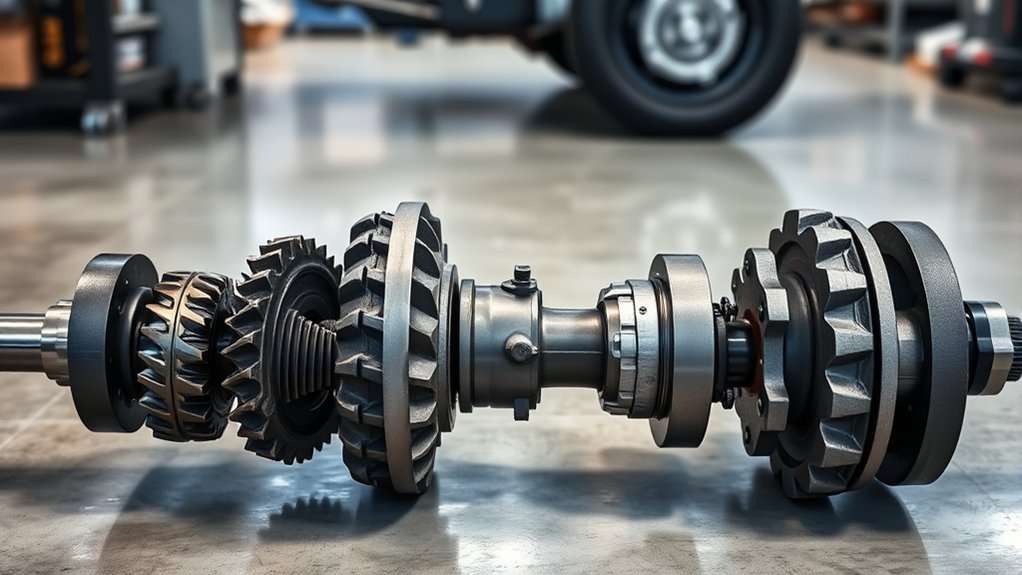
An open differential and a locking differential solve two different driving problems. The open design helps your vehicle turn smoothly on normal roads, while a locker helps keep you moving when traction differs sharply between the two tires on an axle. Choosing the right one depends on where you drive, how often you leave pavement, and how much on-road refinement you expect.
Quick Answer
An open differential is best for normal road driving because it lets the left and right wheels turn at different speeds in a corner. A locking differential can force both axle shafts to turn together, improving forward traction when one tire has little grip. Selectable lockers should be disengaged on high-traction pavement unless the vehicle maker says otherwise.
Key Takeaways
- An open differential allows different left and right wheel speeds, which supports smooth, predictable cornering.
- A locked differential couples both axle shafts, helping the tire with grip produce useful drive force when the other tire slips or lifts.
- A locker does not create tire grip, and it does not guarantee equal power at both tires.
- Selectable, automatic, front, rear, and center locks behave differently, so you must follow your vehicle’s instructions.
- For mostly paved driving, an open differential, limited-slip differential, or brake-based traction system is usually more suitable than a permanently locked axle.
Last updated: July 13, 2026
Deal tip: Want to see a differential at work? LEGO Technic cars like the Ferrari FXX K and Koenigsegg Jesko Absolut include working differentials. See our LEGO car set deals for October Prime Day.
Open Differential vs Locking Differential: The Core Difference
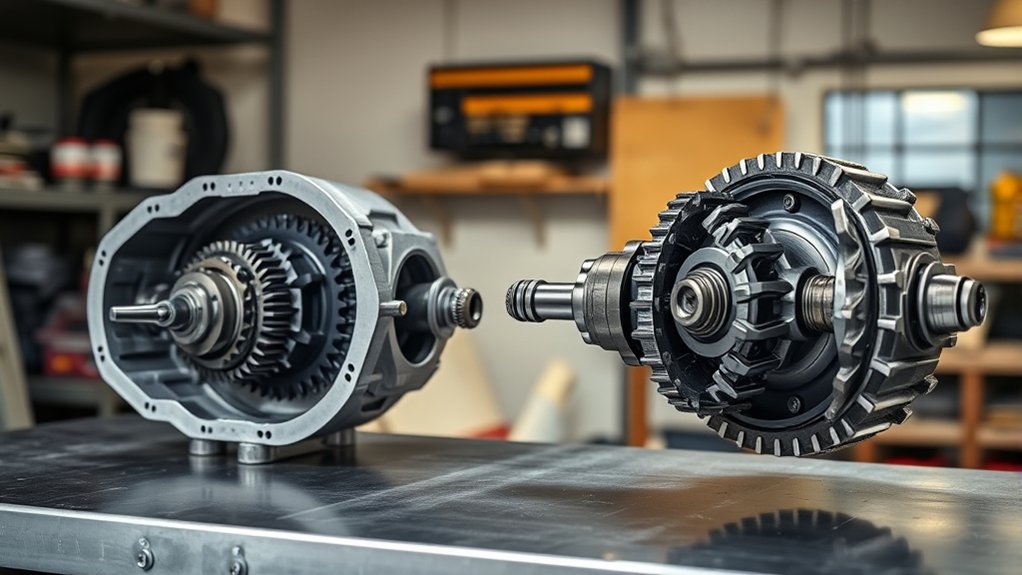
A differential divides drive torque between two axle shafts while allowing the wheels to respond to different conditions. During a turn, the outside tire travels a longer path than the inside tire. An open differential lets the outside wheel rotate faster so neither tire must scrub across the road.
A locking differential can connect the two axle shafts so they rotate at the same speed. This can help when one tire is on mud, loose rock, ice, or another low-grip surface while the other tire still has useful traction.
A locker cannot create grip. It changes how the axle uses the grip already available at each tire.
How an Open Differential Works
A conventional open differential uses side gears and pinion gears to let the axle shafts rotate at different speeds. Engineering research into open-differential mechanisms describes the speed and torque relationships that make this passive differential action possible.
You can review an academic analysis of open-differential behavior in this open-differential mechanism study.
Under normal conditions, an open differential provides smooth operation and predictable steering. Its weakness appears when the two tires have very different traction. The differential applies approximately equal torque to both outputs, so the tire with the least grip can limit how much usable torque reaches the tire with better grip.
This is why one tire may spin while the vehicle barely moves. The system is not deliberately sending all torque to the spinning tire. Instead, the low-grip tire cannot support enough torque for either side of the open differential to produce strong forward drive.
How a Locking Differential Works
An engaged locker prevents normal left-to-right differential action. Both axle shafts are constrained to rotate together, although tire flex and surface slip can still create small differences at the contact patches.
Because the two sides are coupled, the tire with better grip is no longer limited in the same way by the freely spinning tire. It can use more of the axle’s available torque to help move the vehicle.
Wheel speed, torque, and power are not interchangeable terms:
- Wheel speed describes how quickly a tire or axle shaft rotates.
- Torque is the twisting force applied through the axle.
- Power depends on both torque and rotational speed.
A locked differential forces nearly equal axle-shaft speed. It does not guarantee that torque or power at the two tires will always be equal because each tire faces different traction and resistance.
Open vs Locking Differential Comparison
| Feature | Open Differential | Locking Differential |
|---|---|---|
| Wheel speed in turns | Allows different left and right speeds | Forces the axle shafts to rotate together when locked |
| Normal pavement | Smooth and predictable | Can cause tire scrub, steering resistance, or driveline stress if kept locked |
| Uneven traction | May spin the low-grip tire and limit forward drive | Lets the tire with grip contribute more useful drive force |
| Steering behavior | Natural cornering behavior | May increase understeer or steering effort, especially with a front locker |
| Best use | Daily driving, commuting, and mild terrain | Rock crawling, deep mud, uneven trails, and cross-axle obstacles |
How Different Types of Locking Differentials Work
“Locking differential” describes several designs rather than one universal system. The way a locker engages, releases, and behaves in a turn depends on its internal mechanism.
Selectable Lockers
A selectable locker normally behaves like an open differential until you activate it with an electrical, pneumatic, hydraulic, cable, or vacuum control. This design gives you normal cornering on the road and full axle coupling when an obstacle requires it.
For example, Eaton describes its ELocker as an open differential that can be switched to a fully locked mode. The exact engagement limits and approved driving conditions still depend on the vehicle and locker model.
Automatic Lockers
An automatic locker changes its coupling without a dashboard command. Some designs remain locked under drive torque and allow one side to overrun during a turn. Others react to wheel-speed or torque differences.
These units can provide strong off-road traction without driver input, but they may produce clicking, tire chirping, abrupt engagement, or changes in steering response. Their road behavior varies widely, so you should not apply selectable-locker instructions to every automatic design.
Spools and Permanently Locked Axles
A spool permanently connects the axle shafts and provides no differential action. It is generally intended for specialized competition or off-road vehicles, not ordinary street driving. Both tires must cover different distances in a corner, so at least one must slip or scrub.
Warning: Never weld differential gears as a casual substitute for a properly engineered locker. A welded differential can alter handling, increase component stress, and create serious reliability and road-safety problems.
Axle Locker vs Center Differential Lock
An axle locker connects the left and right wheels on one axle. A center differential lock connects or tightly couples the front and rear driveline outputs in a full-time four-wheel-drive system.
Part-time four-wheel-drive systems may not have a center differential at all. Selecting 4H or 4L can mechanically couple the front and rear driveshafts. That is not the same as locking the left and right wheels on an axle.
A vehicle can therefore have four-wheel drive without an axle locker, an axle locker without a center differential, or several locks serving different purposes.
Comparing Open and Locked Differential Performance
An open differential performs best when smooth cornering and predictable road behavior matter most. A locker performs best when one tire may lose most of its traction or leave the ground.
Research into differential-lock control for off-road vehicles describes the same basic trade-off: locked operation improves off-road passability, while open operation supports better maneuverability. You can review the study in Automatic Traction Control for Articulated Off-Road Vehicles.
Rear Locker vs Front Locker
A rear locker usually has less effect on steering than a front locker because the rear wheels do not steer. It can still cause tire scrub, pushing in turns, or sudden changes in traction when used on firm surfaces.
A locked front differential can resist the left-to-right wheel-speed difference needed for steering. You may notice heavier steering or stronger understeer, especially on high-grip ground. Selectable front lockers are commonly reserved for low-speed obstacles when a rear locker and other traction aids are not enough.
Snow and Ice
A locker can improve forward motion in deep snow or when one tire is on a much more slippery surface. However, locking both drive tires can also make both tires break traction together. On ice or a side slope, that can reduce lateral control and allow the vehicle to slide sideways.
Use gentle throttle, appropriate winter tires, and the drive mode specified by the manufacturer. A locker is not a substitute for suitable tires or careful speed control.
Current Vehicle Example
Locker availability varies by trim and model year. Jeep’s current 2026 Wrangler capability information lists available front and rear Tru-Lok electronic locking differentials with Rubicon-oriented equipment. You should not assume that every Wrangler, truck, or four-wheel-drive vehicle has axle lockers.
When Should You Choose a Locking Differential?
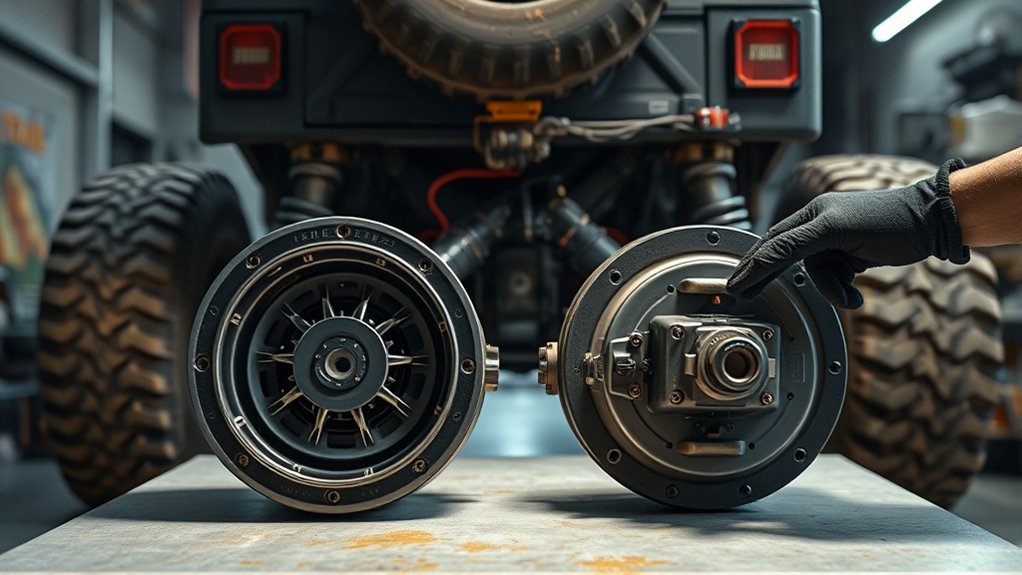
A locking differential makes the most sense when your vehicle regularly encounters conditions that create a major traction difference between the two tires on an axle.
- Rock crawling: A tire may lift from the ground while the opposite tire remains planted.
- Deep mud: One side may dig into soft material while the other finds firmer ground.
- Rutted trails: Uneven suspension positions can unload one tire.
- Loose climbs: Maintaining steady drive can prevent a failed climb or rollback.
- Specialized work: Farms, construction sites, and remote routes may require dependable low-speed traction.
- Off-road competition: Consistent axle coupling may benefit specialized vehicles built for controlled events.
An open differential is normally the better choice when you spend nearly all your time on pavement and only use maintained dirt roads. Modern traction control may provide enough help for occasional slippery conditions without the handling compromises of a fully locked axle.
Pro Tip: Choose a selectable rear locker before adding a front locker when you want strong off-road capability with fewer steering compromises. Confirm compatibility with your exact axle, gear ratio, shafts, electronics, and stability-control system.
How to Engage a Selectable Locker Safely
Engagement procedures differ by manufacturer. Some systems require low range, a low vehicle speed, straight steering, or a complete stop. Others allow limited engagement while moving.
- Read the vehicle and locker instructions before entering the trail.
- Reduce speed before activating the locker.
- Ease off the throttle and avoid large left-to-right wheel-speed differences.
- Confirm that the locker indicator shows full engagement before applying heavy torque.
- Disengage the locker after clearing the obstacle and before returning to high-traction pavement, unless the manufacturer specifically permits continued use.
Warning: Do not activate a selectable locker while one tire is spinning rapidly. The mechanism may try to accelerate the slower axle shaft and wheel assembly instantly, creating a severe shock load. Eaton recommends engagement below 5 mph and with less than a 50-rpm wheel-speed difference for its ELocker, but your system may have different limits. Follow your own manual.
Alternatives to a Fully Locking Differential
Limited-Slip Differential
A limited-slip differential allows different wheel speeds while resisting excessive speed differences. Clutch, cone, viscous, helical-gear, and electronically controlled designs behave differently.
An LSD usually offers smoother road behavior than a fully locked differential while sending more useful torque toward the tire with grip than a basic open differential can. However, most LSDs do not provide the rigid axle coupling of a true locker.
Brake-Based Traction Control
Many modern vehicles retain an open differential but use the brakes to slow a spinning tire. The resulting resistance allows the differential to develop more torque at the opposite tire. The system may also reduce engine output to control wheelspin.
This approach works well for everyday driving and moderate terrain, but repeated brake intervention can create heat. It may also react after slip begins rather than preventing it in advance.
Note: Marketing terms such as electronic differential lock, automatic limited slip, torque vectoring, and electronic LSD do not always describe a mechanical locker. Check the owner’s manual or axle specification to learn what the system actually does.
Maintaining Your Differential for Longevity
Differential service requirements depend on the vehicle, axle, lubricant, towing use, water exposure, and differential design. No universal 30,000-to-60,000-mile interval applies to every open differential or locker.
Use the vehicle maintenance schedule as your primary guide. An aftermarket differential may also have separate lubricant, break-in, inspection, and service instructions from its manufacturer.
| Maintenance Task | Why It Matters |
|---|---|
| Check the service schedule | Your manufacturer may specify inspection or replacement intervals for normal and severe use. |
| Use the specified gear oil | The wrong viscosity, performance grade, or additive package can affect lubrication or differential operation. |
| Confirm friction-modifier requirements | Some clutch-type limited-slip units require modifier, while many lockers and gear-type units do not. |
| Inspect seals and the housing | Leaks can lower the fluid level and reduce gear and bearing protection. |
| Inspect after deep-water use | Damaged seals or submerged breathers can allow water to contaminate the lubricant. |
| Avoid uncontrolled wheelspin | A spinning tire that suddenly regains grip can shock axle shafts, gears, joints, and the locker. |
| Investigate noise or binding | Whining, clunking, chatter, delayed engagement, or failure to unlock may indicate a fluid, setup, bearing, or actuator problem. |
Differential installation also requires correct backlash, bearing preload, gear contact, fastener torque, and axle compatibility. Unless you have the required measuring tools and repair information, installation is best handled by a qualified drivetrain specialist.
Frequently Asked Questions
What is the difference between an open and locked differential?
An open differential allows the left and right wheels to rotate at different speeds, which helps the vehicle turn smoothly. A locked differential couples the two axle shafts so they rotate together, improving forward drive when one tire has much less traction than the other.
What is a differential lock in simple terms?
A differential lock is a mechanism that temporarily makes both axle shafts turn together. If one tire is on a slippery surface or off the ground, the other tire can still use its available grip to help move the vehicle.
Why would you want an open differential?
An open differential provides smooth cornering, predictable road handling, simple operation, and broad suitability for daily driving. It is a practical choice when the vehicle rarely faces severe cross-axle or mixed-traction obstacles.
How does an open differential work?
Internal gears divide drive torque between two axle shafts while allowing their speeds to differ. In a turn, the outside wheel can rotate faster than the inside wheel. When one tire has very little grip, however, the low available torque at that tire can also limit useful torque at the tire with grip.
Can you use a locking differential on pavement?
A selectable locker should normally remain disengaged on dry, high-traction pavement unless the vehicle manufacturer specifically approves its use. A locked axle can cause tire scrub, steering resistance, understeer, or drivetrain stress. Automatic lockers behave differently, so follow the instructions for the exact unit.
Is a differential lock the same as four-wheel drive?
No. Four-wheel drive describes how torque reaches the front and rear axles. An axle differential lock connects the left and right wheels on one axle. A vehicle can have four-wheel drive with open axle differentials, and some two-wheel-drive vehicles can have a rear locker.
Sources
- Eaton ELocker Locking Differential — selectable open-to-locked operation and full axle-lock design.
- Eaton ELocker Frequently Asked Questions — engagement-speed, wheel-speed difference, lubricant, and operation guidance.
- 2026 Jeep Wrangler Capability — current availability of front and rear Tru-Lok electronic locking differentials.
- Automatic Traction Control for Articulated Off-Road Vehicles — open-mode maneuverability and locked-mode off-road passability.
- Design and Analysis of a Three-Output Open Differential — open-differential motion and torque relationships.
Conclusion
Choose an open differential when you value smooth road handling, simple operation, and predictable cornering. Choose a locking differential when your vehicle regularly faces rocks, ruts, mud, lifted wheels, or sharply uneven traction.
A selectable locker offers the most flexibility because you can retain open-differential behavior for normal driving and lock the axle only when needed. Whatever system you use, follow its engagement limits, use the specified lubricant, avoid shock loading, and disengage a selectable locker before returning to firm pavement unless the manufacturer instructs otherwise.
