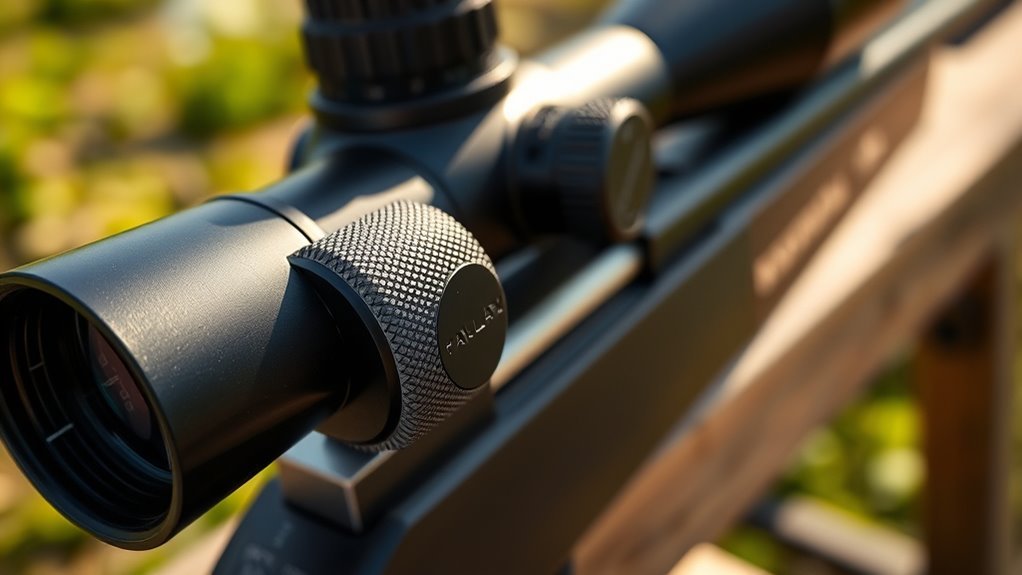
A parallax knob on a scope helps prevent the reticle from appearing to move across the target when your eye shifts behind the eyepiece. This matters when you need a consistent sight picture at different distances. Understanding what the knob does, how to adjust it, and how it differs from other scope controls makes the optic easier to use.
Quick Answer
A parallax knob adjusts the optical focus so the target image and reticle appear in the same focal plane. Start near the target’s distance marking, then check for apparent reticle movement while keeping the scope stationary. Fine-tune until the reticle stays fixed against the target. Side-focus knobs and adjustable objectives perform this function.
Key Takeaways
- Parallax error occurs when the reticle and target image appear on different optical planes.
- The eyepiece diopter focuses the reticle for your eye; the parallax control adjusts the target image.
- Distance markings are starting points, not guaranteed measurements or substitutes for checking reticle movement.
- Side focus is convenient to reach, while an adjustable objective provides the same basic optical correction from the front of the scope.
- Parallax can matter at short distances as well as long distances, depending on the scope and shooting task.
What Is a Parallax Knob on a Scope?
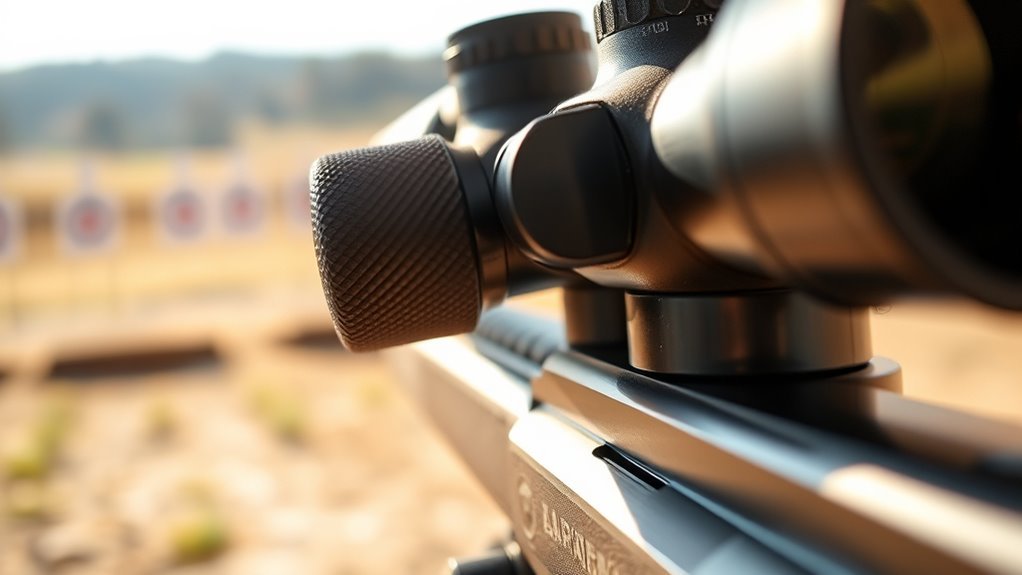
A parallax knob is an adjustable optical control that changes where the target image forms inside a rifle scope. Its purpose is to bring that image into the same optical plane as the reticle.
The reticle is the crosshair or aiming pattern you see through the scope. When the target image and reticle do not share the same focal plane, changing your eye position can make the reticle appear to move across the target.
The rifle may remain completely stationary while this apparent movement occurs. That is parallax error.
Manufacturers generally provide two types of adjustable parallax systems:
- Side focus (SF): A rotating knob mounted on the side of the scope, usually opposite the windage turret.
- Adjustable objective (AO): A rotating adjustment ring around the objective housing at the front of the scope.
Both systems adjust the optical relationship between the target image and reticle. The location and operation of the controls differ, but their main purpose is the same.
A fixed-parallax scope lacks this user-adjustable control. Instead, its optical system is set for a particular distance at the factory.
For a more detailed explanation, see Leupold’s riflescope support guidance, which distinguishes reticle focus from adjustable parallax.
Parallax Adjustment vs. Reticle Focus
These controls are easy to confuse because both affect what you see through the optic.
The eyepiece diopter adjusts the reticle to match your eyesight. The parallax knob adjusts the optical focus for the target distance.
Once the reticle looks sharp, the diopter generally stays in that position unless a different person uses the scope or your vision changes.
Changing the diopter to sharpen a distant target is not a substitute for proper parallax adjustment.
Why Parallax Matters at Long Range
Parallax becomes especially noticeable during precision shooting because small aiming differences can matter against a distant or small target.
At higher magnification, apparent reticle movement is often easier to detect. A small change in eye position can make the crosshairs appear to drift even when the rifle remains still.
The distance from the scope’s parallax-free setting also matters. A fixed-parallax optic used far outside its intended distance range may show more noticeable error.
There is no universal distance at which parallax suddenly becomes a problem.
For example, Leupold documents factory parallax settings of 150 yards for many of its conventional riflescopes, 60 yards for rimfire models, and 100 yards for handgun models. Other manufacturers use different specifications.
These values describe particular scope designs, not a general rule for every optic.
According to Burris’s explanation of parallax, the effect becomes particularly relevant with higher magnification, small targets, and shooting positions that make consistent eye placement difficult.
Correct parallax adjustment offers several benefits:
- Reduces apparent movement between the reticle and target.
- Helps maintain a consistent aiming reference when eye position changes slightly.
- Improves the repeatability of the sight picture during precision shooting.
- Makes it easier to distinguish an optical alignment problem from other aiming issues.
However, correcting parallax does not guarantee a particular group size or eliminate other sources of error.
A stable rifle, suitable eye relief, consistent technique, and properly adjusted optic still matter.
Does Higher Magnification Create More Parallax?
Higher magnification does not automatically create a new focal-plane mismatch. However, it can make existing parallax more apparent and reduce the margin for inconsistent eye placement.
Changing magnification also changes the apparent size of the target and may make small movements easier to see.
For that reason, checking parallax at the magnification you intend to use is sensible. If you change magnification substantially, confirm the sight picture again.
Side Focus vs. Adjustable Objective
Side focus and adjustable objective systems both correct parallax. The main difference is where the control sits and how conveniently you can reach it.
Side focus is generally easier to operate without changing your position behind the scope. An adjustable objective requires access to the front housing but can provide equally effective correction.
| System | Key Trait |
|---|---|
| Side focus | Side-mounted control that is convenient to reach while maintaining your shooting position. |
| Adjustable objective | Front-mounted adjustment ring that changes the optical focus. |
| Best fit | Side focus suits frequent adjustments; adjustable objectives suit users comfortable with front-mounted controls. |
Side Focus
A side-focus knob normally sits on the left side of the scope, opposite the windage turret.
Its location makes it convenient to adjust while keeping your head near your normal viewing position. This can be useful when target distances change frequently.
Many higher-magnification hunting and precision scopes use this arrangement.
However, side focus does not automatically provide a wider adjustment range than an adjustable objective. The actual range depends on the optical design of the individual scope.
Adjustable Objective
An adjustable objective uses a rotating ring around the front objective housing.
It provides the same basic parallax correction but usually requires reaching farther forward to operate the control.
Some adjustable-objective scopes offer very short minimum focusing distances, making them useful for close-range target work.
Neither design is inherently more accurate simply because of where its adjustment control is located.
Compare the specified minimum parallax distance, optical quality, adjustment feel, and repeatability rather than assuming one arrangement always performs better.
How to Set a Parallax Knob Correctly
Correct parallax setup starts with a sharp reticle, a stable scope, and a known or estimated target distance.
The goal is not simply to make the target look clear. It is to minimize apparent reticle movement when your eye shifts slightly behind the optic.
Warning: Before adjusting or inspecting a mounted scope, follow firearm safety procedures. Keep the firearm unloaded during setup, secure it in a stable position, and maintain a safe direction. Never look directly at the sun through a riflescope.
Step 1: Set the Reticle Focus
First, adjust the eyepiece diopter so the reticle appears sharp immediately when you look through the scope.
Use a plain, light-colored background and look away periodically to prevent your eye from compensating for poor focus.
The reticle should appear clear without requiring you to stare at it.
Do not use the parallax knob to correct a blurry reticle. Set the diopter first.
Step 2: Estimate the Target Distance
Determine the approximate distance to the target using a reliable measurement or an informed estimate.
Find the corresponding distance marking on the side-focus knob or adjustable objective.
Turn the control toward that marking to establish an initial setting.
These markings are reference points rather than exact measurements. A scope’s actual parallax-free position may differ slightly from the engraved number.
Step 3: Check the Target Image
Look through the scope and assess whether the target appears clear.
Make small adjustments to improve the image while keeping the reticle sharp.
If the reticle becomes blurry, revisit the eyepiece diopter rather than continually compensating with the parallax control.
Step 4: Check for Reticle Movement
Keep the scope stationary and observe a fixed point on the target.
Move your eye slightly from side to side or up and down behind the eyepiece.
If the crosshairs appear to move against the target, some parallax remains.
Fine-tune the control until that apparent movement is minimized or eliminated.
This movement check is more reliable than trusting the distance marking alone.
Step 5: Confirm the Setting
Return your eye to its normal position and confirm that the target and reticle remain clear.
Repeat the movement check to verify that the reticle stays in the same apparent position against the target.
Recheck the setting when the target distance changes significantly.
The manufacturer’s Vortex focusing instructions also explain why yardage markings should be treated as approximate guides and why the final movement check matters.
Pro Tip: Use a small, clearly defined feature on the target when checking apparent reticle movement. A distinct reference point makes subtle movement easier to recognize than a large, featureless surface.
How to Tell When Parallax Is Still Off
The clearest sign of remaining parallax is apparent reticle movement when your eye changes position behind a stationary scope.
This can happen even if the target looks reasonably sharp. Image clarity alone does not always confirm that parallax has been fully corrected.
The Head-Movement Test
A slight head movement provides a simple way to check whether the target image and reticle are properly aligned.
Observe a fixed target point while keeping the scope still. If the reticle seems to float across that point, the parallax setting needs attention.
When correctly adjusted, the reticle should remain stationary relative to the target despite a small change in viewing position.
The same principle appears in Bushnell’s parallax adjustment procedure.
Common Problems and What They Mean
- Sharp reticle, blurry target: Check the parallax setting and confirm that the target is within the optic’s focusing range.
- Blurry reticle, clear target: Check the eyepiece diopter.
- Reticle appears to move: Fine-tune the parallax adjustment while keeping the scope stationary.
- Black edges around the sight picture: Check eye relief and eye alignment behind the eyepiece.
- Distorted image at high magnification: Consider atmospheric mirage, heat rising from the rifle, or an optical focusing limitation.
- Stiff or ineffective adjustment: Consult the scope manufacturer before forcing the control.
Incorrectly tightened mounting rings can sometimes restrict the movement of an internal focusing assembly.
If the parallax control remains stiff, fails to change focus, or cannot produce a stable sight picture within its stated range, seek manufacturer support or qualified optical service.
Do not attempt to repair sealed internal components without the manufacturer’s instructions.
Does the Parallax Knob Change the Scope’s Zero?
The parallax knob is not a windage or elevation adjustment. Its purpose is to correct the optical relationship between the target image and reticle.
Correcting parallax can change where an inconsistently positioned eye perceives the aiming point, but that is different from deliberately adjusting the scope’s mechanical zero.
If the actual point of impact changes unexpectedly, investigate the entire shooting system rather than assuming the parallax knob is responsible.
What to Look for in a Parallax Scope
A useful adjustable-parallax scope should match the distances at which you intend to use it and provide predictable optical correction.
The most important features are adjustment range, control accessibility, clear markings, and reliable operation.
- Suitable adjustment range: Check the manufacturer’s minimum parallax distance and maximum setting. Close-range use requires a scope that can focus sufficiently near the target.
- Clear distance markings: Legible yardage or meter references make initial adjustment easier.
- Smooth control movement: The adjustment should allow controlled fine-tuning without excessive stiffness or looseness.
- Repeatability: Returning to a previously used distance should produce a consistent optical result.
- Accessible placement: Decide whether side focus or a front-mounted adjustable objective suits your normal shooting position.
- Appropriate optical performance: A clear reticle, usable eye relief, and good target-image quality remain important alongside parallax correction.
Locking controls can be useful when provided, but do not confuse a locking elevation or windage turret with a locking parallax adjustment.
Likewise, the click specifications listed for elevation and windage controls do not describe the precision of the parallax knob.
Why Minimum Parallax Distance Matters
The minimum adjustment distance can be more useful than the maximum when choosing an optic for close-range work.
For example, the published Burris Fullfield 6–24×50 specifications list side-focus parallax adjustment from 25 yards to infinity.
That range describes this particular model, not every side-focus scope.
A different optic may focus closer or begin its adjustment at a greater distance.
If you intend to use a scope at 10 or 25 yards, confirm that its specified adjustment range supports that distance.
A scope designed primarily for distant targets may not provide a clear, parallax-free image at very short ranges.
Can You Use Parallax Markings to Measure Distance?
Parallax markings provide an approximate distance reference, but they should not be treated as a precise rangefinder.
The best optical setting can vary with the individual scope, viewing conditions, and the user’s eyesight.
Use the markings to establish an initial position, then check image clarity and apparent reticle movement.
Parallax Knobs for Hunting, PRS, and Benchrest
The value of adjustable parallax depends on target distance, magnification, and the precision required.
Hunting, Precision Rifle Series (PRS), and benchrest shooting place different demands on the optic, but all benefit from a consistent sight picture.
Hunting
Many hunting scopes use fixed-parallax designs because they are simple and require fewer adjustments.
Adjustable parallax becomes useful when target distances vary widely or the scope uses higher magnification.
Side focus offers convenient access without reaching toward the objective housing.
For close-range hunting, however, a clear field of view and appropriate eye relief may matter more than having a separate adjustment knob.
PRS Competition
PRS involves precision shooting from varied positions and across changing target distances.
A side-focus control allows competitors to make optical adjustments without reaching to the front of the scope.
Clear markings and smooth operation are especially useful when changing distances.
Parallax controls generally provide continuous optical adjustment rather than the indexed windage and elevation clicks used for mechanical aiming corrections.
Benchrest Shooting
Benchrest places a strong emphasis on a stable sight picture and consistent aiming reference.
Adjustable parallax lets the shooter fine-tune the optic for a known target distance.
Because the shooting position is generally controlled, an adjustable objective can also be practical.
The final choice depends on the scope’s optical performance, adjustment range, and the user’s preferred setup.
Across these applications, the practical goal remains the same: a clear target image and minimal apparent reticle movement.
Frequently Asked Questions
How Important Is Parallax on a Scope?
Parallax matters most when small aiming differences can affect precision. It becomes especially relevant with higher magnification, small targets, and inconsistent eye position. A properly adjusted scope reduces apparent reticle movement, but it does not replace correct eye relief, sound mounting, or appropriate windage and elevation settings.
How to Use Parallax Knob on Scope?
First, set the eyepiece diopter so the reticle appears sharp. Turn the parallax knob toward the target’s estimated distance. With the scope stationary, move your eye slightly and watch for apparent reticle movement. Fine-tune the adjustment until the reticle remains stable against the target.
At What Distance Do You Need Parallax Adjustment?
There is no universal distance at which parallax adjustment becomes necessary. Its importance depends on the scope’s factory setting, magnification, target distance, and required precision. Some conventional scopes have fixed settings near 100 or 150 yards, while specialized optics may be designed for much shorter distances.
Does Parallax Matter at 50 Yards?
Yes, parallax can matter at 50 yards, particularly with high magnification or a scope whose factory setting is intended for a longer distance. Many close-range and rimfire applications benefit from suitable parallax correction. Check the optic’s specified range rather than assuming short distances are automatically free from error.
Can You Use a Scope Without a Parallax Knob?
Yes, many scopes use fixed-parallax designs and work well within their intended distance ranges. They require no separate parallax adjustment during normal use. At distances far from their factory setting, apparent reticle movement may become more noticeable, especially at higher magnification.
Is Side Focus the Same as a Parallax Adjustment?
Yes, side focus is a common form of adjustable parallax control. It uses a side-mounted knob to change the optical focus for different target distances. An adjustable objective performs the same basic function through a ring at the front of the scope. Neither control replaces the eyepiece diopter.
Conclusion
A parallax knob helps keep the reticle visually aligned with the target when your eye position changes. Side-focus and adjustable-objective designs provide the same basic correction through different controls.
Choose an optic with an adjustment range suited to your needs. Set the reticle focus first, use the distance markings as a starting point, and confirm the result by checking for apparent reticle movement.
Sources
- Leupold — Riflescope Support: Reticle focus, adjustable parallax, factory distance settings, and troubleshooting.
- Burris Optics — Understanding Parallax: Parallax principles, reticle movement, and precision-shooting considerations.
- Vortex Optics — Frequently Asked Questions: Eyepiece setup, distance markings, parallax checks, and focusing limitations.
- Bushnell — Adjusting Parallax: Side-focus operation and the reticle-movement test.
- Burris Optics — Fullfield 6–24×50 Specifications: Manufacturer-listed side-focus adjustment range.
