A Toyota Tundra can handle long highway drives, heavy cargo, and trailer duty, but a road trip can expose maintenance problems that short local drives may not reveal. Start your inspection about one week before departure. That gives you time to correct tire damage, fluid leaks, weak batteries, overdue maintenance, or towing-equipment problems before you leave.
Quick Answer
Prepare your Toyota Tundra by checking its model-year maintenance schedule, open recalls, engine oil, coolant, brake fluid, tires, brakes, battery, lights, wipers, and emergency equipment. Inspect towing gear and cargo limits when applicable. Complete repairs before departure, then take a short road test and recheck for leaks or warning lights.
Key Takeaways
- Use the maintenance guide and driver-door tire label for your exact Tundra year, trim, tire size, and powertrain.
- Check tire pressure when the tires are cold, and inspect the tread, sidewalls, valve stems, and spare tire.
- Do not dismiss low brake fluid, coolant loss, warning lights, visible leaks, or unusual brake symptoms as simple top-off issues.
- Check payload and towing limits before loading the bed or attaching a trailer.
- Pack emergency supplies, verify roadside-assistance details, and complete a short road test before departure.
At a Glance
| Time Required | About 45 to 75 minutes, plus repair or service time |
| Difficulty | Easy to moderate for inspection; repairs may require a qualified technician |
| Tools Needed | Cold tire-pressure gauge, tread-depth gauge or penny, flashlight, clean rag, gloves, and the vehicle manuals |
| Cost | Usually no cost for inspection if you own the tools; fluids, parts, tires, or professional service cost extra when needed |
Start With Your Tundra’s Model-Year Maintenance Guide
Tundra maintenance requirements differ by model year, engine, hybrid status, drivetrain, tire package, and operating conditions. Before using a generic checklist, locate the owner’s manual and Warranty and Maintenance Guide for your exact truck through the Toyota Owners manual portal.
Review your service records and identify anything that will become due during the trip. Toyota’s 2026 Tundra guide, for example, schedules general maintenance every 5,000 miles or six months. It lists engine oil and filter replacement at 10,000 miles or 12 months under normal conditions, with shorter intervals for specified severe operating conditions. Do not apply those intervals automatically to an older Tundra. Follow the guide for your year.
- Confirm the current odometer reading and the date of the last service.
- Complete any oil change, tire rotation, brake inspection, or other service that will become due before you return.
- Review recent repair invoices for items that still need follow-up.
- Enter your VIN in the Toyota recall lookup or the NHTSA recall database.
- Arrange recall repairs or safety-related service before starting the trip.
Note: Schedule professional service several days before departure. Waiting until the final evening leaves little time to obtain parts, replace tires, diagnose warning lights, or correct alignment and brake problems.
Check Your Toyota Tundra’s Fluids Safely
Fluid checks can reveal leaks, consumption, neglected maintenance, or cooling-system problems before a long drive. Park on level ground, set the parking brake, and follow the checking procedure in your model-year manual. Some levels are checked with the engine cold, while others require a specific operating temperature or service procedure.
Engine Oil
Check the dipstick according to the owner’s manual, normally with the truck level and the engine off. The oil should remain within the marked range. If the level is low, add only the viscosity and specification listed for your engine. Arrange an inspection when the level drops repeatedly, the oil-pressure warning appears, or you see leakage.
Engine Coolant
Check the translucent coolant reservoir only when the engine is cool. The level should be within the marked range, and the coolant should meet Toyota’s specification for your truck. Inspect the reservoir, radiator area, hoses, clamps, and the ground beneath the vehicle for dried residue or fresh leakage.
Warning: Never remove a radiator or pressurized coolant cap while the engine is hot. Hot coolant and steam can cause severe burns. Repeated coolant loss, overheating, or visible leakage requires diagnosis before travel.
Brake Fluid
Verify that the brake-fluid level is within the reservoir markings. Do not treat an unexpectedly low level as a routine top-off. It can be associated with worn brake components or a leak. Have the brake system inspected when the level is below specification, the brake warning light is on, or the pedal feels soft or sinks unusually far.
Washer and Other Applicable Fluids
Fill the windshield-washer reservoir with fluid suitable for the forecast temperatures. Check the spray pattern and confirm that the front and rear washers, when equipped, work correctly.
Do not assume that every Tundra has a driver-checkable transmission or power-steering-fluid reservoir. Many transmission procedures require a specific temperature and fill method. Current-generation trucks use electric power steering, while some older Tundras use hydraulic steering. Check only the fluids and service points listed in your exact manual. If you see a leak, obtain service instead of guessing at the fluid type or fill level.
Inspect and Inflate the Tires
Tires support the truck, passengers, cargo, and trailer tongue weight. Check them before loading the vehicle because an underinflated, damaged, or heavily worn tire can overheat and fail during sustained highway driving.
- Find the correct pressure. Use the Tire and Loading Information label on the driver-side doorjamb or the owner’s manual. Do not use the maximum pressure molded into the tire sidewall as the vehicle setting.
- Check pressure cold. Measure the tires before driving or after the truck has been parked for at least three hours.
- Check every installed tire. Measure all four tires and the spare, if equipped. Replace missing valve caps.
- Inspect tread depth. NHTSA considers a tire worn out at 2/32 inch. If Lincoln’s entire head is visible when a penny is inserted upside down into a main tread groove, replacement is due.
- Inspect the complete tire. Look for cuts, punctures, cracking, bulges, exposed cords, uneven wear, embedded objects, and damaged valve stems.
- Review tire age and service history. Have older, weathered, or unfamiliar tires inspected by a tire professional, even when tread remains.
- Rotate the tires when due. Toyota’s current maintenance charts commonly include rotation at 5,000-mile service points, but your year-specific guide controls.
The NHTSA TireWise guide provides additional information about cold pressure, tread wear, damage, and tire identification.
Pro Tip: Record the cold pressure for each tire before loading the truck. Recheck after a major temperature change, and follow Toyota’s loading or towing instructions rather than guessing at a higher pressure.
Do not rely only on the tire-pressure monitoring system. TPMS is a warning system, not a substitute for a calibrated gauge or visual inspection. A flashing TPMS light may indicate a system fault rather than simple underinflation.
Conduct a Complete Safety Inspection
Brakes
Check for grinding, squealing, vibration, pulling, a soft pedal, increased stopping distance, or brake-warning messages. Look through the wheels for obvious rotor scoring when visibility allows, but do not assume that a visual check confirms remaining pad thickness. Have a qualified technician inspect the brakes when symptoms appear or the service history is uncertain.
Battery and Charging System
Inspect the 12-volt battery for loose connections, corrosion, swelling, leakage, or damaged cables. A slow crank, repeated jump-start need, dim lights during starting, or an older battery justifies a professional battery and charging-system test before a remote trip.
Hybrid Tundras also have high-voltage components. Do not touch orange high-voltage cables or attempt traction-battery service. Follow the hybrid owner’s manual and use qualified service when a hybrid-system warning appears.
Lights, Wipers, and Visibility
- Test low and high beams, brake lights, taillights, turn signals, license-plate lights, and emergency flashers.
- Clean exterior lamps, cameras, parking sensors, mirrors, and the windshield.
- Replace wiper blades that streak, chatter, split, or leave unwiped areas.
- Test the windshield washers, defrosters, heater, and air conditioning.
- Check trailer brake lights and turn signals when towing.
Belts, Hoses, and Underbody
With the engine cool, look for cracked or frayed belts, swollen or brittle hoses, loose connections, and wet areas around the engine bay. Inspect beneath the truck for fresh oil, coolant, fuel, brake fluid, or drivetrain-fluid spots. A few drops of clear water from air-conditioning condensation can be normal, but colored, oily, or strong-smelling fluid requires investigation.
Floor Mats and Cabin Items
Make sure the driver’s floor mat uses the correct retention points and cannot move under the accelerator or brake pedal. Secure bottles, tools, electronics, and other loose items so they cannot enter the pedal area or become projectiles during a sudden stop.
Load Cargo and Prepare for Towing Safely
Do not use a generic online payload or towing number for your truck. Capacity varies by configuration and installed equipment. Review the certification labels and your model-year owner’s manual before loading the bed or connecting a trailer.
Payload and Cargo
- Count passengers, cargo, accessories, and trailer tongue weight as part of the vehicle’s load.
- Do not exceed the truck’s gross vehicle weight rating, axle ratings, tire ratings, or other listed limits.
- Distribute cargo evenly and keep heavy items low and secured.
- Use suitable tie-downs and recheck them after the first stop.
- Confirm that cargo does not block lights, mirrors, cameras, the license plate, or the driver’s view.
Towing Equipment
- Confirm that the hitch, receiver, ball mount, coupler, and fasteners match the trailer and load.
- Attach crossed safety chains with enough clearance for turning but not enough slack to drag.
- Connect the breakaway cable separately from the safety chains where applicable.
- Test trailer running lights, brake lights, and turn signals.
- Inspect trailer tires, pressure, tread, wheel bearings, lug nuts, and the spare.
- Verify trailer-brake and integrated-controller settings according to the trailer and Tundra manuals.
- Use Tow/Haul, Tow+, drive modes, and four-wheel-drive settings only as described for your model.
After loading or hitching, confirm that the truck and trailer sit normally and that no component contacts the ground, body, exhaust, wiring, or suspension. Unusual rear sag, light steering, sway, or unstable braking requires correction before highway travel.
Prepare for Road Trip Emergencies
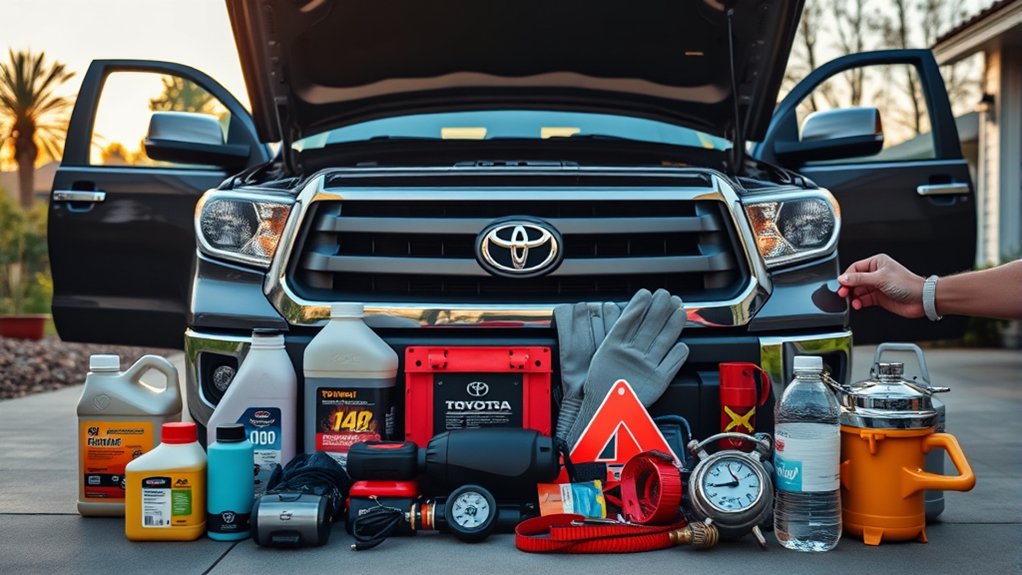
A roadside kit should help you remain visible, contact assistance, handle minor problems, and stay safe while waiting. Adjust the contents for the route, weather, passenger needs, and distance between services.
- Properly inflated spare tire, jack, jack handle, wheel-lock key, and lug wrench
- Owner’s manual and instructions for the correct lifting points
- Jumper cables or a suitable portable jump starter
- Reflective triangles, emergency markers, or approved flares
- Flashlight or headlamp with spare batteries
- First aid kit and necessary medications
- Phone charger and backup power bank
- Drinking water and non-perishable food
- Work gloves, basic hand tools, and clean rags
- Blanket, warm clothing, rain gear, sun protection, or other climate-specific supplies
- Paper map for areas with unreliable mobile service
- Roadside-assistance and insurance contact information
The current Ready.gov car-safety checklist provides additional emergency-kit recommendations.
Warning: Use only the lifting points and procedures listed in the Tundra owner’s manual. Never place any part of your body beneath a vehicle supported only by its emergency jack.
Before leaving, confirm that you know how to reach the spare tire and tools. Check that the wheel-lock key is inside the truck if locking lug nuts are installed. A spare and jack provide little value when required adapters or handles are missing.
Complete a Final Road Test and Departure Check
After the inspection and any service work, take the Tundra on a 10- to 15-minute drive that includes low-speed turns, moderate braking, and a short highway section when conditions allow. Listen for new noises and pay attention to steering, vibration, braking, temperature, and warning messages.
After the Road Test
- Park on clean, level pavement and look for fresh leakage.
- Confirm that no warning lights or maintenance messages remain unexplained.
- Recheck cargo straps, trailer connections, and the hitch.
- Verify that navigation, phone charging, and roadside contacts are ready.
- Check the weather, road conditions, fuel stops, and overnight parking plans.
- Make sure registration, insurance information, licenses, and required travel documents are current.
Postpone the Trip When
Do not begin a long drive when the truck has an overheating condition, active fluid leak, oil-pressure warning, brake warning, soft brake pedal, damaged or underinflated tire, severe vibration, repeated battery failure, fuel smell, smoke, or an unresolved safety recall that affects safe operation. Obtain diagnosis and repair first.
The best pre-trip inspection does more than confirm that the truck starts. It identifies problems while you are still close to tools, parts, service, and a safe place to wait.
Related Guides
Frequently Asked Questions
How often should I change the engine oil in my Tundra?
Follow the Warranty and Maintenance Guide for your exact model year and engine. For example, Toyota’s 2026 guide lists oil and filter replacement at 10,000 miles or 12 months under normal conditions, but certain severe operating conditions require 5,000-mile or six-month replacement. Older Tundras may have different requirements.
What tire pressure is recommended for my Toyota Tundra?
Use the cold inflation pressure printed on the Tire and Loading Information label on the driver-side doorjamb or in the owner’s manual. The correct value can vary by year, trim, tire size, and configuration. Do not use the maximum pressure molded into the tire sidewall as the recommended setting.
Can I use non-OEM fluids in my Tundra?
A fluid does not always need Toyota branding, but it must meet every specification listed for your model, engine, transmission, cooling system, and climate. Do not choose a fluid based only on color or a broad “universal” label. When compatibility is uncertain, use the specified Toyota fluid or confirm an equivalent with a qualified service provider.
What tools do I need for a tire inspection?
Use a reliable tire-pressure gauge, a tread-depth gauge or penny, and a flashlight. You do not need to jack up the truck for a basic pressure, tread, and sidewall inspection. Check that the factory jack, handle, lug wrench, spare, and wheel-lock key are present for roadside use.
How do I reset the maintenance light on my Tundra?
Reset the reminder only after completing the required maintenance. The procedure varies by model year, instrument cluster, and display type. Use the maintenance-data or reminder-reset instructions in your exact owner’s manual rather than relying on a universal pedal, button, or ignition sequence.
What should I check before towing with my Tundra?
Confirm the truck’s configuration-specific towing and payload limits, then inspect the hitch, coupler, safety chains, breakaway cable, wiring, trailer lights, brakes, tires, wheel hardware, cargo distribution, and controller settings. Count passengers, cargo, accessories, and tongue weight when calculating vehicle load.
How early should I inspect my Tundra before a road trip?
Begin about one week before departure, especially when the truck is due for service, has been driven infrequently, will tow a trailer, or will travel through remote areas. Complete a final pressure, fluid-leak, cargo, light, and equipment check within 24 hours of leaving.
Conclusion
Preparing your Toyota Tundra for a road trip starts with the correct model-year information. Review scheduled maintenance, check recalls, inspect applicable fluids, measure tire pressure cold, test the brakes and battery, confirm lights and wipers, and secure every load. When towing, verify the truck’s limits and inspect the complete trailer connection.
Finish with a short road test and do not ignore leaks, warning lights, brake changes, damaged tires, overheating, or unstable handling. Correcting those problems before departure is safer and usually easier than dealing with them beside the highway.
Sources
- Toyota 2026 Tundra Warranty & Maintenance Guide — maintenance intervals, fluid inspections, tire rotation, and service-condition guidance
- Toyota Owner’s Manuals and Warranty Guides — model-year-specific operating, maintenance, fluid, tire, towing, and emergency procedures
- NHTSA Summer Driving and Road Trip Tips — batteries, cooling systems, lights, wipers, fluids, tires, and trailer-light checks
- NHTSA TireWise — tire pressure, tread depth, damage, wear, and tire-safety guidance
- NHTSA Recall Lookup — VIN-based safety-recall information
- Ready.gov Car Safety — emergency vehicle kit and roadside-preparedness recommendations