A gaming laptop can run much hotter than a basic office laptop without necessarily overheating. The important question is not whether the CPU or GPU crosses one universal temperature such as 80°C or 85°C. Instead, compare sustained temperatures, clock behavior, fan operation, and stability with the limits specified for your exact processor, graphics chip, and laptop model.
Quick Answer
Gaming temperatures around 70–85°C are common on many laptops, but there is no universal safe cutoff. Some modern mobile CPUs are designed to operate near 100°C before thermal controls intervene. Judge heat by your exact hardware limit, sustained throttling, crashes, fan behavior, and whether temperatures improve when airflow is restored.
Key Takeaways
- A gaming laptop does not need to remain below 80°C or 85°C to be safe; exact limits vary by CPU, GPU, firmware, and laptop design.
- Short temperature spikes matter less than sustained heat combined with clock-speed drops, stuttering, crashes, or shutdowns.
- Some modern laptop CPUs have maximum junction temperatures around 100°C or higher, so check the specification for your exact processor.
- Blocked vents, dust, soft surfaces, high room temperature, heavy workloads, and incorrect thermal settings can all raise temperatures.
- Start with airflow, monitoring, current BIOS and drivers, and manufacturer diagnostics before considering internal servicing or thermal-paste replacement.
Is It Safe to Run a Gaming Laptop Hot?
Yes, a gaming laptop can safely run hot when it remains within the operating limits set by its CPU, GPU, and system manufacturer. High-performance laptops deliberately allow their processors to use available thermal and power headroom to deliver more performance.
That means a temperature such as 85°C or 90°C is not automatically evidence of overheating. Intel explains that its processor Tjunction max varies by model and is commonly around 100–110°C. When a processor reaches its thermal-control point, it can reduce frequency and power to protect itself. You can check the specification for a particular Intel processor through Intel’s processor temperature guidance.
AMD also publishes model-specific limits. For example, the Ryzen 9 7945HX has a listed maximum operating temperature of 100°C. That does not mean every gaming laptop should run at 100°C continuously; it shows why one universal 85°C or 95°C danger line is misleading.
A temperature number is most useful when you compare it with the exact component limit and watch what happens to clock speeds, performance, and system stability at the same time.
A laptop deserves troubleshooting when heat is accompanied by persistent thermal throttling, severe frame-rate drops, unexpected shutdowns, fan problems, or temperatures that are unusually high for that specific machine under the same workload.
What Is a Normal Gaming Laptop Temperature?
There is no single normal temperature for every gaming laptop. Chassis thickness, cooling design, fan profile, CPU power limits, GPU wattage, ambient temperature, game workload, and manufacturer tuning all affect the result.
As a general observation, many gaming laptops may sit roughly in the 30–60°C range during idle or light work and reach approximately 70–90°C on one or more sensors during demanding gaming. Those figures are useful as broad reference points, not hardware specifications.
| Reading or Behavior | How to Interpret It |
|---|---|
| 30–60°C during idle or light work | Common on many laptops, although room temperature and fan-stop modes can move the number higher or lower. |
| 70–85°C while gaming | Common for many CPU/GPU workloads and usually not concerning by itself. |
| 85–95°C on a CPU | High, but potentially within design limits on some gaming laptops. Check the exact processor and OEM specification. |
| Near the component’s specified thermal limit | Watch for reduced clock speeds, lower power, FPS instability, or other evidence of thermal throttling. |
| Repeated shutdowns, crashes, fan failure, or severe throttling | Troubleshoot immediately even if the temperature reading appears to be below a generic internet threshold. |
Idle And Light Load
Idle temperature varies more than many temperature guides suggest. A laptop that has just finished an update, virus scan, game download, battery charge cycle, or background process may not be truly idle even when no foreground application is open.
Fan-stop modes can also allow temperatures to rise deliberately before the fans begin spinning. For that reason, a higher idle reading does not automatically indicate a cooling fault.
If idle temperatures suddenly become much higher than they were previously, open Task Manager and check for unexpected CPU or GPU activity. Also confirm that the vents are clear and that the laptop is sitting on a hard surface.
Safe Gaming Temperature Ranges
During intensive gaming, temperatures frequently rise because the CPU and GPU increase clock speed and power consumption. A reading in the 70–85°C region is common on many machines, while some laptop CPUs legitimately operate in the upper 80s or 90s under heavy boost conditions.
The safest reference is the manufacturer’s own limit. Intel advises users to identify their processor and check its maximum operating temperature or Tjunction specification rather than assuming one value fits every CPU. AMD likewise publishes maximum operating temperatures on individual processor specification pages.
Note: CPU package temperature, GPU core temperature, GPU hotspot or junction temperature, memory temperature, and exterior chassis temperature are different measurements. Do not compare them as if they use the same safe limit.
Cooling And Throttling Signs
Temperature becomes more meaningful when you monitor performance at the same time. Thermal throttling occurs when hardware or system firmware reduces frequency or power to keep a component from exceeding its thermal limit.
Possible signs include:
- CPU or GPU clock speeds repeatedly falling during a steady workload.
- Frame rates declining after several minutes of play.
- Stuttering that appears only after the laptop becomes hot.
- Fans running at high speed while temperatures continue climbing.
- Unexpected restarts or thermal shutdowns.
- A cooling fan that does not operate when the system is under heavy load.
Intel describes throttling as a protective mechanism that reduces processor speed when thermal limits are reached. A brief high reading without a corresponding loss of performance is therefore different from continuous thermal throttling.
Why Gaming Laptops Get So Hot
Gaming laptops combine high-performance processors with a compact cooling system. During a demanding game, the CPU and GPU can consume substantial electrical power, and much of that power ultimately becomes heat that must leave through heat pipes, vapor chambers, heat sinks, and exhaust fans.
Powerful CPUs and GPUs
Modern gaming CPUs and GPUs continuously adjust frequency, voltage, and power according to workload, temperature, and available power headroom. Higher frame rates, ray tracing, CPU-heavy simulation, rendering, and background tasks can therefore increase heat production.
High temperature alone does not prove that a processor is malfunctioning. What matters is whether the system remains within the component’s specified operating limits while delivering stable performance.
Tight Chassis, Limited Airflow
A laptop has far less space for cooling hardware than a desktop PC. Its fans must pull air through relatively small intake openings and force hot air through compact heat-sink fins.
Soft surfaces such as beds, blankets, pillows, and couches can partially block bottom or side intakes. Both ASUS and Dell recommend using laptops on firm, flat surfaces and keeping ventilation openings unobstructed.
Dust, hair, and debris can further restrict airflow through vents and heat-sink fins. High room temperature also reduces the temperature difference available for the cooling system to transfer heat into the surrounding air.
Heavy Loads Raise Heat
Demanding games can load both the CPU and GPU simultaneously. As power consumption rises, the cooling system responds by increasing fan speed and moving more heat through the exhaust.
Graphics settings can affect this load. Higher frame-rate targets may keep the CPU and GPU working harder, while demanding resolution, ray tracing, and visual settings can increase GPU utilization. If heat or noise becomes excessive, limiting frame rate or reducing selected settings can lower power consumption without requiring hardware changes.
When Does Gaming Laptop Heat Become a Problem?
Gaming laptop heat becomes a problem when the system can no longer maintain expected operation within its designed thermal limits. There is no universal temperature at which every laptop changes from safe to unsafe.
Investigate the cooling system when one or more of these conditions occur:
- The CPU or GPU repeatedly reaches its specified thermal limit and remains throttled.
- Performance declines sharply as the laptop warms up.
- The laptop shuts down or restarts during gaming.
- A fan stops working, makes abnormal mechanical noises, or remains unexpectedly slow under load.
- Temperatures are substantially higher than the laptop’s own previous behavior under the same game and room conditions.
- The problem began after a BIOS, driver, repair, thermal-paste change, or physical impact.
A hot keyboard deck or hot exhaust air alone does not prove the laptop is overheating. Heat being expelled through the exhaust is part of normal cooling operation.
How to Lower Gaming Laptop Temperature
At a Glance
| Time Required | About 10–30 minutes for basic diagnosis and external cleaning |
| Difficulty | Easy for external troubleshooting; advanced for internal servicing |
| Tools Needed | Temperature-monitoring software, hard work surface, and optionally canned compressed air or a laptop stand |
| Cost | Often $0 for diagnosis; optional stand, cooling pad, or professional service adds cost |
Use a step-by-step approach instead of immediately opening the laptop or replacing thermal paste.
- Identify the exact CPU and GPU. Check the processor specification and the laptop manufacturer’s documentation for thermal limits or relevant operating guidance.
- Record a baseline. Run the same game, graphics settings, room conditions, and power mode while logging CPU temperature, GPU temperature, clock speeds, utilization, and frame rate.
- Move the laptop to a hard, flat surface. Make sure every intake and exhaust vent has space around it.
- Check for blocked vents. Dust and debris around the openings can restrict airflow.
- Check the manufacturer’s thermal mode. Gaming laptops may offer Quiet, Balanced, Performance, Turbo, or similar profiles that change power and fan behavior.
- Update BIOS, firmware, and relevant drivers. ASUS and Dell both include firmware and driver updates in their overheating troubleshooting guidance.
- Reduce unnecessary load. Close unwanted background applications and consider limiting FPS or reducing particularly demanding graphics settings.
- Run the OEM fan or hardware diagnostic if available. A failing fan requires repair rather than more aggressive software tuning.
Warning: Turn the laptop off and disconnect external power before cleaning vents. Follow the manufacturer’s service instructions. Dell advises using canned compressed air rather than vacuum cleaners or blowers around computer vents because static electricity or excessive airflow can damage components.
[Amazon Products Picked for You]

👍【Triple Efficient Fans】TECKNET laptop cooling pad with 3 powerful fans works at 1200 RPM to pull in cool air from the bottom to prevent your laptop, notebook, netbook, Ultrabook, Apple MacBook Pro cool from overheating during extended use or intense gaming.

New Upgraded Version-Cooling Gets Quiet and Quicker: Equipped with 5.5-inch large diameter turbo booster fan, combined sealed foam, ensures perfect cooling effect, 360 degrees all-round dynamic cooling, your laptop can reduce temperature by 44°C in 90 seconds (CPU+GPU), even during 4K rendering or AAA gaming, operating noise ≤70dB

【12-Core Deep Cooling Fans】The Trullypine F12 Laptop Cooling Pad is equipped with 12 high-speed silent fans, providing excellent cooling effect and temperature control, 360 degrees all-round dynamic cooling; The large metal mesh provides great heat dissipation performance. Four diamond-shaped groove designs bring better heat dissipation space, being built to accelerate heat dissipation.At the same time, these high-end laptop cooling fans are all equipped with capacitor components to reduce working noise, very quiet and create a low noise environment for you!
How to Check Your Exact Temperature Limit
Generic temperature charts are useful for orientation, but your processor’s own specification should take priority.
- Find the CPU model in Windows Task Manager, System Information, your laptop’s support application, or the manufacturer’s specification sheet.
- For an Intel processor, look up the processor on Intel ARK and find its Tjunction or maximum operating temperature.
- For an AMD processor, open the exact processor product page and look for “Max. Operating Temperature (Tjmax).”
- Check your laptop manufacturer’s support documentation because OEM firmware may apply model-specific power and thermal controls.
- For the discrete GPU, use the GPU vendor and laptop manufacturer’s specifications rather than assuming the CPU limit applies to the GPU.
This approach also prevents confusion between different temperature sensors. A CPU package reading, GPU core reading, GPU hotspot, SSD temperature, and palm-rest surface temperature are not interchangeable.
What Cooling Tips Actually Work Best?
The most reliable cooling measures are the ones that restore airflow, reduce unnecessary power consumption, or correct an actual cooling fault.
| Measure | What It Does | When to Use It |
|---|---|---|
| Hard, flat surface | Keeps bottom and side intakes from being blocked | Always during demanding use |
| Laptop stand or cooling pad | May improve access to intake air; the actual temperature change varies by laptop design | Useful when bottom airflow is restricted or additional elevation helps |
| External vent cleaning | Removes dust that can obstruct airflow | When dust is visible or airflow has declined |
| Performance or fan-profile adjustment | Changes the balance between power, fan noise, and temperature | When supported by the laptop manufacturer |
| FPS limit or reduced graphics load | Can reduce CPU/GPU power consumption | When maximum performance is unnecessary or temperatures/noise are excessive |
A cooling pad can help, especially when its airflow aligns with the laptop’s intake vents, but there is no reliable universal promise that it will reduce temperatures by a specific number of degrees.
For monitoring, MSI Afterburner can display CPU and GPU statistics during gameplay when configured with its on-screen display. Your laptop manufacturer’s own monitoring utility may also provide temperatures, fan modes, and diagnostics.
Pro Tip: Compare temperature, clock speed, utilization, and FPS over a 15–20 minute repeatable gaming session. A single one-second temperature spike tells you far less than a sustained pattern showing rising heat and falling clocks.
[Amazon Products Picked for You]
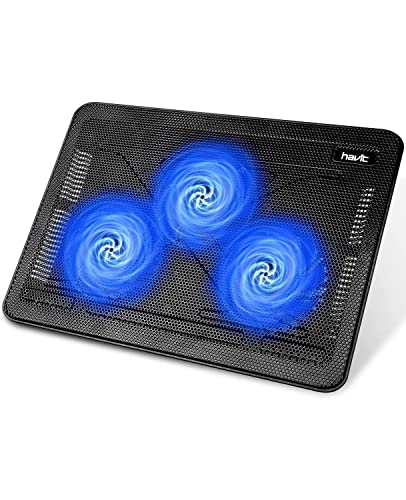
Ultra-Portable: Slim, portable, and light weight allowing you to protect your investment wherever you go

Whisper-Quiet Operation: Enjoy a noise-free and interference-free environment with super quiet fans, allowing you to focus on your work or entertainment without distractions.

Super Laptop Cooling Fans: ICE COOREL laptop Cooling Pad with the mesh design and the 6 fans (70mm) spinning at adjustable speed from 2400-2600 RPM, greatly dissipate the heat from the laptop, enable it in good working condition, and prolong the lifespan of your laptop; Six ultra-quiet fans create a noise-free environment for you !
Should You Replace the Thermal Paste?
Thermal paste does not need to be replaced on a universal calendar. Many laptops can run for years without requiring repasting, while others may eventually develop poor thermal contact because of age, previous servicing, pump-out, or an improperly installed cooling assembly.
Consider professional inspection or model-specific servicing when temperatures have become significantly worse over time despite clear vents, functioning fans, current firmware, and otherwise identical workloads.
Opening a laptop can involve delicate fan cables, thermal pads, liquid-metal compounds, warranty considerations, or model-specific screw sequences. Follow the official service manual when one is available. If the machine uses liquid metal or you are not experienced with laptop cooling assemblies, professional service is the safer option.
[Amazon Products Picked for You]

CONSISTENT QUALITY: Our thermal paste packaging design has evolved over time, but the formula has remained the same, ensuring reliable performance.

EXTREME HEAT CONDUCTIVITY - With an exceptional thermal conductivity, Kryonaut is perfect for even the most demanding congurations and can be used in industrial cooling systems

NEXT-LEVEL THERMAL PERFORMANCE: MX-7 features a performance-optimized, dense, and highly viscous consistency. Its high filler content ensures exceptional heat transfer
Frequently Asked Questions
Is 80°C too hot for a laptop CPU?
Not necessarily. Around 80°C can be normal for a gaming laptop CPU under a demanding load. Check the processor’s Tjunction specification and watch for sustained throttling, crashes, or unusually poor performance rather than judging the laptop from 80°C alone.
What is the normal operating temperature for a laptop?
There is no universal normal temperature. Many laptops may operate around 30–60°C during idle or light use and roughly 70–90°C during demanding workloads, but the correct limit is the one specified for the exact CPU, GPU, and laptop design.
Is 92°C hot for a laptop CPU?
Yes, 92°C is a high CPU temperature, but it can still be within specification for some gaming-laptop processors. Check the exact Tjunction limit and determine whether the CPU is continuously throttling. A 92°C peak is different from a sustained 92°C reading accompanied by falling clock speeds or instability.
Is 70°C safe for a laptop?
For most modern laptop CPUs and GPUs, 70°C during a workload is comfortably below their maximum operating temperature. Exact limits still vary, so use the component and laptop manufacturer’s specifications as the final reference.
Is 95°C dangerous for a gaming laptop?
It is high, but not automatically dangerous. Some mobile CPUs have maximum junction temperatures around 100°C or higher. If the processor is at or near its limit for long periods and continuously throttling, improve airflow and investigate the cooling system.
When should I worry about gaming laptop temperature?
Worry when high temperature is accompanied by sustained thermal throttling, sharp performance loss, repeated crashes or shutdowns, fan failure, blocked airflow, or a large unexplained increase compared with the laptop’s previous behavior under the same workload.
Conclusion
Gaming laptops are designed to handle substantial heat, so a high temperature reading is not automatically evidence of overheating. The most reliable approach is to check the thermal limit for the exact CPU and GPU, monitor sustained temperatures together with clock speeds and performance, and look for real symptoms such as throttling, crashes, shutdowns, or fan problems.
Good airflow, clean vents, a hard operating surface, current firmware, appropriate thermal settings, and sensible workload management solve many heat-related problems without opening the laptop. If temperatures suddenly worsen despite those checks, a fan, heat sink, thermal interface, or other cooling component may need professional inspection.
Sources
- Intel — Information about Temperature for Intel Processors — explains Tjunction maximum, model-specific thermal limits, and processor thermal controls.
- AMD — Ryzen 9 7945HX Specifications — example of a current mobile CPU with a published 100°C maximum operating temperature.
- ASUS — Overheating and Fan Troubleshooting — covers ventilation, firmware, fan diagnostics, compressed-air cleaning, and hard-surface use.
- Dell — How to Prevent Overheating — covers blocked vents, cooling pads, power settings, drivers, BIOS, and overheating symptoms.
- MSI — How to Use MSI Afterburner — documents CPU/GPU monitoring and on-screen temperature statistics during gaming.
