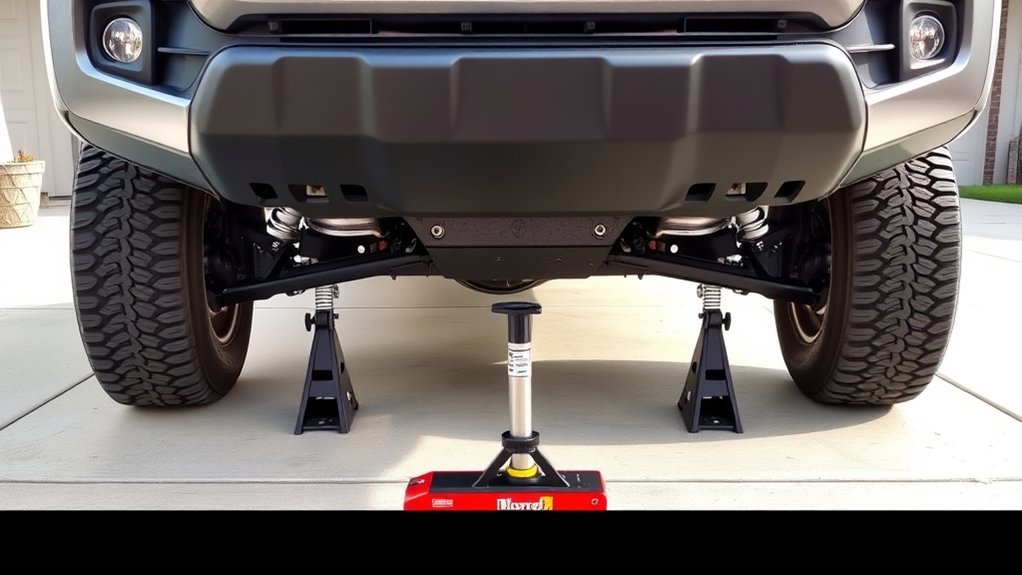
Working under your Toyota Tacoma is not the time to guess. Safe jack stand placement starts with the right surface, the right equipment, and the correct lift and support points for your exact model year. Use this guide as a safety checklist, then confirm the final lift points in your Tacoma owner’s manual or Toyota repair information before you raise the truck.
Last Updated: July 4, 2026
Quick Answer
Place Tacoma jack stands only on strong, approved support points. Many models use front frame-rail support areas and rear axle-tube support near the spring or U-bolt area, but the exact points vary. Always check your manual, work on level ground, chock the wheels, and never work under a truck held only by a jack.
Key Takeaways
- Use your Tacoma owner’s manual or Toyota repair information as the final authority for lift points.
- A jack lifts the truck, but jack stands support it while you work.
- Park on a firm, level surface, chock the wheels, and inspect every jack and stand before use.
- Do not support the truck on plastic panels, thin brackets, suspension links, rock sliders, or any part that can bend, move, or slip.
At a Glance
| Time Required | 10 to 20 minutes to lift, support, and stability-check the truck before starting work |
| Difficulty | Moderate, because incorrect support points can damage the truck or cause injury |
| Tools Needed | Floor jack, rated jack stands, wheel chocks, owner’s manual, flashlight, gloves, and eye protection |
| Cost | No added cost if you already own properly rated equipment; replacement equipment cost varies by capacity and brand |
Understanding the Importance of Safe Jack Stand Placement
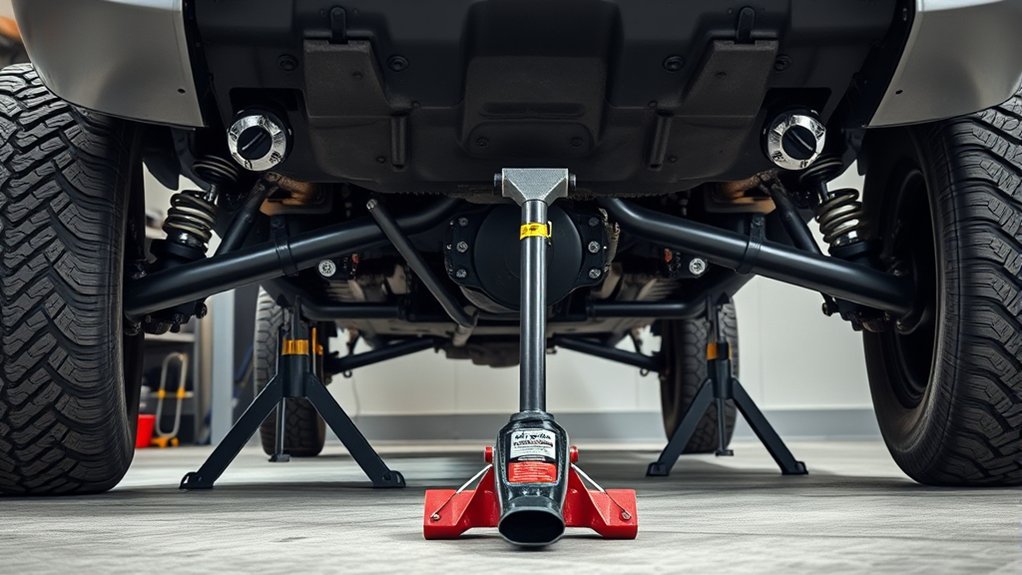
Safety comes first when you lift your Toyota Tacoma. Your jack raises the truck, but your jack stands must hold the truck after it is raised. Mixing up those two jobs creates the biggest risk.
Start by checking your Toyota owner’s manual for your model year. For repair-level lift and support procedures, use Toyota’s Technical Information System or a factory repair manual. Tacoma lift points can vary by generation, cab, drivetrain, suspension, and aftermarket modifications.
In general, safe support points are strong, flat, structural areas. On many Tacoma models, the front support area is on the frame rails, and the rear support area is often on the rear axle tubes near the spring or U-bolt area. Treat that as general guidance, not a replacement for the manual.
Warning: Never crawl under a Tacoma supported only by a hydraulic jack, bottle jack, scissor jack, or emergency tire jack. After raising the truck, lower it onto properly rated jack stands before working underneath.
Essential Best Practices for Lifting Your Tacoma Safely
Safe lifting starts before the jack touches the truck. Work slowly, keep the truck balanced, and stop if anything shifts, creaks, or looks unstable.
Before You Lift: Safety Checklist
- Park your Tacoma on flat concrete or another firm, level surface.
- Shift into Park on an automatic transmission or into gear on a manual transmission.
- Set the parking brake when it helps secure the wheels that stay on the ground.
- Chock the wheels on the opposite end before lifting.
- Remove heavy loose cargo that could shift while the truck is raised.
- Inspect the floor jack, handle, saddle, wheels, jack stands, locking pins, and welds.
- Confirm the rated capacity marked on your jack and jack stands.
- Keep children, pets, and bystanders away from the work area.
Proper Jack Placement Techniques
A lift point is where the jack raises the truck. A support point is where the jack stand holds the truck. These points are not always the same, so confirm both before you begin.
| Area | Common Jack Use | Common Stand Support |
|---|---|---|
| Front | Use the Toyota-approved front lift point for your model year. | Use strong, flat frame-rail support points where the manual allows. |
| Rear | Use the Toyota-approved rear lift point, which may be an axle or differential-area point only when the manual allows it. | Use rear axle tubes near spring or U-bolt areas on many leaf-spring models, or use manual-approved frame support points. |
| Modified trucks | Recheck lift points after suspension lifts, skid plates, sliders, or aftermarket bumpers. | Use only structural support points that can hold the load without slipping or bending. |
Safety Checks Before Lifting
After the stands touch the truck, lower the jack slowly until the truck’s weight rests on the stands. Keep the jack close to the lift point as a backup, but do not rely on it as the main support.
Before going underneath, push the truck gently from the side and front. You are checking for slipping, tilting, rocking, or a stand that is not fully seated. If anything moves, raise the truck again, reset the stands, and repeat the check.
A jack lifts your Tacoma. Jack stands support your Tacoma. Do not confuse those two jobs.
Identifying the Best Lift Points on Your Tacoma
The best lift points are the points Toyota specifies for your exact truck. Use the owner’s manual for emergency lifting and the repair manual for maintenance lifting. This is especially important if your Tacoma has a lift kit, aftermarket skid plates, rock sliders, long-travel suspension, or a heavy bumper.
Front Jack Point Options
For front-end work, support usually belongs on strong frame sections, not plastic covers, steering parts, control arms, skid plates, or thin brackets. Some Tacoma model years have a central front jacking point, while others require a different approved point. Do not assume one online diagram applies to every Tacoma.
If you only need to remove one front wheel, follow the emergency jack point shown in your manual. If you need room to work underneath, raise the truck with a proper floor jack and support it with stands on approved frame areas before you go under it.
Rear Jack Point Guidelines
For many Tacoma models with a leaf-spring rear axle, owners commonly lift from an approved rear axle or differential-area lift point, then support the truck under strong rear axle-tube areas near the spring or U-bolt plates. Use this approach only when your model-year instructions allow it.
Do not place jack stands under the center of the differential unless a factory service procedure specifically allows it. The differential may be a lift point on some vehicles, but a lift point and a jack stand support point are not always the same.
If the stand saddle sits at an angle, contacts a rounded edge, rests on rust, or barely touches the support point, stop and reset it. A wide, flat, centered contact point is safer than a narrow or tilted one.
Roadside Tire Change vs. Maintenance Lift
A roadside tire change is different from garage maintenance. The factory emergency jack is meant for short-term wheel changes, not for working under the truck. For oil changes, brake work, suspension checks, or underbody inspection, use a floor jack and jack stands rated for the load.
Note: If you cannot identify the correct lift and support points, do not guess. Use Toyota service information or have a qualified technician lift the truck.
How to Use Floor Jacks and Jack Stands Safely
Use a floor jack and jack stands with a clearly marked capacity that exceeds the load you are supporting. Do not use damaged equipment or stands with missing labels.
- Prepare the area. Park on flat concrete, turn off the engine, and clear the work space.
- Secure the truck. Shift into Park or gear, set the parking brake when appropriate, and chock the wheels that stay on the ground.
- Inspect the equipment. Check the jack, handle, saddle, wheels, stands, locking pins, welds, and rating labels.
- Find the approved lift point. Use the manual for your Tacoma’s model year and trim.
- Lift slowly. Raise the truck in small, steady movements and watch for shifting.
- Place the jack stands. Set each stand at the same height on strong, approved support points.
- Lower onto the stands. Lower the jack slowly until the truck rests fully on the stands.
- Check stability. Gently shake the truck before going underneath.
- Lower safely when done. Raise the truck slightly, remove the stands, lower the jack slowly, and remove the wheel chocks last.
| Step | Action | Safety Check |
|---|---|---|
| 1 | Set wheel chocks before lifting. | The opposite wheels cannot roll. |
| 2 | Lift from the approved jack point. | The jack saddle sits flat and centered. |
| 3 | Place stands on approved support points. | Both stands sit squarely at equal height. |
| 4 | Lower the truck onto the stands. | The truck’s weight rests on the stands, not the jack. |
| 5 | Shake-test before going under. | No slipping, tilting, rocking, or creaking. |
Key Safety Tips for Working Under Your Vehicle
Use equipment rated for the actual load. OSHA’s jack safety rule says the operator must make sure the jack rating is sufficient to lift and sustain the load, and the rated load must be marked on the jack.
Use stands in pairs on the same end of the truck when lifting the front or rear. Keep them at equal height so the truck does not lean. Do not stack bricks, cinder blocks, loose boards, or random blocks under the stands. If the stand sinks into asphalt, dirt, gravel, or hot pavement, move to a better surface.
Place removed wheels under the frame as a secondary backup only after the truck is already on jack stands. This does not replace jack stands, but it can add a small safety margin if something shifts.
Pro Tip: Take a photo of the stand placement before you crawl under the truck. If the saddle looks off-center, angled, or barely seated, reset the stand.
What to Avoid for Safe Lifting of Your Tacoma?
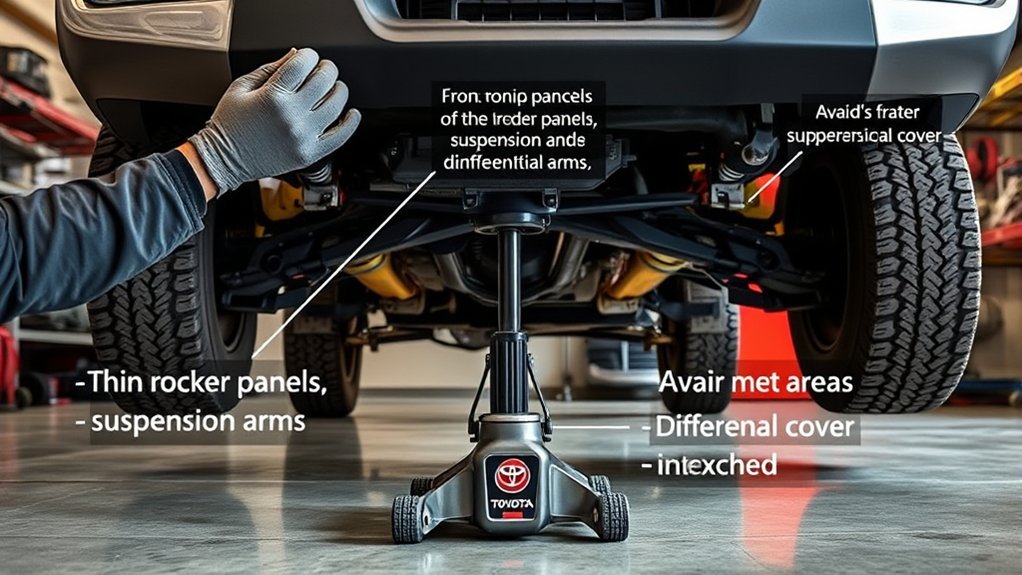
Most lifting problems happen because the truck is supported in the wrong place, on the wrong surface, or with the wrong equipment. Avoid shortcuts, even for quick jobs.
| What to Avoid | Why It’s Risky | Safer Choice |
|---|---|---|
| Working under a hydraulic jack only | Hydraulic jacks can leak down, shift, or fail. | Lower the truck onto rated jack stands first. |
| Using weak plastic parts or body panels | They are not designed to hold the truck’s weight. | Use approved frame or axle support points. |
| Using control arms as general lift points | Suspension parts can move, angle, or bend. | Use the lift points Toyota specifies for your model. |
| Supporting the truck on rock sliders | Some sliders mount to the body or brackets, not the frame. | Use frame points unless the slider maker confirms frame-rated lifting. |
| Placing stands on gravel, dirt, slopes, or hot asphalt | The stand feet can sink, slide, or tilt. | Move to a flat, hard, level surface. |
| Using bricks, cinder blocks, or scrap wood as stands | They can crack, split, or shift without warning. | Use properly rated automotive jack stands. |
How to Keep Your Jack Stands and Equipment in Top Shape
Inspect your jack and stands before each use. Look for bent frames, cracked welds, missing pins, broken pawls, damaged saddles, hydraulic leaks, loose wheels, and heavy rust. Do not use damaged equipment.
Keep the jack clean and lubricated according to the manufacturer’s instructions. Store jack stands in a dry indoor area. If a jack has been overloaded, dropped, or used during a sudden vehicle shift, take it out of service until it has been inspected.
Automotive stands and jacks fall under portable automotive service equipment standards, including ASME’s PASE safety standard. Buy equipment with clear rating marks, readable labels, and a saddle design that fits the support point you plan to use.
Note: Before using older jacks or stands, search the CPSC recall database for product safety warnings or recalls.
Related Guides
Frequently Asked Questions
Where should you place jack stands on a Toyota Tacoma?
Use the approved support points for your Tacoma’s model year. Many models use front frame-rail support areas and rear axle-tube support near the spring or U-bolt area, but you should always confirm the exact points in your owner’s manual or repair manual.
Can you use the rear differential as a jack stand point?
Do not use the differential as a jack stand support point unless a factory service procedure specifically allows it. On some trucks, the differential area may be an approved lift point, but stands should support approved frame or axle locations.
How do you determine the proper lift points for a vehicle?
Start with the vehicle owner’s manual. For maintenance or repair lifting, use the factory repair manual or Toyota service information. Look for points labeled for jacking, hoist arms, or safety stands, and avoid suspension parts or body panels unless the manual allows them.
What is the 3/4 rule for floor jacks?
The 3/4 rule is informal advice, not a Toyota rule or an official jack standard. A safer rule is to use a jack and stands with a marked rated capacity that exceeds the load you are lifting or supporting.
Are 3-ton jack stands enough for a Toyota Tacoma?
Properly rated 3-ton jack stands are commonly used for midsize trucks, but you still need to check the stand’s marked rating, the truck’s loaded weight, and the support-point fit. Never use stands with missing labels or unknown capacity.
Can you leave a Tacoma on jack stands overnight?
You can leave a truck supported on properly rated stands during a longer repair only if the stands are on flat concrete, positioned correctly, and stable. Keep the hydraulic jack nearby as a backup, but do not use it as the main support.
Where is the secret compartment in a Toyota Tacoma?
On many Tacoma models, small storage areas are located under or behind the rear seats. This can help store small tools or emergency items, but it does not affect jack stand placement. Check your owner’s manual for your cab style.
Conclusion
Safe Tacoma jack stand placement comes down to three habits: verify the approved points, use rated equipment, and check stability before you work underneath. Do not rush the setup just because the repair seems quick. A few extra minutes with the manual, wheel chocks, and a proper shake test can protect both you and your truck.
Sources
- Toyota Owners Manuals and Warranties — supports using vehicle-specific manuals for owner information.
- Toyota Technical Information System — supports factory service and repair information for Toyota vehicles.
- OSHA 1910.244, Other Portable Tools and Equipment — supports jack rating, load securing, inspection, lubrication, and defective-equipment warnings.
- ASME PASE, Safety Standard for Portable Automotive Service Equipment — supports portable automotive service equipment standards for jacks, stands, ramps, and related tools.
- U.S. Consumer Product Safety Commission Recalls — supports checking product recalls and safety warnings for older jacks and jack stands.