
Last updated: September 22, 2026
Toyota Tacoma ATF WS is not the correct fluid for every 2005-and-newer automatic Tacoma. For 2005–2015 trucks, the transmission matters: the 4-speed automatic uses Toyota Genuine ATF Type T-IV, while the 5-speed automatic uses Toyota Genuine ATF WS. Toyota specifies ATF WS for 2016–2023 6-speed automatics and for the verified 2024–2025 8-speed automatic as well.
Before buying or adding fluid, confirm the transmission in your exact model year. Using T-IV where WS is specified, or WS where T-IV is specified, can cause shift-quality problems and transmission damage. Service intervals also depend on operating conditions, so do not apply a blanket 30,000-mile or 60,000-mile change rule to every Tacoma.
Quick Answer
- 2005–2015 4-speed automatic: Toyota Genuine ATF Type T-IV.
- 2005–2015 5-speed automatic: Toyota Genuine ATF WS.
- 2016–2023 6-speed automatic: Toyota Genuine ATF WS.
- 2024–2025 8-speed automatic: Toyota Genuine ATF WS.
- ATF WS and Type T-IV are different specifications. Toyota states that WS is not compatible with T-IV or Dexron ATF.
- For a 2023 Tacoma, Toyota calls for transmission-fluid replacement at 60,000 miles/72 months when the truck is primarily used for specified severe conditions such as towing/heavy loading or extensive idling and low-speed driving. Normal-use guidance centers on inspection rather than a universal 30,000–60,000-mile replacement interval.
- Many WS-equipped Tacoma transmissions are sealed and use a temperature-dependent overflow-level procedure rather than a conventional dipstick check.
What ATF WS Is and Why Toyota Made It
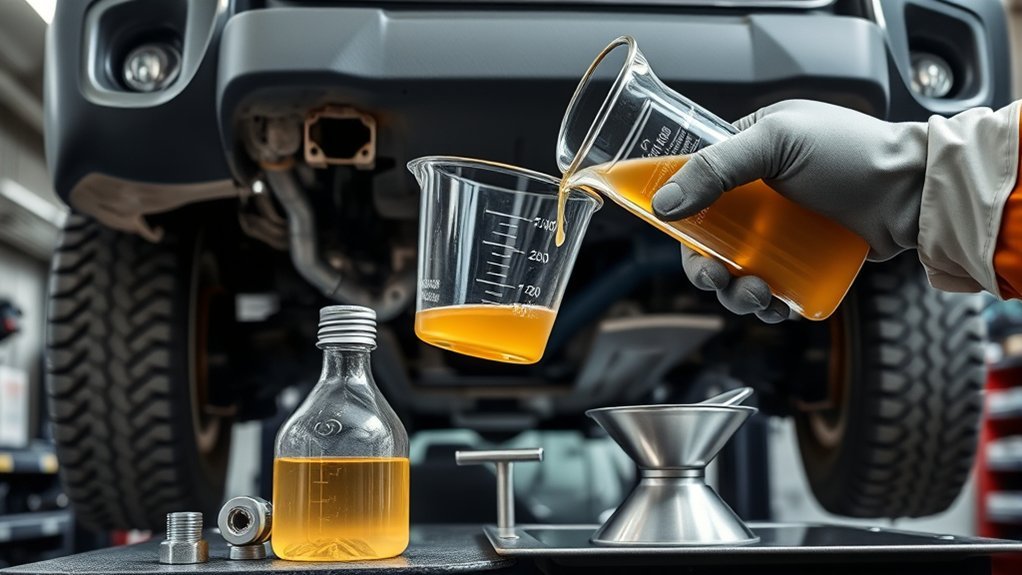
ATF WS means Toyota World Standard automatic transmission fluid. Toyota introduced the WS specification for transmissions designed around its particular viscosity and friction characteristics. Toyota’s technical guidance says WS was introduced to increase the mileage between scheduled maintenance checks.
The important point for a Tacoma owner is compatibility rather than marketing terms such as “premium” or “synthetic.” A transmission designed for WS should receive the fluid Toyota specifies for that transmission. Toyota also states that ATF WS is not compatible with Type T-IV or Dexron ATF.
Toyota’s WS guidance includes another handling warning: keep unused ATF WS containers sealed. Toyota says exposure to the atmosphere can allow the fluid to absorb moisture and potentially cause shift concerns. Use clean, new fluid when servicing a WS-equipped transmission.
Which Toyota Tacoma Transmissions Use ATF WS?
The safest way to choose Tacoma transmission fluid is by model year and transmission, not simply by saying “2005+.” Toyota sold both T-IV and WS automatic-transmission applications during the second-generation Tacoma years.
| Tacoma application | Automatic transmission | Toyota fluid specification |
|---|---|---|
| 2005–2015 | 4-speed | Toyota Genuine ATF Type T-IV |
| 2005–2015 | 5-speed | Toyota Genuine ATF WS |
| 2016–2023 | 6-speed | Toyota Genuine ATF WS |
| 2024–2025 | 8-speed | Toyota Genuine ATF WS |
Important: Always confirm the fluid specification in the owner’s manual or factory service information for your exact truck before servicing it. Production configuration, transmission type, and market can matter.
2005–2015 Tacoma Models
The second-generation Tacoma is where the common “all 2005+ Tacomas use WS” mistake begins. Toyota’s specifications distinguish the automatic transmissions by speed: 4-speed automatics use Type T-IV, while 5-speed automatics use ATF WS.
That means engine size by itself is not a safe fluid-selection shortcut. Identify the transmission first, then use the specification Toyota lists for that transmission.
2016 and Newer WS Automatic Transmissions
For 2016–2023 Tacomas, Toyota specifies Toyota Genuine ATF WS for the 6-speed automatic transmissions. Toyota also specifies ATF WS for the verified 2024–2025 8-speed automatic.
Do not confuse an automatic-transmission fluid specification with manual-transmission gear oil. Manual Tacoma transmissions use different lubricants and procedures.
How ATF WS Differs From Type T-IV and Other ATFs
ATF WS and Type T-IV are separate Toyota automatic-transmission fluid specifications. They were designed for different transmission applications, and Toyota specifically states that WS is not compatible with Type T-IV or Dexron ATF.
This is why choosing fluid based only on vehicle brand or model name is risky. A 2015 Tacoma can require either T-IV or WS depending on whether it has the 4-speed or 5-speed automatic transmission.
Why the Fluid Specification Matters
Automatic transmissions rely on the fluid for hydraulic operation, lubrication, cooling, and the friction behavior of clutches and torque-converter components. A fluid with the wrong characteristics can change shift behavior and lubrication performance.
Toyota’s owner-manual warnings state that using a transmission fluid other than the specified type may cause abnormal operation, vibration, poor shift quality, or transmission damage. For that reason, the specification listed for the exact transmission is more important than generalized claims about one fluid being “better” than another.
What Toyota Says About ATF WS Handling
Toyota’s World Standard ATF technical guidance does not require owners to compare additive chemistry or base-oil formulas. Its practical instructions are simpler: use the specified WS fluid in WS applications, do not mix it with T-IV or Dexron, keep stored WS fluid sealed, and use clean fluid during service.
Toyota states that an opened WS container should be kept sealed because exposure to the atmosphere can allow the fluid to absorb moisture and potentially cause shift concerns.
Vehicle Compatibility Limits
Do not assume that a fluid is interchangeable simply because both products are Toyota automatic-transmission fluids. Type T-IV and WS serve different applications.
- Confirm the model year and transmission type before buying fluid.
- Use Type T-IV where Toyota specifies T-IV and WS where Toyota specifies WS.
- Do not mix WS with Type T-IV or Dexron ATF.
- If the previous service history is unknown, identify what the transmission requires before adding any fluid.
What Signs Mean Your Tacoma Transmission Needs Inspection?
Transmission symptoms do not automatically mean the fluid needs to be changed. They can also come from an incorrect fluid level, a leak, software or control issues, worn internal parts, a torque-converter problem, or another drivetrain fault.
Have the transmission inspected if you notice delayed engagement when selecting Drive or Reverse, repeated slipping or RPM flare between shifts, unusually harsh shifts, a transmission-temperature warning, an external fluid leak, or new abnormal noises. If fluid inspected during service is contaminated with water or contains significant metallic debris, further diagnosis is more important than simply refilling it.
Fluid color by itself is not a reliable mileage-based replacement rule. Do not replace ATF solely because it has darkened at an arbitrary mileage such as 20,000 miles.
When Should Toyota Tacoma ATF WS Be Serviced?
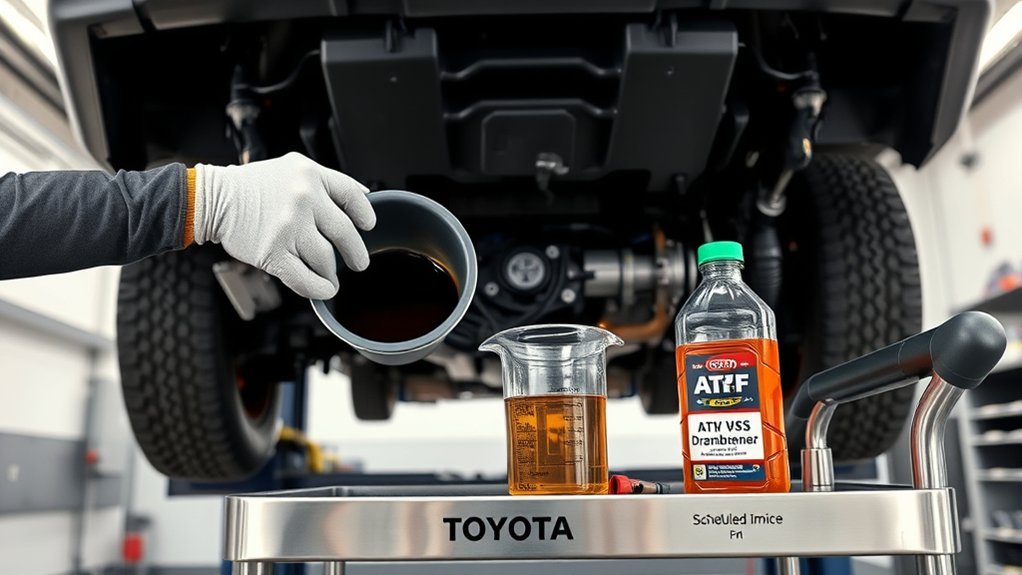
There is no accurate universal “change every 30,000–60,000 miles” rule for every Tacoma. Follow the maintenance guide for your exact model year and operating conditions.
For example, Toyota’s 2023 Tacoma Warranty & Maintenance Guide lists transmission-fluid replacement at 60,000 miles or 72 months when the truck is primarily operated while towing, using a car-top carrier, or under heavy vehicle loading. The same 60,000-mile service point calls for automatic-transmission-fluid replacement when the truck sees extensive idling and/or low-speed driving for long distances, such as certain commercial-use patterns.
Under the normal schedule, Toyota emphasizes inspection of sealed components for leakage rather than prescribing a blanket 30,000-mile fluid replacement.
Older Toyota World Standard ATF guidance, published as Toyota T-SB-0006-11 Rev1, also described WS as an inspection-focused fluid rather than one requiring routine flushing. That does not override the maintenance guide for your particular Tacoma. The practical rule is simple: use your model-year Toyota maintenance schedule as the primary interval source.
How Do You Check, Top Up, or Change Tacoma ATF WS?
First identify whether your Tacoma uses a conventional dipstick procedure or a sealed transmission with fill and overflow plugs. Do not apply a generic dipstick method to a sealed WS transmission.
Many newer Tacoma automatics require the truck to be level while the fluid is checked through an overflow system within a specified transmission-fluid temperature range. The exact temperature range, plug procedure, refill quantity, and torque specifications vary by transmission, so use the factory procedure for the exact model year.
For a drain-and-fill, do not refill the transmission with the published total or reference capacity unless the factory procedure specifically calls for that amount. A normal drain removes only part of the total fluid. Measure what comes out and follow the service procedure for the transmission being serviced.
Before draining a sealed transmission, make sure the fill plug can be removed. Keep the vehicle level, use appropriate lifting equipment, and never work underneath a vehicle supported only by a jack.
If the transmission is leaking, repeatedly low on fluid, slipping, overheating, or shifting abnormally, diagnose the cause rather than repeatedly topping it off. Toyota’s general transmission-fluid information is available in Toyota’s transmission-fluid guidance.
Common Mistakes When Handling ATF WS
Using WS in every 2005+ Tacoma: This is incorrect. The 2005–2015 4-speed automatic uses Type T-IV, while the 5-speed uses WS.
Mixing WS with T-IV or Dexron: Toyota specifically states that ATF WS is not compatible with those fluids.
Using a universal 30,000-mile interval: Toyota’s maintenance requirements vary by model year and operating conditions. Check the maintenance guide for the truck.
Checking a sealed transmission like a dipstick-equipped unit: A sealed transmission may require a temperature-dependent overflow-level procedure.
Refilling with total capacity after a simple drain: Total/reference capacity is not necessarily the amount removed during a drain-and-fill.
Assuming a fluid change will fix every shift problem: Slipping, harsh shifting, delayed engagement, and overheating may require diagnosis beyond fluid service.
ATF WS Alternatives, Compatibility, and Warranty Notes
Toyota recommends Genuine Toyota ATF WS in transmissions that specify WS. Toyota’s WS technical bulletin also warns that aftermarket fluids represented as compatible substitutes can cause shift concerns or internal damage if they do not provide the required performance.
Some aftermarket fluid manufacturers independently list their products for Toyota/Lexus WS applications. For example, Valvoline lists MaxLife Multi-Vehicle ATF as recommended by Valvoline for Toyota/Lexus WS applications. That is an aftermarket manufacturer’s compatibility statement; it should not be described as Toyota approval.
If you choose a non-Toyota fluid, confirm that the current product documentation explicitly lists the exact Toyota WS application, use one fluid consistently rather than mixing unknown products, and keep the receipt and product specification with your maintenance records.
For U.S. warranty coverage, using an aftermarket product does not automatically void a vehicle warranty. However, warranty coverage can be denied for damage shown to have been caused by an improper aftermarket product or service. Following the required fluid specification and keeping service records reduces avoidable disputes.
Frequently Asked Questions
What Does ATF WS Mean?
ATF means automatic transmission fluid, and WS means Toyota’s World Standard specification. Toyota introduced WS for transmissions designed around that fluid specification and to increase the distance between scheduled maintenance checks.
What Is the Difference Between Toyota Genuine ATF Type T-IV and WS?
Type T-IV and ATF WS are different Toyota transmission-fluid specifications intended for different transmission applications. Toyota states that ATF WS is not compatible with T-IV or Dexron ATF. On 2005–2015 Tacomas, the 4-speed automatic uses T-IV while the 5-speed automatic uses WS.
Is Toyota WS Transmission Fluid Lifetime?
Do not use the word “lifetime” as a universal no-service rule. Toyota’s older ATF-WS technical bulletin described inspection-only maintenance for covered WS applications, but Tacoma maintenance guides also call for fluid replacement under specified severe operating conditions. Follow the maintenance guide for your exact model year and use.
What Does WS Stand for in Transmission Fluid?
WS stands for World Standard, Toyota’s name for this automatic-transmission-fluid specification.
Which Toyota Tacoma Models Use ATF WS?
Verified applications include 2005–2015 Tacomas with the 5-speed automatic, 2016–2023 Tacomas with the 6-speed automatic, and 2024–2025 Tacomas with the 8-speed automatic. The important exception is the 2005–2015 4-speed automatic, which uses Toyota Genuine ATF Type T-IV.
Can You Use Type T-IV Instead of ATF WS?
No. Toyota states that ATF WS is not compatible with Type T-IV or Dexron ATF. Use the specification listed for the exact transmission.
How Often Should Tacoma ATF WS Be Changed?
There is no single replacement interval that applies to every Tacoma. For the 2023 Tacoma, Toyota calls for replacement at 60,000 miles/72 months under specified conditions such as towing/heavy loading or extensive idling and low-speed operation. Under normal use, the schedule focuses on inspection. Check the maintenance guide for your exact model year.
Conclusion
The most important step is to identify the transmission before buying fluid. A 2005–2015 Tacoma can use either Type T-IV or ATF WS depending on whether it has the 4-speed or 5-speed automatic. Toyota specifies WS for the later 6-speed and verified 2024–2025 8-speed automatic transmissions.
After confirming the correct fluid, follow the maintenance schedule and level-check procedure for your exact model year. Do not mix WS with T-IV or Dexron, do not use a generic dipstick procedure on a sealed transmission, and do not assume a total/reference capacity is the correct refill amount after a simple drain. If the truck is slipping, leaking, overheating, or shifting abnormally, diagnose the cause instead of assuming new fluid alone will solve it.
