
Your Toyota Tacoma’s tire pressure placard gives the factory specifications you need for safe on-road inflation. Open the driver’s door and read the Tire and Loading Information label on the driver’s-side B-pillar or door edge. Use its exact cold-pressure values for the front, rear, and spare tires instead of relying on a generic PSI range or the maximum pressure molded into a tire’s sidewall.
Quick Answer
Find the Tacoma’s Tire and Loading Information label inside the driver’s door opening. Match the listed original tire size, then read the recommended cold PSI for the front, rear, and spare tires. Inflate each tire to its listed value after the truck has been parked for at least three hours.
Key Takeaways
- Use the exact cold-pressure values on your Tacoma’s placard; there is no single correct PSI for every Tacoma.
- The front, rear, and spare tires may have different size or pressure specifications.
- The sidewall number is a tire limit, not the truck manufacturer’s normal inflation recommendation.
- Check pressure monthly, before long trips, and after major temperature changes.
- TPMS is a warning system, not a substitute for checking pressure with an accurate gauge.
At a Glance
| Time Required | About 10 minutes |
| Difficulty | Easy |
| Tools Needed | Reliable tire-pressure gauge; air source if adjustment is needed |
| Cost | Usually free with your own gauge and air source; some stations charge for air |
Why Proper Tire Pressure Is Essential for Safety and Performance
Your Tacoma’s recommended pressure is chosen to support the truck’s intended load, handling, braking, ride, and tire durability with its original equipment. The National Highway Traffic Safety Administration advises checking all tires at least monthly while they are cold.
Underinflation makes a tire flex more, which can build heat, increase rolling resistance, shorten tread life, and affect handling. Excess pressure can create a harsher ride, reduce the tire’s ability to absorb impacts, and contribute to uneven wear. Correct pressure helps the tire carry its assigned load as the vehicle manufacturer intended.
Where to Find Your Tacoma Tire Pressure Placard
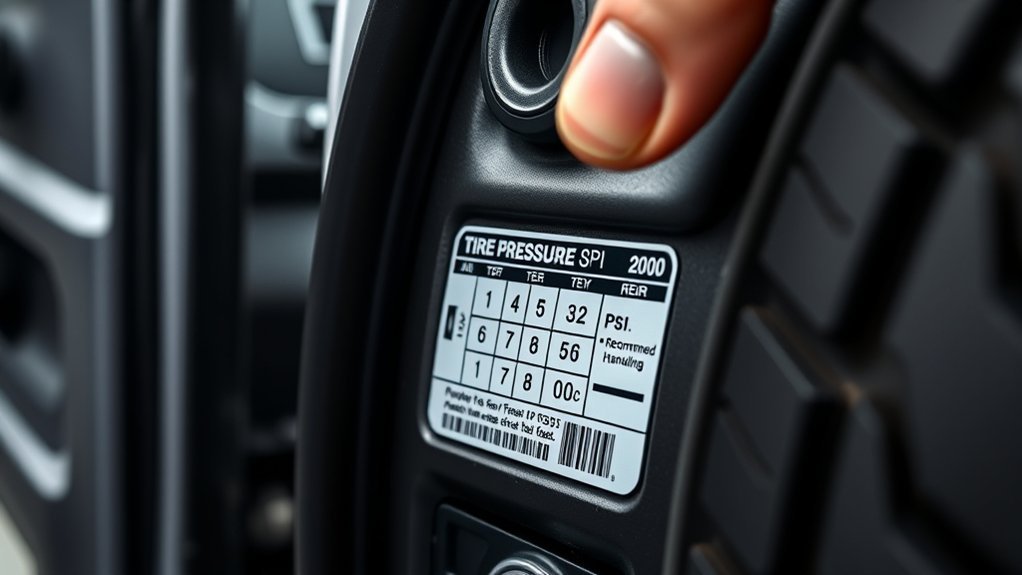
Open the driver’s door and look at the vertical body pillar beside the seat, commonly called the B-pillar. The label may also be on the rear edge of the driver’s door or another inward-facing surface next to the driver’s seat if the pillar cannot hold a readable label.
Look for a label headed Tire and Loading Information. It normally sits near a separate certification label that lists items such as the VIN, GVWR, and axle ratings. These labels serve different purposes, so use the Tire and Loading Information label for normal cold tire pressure.
Note: Do not copy a pressure from another Tacoma. Year, trim, cab, drivetrain, wheel package, tire size, and original equipment can change the listed values.
How to Read the Tacoma Tire Pressure Placard
Read the placard one field at a time. Federal labeling rules require the label to identify the vehicle’s seating and loading limit, original tire sizes, and recommended cold inflation pressures.
| Placard Field | What It Means | What You Should Do |
|---|---|---|
| Combined weight limit | Maximum combined weight of occupants and cargo | Do not exceed the printed pound or kilogram limit |
| Seating capacity | Number of designated seating positions | Use it with the combined weight limit when planning a load |
| Front tire size and cold pressure | Original front tire specification and recommended PSI/kPa | Match the size and inflate both front tires to the listed cold value |
| Rear tire size and cold pressure | Original rear tire specification and recommended PSI/kPa | Use the rear value even if it differs from the front |
| Spare tire size and pressure | Specification for the spare, when provided | Check the spare separately because its pressure may differ |
PSI means pounds per square inch, while kPa means kilopascals. Use either unit shown by your gauge, but do not mix a PSI number with a kPa setting.
Placard vs. Tire Sidewall vs. Certification Label
These three markings answer different questions:
- Tire and Loading Information placard: Gives the truck manufacturer’s recommended cold pressure, original tire sizes, seating capacity, and combined occupant-and-cargo limit.
- Tire sidewall: Identifies the tire’s size, load index, speed rating, construction, and maximum load or pressure information. The maximum sidewall pressure is not the Tacoma’s everyday target.
- Vehicle certification label: Lists regulatory and weight-rating information such as GVWR and GAWR. It does not replace the cold-pressure values on the tire placard.
Warning: Never inflate a tire to its sidewall maximum simply because that number is higher. Use the Tacoma placard unless Toyota or a qualified tire professional has specified a different pressure for an approved non-original setup.
How Tire Pressure Affects Tacoma Performance
Pressure changes how a tire carries load and responds to steering, braking, heat, and road impacts. The goal is not to make every tire read the same number. The goal is to match each axle’s placard specification while the tires are cold.
| Tire Pressure Condition | Likely Effect | Recommended Action |
|---|---|---|
| Below placard value | More flex, heat, rolling resistance, and possible handling changes | Add air and inspect for leaks or damage |
| Above placard value when cold | Harsher ride, less impact absorption, and possible uneven wear | Release air gradually to the listed cold value |
| At placard value when cold | Intended load support, ride, and handling | Recheck monthly |
| Pressure changes with weather | A correctly inflated tire may read lower or higher after a temperature shift | Recheck cold pressure and restore the placard value |
The U.S. Department of Energy reports that underinflation can reduce fuel economy by about 0.2% for each 1 PSI drop in the average pressure of all tires. Keeping tires properly inflated improves fuel economy by about 0.6% on average and up to 3% in some cases.
How to Check and Adjust Tacoma Tire Pressure
1. Let the Tires Cool
For the most accurate reading, park the truck for at least three hours before checking pressure. Measure before a long drive, not immediately after highway use or towing.
2. Read the Placard Before Using the Gauge
Write down the listed front, rear, and spare values. Do not assume all positions use the same pressure.
3. Measure Each Tire
Remove the valve cap, press the gauge squarely onto the valve stem, and note the reading. A brief hiss while seating the gauge is normal, but a poor seal can produce an inaccurate result.
4. Add or Release Air
Add air in short bursts if the reading is low. If the cold reading is high, press the valve core briefly to release air. Recheck after each adjustment until the gauge matches the placard.
5. Recheck and Replace the Valve Caps
Measure each tire again, including the spare when accessible. Reinstall the valve caps to help keep dirt and moisture away from the valve.
Pro Tip: Keep a known-good gauge in the glove box. Using the same gauge each month makes changes easier to spot.
Note: Do not bleed a warm tire down to the placard’s cold value. If a warm tire is clearly underinflated, add air to at least the placard value, then recheck and fine-tune it after the tire cools.
Towing, Aftermarket Tires, and Off-Road Use
Towing and Heavy Loads
Stay within the combined occupant-and-cargo limit printed on the label, and consult your model-year Tacoma owner’s manual for towing instructions. Do not automatically add extra PSI for a trailer or heavy load unless Toyota provides a specific instruction for your configuration.
Aftermarket Tires and Wheels
If your Tacoma no longer has the original tire size or load range shown on the placard, do not guess. Ask the tire manufacturer, Toyota dealer, or a qualified tire professional to determine the correct cold inflation pressure and confirm that the replacement tires meet the truck’s load requirements.
Off-Road Airing Down
The placard pressure is the on-road cold-inflation baseline. Some experienced off-road drivers temporarily reduce pressure for specific terrain, but this changes load capacity, heat buildup, steering response, and the risk of tire or wheel damage.
Warning: Reinflate to the correct on-road pressure before returning to normal-speed pavement. Never exceed the tire, wheel, axle, or vehicle load limits.
Top Mistakes to Avoid When Measuring Tire Pressure
- Using a generic Tacoma PSI: The correct value is the one printed on your truck’s label.
- Using the sidewall maximum: That marking is not the normal vehicle recommendation.
- Checking only after driving: Heat raises the reading and can hide underinflation.
- Assuming front and rear pressures match: Read both placard rows.
- Ignoring the spare: A neglected spare may be unusable when you need it.
- Trusting TPMS as a precision gauge: The warning may not appear until pressure is significantly low.
- Resetting TPMS before correcting pressure: Inflate and inspect the tires first, then follow the model-year manual.
- Keeping placard pressure after a major tire change without verification: Non-original sizes or load ranges may require a professionally determined pressure.
Understanding TPMS and Its Role in Tire Maintenance
Model-year 2008 and newer U.S. passenger vehicles and light trucks are required to have a Tire Pressure Monitoring System. Depending on your Tacoma’s year and equipment, the system may show individual readings or only a low-pressure warning.
Federal rules require the warning to activate when one or more tires reach a defined significant-underinflation threshold. That threshold is generally 25% below the manufacturer’s recommended cold pressure or a specified minimum pressure, whichever is higher. This is why a tire can be below its ideal placard value before the warning appears.
- Steady warning light: Stop safely, inspect the tires, and check all pressures with a gauge.
- Light flashes for about a minute, then stays on: The system may have a malfunction. Consult the owner’s manual or arrange service.
- Light returns after inflation: Recheck when cold and inspect for a leak, puncture, damaged valve, incompatible wheel, or sensor issue.
TPMS warns you about significant underinflation; it does not replace a monthly cold-pressure check with an accurate gauge.
Year-Round Tips for Maintaining Proper Tire Pressure
- Check monthly: Measure all tires, including the spare, while cold.
- Check before long trips: Correct pressure before adding hours of highway heat.
- Recheck after temperature swings: Restore the placard value rather than choosing a separate winter or summer target.
- Inspect while measuring: Look for nails, cuts, bulges, cracking, damaged valve stems, or unusual wear.
- Track repeated pressure loss: A tire that regularly needs air should be inspected for a leak.
- Use the model-year manual: Follow Toyota’s instructions for TPMS reset, tire rotation, towing, and replacement tires.
What to Do If the Placard Is Missing or Damaged
Do not rely on a search result, another truck’s label, or the tire sidewall. Use Toyota’s official manuals lookup for your model year, or contact a Toyota dealer with the VIN so the original tire and pressure specifications can be confirmed.
If the truck has been modified, ask a qualified tire professional to verify tire load capacity, wheel compatibility, axle limits, and the correct cold inflation pressure before driving.
Frequently Asked Questions
How do I read a Toyota Tacoma tire pressure placard?
First confirm that the tire size on the truck matches the original size listed on the label. Then read the separate cold PSI or kPa values for the front, rear, and spare tires. Also note the combined occupant-and-cargo limit and seating capacity.
Is 35 PSI correct for every Toyota Tacoma?
No. The correct pressure varies by model year, trim, tire size, axle, and equipment. Use the exact cold-pressure value printed on your Tacoma’s Tire and Loading Information label.
Should I use the maximum PSI printed on the tire sidewall?
No. The sidewall marking describes a tire limit, not the Tacoma’s normal operating recommendation. Use the vehicle placard unless an approved replacement setup has a different professionally determined pressure.
Should I increase tire pressure when towing?
Do not raise pressure automatically. Stay within the truck’s loading limits and follow the towing and tire instructions in your model-year owner’s manual. Increase pressure only when Toyota or a qualified tire professional specifies it for your exact setup.
Why is the TPMS light still on after I add air?
Another tire may still be low, the tires may need a cold recheck, or the system may need its model-specific relearn procedure. A flashing light followed by steady illumination can indicate a malfunction.
What if my Tacoma has aftermarket tires or wheels?
Confirm that the replacement tires meet the required size and load capacity. If they differ from the placard specification, have Toyota, the tire manufacturer, or a qualified tire professional determine the correct cold pressure and verify TPMS compatibility.
Conclusion
Your Tacoma’s tire pressure placard is more reliable than a generic online PSI chart because it reflects the truck’s original tire and loading specifications. Read the label inside the driver’s door opening, measure all tires after they have cooled, and match the front, rear, and spare values exactly. Monthly checks, prompt leak repairs, and model-specific TPMS guidance will help protect handling, tire life, and fuel economy.
Sources
- NHTSA TireWise — tire-label location, cold-pressure checks, sidewall guidance, and TPMS maintenance.
- 49 CFR 571.110 — required Tire and Loading Information placard location and contents.
- 49 CFR 571.138 — TPMS warning and malfunction requirements.
- FuelEconomy.gov: Keeping Your Vehicle in Shape — fuel-economy effects of proper tire inflation.
- Toyota Manuals and Warranties — model-year owner’s manual lookup.
