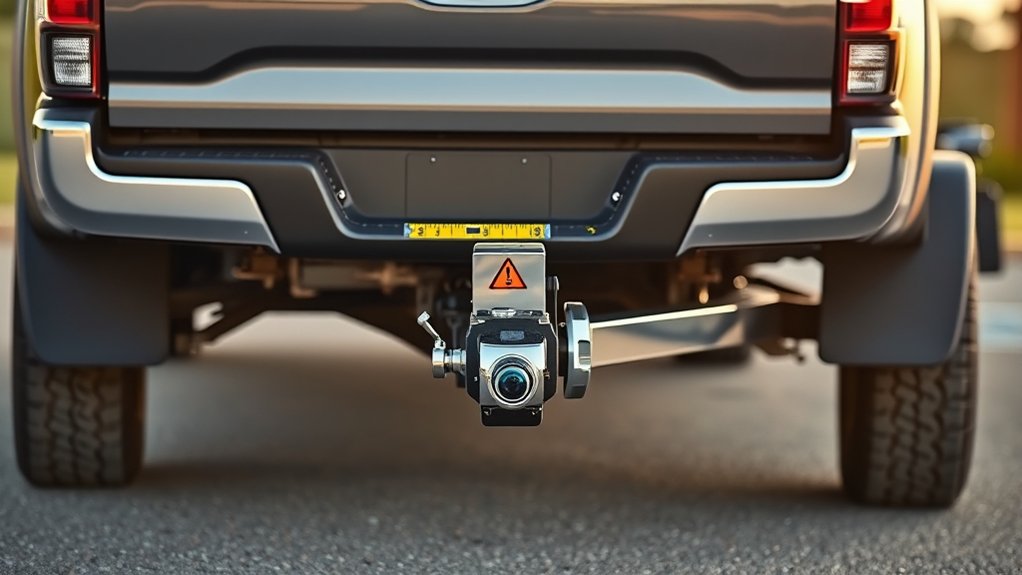
There is no universal Toyota Tacoma hitch height or fixed drop that works for every trailer. To choose the correct ball mount, park the Tacoma and trailer on level ground, level the trailer, then measure from the ground to the top inside edge of the Tacoma’s receiver opening and from the ground to the bottom of the trailer coupler. If the receiver is higher, the difference is the drop you need. If the coupler is higher, the difference is the rise you need.
After connecting the properly loaded trailer, recheck that the trailer sits level and that the Tacoma, receiver, ball mount, hitch ball, coupler, and trailer remain within their applicable weight ratings.
By Tony B. Hensel · Last updated September 22, 2026 — hitch-measurement method, tongue-weight guidance, towing references, internal links, and FAQs reviewed.
Quick Answer
Measure from the ground to the top inside edge of your Tacoma’s hitch receiver opening (A). With the trailer level, measure from the ground to the bottom of its coupler (B). If A is higher than B, subtract B from A to find the required drop. If B is higher than A, subtract A from B to find the required rise. Do not assume that a 4-inch drop is correct without measuring your truck and trailer.
| Measurement Result | What You Need | Calculation |
|---|---|---|
| Receiver is higher than coupler | Drop | Receiver height − coupler height |
| Coupler is higher than receiver | Rise | Coupler height − receiver height |
| Heights are approximately equal | Little or no rise/drop | Confirm using the ball mount manufacturer’s listed dimensions |
Source note: Toyota instructs Tacoma owners to set the trailer ball at the proper height for the coupler and to confirm that the trailer is level when hitched. For exact limits and towing requirements, use the manual for your specific model year and configuration through Toyota Owners. The standard rise/drop measurement method is also documented by CURT and etrailer.
Why Proper Hitch Height Is Essential for Tacoma Towing
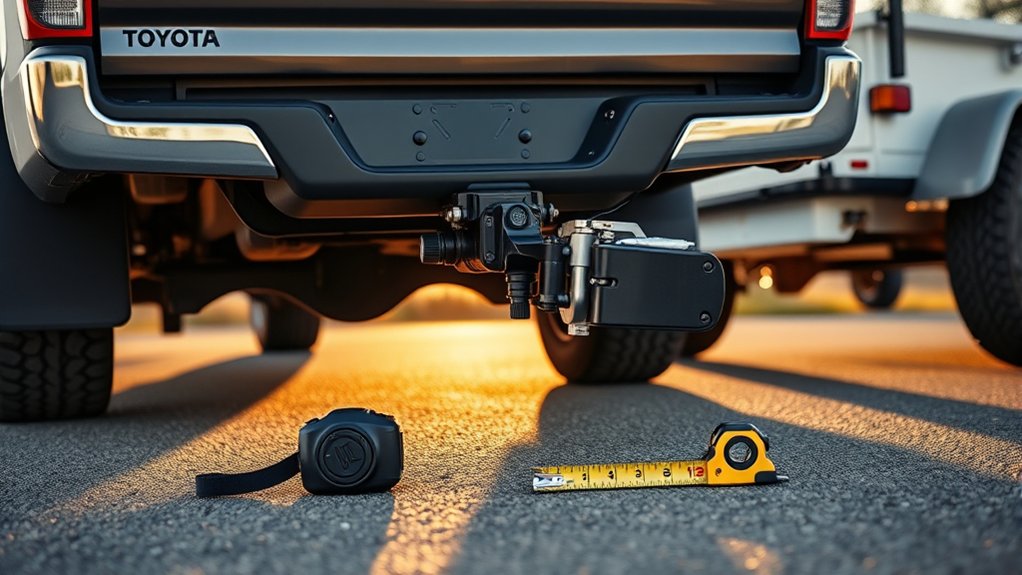
Correct ball height helps your trailer sit level after it is connected. Toyota specifically tells owners to confirm that the trailer ball is set at the proper height for the coupler and that the trailer is level when hitched.
A level trailer is only one part of a stable towing setup. Tongue weight, trailer loading, tire condition and pressure, speed, suspension condition, trailer brakes, hitch ratings, and the Tacoma’s own weight limits also affect handling. Hitch height should therefore be treated as one part of the complete Tacoma towing check rather than as a cure for every sway or handling problem.
Choose hitch rise or drop from actual receiver and coupler measurements. Do not rely on a Tacoma-wide “standard” drop.
An adjustable ball mount can be useful when you regularly tow trailers with different coupler heights, but it still has to match your receiver size and meet every applicable weight rating.
How Can You Measure Your Tacoma Hitch Height Accurately?
Park the Tacoma on firm, level ground. Measure vertically from the ground to the top inside edge of the receiver opening. Record this as measurement A.
Next, place the uncoupled trailer on the same type of level surface. Use the trailer jack to make the trailer frame level, then measure from the ground to the bottom of the coupler. Record this as measurement B.
- If A is greater than B, you need a drop equal to A minus B.
- If B is greater than A, you need a rise equal to B minus A.
- Use the ball mount manufacturer’s published rise/drop dimensions when choosing the nearest suitable mount.
- After hitching the properly loaded trailer, confirm that it remains level and that excessive suspension sag, incorrect tongue weight, or overloading is not changing the setup.
Do not have a person stand on the bumper as a substitute for the real towing load. The better check is to connect the properly loaded trailer and evaluate the actual coupled setup.
Choosing the Right Hitch Ball Mount for Your Tacoma
Correct rise or drop is only one requirement. The ball mount’s shank must fit the Tacoma’s receiver, and the ball mount must have enough capacity for the trailer.
Measure receiver height and level-trailer coupler height first; then choose a ball mount with the correct rise/drop, receiver fit, and weight rating.
The hitch-ball diameter must also match the trailer coupler. Common trailer-ball diameters include 1-7/8 inch, 2 inch, and 2-5/16 inch, but the coupler itself should determine the size. Most couplers are stamped with the required ball diameter.
Check the ratings for the receiver, ball mount, hitch ball, coupler, and trailer. The towing setup is limited by its lowest-rated applicable component, and none of those ratings override the Tacoma’s vehicle-specific towing, payload, axle, or combined-weight limits.
How to Measure for the Correct Hitch Drop?
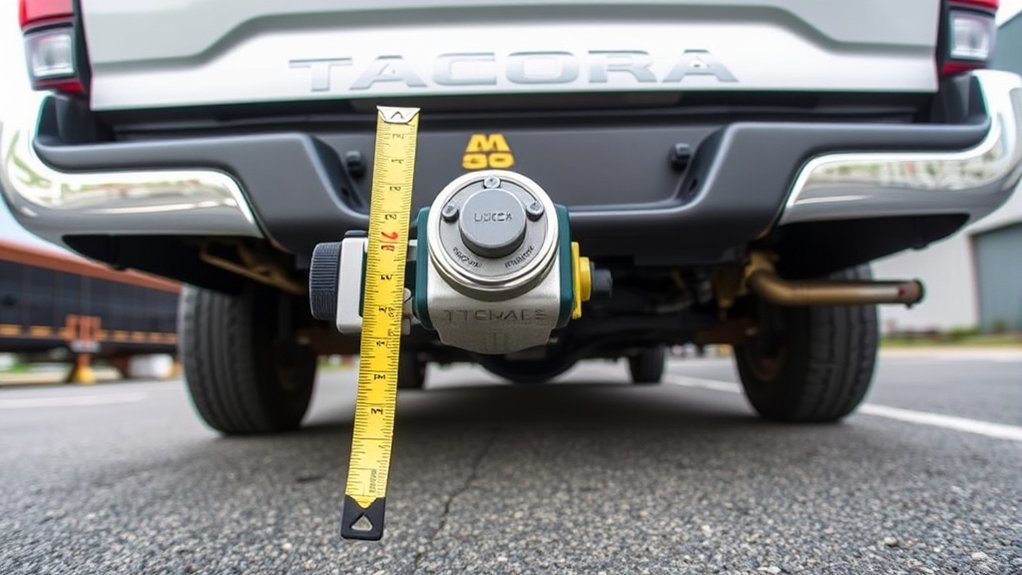
Use this five-step process:
- Park the Tacoma on level ground.
- Measure from the ground to the top inside edge of the hitch receiver opening.
- Level the uncoupled trailer and measure from the ground to the bottom of its coupler.
- Subtract the lower measurement from the higher measurement to calculate the required rise or drop.
- Connect the properly loaded trailer and confirm that it remains level before towing.
Drop example: If the receiver measures 19 inches and the trailer coupler measures 15 inches, the difference is 4 inches. That setup calls for approximately a 4-inch drop, subject to the ball mount manufacturer’s actual dimensions and ratings.
Rise example: If the receiver measures 17 inches and the coupler measures 20 inches, the difference is 3 inches. That setup calls for approximately a 3-inch rise.
For conventional towing, tongue weight must also remain within the range specified by Toyota for your exact Tacoma. For example, Toyota’s 2024 Tacoma owner’s manual specifies conventional-trailer tongue weight of 9% to 11% of gross trailer weight. Check the manual for your own model year rather than applying that number blindly to every Tacoma.
Why Tacoma Hitch Height Varies by Model and Setup
There is no reliable single receiver-height number for every Toyota Tacoma. The measurement at your truck can change with model year, tire diameter, suspension design, trim, cargo, accessories, aftermarket receivers, and suspension modifications.
A leveling kit or lift can change receiver height enough to require a different ball-mount position. Larger tires can also raise the truck. Added cargo and trailer tongue load can move the rear of the Tacoma in the opposite direction by compressing the suspension.
That is why a measurement reported by another Tacoma owner should not be treated as your specification. Measure the actual truck you will tow with. If you also need to confirm the receiver opening itself, see the Toyota Tacoma hitch receiver size guide.
Weight Distribution for Heavy Loads
A weight-distribution hitch is not simply a correction for an incorrect ball-mount height. It is a separate towing system used only when the vehicle, receiver, trailer, and hitch manufacturer allow or require it.
Requirements can change by Tacoma generation and configuration. For example, Toyota’s 2024 Tacoma owner’s manual states that a sway-control device with sufficient capacity is required when gross trailer weight exceeds 2,000 pounds and that a weight-distribution hitch with sufficient capacity is required when gross trailer weight exceeds 5,000 pounds. Check your exact owner’s manual before applying those thresholds to another model year.
A weight-distribution system also does not increase Toyota’s TWR, GVWR, GAWR, GCWR, payload limit, or another component’s rating. See the Tacoma towing capacity vs. payload guide for the weight-limit relationship.
Tacoma Hitch Height Checklist Before You Buy a Ball Mount
Before ordering a fixed or adjustable ball mount, confirm all of the measurements and ratings that control your setup. Correct drop alone is not enough.
Confirm the Measurements and Ratings
- Receiver height: ground to the top inside edge of the receiver opening.
- Coupler height: ground to the bottom of the coupler with the trailer level.
- Receiver opening and ball-mount shank size.
- Required trailer-ball diameter stamped on the coupler.
- Receiver, ball mount, hitch ball, coupler, trailer, and Tacoma weight ratings.
Recheck the Setup After the Trailer Is Connected
After connecting the properly loaded trailer, step back and check whether the trailer remains level. If it does not, investigate the ball-mount setting, tongue weight, trailer loading, truck loading, suspension condition, and any lift or leveling modifications before towing.
Do not assume that making the truck look level means the entire combination is within its ratings. Actual trailer weight, tongue weight, payload, axle loads, and component ratings still control.
Why Adjustable Hitches Offer Flexibility for Tacoma Towing
An adjustable ball mount can be practical when you tow more than one trailer or when the same truck’s ride height changes after suspension or tire modifications. Instead of buying several fixed mounts, you can reposition the ball platform within the mount’s approved adjustment range.
- Match different trailer coupler heights without relying on one fixed drop.
- Change from a drop position to an approved rise position when the product supports it.
- Recheck the setting after suspension, tire, or trailer changes.
- Use only positions that remain within the ball mount manufacturer’s published ratings.
Adjustment range does not replace capacity. Choose a model whose receiver size, ball size, gross trailer weight rating, and tongue-weight rating are suitable for the entire towing setup.
Steel or Aluminum: Which Hitch Material Should You Choose?
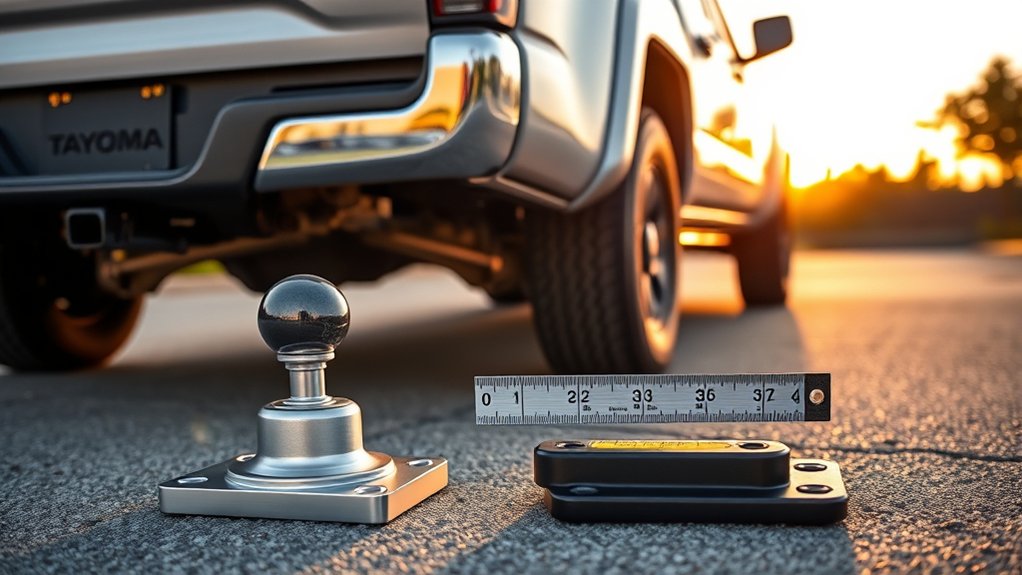
Do not choose a ball mount based on material alone. Both steel and aluminum products can be suitable when they are engineered and rated for the required load.
What to Check on a Steel Ball Mount
Steel mounts are common and are available in a wide range of fixed and adjustable designs. Compare the manufacturer’s gross trailer weight and tongue-weight ratings, receiver size, finish, corrosion protection, adjustment mechanism, and installation requirements rather than assuming that every steel mount has the same strength.
What to Check on an Aluminum Ball Mount
Aluminum designs can reduce the weight you handle when installing or adjusting the mount and may offer good corrosion resistance. Their actual towing capacity still depends on the specific design and published rating. Do not assume that an aluminum mount is automatically stronger or weaker than a steel alternative.
Ensuring Compatibility: Understanding Shank Size and Receiver Tube
The ball-mount shank must fit the receiver opening. Do not choose a larger shank merely because you are towing a heavier trailer.
Many Tacoma towing setups use a 2-inch receiver, but the correct approach is to verify your exact factory or aftermarket hitch before buying the ball mount. A 2.5-inch shank will not directly fit a 2-inch receiver.
- Measure the inside width and height of the receiver opening if you are unsure of its size.
- Confirm the receiver’s label or manufacturer specification.
- Match the ball-mount shank to that receiver size.
- If an adapter is being considered, follow the receiver and adapter manufacturers’ instructions and ratings because an adapter does not increase the Tacoma’s towing limits.
For more model-specific receiver information, use the Tacoma hitch receiver size guide.
Why Online Tacoma Hitch-Height Numbers Differ
You may see Tacoma owners report very different receiver heights online. Those numbers can all come from real trucks while still being unsuitable for your truck because model year, trim, tires, suspension, cargo, aftermarket hitches, lift kits, leveling kits, and measurement technique can change the result.
Use online measurements only as examples. Your own receiver-to-ground measurement and your own trailer’s level coupler height should determine the required rise or drop.
Related Guides
Frequently Asked Questions
How Much Drop Should My Hitch Have?
There is no universal drop for a Toyota Tacoma. Measure from the ground to the top inside edge of the receiver opening and compare that with the ground-to-bottom-of-coupler measurement taken while the trailer is level. If the receiver is higher, the difference is the required drop.
Does Tacoma Model Year Change the Hitch Drop You Need?
It can. Tacoma generations, trims, tires, suspension designs, towing equipment, and ride heights differ. Measure the actual truck rather than transferring a hitch-height number from another model year.
Is It Better to Have a Trailer Hitch Too High or Too Low?
Neither should be treated as the target. Toyota instructs owners to set the trailer ball at the proper height for the coupler and confirm that the trailer is level when hitched. If the trailer does not sit level, recheck rise/drop, loading, tongue weight, and the condition of the towing setup.
Does a Lift or Leveling Kit Change the Hitch Drop I Need?
Yes, it can change the receiver’s height above the ground and therefore change the required ball-mount rise or drop. Re-measure after any suspension, tire-size, or ride-height change instead of continuing to use the old hitch setting automatically.
What Size Trailer Ball Does a Tacoma Need?
The trailer coupler determines the required ball diameter. Common trailer-ball sizes include 1-7/8 inch, 2 inch, and 2-5/16 inch. Check the size stamped on the coupler and make sure the ball’s load rating is suitable for the trailer.
Conclusion
To set Toyota Tacoma hitch height correctly, measure your own truck and trailer instead of starting with a preset drop. Measure from the ground to the top inside edge of the receiver, level the trailer and measure to the bottom of its coupler, calculate the required rise or drop, then select a correctly rated ball mount and trailer ball.
After connecting the properly loaded trailer, confirm that it remains level and verify tongue weight, payload, axle limits, towing capacity, and every hitch-component rating before driving. Re-measure whenever tire size, suspension height, receiver hardware, or the trailer changes.
