
Choosing the correct coolant concentration for your Toyota Camry is less about inventing a custom ratio and more about matching the specification for the exact model year, powertrain, market, and cooling circuit. Use the coolant named in the owner’s manual, check the level only when the vehicle is cold, and never dilute a ready-to-use product.
Quick Answer
For a Toyota Camry that specifies Toyota Super Long Life Coolant, use that coolant or a fully compatible equivalent in the exact form required by the model-year manual. Do not add water to premixed coolant or choose a 60/40 or 65/35 blend unless Toyota specifically approves it for your vehicle.
Key Takeaways
- Check the manual for the exact model year, engine, market, and cooling circuit before buying or mixing coolant.
- Use ready-to-use coolant as supplied; dilute only a true concentrate and only as directed.
- Never open a radiator or pressurized coolant cap while the system is hot.
- Do not identify coolant by color alone, because color does not prove chemical compatibility.
- A repeatedly falling coolant level usually indicates a leak or another cooling-system fault.
- Hybrid Camrys may have separate engine and inverter cooling circuits, each with its own reservoir and service schedule.
At a Glance
| Time Required | About 5 minutes for a cold level check. A complete drain, refill, and bleed can take an hour or longer, depending on the model and procedure. |
| Difficulty | Easy for inspection and a small top-off; moderate to advanced for draining, refilling, and bleeding. |
| Tools Needed | Flashlight, gloves, eye protection, clean funnel, and the specified coolant. A drain pan, lifting equipment, torque tools, and service information may be required for replacement. |
| Cost | A visual inspection costs nothing. Coolant, testing tools, parts, disposal, and professional labor vary by model and location. |
What Is Coolant, and What Does It Do in a Toyota Camry?
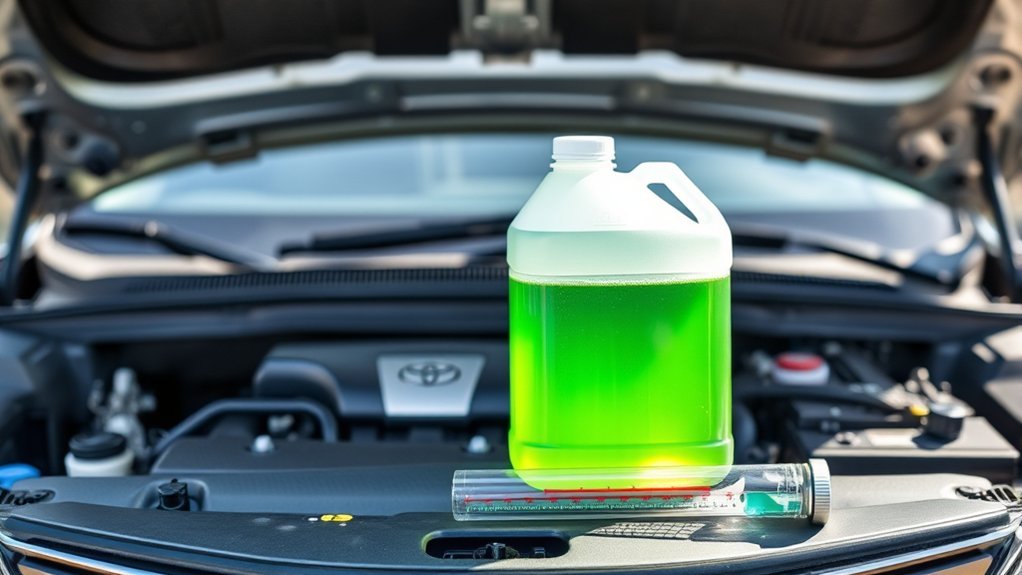
Engine coolant, also called antifreeze, carries heat away from the engine and releases it through the radiator. Its additive package also helps protect the water pump, radiator, heater core, passages, seals, and metal surfaces from corrosion and deposits.
Hybrid Camrys may also use coolant in a separate inverter cooling circuit. Do not assume that two similar-looking reservoirs serve the same parts. Identify each reservoir by its cap label and the model-year manual before adding fluid.
The correct coolant is defined by Toyota’s model-year specification and cooling circuit—not by color or a universal percentage.
For current U.S.-market Camrys that call for it, Toyota specifies Genuine Toyota Super Long Life Coolant or a similar high-quality ethylene-glycol coolant using the chemistry described in the maintenance guide. Toyota’s 2026 guide describes that chemistry as non-silicate, non-amine, non-nitrate, and non-borate with long-life hybrid organic acid technology. Older Camrys can use a different Toyota coolant, so verify the year before mixing products.
How Do You Choose the Correct Coolant for Your Camry?
Use the vehicle identification number or exact model year to open Toyota’s manual and warranty lookup. Confirm the powertrain, market, coolant name or chemistry, and whether you are servicing the engine or inverter circuit.
- Match the vehicle: Confirm the model year, engine or hybrid powertrain, and sales market.
- Match the circuit: Identify the engine, inverter, or intercooler reservoir named in the manual.
- Match the specification: Use the Toyota product or compatible chemistry expressly allowed by the manual.
- Match the product form: Determine whether the container is premixed, ready to use, or concentrated.
- Check the seal and condition: Do not use a damaged, unlabeled, contaminated, or previously opened container of uncertain contents.
Note: “Universal,” “all makes,” or a matching color is not enough by itself. The replacement coolant must meet the Toyota chemistry and compatibility requirements for the exact vehicle.
How Do You Ensure Adequate Freeze Protection?
Start with the product and concentration specified for your Camry. A label that says “premixed,” “pre-diluted,” or “ready to use” means the product is normally poured in without added water. A true concentrate must be mixed exactly as directed by the product label and vehicle manual, using the water quality those instructions require.
- Confirm the specification: Select the correct Toyota manual for the vehicle.
- Read the container: Identify whether the coolant is ready to use or concentrated before opening it.
- Test an unknown mixture: Use a refractometer intended for the coolant type, or have a repair shop measure the freeze point when service history is unclear.
- Inspect the fluid: Look for oil, rust, sludge, debris, or an unexpected color change.
- Correct contamination properly: If incompatible coolant, excessive water, oil, rust, or debris is present, arrange a complete diagnosis and service instead of repeatedly topping off.
Note: A freeze-point reading estimates concentration, but it does not prove that the corrosion inhibitors are healthy or that two coolant chemistries are compatible.
What Is the Ideal Toyota Camry Coolant Concentration?
The ideal concentration is the one Toyota specifies for the exact vehicle and product. Do not create a stronger glycol blend merely because the Camry operates in Arizona, Florida, northern Canada, or another demanding climate. More glycol is not automatically better; it changes freeze protection, viscosity, and heat-transfer performance.
| Product Type | Correct Approach |
|---|---|
| Toyota premixed coolant | Use it as supplied when the Camry manual specifies that product. Do not add water routinely. |
| Compatible premixed equivalent | Confirm that the chemistry, performance, and mixing compatibility match the manual—not merely the color. |
| Coolant concentrate | Mix only according to the product label and Toyota specification, using the required water quality and a clean container. |
| Custom 60/40 or 65/35 blend | Do not use it as a default. Choose it only when Toyota and the coolant manufacturer both approve it for the exact vehicle and climate. |
| Plain water | Not suitable for normal long-term use because it lacks the required freeze, boiling, and corrosion protection. |
Pro Tip: Photograph the front and back of the coolant container and save the service receipt. You will know the exact product and concentration used if the reservoir needs attention later.
How Do You Check Toyota Camry Coolant Safely?

Warning: Let every coolant circuit cool completely before touching a cap. A hot pressurized system can release scalding liquid or steam. Wear gloves and eye protection, keep coolant away from children and pets, and clean spills immediately.
- Park on level ground: Switch off the vehicle and wait until it is fully cold, preferably after it has sat for several hours.
- Identify the reservoir: Use the cap label and manual. A hybrid Camry may have more than one coolant reservoir.
- Read the cold markings: The level should be between the cold “LOW” and “FULL” marks or the equivalent labels used on the reservoir.
- Inspect the condition: Look for wet hose connections, crusty residue, damaged caps, stained panels, oily coolant, rust, or floating debris.
- Top off only when needed: Add the exact specified coolant slowly through a clean funnel. Stop at the cold full mark and do not overfill.
- Recheck later: Inspect the cold level again after several normal trips. A second drop deserves diagnosis.
Do not rely on reservoir color alone. Lighting, age, contamination, and mixed products can change the appearance.
What Should You Do If the Coolant Is Low?
A slightly low cold level may need a small top-off, but a reservoir that repeatedly falls below the minimum mark needs more than additional fluid. Coolant should not keep disappearing from a sealed, healthy system.
Check the Coolant Reservoir Level
- Confirm that the vehicle is cold and parked on level ground.
- Verify the correct reservoir before removing a cap.
- Compare the level with the cold markings rather than judging it while the system is hot.
- Inspect nearby parts for dried pink, red, white, or other colored residue that may reveal a slow leak.
If the level is only slightly low and no warning signs are present, top it off with the specified coolant. Record the date and mileage so you can tell whether the level continues to fall.
Add the Appropriate Coolant
Use ready-to-use coolant without adding water. If you have a true concentrate, prepare it in a clean container according to the product and vehicle instructions before pouring it into the reservoir. Never guess the ratio inside the car.
Avoid mixing coolant solely because two products share the same color. Different additive packages can look similar but may not be chemically compatible. When the existing product is unknown, professional testing and a complete exchange may be safer than adding a random coolant.
Know When Low Coolant Points to a Leak
Arrange an inspection when you notice any of these conditions:
- The reservoir drops again after a correct top-off.
- You see puddles, damp hose joints, crusty residue, or a wet radiator area.
- The cabin smells sweet or the windshield develops an oily film.
- The heater output changes unexpectedly.
- The temperature warning appears or the gauge rises above its normal position.
- The engine oil looks milky or the exhaust produces persistent white vapor after the engine is fully warm.
Possible causes include a loose or damaged cap, split hose, leaking radiator, water-pump leak, heater-core leak, damaged reservoir, or an internal engine problem.
What Are the Signs of Overheating, and What Should You Do?
Common warnings include a high-temperature light, a gauge moving into the hot zone, reduced power, steam under the hood, a strong coolant odor, coolant on the ground, or a heater that suddenly blows cold air.
If your Camry begins overheating:
- Turn off the air conditioner and move to a safe place away from traffic.
- Stop and shut the vehicle off if the warning remains on, the gauge continues rising, or steam appears.
- Do not open a radiator or pressurized reservoir cap.
- Wait for the system to cool completely before making a visual inspection.
- Arrange towing if coolant is leaking, a reservoir is empty, the warning returns, or you cannot identify the cause.
Continuing to drive an overheating engine can damage gaskets and metal components and can turn a small cooling-system fault into a major repair.
How Often Should You Change Toyota Camry Coolant?
The correct interval depends on the model year, powertrain, market, and cooling circuit. Do not use a universal two-year rule or assume that the engine and inverter circuits share the same schedule.
- 2024 U.S. Camry example: Toyota lists the initial engine-coolant replacement at 100,000 miles or 120 months, followed by replacement every 50,000 miles or 60 months. See the 2024 Camry Warranty and Maintenance Guide.
- 2025 U.S. Camry example: Toyota lists initial engine/intercooler coolant replacement, when applicable, at 100,000 miles or 120 months, followed by 50,000 miles or 60 months. It lists initial inverter/intercooler coolant replacement, when applicable, at 150,000 miles or 180 months, followed by 50,000 miles or 60 months. See the 2025 Camry Warranty and Maintenance Guide.
- 2026 U.S. Camry example: Toyota carries forward the same applicable intervals: 100,000 miles or 120 months initially for engine/intercooler coolant and 150,000 miles or 180 months initially for inverter/intercooler coolant, with 50,000-mile or 60-month replacement intervals afterward. See the 2026 Camry Warranty and Maintenance Guide.
Older Camrys can follow different schedules and may specify different coolant products. Use the guide tied to the VIN or exact model year.
Replace coolant sooner when testing shows inadequate protection, the fluid is contaminated, incompatible products were mixed, cooling-system repairs introduced debris, or Toyota’s repair procedure requires replacement.
DIY Guide to Changing Toyota Camry Coolant

A complete coolant change requires more care than a reservoir top-off. Some Camrys need underbody access, multiple drain points, a model-specific bleeding sequence, an electric-pump procedure, or service equipment. Toyota’s current maintenance guidance says a qualified technician should perform coolant replacement.
Warning: Stop if you cannot obtain the exact capacity, drain-point, refill, torque, and bleeding procedure for the model and cooling circuit. Trapped air can cause overheating even when a reservoir appears full.
- Verify the service information: Confirm the coolant specification, capacity, drain locations, reservoir identification, torque values, and bleeding method for the model year and powertrain.
- Let the vehicle cool: Park on level ground, switch it off, set the parking brake, and wait until every coolant circuit is cold.
- Prepare protective equipment: Wear gloves and eye protection. Position a clean drain pan with enough capacity for the old coolant.
- Raise the vehicle safely if required: Use the approved lifting points and properly rated jack stands. Never work beneath a vehicle supported only by a jack.
- Drain the specified circuit: Open only the drain points listed for the vehicle. Capture all coolant and prevent it from reaching soil, drains, children, or animals.
- Close the drains correctly: Replace damaged seals and tighten plugs to the specified torque.
- Refill with the correct product: Use premixed coolant as supplied. Mix concentrate only when the label and Toyota procedure call for it.
- Bleed the cooling system: Follow the exact engine or inverter procedure. Do not assume that running the heater alone will remove every air pocket.
- Check operation: Confirm normal temperature, stable heater output, proper pump or fan operation, no warning lights, and no leaks.
- Cool and recheck: After the vehicle is fully cold again, verify the reservoir level and inspect every disturbed connection.
- Dispose of the used coolant: Seal it in a labeled container and take it to an approved recycling or household-hazardous-waste facility.
Never pour used coolant onto the ground or into a sink, toilet, storm drain, or septic system. The U.S. Environmental Protection Agency recommends checking with local environmental, health, or solid-waste agencies for collection options.
What Are the Pros and Cons of Different Coolant Mixtures?
Coolant selection involves more than freeze protection. The fluid must also control corrosion, protect compatible seals and pumps, resist boiling, transfer heat, and remain compatible with the materials and coolant already in the vehicle.
Efficiency of Coolant Mixtures
- Manufacturer-specified premix: Usually offers the simplest and least error-prone option because concentration and water quality are controlled.
- Concentrate mixed correctly: Can be appropriate for an approved application but introduces the risk of measurement errors, unsuitable water, and contamination.
- Excessively strong glycol mixture: May alter low-temperature protection within the product’s approved range but can reduce heat-transfer performance and increase viscosity.
- Over-diluted coolant: Weakens freeze, boiling, and corrosion protection.
- Plain water: Transfers heat effectively but lacks the complete freeze, boiling, corrosion, and additive protection required for normal long-term automotive use.
Freeze Protection Levels
Do not assume that every brand reaches the same freeze point at the same percentage. Formulations differ, and the tester must be suitable for the coolant type. When the mixture history is unknown, test it with an appropriate refractometer and inspect its condition rather than relying on a generic online chart.
A custom 60/40 or 65/35 mixture is not automatically safer. Use one only when the coolant manufacturer’s data and Toyota’s instructions both allow it. Otherwise, use the specified ready-to-use coolant.
Related Guides
Frequently Asked Questions
What type of coolant does a Toyota Camry take?
Many later U.S.-market Camrys specify Toyota Super Long Life Coolant or a compatible coolant meeting Toyota’s required chemistry. Older models may specify a different product. Check the exact model-year manual and cooling circuit before purchasing or mixing coolant.
Is a 60/40 coolant mixture better than 50/50?
Not automatically. A stronger glycol mixture changes freeze protection, viscosity, and heat transfer. Use 60/40 only when Toyota and the coolant manufacturer approve it for the exact vehicle and operating conditions.
Is concentrated coolant the same as 50/50 coolant?
No. Concentrate must be diluted according to its label and the vehicle specification. A 50/50 or ready-to-use product has already been mixed and should not normally receive additional water.
What is the minimum coolant concentration for a Toyota Camry?
Toyota does not publish one universal minimum for every Camry generation, market, product, and cooling circuit. Follow the coolant type and concentration instructions in the exact model-year manual rather than applying a general percentage.
Can you mix pink Toyota coolant with red, green, or universal coolant?
Do not judge compatibility by color. Mix products only when the replacement coolant explicitly meets the Toyota specification and confirms compatibility with the existing chemistry. When uncertain, use the specified Toyota coolant or have the system serviced.
Can you add water to a Camry in an emergency?
Only as a temporary emergency measure when the correct coolant is unavailable, the system is fully cold, and the vehicle must be moved to safety. Repair the cause and restore the specified coolant concentration promptly. Never open a hot pressurized system.
Why does my Camry’s coolant level keep dropping?
Repeated coolant loss can come from a cap, hose, radiator, water pump, heater core, reservoir, or internal engine leak. Stop treating repeated top-offs as normal and arrange a pressure test or cooling-system inspection.
Does a Camry Hybrid have more than one coolant reservoir?
Some hybrid Camrys have separate engine and inverter cooling circuits with separate reservoirs. Identify the cap and circuit in the exact manual before adding coolant because the service procedures and intervals may differ.
Conclusion
The safest Toyota Camry coolant concentration is the one specified for the exact model year, powertrain, market, cooling circuit, and coolant product. Use premixed coolant without further dilution, identify every reservoir before adding fluid, and treat recurring coolant loss as a fault rather than normal consumption.
Check levels only when the system is cold, follow Toyota’s model-specific replacement schedule, and leave draining or bleeding to a qualified technician when the service procedure is unavailable. Correct coolant maintenance protects the engine, inverter components where applicable, cooling passages, seals, pumps, and radiator without relying on unsupported custom mixtures.
Sources
- Toyota 2026 Camry Warranty and Maintenance Guide — current U.S. coolant chemistry, inspection guidance, technician guidance, and replacement intervals.
- Toyota 2025 Camry Warranty and Maintenance Guide — engine and inverter coolant replacement intervals.
- Toyota 2024 Camry Warranty and Maintenance Guide — engine-coolant schedule for that model year.
- Toyota Genuine Super Long Life Coolant — official product identification and owner-manual fit guidance.
- ATSDR Ethylene Glycol ToxFAQs — ingestion, skin-contact, child-safety, and spill precautions.
- U.S. EPA Household Hazardous Waste Guidance — safe storage and local disposal or collection guidance.
