Last updated: September 11, 2026
The Toyota Camry’s history spans more than four decades of changing designs, powertrains, technology, and buyer expectations. Toyota launched the front-wheel-drive Camry in Japan in March 1982 and began exporting it to the United States in January 1983. Using the common U.S. model-year sequence, the Camry has passed through nine generations, growing from a compact family car into a midsize sedan and becoming hybrid-only beginning with the 2025 model year.
Quick Answer
The Toyota Camry began as a front-wheel-drive model in Japan in 1982 and reached the United States for the 1983 model year. Across the nine-generation U.S. model-year sequence, it grew into a midsize sedan, added V6 and hybrid power, began U.S. production in Kentucky, adopted Toyota’s TNGA platform, regained available AWD, and became hybrid-only beginning with the 2025 model.
Key Takeaways
- Toyota launched the front-wheel-drive Camry in Japan in March 1982 and began exporting it to the United States in January 1983.
- This guide uses the common U.S. model-year generation sequence, which starts with the 1983 Camry. Toyota’s global historical archive uses different numbering because it includes the 1980 Celica Camry and market-specific lineages.
- Major milestones include U.S. production beginning in Kentucky in 1988, available V6 power, the 2007 Camry Hybrid, the TNGA-based eighth generation, the return of AWD for 2020, and the hybrid-only ninth generation.
- Used-car shoppers should judge an individual Camry by its maintenance, condition, configuration, and recall status—not by a universal “best” or “worst” model-year list.
Toyota Camry Timeline: Major Milestones
The easiest way to follow the Camry’s evolution is to separate its major engineering and market milestones from its detailed generation changes.
| Year | Camry Milestone |
|---|---|
| 1980 | Toyota introduced the rear-wheel-drive Celica Camry in Japan. Toyota’s global historical archive includes this car in its Camry lineage, which is one reason generation numbering varies by source. |
| 1982 | The new front-wheel-drive Camry and Vista launched in Japan in March. |
| 1983 | Camry exports to the United States began in January, establishing the first model in the common U.S. generation sequence. |
| 1988 | Camry production began at Toyota’s Kentucky plant. The second-generation U.S. lineup also brought available V6 power and All-Trac all-wheel drive during this era. |
| 1992 | The wider XV10 moved the U.S. Camry firmly into the midsize family-sedan class. |
| 2007 | The sixth-generation Camry introduced the first U.S. Camry Hybrid and a new 3.5-liter V6. |
| 2018 | The eighth-generation Camry adopted Toyota New Global Architecture and the GA-K platform, bringing a lower seating position and more handling-focused chassis. |
| 2020 | All-wheel drive returned to the U.S. Camry for the first time since 1991. |
| 2025 | The ninth-generation U.S. Camry became hybrid-only, with 225 net combined horsepower in front-wheel-drive form and 232 horsepower with electronic on-demand AWD. |
| 2026 | The hybrid-only ninth generation continued, with Toyota adding the Nightshade grade to the U.S. lineup. |
Toyota Camry History and Significance
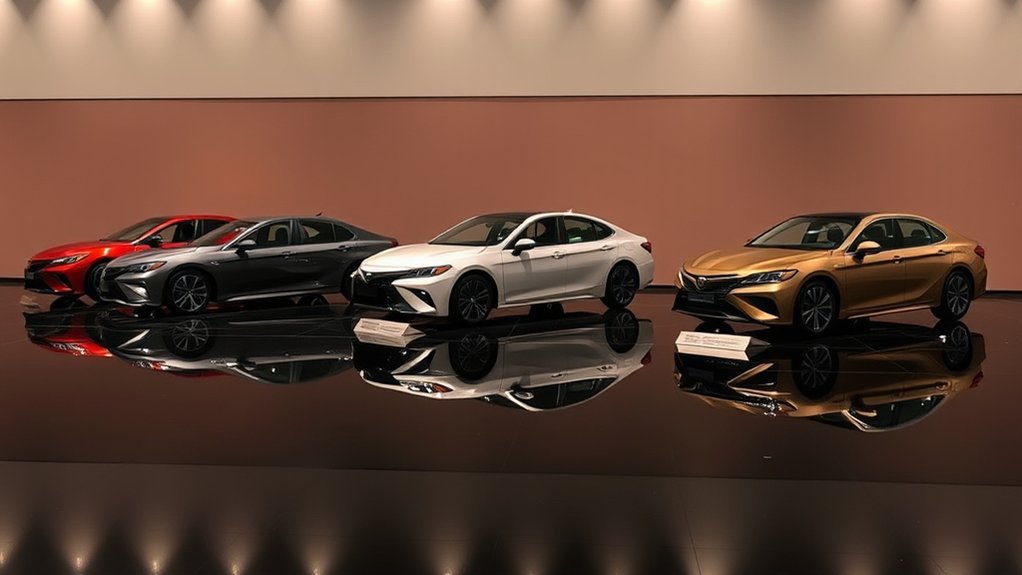
Since its introduction as a front-wheel-drive model in 1982, the Toyota Camry has developed from a compact car into one of the most recognizable midsize sedans in the United States. Its history reflects Toyota’s emphasis on practical transportation, efficient packaging, predictable operation, and gradual technical improvement.
Generation-count note: This article calls the 1983–1986 U.S. Camry the first U.S. generation and the 2025–present model the ninth. Toyota’s global archive may show different generation numbers because it includes the 1980 rear-wheel-drive Celica Camry and Japanese-market Camry lineages that did not always match North American redesign timing.
The Camry entered a market that already included strong Japanese competitors such as the Honda Accord. Toyota differentiated its new model with a front-wheel-drive layout that provided more usable passenger space than a similarly sized rear-wheel-drive design. According to Toyota’s corporate history, development of the front-wheel-drive Camry and Vista began in August 1977 and emphasized interior space, reduced weight, compact powertrain packaging, and fuel efficiency.
Those priorities helped the Camry become a long-running U.S. sales leader. Its reputation was built less on a single dramatic innovation than on Toyota’s ability to update the car as buyers demanded more room, stronger performance, improved safety, easier connectivity, and better fuel economy.
By 1985, Toyota reported 128,000 annual Camry sales in the United States—evidence of how quickly the front-wheel-drive model gained a place in the market.
The Origins of the Toyota Camry
The name has roots before the front-wheel-drive car familiar to U.S. buyers. Toyota introduced the rear-wheel-drive Celica Camry in Japan in 1980. The company then launched the newly developed front-wheel-drive Camry and Vista in Japan in March 1982. Because Toyota’s international archives include the Celica Camry and market-specific models, historical generation counts can differ from the common U.S. sequence used on this page.
Toyota began developing the front-wheel-drive Camry and Vista in August 1977. According to Toyota’s historical record, the engine was mounted transversely to shorten the engine compartment and recover more room for passengers. Exports of the resulting Camry to the United States began in January 1983, which is why the first U.S. Camry is generally identified as a 1983 model.
The first-generation V10 Camry was compact by modern standards. It used a transverse engine and front-wheel drive, a layout that reduced the space required for the drivetrain and helped create a roomier cabin. U.S. buyers could choose a four-door sedan or a five-door liftback, depending on model year and specification.
Early engines included four-cylinder gasoline units, while some markets also received diesel power. The first Camry was not positioned as a high-performance car. Its appeal came from efficient packaging, manageable operating costs, and a design suited to daily commuting and family use.
By 1985, U.S. sales had reached 128,000 units. Toyota then deepened the Camry’s American connection when production began at Toyota Motor Manufacturing Kentucky in May 1988. That plant became a major manufacturing base for U.S.-market Camrys in the decades that followed.
Note: The generation dates below follow common U.S. model-year designations. Production dates, names, body styles, launch timing, and generation numbering can differ in Japan and other international markets.
Toyota Camry Generations at a Glance
The Camry’s nine commonly recognized U.S. generations show how the model grew in size, changed body styles, adopted new powertrains, and responded to shifting market expectations. For a deeper shopping-focused breakdown of each redesign, see Toyota Camry Generations Explained.
| Generation | U.S. Model Years | Major Changes |
|---|---|---|
| First: V10 | 1983–1986 | Compact front-wheel-drive sedan and liftback; efficient packaging and four-cylinder power. |
| Second: V20 | 1987–1991 | More rounded styling, a quieter cabin, wagon availability, available V6 power, and available All-Trac all-wheel drive. |
| Third: XV10 | 1992–1996 | A wider, larger body moved the U.S. Camry firmly into the midsize class; sedan, wagon, and coupe versions appeared. |
| Fourth: XV20 | 1997–2001 | Improved refinement and available V6 performance; the Camry Solara became the related coupe and convertible line. |
| Fifth: XV30 | 2002–2006 | A taller, roomier body, a more upright cabin, and a stronger focus on the four-door sedan. |
| Sixth: XV40 | 2007–2011 | The first Camry Hybrid, a new 3.5-liter V6, and expanded convenience and safety technology. |
| Seventh: XV50 | 2012–2017 | Weight and efficiency improvements, updated infotainment, and an extensive exterior and interior refresh for 2015. |
| Eighth: XV70 | 2018–2024 | Toyota New Global Architecture, a lower and sportier body, revised handling, gasoline and hybrid powertrains, and the return of available AWD for 2020. |
| Ninth: XV80 | 2025–present | A hybrid-only U.S. lineup, available electronic all-wheel drive, updated displays, and Toyota Safety Sense 3.0. |
How the Camry’s Design Evolved
The first-generation Camry reflected early-1980s design trends with straight body lines, large glass areas, and a simple, functional cabin. Its compact exterior concealed a relatively spacious interior, thanks largely to the transverse engine and front-wheel-drive layout.
The second generation introduced softer edges and greater refinement. Toyota also offered a wagon, giving families more cargo capacity without moving to a larger vehicle. An available V6 broadened the Camry’s appeal to drivers who wanted smoother and stronger acceleration.
The third-generation XV10 was one of the most important changes in the Camry’s history. The U.S. version became wider and more substantial, moving clearly into the midsize segment. Its rounded exterior, quieter ride, and larger cabin matched American preferences of the early 1990s.
The fourth generation continued the emphasis on comfort and available V6 power. Toyota also separated the coupe concept into the Camry Solara line, which later included a convertible. The standard Camry increasingly concentrated on the four-door family-sedan market.
The fifth-generation XV30 adopted a taller roof and more upright proportions, creating additional headroom and easier entry. The sixth generation sharpened the exterior and introduced the Camry Hybrid for the 2007 model year. The seventh generation initially followed a conservative design direction before receiving an extensive 2015 refresh with substantially revised exterior panels and a more expressive front end.
For 2018, the eighth-generation Camry moved to Toyota’s TNGA-based GA-K platform. It sat lower, used more dramatic body lines, and offered sport-oriented trims alongside comfort-focused versions. This generation represented a deliberate effort to give the Camry more visual character and more responsive road manners.
The ninth generation arrived for the 2025 model year with familiar underlying proportions but redesigned front and rear styling, a revised cabin, larger available displays, and an exclusively hybrid U.S. powertrain range. Toyota describes it as the Camry’s ninth U.S. generation in its official introduction of the 2025 model.
How Market Trends Influenced the Camry’s Evolution
Market trends played a major role in transforming the Toyota Camry from a compact car into a larger midsize sedan. During the 1980s and 1990s, many U.S. buyers wanted more rear-seat space, quieter highway travel, larger trunks, and more powerful engines. Toyota responded by increasing the Camry’s dimensions and offering V6 power without abandoning four-cylinder efficiency.
Body-style demand also changed. Early generations included liftbacks, wagons, and coupes, but the U.S. market increasingly associated the Camry with the four-door sedan. The Solara gave Toyota a separate nameplate for coupe and convertible buyers, while the regular Camry focused on the higher-volume family-car segment.
The rise of environmental awareness and fuel-price concerns strengthened demand for electrified powertrains. Toyota introduced the Camry Hybrid for the 2007 model year, combining a gasoline engine with electric-motor assistance. Later hybrid generations improved performance, packaging, and fuel efficiency while making the technology feel more conventional in daily use.
Another market shift was growing demand for all-wheel drive. Toyota had offered Camry All-Trac models from 1988 through 1991, then returned AWD to the U.S. Camry for the 2020 model year. The modern 2020 system used a mechanical rear driveline, while the ninth-generation hybrid’s Electronic On-Demand AWD uses a dedicated rear electric motor.
As crossovers and SUVs gained market share, midsize sedans faced greater pressure to offer distinctive styling, stronger technology, and lower operating costs. The eighth-generation Camry answered with sportier design and improved handling. The ninth generation shifted the U.S. lineup entirely to hybrid power, making electrification a standard part of the Camry rather than a separate niche choice.
Technology, Safety, and Electrification
The Camry’s technology changed gradually during its early generations. Features that were once optional or uncommon—including automatic climate control, premium audio, navigation, stability control, multiple airbags, and keyless access—became more widely available as buyer expectations and safety standards evolved.
The 2007 model-year Camry Hybrid was a major powertrain milestone. It used a gasoline engine, an electric motor, and a hybrid battery to reduce fuel consumption, particularly in stop-and-go driving. The system could recover energy during deceleration and use electric assistance when conditions allowed.
The eighth generation’s TNGA platform brought structural and chassis changes intended to improve seating position, handling, ride quality, and powertrain packaging. Toyota continued offering gasoline four-cylinder, V6, and hybrid versions during this generation, depending on trim and model year. For a detailed year-by-year powertrain breakdown, see Toyota Camry Engine Options by Model Year Explained.
For the ninth generation, Toyota made every U.S. Camry a hybrid. Front-wheel-drive versions use Toyota’s fifth-generation hybrid system, while electronic on-demand all-wheel-drive models add a dedicated electric motor at the rear. Toyota lists combined system output at 225 horsepower with front-wheel drive and 232 horsepower with all-wheel drive.
The redesigned model also introduced Toyota Safety Sense 3.0. Depending on operating conditions, its functions can assist with tasks such as detecting certain vehicles or pedestrians, maintaining a selected following distance, providing lane-related alerts, and supporting steering within a detected lane.
Note: Driver-assistance features have operating limits and do not make the vehicle self-driving. The driver remains responsible for watching the road, controlling the vehicle, and responding to traffic conditions.
Toyota’s current U.S. materials document the 2026 Camry as an all-hybrid model with front-wheel drive or available electronic on-demand all-wheel drive. The 2026 lineup also includes a Nightshade grade, confirming that references to the 2025 redesign should no longer be written as a future development.
What the Camry’s History Means for Used-Car Shoppers
Each Camry generation has different strengths, features, powertrains, and age-related concerns. However, there is no universal Camry model year that every shopper should buy or avoid. An individual vehicle’s condition often matters more than a broad reputation attached to its model year.
Before buying a used Camry:
- Review maintenance records. Look for evidence of regular oil changes, fluid service, brake work, tire replacement, and repairs appropriate for the vehicle’s age and mileage.
- Check the VIN for open recalls. Use the official NHTSA recall lookup and confirm that completed recall work appears in the vehicle’s records.
- Research the exact configuration. Reliability concerns can differ between four-cylinder, V6, hybrid, front-wheel-drive, and all-wheel-drive versions.
- Inspect the vehicle’s condition. Check for fluid leaks, uneven tire wear, warning lights, corrosion, collision repairs, and signs of neglected maintenance.
- Arrange a pre-purchase inspection. A qualified independent technician can identify issues that may not appear during a short test drive.
- Evaluate older hybrids carefully. Review hybrid-system warnings, battery condition, cooling-system maintenance, and any available diagnostic information.
Pro Tip: Compare two used Camrys by service history, physical condition, recall completion, and inspection results before comparing them only by model year. A well-maintained higher-mileage car can be a better purchase than a lower-mileage example with poor records or long-term neglect.
Frequently Asked Questions
What is the history of the Toyota Camry?
Toyota launched the front-wheel-drive Camry in Japan in March 1982 and began exporting it to the United States in January 1983. It started as a compact front-wheel-drive car and gradually became a larger midsize sedan. Across the common nine-generation U.S. sequence, it added V6 power, hybrid technology, advanced safety systems, improved infotainment, all-wheel drive, and an all-hybrid powertrain lineup.
What are the Toyota Camry generations?
The commonly used U.S. model-year timeline is: first generation, 1983–1986; second, 1987–1991; third, 1992–1996; fourth, 1997–2001; fifth, 2002–2006; sixth, 2007–2011; seventh, 2012–2017; eighth, 2018–2024; and ninth, 2025–present. Dates and generation numbering can differ in other markets.
Why do some sources show a different number of Toyota Camry generations?
Generation counts differ because Toyota sold different Camry lineages in Japan and international markets. Toyota’s global historical archive includes the rear-wheel-drive 1980 Celica Camry and later Japanese-market models, while U.S. guides commonly count the front-wheel-drive 1983–1986 Camry as the first U.S. generation. Always check which market and numbering system a source is using.
When did Toyota start building the Camry in the United States?
Toyota began Camry production at its Georgetown, Kentucky plant in May 1988. The Kentucky facility later became one of the Camry’s main North American manufacturing bases and continues to build the current generation.
When did all-wheel drive return to the Toyota Camry?
All-wheel drive returned to the U.S. Camry for the 2020 model year, the first AWD Camry since 1991. Earlier second-generation models offered Toyota’s All-Trac system from 1988 through 1991. The current hybrid AWD system is different because it uses a dedicated rear electric motor.
Are there any Toyota Camry years to avoid?
There is no universal avoid list that applies to every Camry. Complaint frequency, recalls, maintenance, climate exposure, powertrain, mileage, and previous repairs all matter. Check the specific VIN for open recalls, review service records, research the exact engine and transmission, and obtain an independent pre-purchase inspection.
What year Toyota Camry is the most reliable?
No single model year is officially proven to be the most reliable for every owner. Later examples may have newer safety and convenience features, while some older generations are valued for mechanical simplicity. The best choice is usually a properly maintained vehicle with complete records, no unresolved recalls, a clean inspection, and a configuration suited to your needs.
When did the Toyota Camry Hybrid first appear?
The Camry Hybrid joined the U.S. lineup for the 2007 model year. It paired a gasoline engine with electric-motor assistance and regenerative braking. Hybrid technology remained available in later generations and became standard across the U.S. Camry lineup beginning with the ninth-generation 2025 model.
Is the current Toyota Camry hybrid only?
Yes. Beginning with the ninth-generation 2025 Camry, Toyota’s U.S. lineup uses hybrid power across all grades. The 2026 lineup continues that approach. Buyers can choose front-wheel drive or available electronic on-demand all-wheel drive, which adds a dedicated electric motor to drive the rear wheels when needed.
Conclusion
The Toyota Camry’s evolution reflects changing expectations for a mainstream family car. Its modern front-wheel-drive history began in Japan in 1982 before U.S. exports started in 1983. It then grew into a midsize sedan, gained V6 power, established a major U.S. manufacturing base in Kentucky, added hybrid technology, adopted TNGA, restored all-wheel drive, and finally switched the entire U.S. lineup to hybrid power for 2025.
When comparing Camrys, first identify the exact market, model year, generation, powertrain, and drivetrain. That avoids confusion created by different international generation counts and gives you a more useful basis for comparing specifications, maintenance history, recalls, and used-car condition.
Sources
- Toyota Motor Corporation: Development of Front-Wheel-Drive Vehicles — Camry/Vista development beginning in 1977, March 1982 Japanese launch, January 1983 U.S. exports, packaging goals, and 1985 U.S. sales.
- Toyota Motor Corporation: Camry Vehicle Gallery — Toyota’s global historical generation sequence, including the Celica Camry.
- Toyota: Ninth-Generation 2025 Camry Introduction — U.S. generation status, hybrid-only lineup, drivetrain outputs, electronic all-wheel drive, and safety technology.
- Toyota: Camry AWD Returns for 2020 — return of AWD after 1991, earlier All-Trac history, and 2020 AWD system details.
- Toyota: 2026 Camry Vehicle Information — current 2026 model-year context and Nightshade grade.
- Toyota: Current Camry — current U.S. hybrid powertrain, horsepower, drivetrain, grades, and Nightshade information.
- Toyota Safety Sense — official descriptions and operating limitations for Toyota driver-assistance features.
- National Highway Traffic Safety Administration: Recalls — VIN-specific recall lookup and information about recall remedies.
