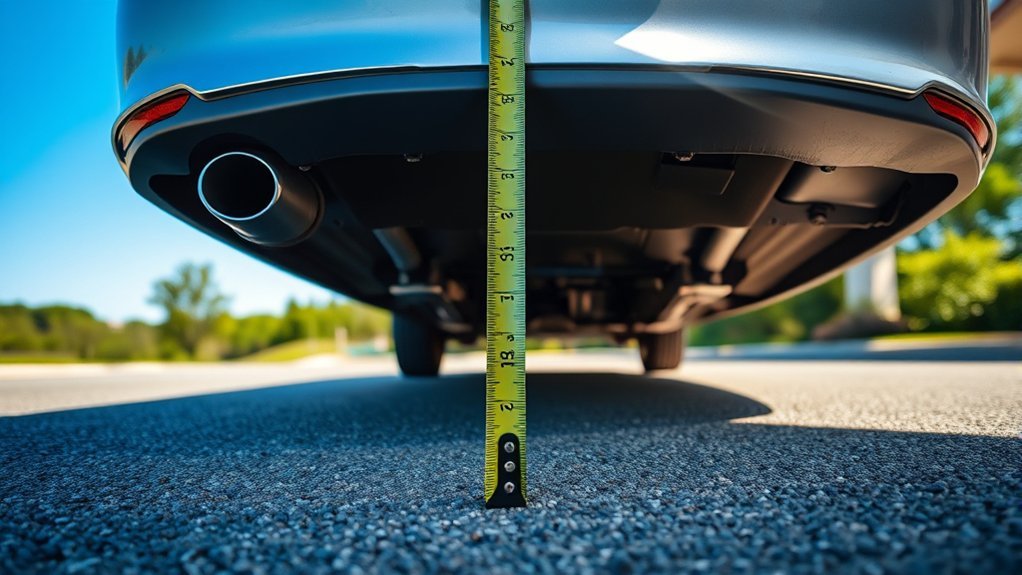
Last updated: September 19, 2026 — 2026 Camry ground-clearance data, tire guidance, warranty wording, internal links, and structured data rechecked.
Toyota Camry ground clearance is not one universal number. For a current reference, Toyota Canada lists 137 mm (5.4 in.) for the 2026 Camry configurations shown in its current specifications. Older model years and other markets can differ, so use the figure for your exact Camry rather than applying one number to every car.
To measure your own Camry, park on hard, level ground, set the cold tire pressures to the driver-door label, remove unusual cargo, and measure vertically from the pavement to several low underbody points. Repeat the lowest readings and record the smallest rigid-component distance, while noting a lower flexible air dam or splash shield separately.
Quick Answer
For one current reference, the 2026 Canadian-market Camry is listed at 137 mm (5.4 in.) of ground clearance. Your own Camry may differ by model year, market, tires, load, suspension, and measurement point. To measure it, park on hard, level ground with the correct cold tire pressures, check several low underbody points, repeat the lowest readings, and record the smallest rigid-component distance. Record flexible air-dam clearance separately because it may scrape before a rigid underbody component does.
Key Takeaways
- Toyota Canada currently lists 137 mm (5.4 in.) for the 2026 Camry configurations shown in its specifications, but older years and other markets can differ.
- Ground clearance is the smallest vertical distance between level pavement and a relevant low point beneath the vehicle.
- Use the cold tire pressures on the driver-door placard and record the vehicle’s load before measuring.
- Check the front, center, and rear underbody instead of measuring only the bumper, air dam, or four corners.
- A larger tire changes theoretical clearance by about half its increase in overall diameter, but fitment and safety matter more than the small gain.
- Investigate tire-pressure, load, loose-panel, and suspension problems before using lift parts or oversized tires to address scraping.
At a Glance
| 2026 Reference | 137 mm (5.4 in.) for the current Canadian-market configurations shown by Toyota; verify other years and markets separately |
| Time Required | About 10 to 15 minutes |
| Difficulty | Easy |
| Tools Needed | Tape measure or ruler, tire-pressure gauge, flashlight, inspection mirror, and notepad or phone |
| Cost | No added cost if you already own the tools |
What Is Ground Clearance and Why Does It Matter for the Toyota Camry?
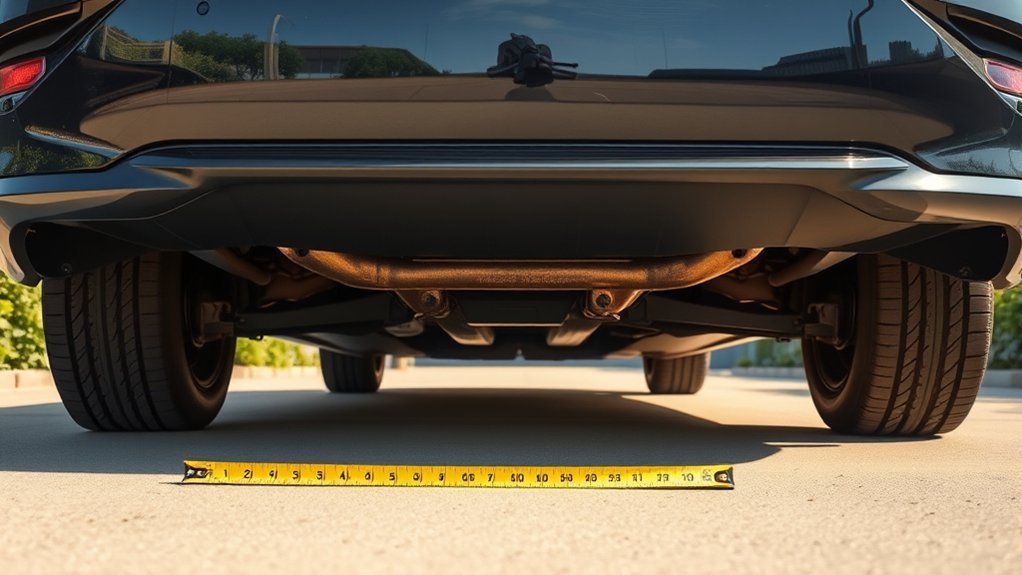
Ground clearance describes the vertical space between a level road surface and the lowest relevant point beneath your Camry. The smallest measurement matters because that component is most likely to contact a steep driveway, raised pavement, road debris, or the top of a speed bump.
Ground clearance is not the same as overall vehicle height or the gap between a tire and the fender. Fender measurements can help identify suspension sag or a left-to-right difference, but they do not show how much space exists beneath the vehicle.
Rigid Underbody Clearance vs. Flexible Air-Dam Clearance
For a useful home check, record two values when necessary. First, measure the lowest rigid underbody point, such as a subframe, suspension mount, exhaust section, or firm underbody panel. Second, record a lower flexible air deflector or splash shield as a separate scrape-risk measurement. Flexible trim may touch first without representing the manufacturer’s published minimum running-clearance point.
A Camry’s low sedan body supports stable road manners and aerodynamic efficiency. However, a long front overhang or low air deflector may scrape even when the central underbody has more room. Approach angle, breakover angle, wheelbase, suspension movement, vehicle load, and the shape of an obstacle all affect whether contact occurs.
For one current, market-specific reference, Toyota Canada lists 137 mm (5.4 in.) of ground clearance for the 2026 Camry configurations shown on its specifications page. Its current product summary shows that figure for SE FWD, SE Upgrade AWD, XLE AWD, and XSE AWD. Treat 5.4 inches as a current 2026 Canadian-market reference, not a universal figure for older Camrys, other markets, or modified vehicles.
Note: Published ground-clearance figures are model- and market-specific engineering specifications. A home measurement is an estimate of your vehicle in its present condition, with its current tires, load, suspension, and underbody parts.
Toyota Camry Ground Clearance by Model Year: Official Examples
Toyota’s own specifications show why a Camry ground-clearance number should always be tied to a model year and market. The following are verified manufacturer examples rather than a complete year-by-year lookup.
| Model Year | Market | Published Clearance | Source Context |
|---|---|---|---|
| 2024 | United States | 5.7 in. | Toyota’s 2024 U.S. Camry brochure lists 5.7 in. across the Camry configurations in its dimensions table. |
| 2026 | Canada | 137 mm (5.4 in.) | Toyota Canada’s current specifications list 137 mm (5.4 in.) for the configurations shown in its current table. |
Do not interpolate between these examples or assume an unlisted year has the same clearance. Check Toyota documentation for the exact model year and sales market, especially when comparing a used Camry with a newer generation.
How to Measure Your Camry’s Ground Clearance
Use the same preparation every time you measure. Consistent conditions make it easier to compare readings after a tire change, suspension repair, underbody repair, or change in vehicle load.
Step-by-Step Ground-Clearance Measurement
- Park on a hard, level surface and let the car cool. A smooth garage floor or level paved driveway works better than gravel, grass, cracked pavement, or a slope. Straighten the steering wheel, shift to Park, switch the vehicle off, apply the parking brake, and keep the key away from the car. Do not reach near a hot exhaust system.
- Check the tires while cold. Set each tire to the pressure shown on the driver-side door-jamb Tire and Loading Information Label. The National Highway Traffic Safety Administration defines a cold tire for pressure checking as one that has not been driven for at least three hours and advises using the vehicle manufacturer’s cold-pressure recommendation, not the maximum pressure molded into the tire sidewall. For the Camry-specific procedure, see our Toyota Camry tire-pressure guide.
- Remove unusual cargo and note the load. Take out heavy items that are not normally carried. Record the approximate fuel level and whether passengers or luggage are present if you want to compare loaded and unloaded clearance.
- Inspect likely low points. Use a flashlight and inspection mirror to look beneath the front, center, and rear of the car without placing your head or body under it. Possible low areas include an underbody panel, subframe, exhaust component, suspension mounting point, or front air deflector.
- Measure vertically. Hold a ruler or tape measure perpendicular to the pavement. Measure from the ground to each likely low point without pressing, lifting, or bending flexible trim. Record rigid and flexible points separately.
- Repeat each low reading. Measure the lowest candidates at least twice. If the results differ, reposition the ruler and check that the floor is level before recording the value.
- Record the smallest result. The lowest repeatable rigid-component distance is your practical ground-clearance estimate. Keep the front air-dam or flexible-panel clearance as a separate scrape-risk figure.
Warning: Do not crawl under a vehicle supported only by a jack. A jack can shift or fail, and lifting the Camry also changes the suspension position, making the clearance reading inaccurate. This check normally requires only a flashlight and inspection mirror. Any task that requires entering beneath the vehicle needs the correct Toyota lifting points and properly rated support equipment on a stable, level surface.
Your Camry’s practical ground clearance is the smallest repeatable vertical distance beneath the vehicle, not an average of four corner or fender measurements.
Pro Tip: Photograph each measurement point and label it with the reading, tire pressure, tire size, and vehicle load. The record makes future comparisons more reliable after tire, alignment, spring, strut, exhaust, or underbody repairs.
What to Record With the Measurement
- Date, location, and whether the surface was level.
- Cold tire pressures and the installed tire size.
- Passenger, cargo, and approximate fuel-load condition.
- Lowest rigid underbody point and its reading.
- Lowest flexible air-dam or splash-shield point and its reading.
Why Your Measurement May Differ From a Published Specification
A home measurement may not match a number found in a manufacturer specification, vehicle database, or comparison chart. A small difference does not automatically indicate a problem because the published value and your home reading may use different vehicle conditions or reference points.
- Model year and trim: Different Camry generations and trims may use different wheels, tires, underbody panels, and suspension tuning. Toyota’s current Camry specifications and 2026 Camry model information show grade-level differences in wheel size and suspension equipment.
- Tire pressure: Underinflation reduces the tire’s loaded radius and can lower the body slightly.
- Tire wear: A worn tread has a smaller overall radius than a new tire of the same size.
- Passenger and cargo weight: Added weight compresses the springs and reduces clearance.
- Fuel and equipment: Fuel level, accessories, and items stored in the trunk affect vehicle weight.
- Suspension condition: A weakened or broken spring, worn mount, or damaged suspension component can change ride height.
- Measurement definition: One source may measure to a rigid component while another includes a flexible air deflector or excludes selected components.
- Rounding: Published inch and millimetre values may be rounded, and a home tape measure can introduce small reading errors.
- Surface error: A sloped, cracked, crowned, or uneven floor can distort the result.
Use Toyota’s manuals and warranty portal to locate information for your exact model year. If the published specification is unavailable, a careful measurement of the actual vehicle is more useful than applying a figure from another generation or market.
Factors Affecting Ground Clearance in the Toyota Camry
Several design, maintenance, and loading factors can change how much usable space your Camry has beneath it.
- Suspension design: Springs, struts, control arms, bushings, and suspension mounting points establish the vehicle’s normal ride height and movement.
- Vehicle load: Passengers, luggage, and heavy trunk cargo compress the suspension. The rear may sit lower when weight is concentrated behind the back seat.
- Tire dimensions: A tire with a larger overall diameter can raise the wheel center, but only part of that diameter increase becomes added clearance.
- Tire pressure and wear: Low pressure and reduced tread depth can slightly lower the vehicle.
- Suspension wear or damage: Broken springs, collapsed mounts, damaged bushings, or bent parts can create an uneven stance.
- Underbody additions: Aftermarket braces, exhaust parts, aerodynamic panels, and skid plates may become the new lowest point.
How Tire Size Changes Ground Clearance
A tire’s full diameter increase does not become added ground clearance. Only the increase in radius raises the axle and body.
Estimated clearance change = (new tire diameter − original tire diameter) ÷ 2
For example, replacing a 26.0-inch tire with a 26.6-inch tire creates a theoretical diameter increase of 0.6 inch. The estimated ground-clearance increase is about 0.3 inch.
The real change may be slightly different because tires compress under vehicle weight. Brand, wheel width, inflation pressure, tread depth, and load also affect the tire’s loaded radius. The formula estimates only the vertical change; it does not prove that the tire will fit.
A larger tire must clear the fender liner, strut, suspension components, and body through full steering lock and suspension travel. It must also have an appropriate load index and speed rating. A substantial diameter change changes effective rolling circumference and can create rubbing, load-rating, and fitment problems. NHTSA recommends using the original tire size or another size recommended by the vehicle manufacturer. Before considering another size, review our Toyota Camry tire-size decoding guide and Camry wheel-and-tire fitment guide.
Modifications to Improve Your Camry’s Ground Clearance
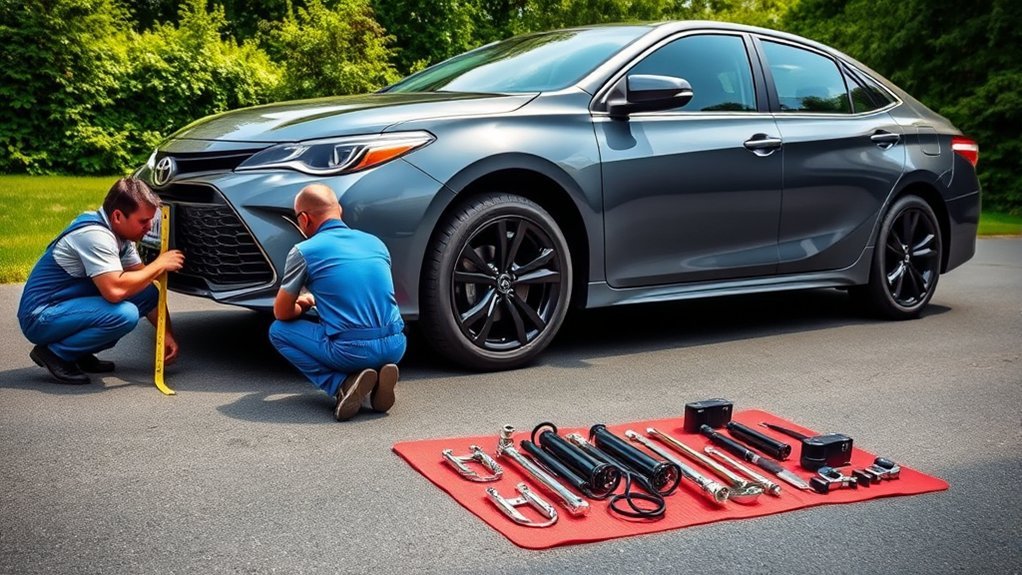
Most Camry owners should keep the factory ride height. The suspension, steering, braking systems, tires, body clearances, and other vehicle systems were developed to work together at the original ride height.
A modification may help with a specific clearance problem, but it can also create new fitment, handling, alignment, durability, calibration, and legal concerns. Correct low tire pressure, excessive load, worn tires, loose panels, or failed suspension parts before treating normal ride height as the problem.
| Option | Possible Effect | Checks Required |
|---|---|---|
| Replace worn factory-size tires | Restores some clearance lost through tread wear | Correct size, pressure, load index, speed rating, balance, and alignment |
| Manufacturer-approved alternate tire size | May create a small change in clearance | Overall diameter, rubbing, wheel fit, load rating, and full steering and suspension travel |
| Replacement springs or struts | Can restore ride height if original parts have sagged or failed | Exact model compatibility, complete axle-pair replacement when required, alignment, and ride-height inspection |
| Load-support springs | May reduce sag while carrying weight | Load limits, unloaded ride quality, suspension travel, and manufacturer instructions |
| Lift components | May raise selected parts of the body | Exact-year engineering, axle and joint angles, alignment range, steering geometry, braking, sensor calibration, handling, and local legal requirements |
| Skid plate or underbody guard | May protect a vulnerable component from light contact | Reduced clearance, added weight, cooling, drainage, mounting strength, and service access |
A skid plate does not increase clearance. Its thickness and mounting hardware may reduce the available space beneath the car. A spring with a higher spring rate also does not automatically raise an unloaded Camry; ride height depends on the complete spring design, installed length, vehicle load, and suspension geometry.
Warning: A higher body does not convert a Camry into an off-road vehicle. Changes to suspension height or tire diameter can affect steering, braking, alignment, stability, component wear, and tire or body clearance. Use parts engineered for the exact model year and trim, then have the vehicle inspected and aligned.
Using aftermarket parts or an independent repair shop does not automatically cancel the entire vehicle warranty. The Federal Trade Commission’s consumer auto-warranty guidance states that aftermarket or recycled parts do not automatically void the warranty. If a defective part or incorrect installation causes covered damage, the manufacturer or dealer may deny coverage for that damaged part, but it must show that the aftermarket or recycled part caused the damage.
How Does Toyota Camry Ground Clearance Compare With Similar Sedans?
A fair comparison requires more than placing one clearance number beside another. Compare the same model year, market, trim, drivetrain, wheel package, and loading condition. Confirm that each source uses the same definition of ground clearance.
Use the following checklist when comparing the Camry with an Accord, Altima, Civic, 3 Series, or another sedan:
- Check the manufacturer’s specification for the exact model year and trim.
- Confirm the original tire size and wheel package.
- Look for sport suspensions, aerodynamic packages, exhaust differences, or underbody panels.
- Determine whether the figure includes a flexible air deflector.
- Compare front and rear overhang, wheelbase, and approach or breakover geometry, not clearance alone.
- Measure the actual vehicles under similar tire-pressure and load conditions when possible.
A sedan with slightly more central underbody clearance may still scrape first if it has a longer, lower front overhang. Another car with a shorter overhang may clear the same driveway even with a similar published ground-clearance figure. A long wheelbase can also increase the chance of touching the center of a sharp crest or tall speed bump. If tight driveway and parking geometry also matters to you, see our Toyota Camry turning-radius guide.
Signs Your Camry May Be Sitting Too Low
A lower reading does not always mean the vehicle needs modification. It may point to incorrect tire pressure, excessive load, worn tires, a loose underbody panel, or damaged suspension parts.
Arrange an inspection if you notice any of these symptoms:
- One corner or one side sits visibly lower on level ground.
- The car scrapes familiar driveways or speed bumps that it previously cleared.
- A tire rubs the fender liner during turns or over bumps.
- The suspension bottoms out or makes a sharp impact sound.
- A spring appears cracked, displaced, or heavily corroded.
- A strut leaks fluid or the vehicle continues bouncing after a bump.
- A splash shield, heat shield, exhaust part, or aerodynamic panel hangs lower than normal.
- Fender-to-wheel measurements differ noticeably after tire pressures and vehicle loading are equalized.
Measure fender height at matching points on the left and right sides when checking for sag. Use that comparison only as a diagnostic clue. The minimum underbody measurement remains the correct way to estimate practical ground clearance.
After a hard scrape: If you notice a fluid leak, tire rubbing, a dragging exhaust or underbody panel, a warning light, or a noticeable change in steering or braking afterward, stop when it is safe and have the vehicle inspected before continuing normal driving.
How to Reduce Scraping on Driveways and Speed Bumps
- Approach steep driveway transitions and speed bumps slowly.
- Use a slight angle only when traffic, lane markings, pedestrians, curbs, and available space make it safe and legal.
- Avoid braking hard while the front wheels are climbing an obstacle because forward weight transfer can compress the front suspension.
- Do not straddle road debris unless you know it will clear the lowest point.
- Avoid climbing curbs. A curb can damage tires, wheels, alignment, splash shields, and suspension parts.
- Reduce heavy trunk cargo before entering a steep driveway if the rear of the car is close to scraping.
Frequently Asked Questions
How is vehicle ground clearance measured?
Park on hard, level ground, prepare the tires and vehicle load, inspect several likely low underbody points, and measure vertically from the pavement to each point. Repeat the lowest readings and record the smallest rigid-component distance as the practical ground-clearance estimate.
What is the ground clearance of a Toyota Camry?
No single figure applies to every Camry. As one current manufacturer example, Toyota Canada lists 137 mm (5.4 in.) for the 2026 Camry configurations shown in its specifications. Toyota’s 2024 U.S. brochure listed 5.7 inches, illustrating why the model year and market must be checked before using a clearance figure.
Is 5.4 inches of Camry ground clearance enough for speed bumps?
A 5.4-inch published clearance does not guarantee that every speed bump or driveway will clear. Front overhang, wheelbase, obstacle shape, vehicle load, suspension movement, tire condition, and a low air dam can cause contact even when the central underbody has more room. Approach unfamiliar bumps slowly and do not assume their height is safe from the published clearance alone.
Should I measure the front bumper or air dam?
Measure a low bumper lip or air dam as a separate scrape-risk point, especially if it hangs below the body. Also inspect rigid underbody components because flexible trim may not represent the manufacturer’s minimum running-clearance definition.
Does tire pressure affect ground clearance?
Yes. An underinflated tire has a smaller loaded radius and can lower the vehicle slightly. Check pressure while the tires are cold and use the specification on the driver-door placard, not the maximum pressure on the tire sidewall.
Do worn tires reduce ground clearance?
Yes, slightly. As tread wears away, the tire’s overall diameter and radius decrease. Replacing a heavily worn tire with a new tire of the same specified size can restore some of that lost radius, but the change is normally modest.
How much clearance does a larger tire add?
The theoretical increase is about half the change in overall tire diameter. A tire that is 0.6 inch larger in diameter may add about 0.3 inch of clearance before accounting for compression under load. Use the original tire size or another manufacturer-recommended size and confirm rubbing clearance, wheel fit, load capacity, and full steering and suspension travel before changing sizes.
Can I safely increase Toyota Camry ground clearance?
Start by correcting low tire pressure, excessive load, worn tires, loose underbody panels, or failed suspension parts. Factory ride height is the lowest-risk setup. If a modification is still necessary, use parts engineered for the exact model year and trim and verify alignment, steering, braking, suspension travel, tire clearance, and applicable legal requirements after installation.
Why is one side of my Camry lower than the other?
Uneven pavement, tire pressure, cargo placement, a weak or broken spring, a damaged mount, or another suspension problem may cause the difference. Recheck on level ground with equal cold tire pressures, then arrange an inspection if the difference remains.
How accurate is a home ground-clearance measurement?
A careful home reading is useful for documenting your own car and comparing changes over time, but it may not match a manufacturer’s engineering measurement. Surface level, tire condition, load, reference-point choice, and ruler position can create small differences. Repeat each low reading and avoid false precision.
Can I use a jack to make measuring easier?
No. Lifting the car changes the suspension position and makes the ground-clearance measurement inaccurate. A flashlight and inspection mirror are usually sufficient. Never enter beneath a vehicle supported only by a jack.
Conclusion
Accurate Toyota Camry ground-clearance measurement starts by identifying the exact model-year and market specification, then measuring the actual car under consistent conditions. For the current Canadian-market 2026 Camry configurations shown by Toyota, the published figure is 137 mm (5.4 in.); older Camrys and other markets can differ.
Park on hard, level ground, use the correct cold tire pressures, remove unusual cargo, let hot components cool, inspect several underbody areas, repeat the lowest readings, and record the smallest rigid-component distance. Keep flexible air-dam clearance separate. If scraping becomes more frequent or one side sits low, inspect the tires, splash shields, exhaust, and suspension before considering larger tires or a suspension-height modification.
Sources
- Toyota Camry Specifications: Current U.S. trim, wheel, suspension, equipment, and dimensional information.
- Toyota 2026 Camry Model Information: Grade-specific wheel sizes and sport-tuned suspension details.
- Toyota Manuals and Warranties: Model-year-specific owner information, tire guidance, and lifting precautions.
- Toyota Canada 2026 Camry Specifications: Current Canadian-market ground-clearance reference.
- Toyota 2024 U.S. Camry Brochure: Official 2024 U.S.-market dimensions, including the 5.7-inch ground-clearance specification.
- NHTSA TireWise: Cold tire pressure, placard, tire-size, maintenance, and replacement guidance.
- Federal Trade Commission Auto-Warranty Guidance: Warranty treatment of independent service and aftermarket or recycled parts.
