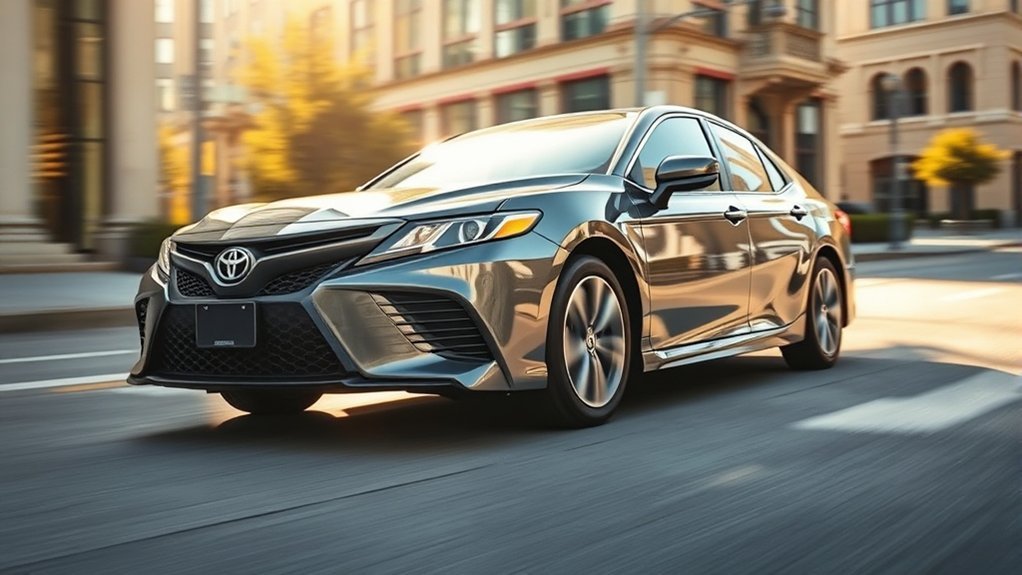
For the 2026 U.S.-market Toyota Camry, Toyota currently lists a 37.4-foot turning circle. That is the full turning diameter, not the radius. It equals an approximate 18.7-foot radius, 11.4-meter diameter, or 5.7-meter radius. Use that figure for the current U.S. model, but verify the exact model year and market before applying it to an older or non-U.S. Camry.
Last updated: September 19, 2026. This revision verifies the current 2026 U.S. Camry turning-circle figure against Toyota’s comparison data and clarifies radius, diameter, curb-to-curb, and market-specific measurements.
Quick Answer
The 2026 U.S. Toyota Camry has a Toyota-listed turning circle of 37.4 feet. That is the full diameter of the circle, so the corresponding turning radius is about 18.7 feet. In metric units, the figures are approximately 11.4 meters diameter and 5.7 meters radius. Older Camrys and cars sold in other markets can use different figures or measurement terminology.
Key Takeaways
- Toyota’s current U.S. comparison data lists a 37.4-foot turning circle for the displayed 2026 Camry configuration.
- A 37.4-foot diameter equals an approximate 18.7-foot radius, 11.4-meter diameter, or 5.7-meter radius.
- “Turning radius,” “turning diameter,” and “turning circle” are sometimes used inconsistently, so check what the source actually measures.
- Curb-to-curb measurements follow the tire path; wall-to-wall or body measurements account for more of the vehicle envelope and are normally larger.
- Turning circle matters mainly during parking, U-turns, driveways, garages, and other low-speed maneuvers.
- Confirm the model year, market, drivetrain, wheel package, units, and measurement method before comparing two Camrys or comparing a Camry with another vehicle.
What Is the Toyota Camry Turning Radius?
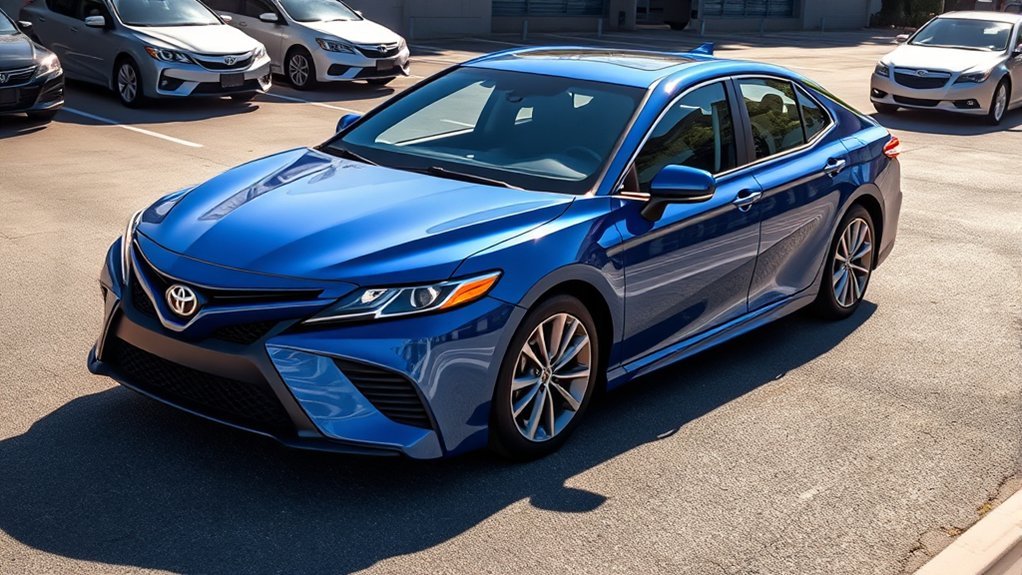
For the current U.S. model, Toyota’s 2026 Camry comparison data lists a 37.4-foot turning circle. A vehicle’s turning radius is half its turning diameter, so that figure corresponds to an approximate 18.7-foot radius.
| 2026 U.S. Camry measurement | Equivalent | Meaning |
|---|---|---|
| 37.4 ft turning circle | Approximately 11.4 m | Full turning diameter listed by Toyota for the displayed current U.S. configuration |
| 18.7 ft radius | Approximately 5.7 m | Half of the 37.4-foot turning circle |
The reference point also matters. A curb-to-curb figure normally follows the path of the outer tire, while a wall-to-wall or body-clearance measurement includes more of the vehicle’s exterior envelope.
Note: Never compare two turning figures until you confirm that both use the same unit, reference point, and radius-or-diameter convention. A 5.7-meter radius and an 11.4-meter diameter describe approximately the same geometric circle.
Market-specific documentation shows why this distinction matters. Toyota Indus Motor Company’s current Pakistan-market Camry brochure lists a 6.1-meter “Min. Turning Radius Body”. That should not be treated as a contradiction of Toyota U.S.’s 37.4-foot turning-circle figure because the market, configuration, and measurement wording differ. See the Toyota Pakistan Camry brochure.
The current U.S. lineup includes multiple trims and both front-wheel-drive and electronic on-demand all-wheel-drive versions. Use the official Toyota Camry overview and Toyota’s current specification interface to confirm the configuration you are researching.
For the Camry’s length, width, height, wheelbase, ground clearance, and related measurements, see our Toyota Camry exterior dimensions guide.
How Are Turning Radius and Turning Diameter Measured?
A vehicle’s minimum turning circle describes a low-speed maneuver with the steering at or near full lock. The two most useful terms are:
- Curb to curb: Measures the circle traced by the outer tire or wheel path. This is commonly used in passenger-vehicle specification tables.
- Wall to wall: Measures the space required by the vehicle’s outer body as it turns. Body overhang makes this figure larger than a tire-path measurement.
Wheelbase, steering angle, track width, suspension design, tire dimensions, steering geometry, and available clearance can all influence the result. Exterior length alone does not tell you how tightly a vehicle will turn.
A minimum turning-circle specification describes a controlled, low-speed maneuver at or near full steering lock. It is not a measurement of high-speed handling.
Why Do Published Camry Turning Figures Differ?
Different Camry numbers can both be legitimate if they refer to different vehicles or measurement methods. Check these details before comparing figures:
- Radius versus diameter: One source may publish half the circle while another publishes the full width.
- Curb to curb versus wall to wall or body: Tire-path and body-clearance measurements are not interchangeable.
- Model year and generation: Steering geometry, wheelbase, body design, and available tire packages can change.
- Trim and factory wheels: Tire width, wheel offset, suspension hardware, and clearance requirements can vary.
- Drivetrain: Front-wheel-drive and all-wheel-drive configurations may use different hardware or packaging.
- Market: U.S., Canadian, Asian, Australian, and other regional Camrys may not share identical specifications.
- Rounding: A figure converted between feet and meters may be rounded differently.
A real U-turn can also require more pavement than the published turning diameter. The specification represents a controlled circular path. A real road adds your starting position, lane markings, curbs, parked vehicles, body overhang, slopes, entry angle, exit angle, and the safety clearance you should leave around obstacles.
How Can You Measure Your Camry’s Turning Diameter?
You can estimate your Camry’s curb-to-curb turning diameter in a large, empty, level area. This is a practical estimate rather than a standardized manufacturer measurement.
- Prepare the vehicle: Set the tires to the cold pressures on the driver-side Tire and Loading Information label and remove unusual cargo.
- Choose a safe location: Use a dry, level, traffic-free paved area with plenty of room in every direction.
- Mark a starting point: Place a removable chalk mark where the outside front tire begins.
- Turn slowly: Move at walking speed with the steering smoothly brought to full lock. Do not force the wheel harder after it reaches its stop.
- Complete the circle: Drive one complete circle while a helper remains well outside the vehicle’s path.
- Mark the outer tire path: Use several chalk points or removable markers to identify the widest part of the outer tire track.
- Measure across the circle: Measure the greatest straight-line distance through the center of the marked path.
- Repeat in the other direction: Measure both left and right turns and record any meaningful difference.
Warning: Do not perform this test on a public road, near pedestrians, or in a confined parking area. Keep helpers outside the possible swept path, drive only at walking speed, and stop immediately if visibility or clearance is uncertain.
A small difference between repeated measurements can result from marking accuracy, steering input, tire scrub, pavement condition, or rounding. A large left-to-right difference, binding, rubbing, unusual noise, or inconsistent steering effort deserves inspection.
How Does the Camry Turning Radius Affect Urban Driving?
The Camry’s turning circle matters most during U-turns, narrow driveway entries, compact parking-garage turns, and turnarounds on confined streets. A smaller turning diameter generally means the vehicle can complete the maneuver with less lateral space.
A Camry is a midsize sedan, but vehicle class or exterior length alone cannot predict maneuverability. Steering geometry and maximum wheel angle matter too, which is why two similarly sized cars can have different turning circles.
You may need a three-point turn when the usable road width is smaller than the space required by the tire path plus safe body clearance. That does not describe high-speed handling; it simply means a single uninterrupted forward arc does not fit.
Visibility also affects how easy the Camry feels to maneuver. Windshield pillars, mirrors, camera views, lighting, and equipped parking aids can matter just as much as the published turning-circle number in everyday use.
How Can You Maneuver a Camry in Tight Spaces?
Use slow, deliberate movements and plan the vehicle’s path before committing to a tight turn.
- Approach slowly: Lower speed gives you more time to observe pedestrians, curbs, posts, and nearby vehicles.
- Use the available width: When legal and safe, begin a tight turn from the outer side of your lane or parking aisle.
- Look toward the intended path: Check the front corners, mirrors, blind spots, and area behind the car.
- Allow for front-end swing: The front bumper moves outward while the rear wheels follow a tighter inside path.
- Use small corrections: Stop and reposition instead of forcing the vehicle through a turn that feels too tight.
- Use parking technology as assistance: A rear camera, parking sensors, or panoramic-view system can help when your Camry has that equipment.
- Practice in an open area: An empty parking lot can help you learn where the front and rear corners travel during a tight turn.
Warning: Cameras and parking sensors may not show every person, animal, curb, post, or low object. The National Highway Traffic Safety Administration says backup cameras do not replace mirrors or physically looking around the vehicle. Stop whenever you are uncertain about clearance.
During a very tight maneuver, leave clearance on both sides. Watching only the inside rear wheel can cause you to overlook the front corner swinging toward a nearby vehicle, wall, or post.
Does the Camry’s Turning Radius Matter on Highways?
The minimum turning circle has little direct relevance to normal highway driving because lane changes, curves, and merges use much smaller steering angles than a full-lock parking maneuver.
At higher speeds, steering response, suspension tuning, tires, alignment, road surface, crosswinds, stability-control systems, visibility, and driver input matter more. Use the 37.4-foot figure to judge low-speed maneuverability, not highway safety or emergency handling.
How Should You Compare the Camry’s Turning Radius With Other Cars?
Compare equivalent measurements rather than comparing vehicle categories alone. A Camry may turn more tightly than some long-wheelbase SUVs or pickups, while a compact crossover with favorable steering geometry may need less space than the Camry.
Use the following checklist:
| Comparison item | What to check |
|---|---|
| Measurement type | Compare curb-to-curb with curb-to-curb or wall-to-wall with wall-to-wall. |
| Radius or diameter | Confirm whether the number describes half the circle or its full width. |
| Model year | Compare the exact generations and model years you are considering. |
| Trim and wheels | Check whether the manufacturer publishes different figures for different configurations. |
| Drivetrain | Confirm whether the value applies to front-wheel drive, all-wheel drive, or both. |
| Market | U.S., Canadian, Asian, Australian, and other versions may use different configurations or specifications. |
A smaller turning diameter helps in crowded areas, but it is only one buying factor. Passenger space, cargo capacity, visibility, comfort, fuel economy, ground clearance, safety equipment, and other daily requirements may be more important for your use.
How Does the Camry Turning Radius Affect Parking?
The turning circle affects parking because the front body, front wheels, and rear wheels follow different paths. Understanding those paths can reduce unnecessary corrections.
Parallel Parking
Parallel parking requires room for the front of the car to swing outward while the rear moves into the space. Reverse slowly, use a consistent starting position, and check the front corner before turning the steering back toward the curb.
Do not rely only on the rear camera. It may not show the front bumper or every nearby object.
Perpendicular and Angled Parking
Use as much of the parking aisle as safely available before beginning a sharp turn into a perpendicular space. Turning too early can bring the inside rear wheel close to the line, while turning too late can leave the Camry angled or place its outside front corner close to the opposite row.
When reversing out, remember that the front end swings toward the vehicle or object on the opposite side. Check both front corners as well as the rear path.
U-Turns and Three-Point Turns
Toyota’s 37.4-foot current U.S. turning-circle figure should not be treated as a promise that a 37.4-foot-wide road is enough for every U-turn. The published circle does not include your starting offset, every part of the body, curbs, parked vehicles, medians, slopes, lane restrictions, or a safe clearance margin.
Make a U-turn only where it is legal, visible, and safe. When space is uncertain, a controlled multi-point turn or another route is better than forcing the car through a single movement.
Pro Tip: During a test drive, try a legal U-turn, a perpendicular parking space, and a parallel-parking setup. Those maneuvers show how the Camry fits your normal driving environment better than a specification alone.
How Does Turning Radius Affect a Camry Owner’s Daily Experience?
Your experience depends on where you drive. A Camry may feel easy to maneuver in open suburban lots but require more planning in narrow alleys, older garages, or streets lined with parked vehicles.
Drivers moving from a short compact car may notice the Camry’s additional length and swept path, while someone moving from a large SUV, van, or pickup may find the sedan easier to place.
If the Camry suddenly becomes harder to steer, do not assume its designed turning circle has changed. Check tire pressure and visible tire condition first. Rubbing, binding, pulling, unusual noise, an off-center steering wheel, or noticeably different behavior left versus right can point to a tire, alignment, steering, wheel-clearance, or suspension problem.
Why Does Turning Radius Matter Less on Long Trips?
Turning diameter matters when leaving a parking space or navigating a tight destination. During most highway travel, the steering remains close to straight ahead, so seat support, cabin space, noise, ride quality, climate control, visibility, and driving position affect comfort more often.
Long-Distance Travel Considerations
Camry trims can differ in wheels, tires, seating materials, and equipment. Before a long trip, adjust the seat and steering wheel for a comfortable driving position, set the mirrors, and use the recommended cold tire pressures on the vehicle’s Tire and Loading Information label.
Highway Cruising Experience
Judge highway behavior through a road test rather than the minimum turning-circle specification. Straight-line stability, steering corrections, road noise, seat support, visibility, tire condition, and ride quality are more relevant at highway speed.
Balancing Comfort and Maneuverability
Match the vehicle to how you actually drive. Frequent city parking gives greater importance to visibility, vehicle length, turning diameter, and parking aids. Frequent highway travel places more emphasis on seating, ride quality, noise, efficiency, climate control, and luggage space.
- Mostly city use: Test tight parking spaces, garages, driveway entries, and legal U-turns.
- Mostly long trips: Test seating comfort, road noise, visibility, ride quality, and highway stability.
- Mixed use: Include both low-speed maneuvering and faster-road driving in the same test drive.
How Do You Maintain Predictable Camry Steering?
Routine care will not reduce the Camry’s designed factory turning diameter, but it helps the car steer and track normally. Use the maintenance information for your exact model year rather than a generic schedule.
| Item | Why it matters | What to do |
|---|---|---|
| Tire pressure | Incorrect pressure can change steering feel, grip, and tire wear. | Use the cold pressure on the driver-side Tire and Loading Information label, not the tire sidewall maximum. |
| Wheel alignment | Poor alignment can cause pulling, an off-center steering wheel, or uneven tire wear. | Arrange an inspection when symptoms appear or after a significant impact. |
| Tire and wheel size | Nonstandard wheels or tires may rub or reduce available steering clearance. | Use an approved size with suitable load rating, speed rating, offset, and clearance. |
| Steering and suspension | Worn or damaged parts may create looseness, noise, binding, or uneven response. | Arrange an inspection if steering effort or behavior changes. |
| Parking cameras and sensors | Dirty lenses or blocked sensors can reduce useful visibility or warnings. | Keep equipped cameras and sensors clean and unobstructed. |
The NHTSA tire-safety guidance says to use the manufacturer’s recommended cold pressure from the Tire and Loading Information label or owner’s manual. Toyota provides model-specific manuals and warranty information through its official owner resources.
Note: Avoid forcing the steering wheel harder after it reaches full lock or holding unnecessary pressure against the stop. If the steering cannot reach its normal travel smoothly, have the tires, wheels, steering, and suspension inspected.
How Do You Find Your Camry’s Exact Turning Specification?
Use this process when you need a model-specific figure:
- Confirm the Camry’s model year and the country or market where it was originally sold.
- Identify the exact trim, drivetrain, and original factory wheel and tire package.
- Check Toyota’s model page, full specifications, and comparison interface for that market.
- Search for an official model-year brochure, product summary, fleet guide, or technical specification sheet.
- Look for “turning circle,” “turning diameter,” “minimum turning radius,” “curb to curb,” “wall to wall,” or “body.”
- Confirm whether the number is in feet, meters, or millimeters and whether it represents a radius or full diameter.
- If public material omits the measurement, ask a Toyota dealer to check the appropriate technical specifications by VIN or model code.
- When comparing another vehicle, use the same measurement method and unit for both.
Toyota’s current U.S. Camry overview identifies the active U.S. model year and configurations. The Toyota Canada Camry specification page provides Canadian-market configuration information. Equipment and published terminology can differ by market.
Note: Do not automatically apply a specification from another country to your Camry. Market-specific cars can differ in wheels, tires, drivetrain, equipment, steering clearance, and the reference method used for the published turning figure.
Frequently Asked Questions
What is the turning radius of a 2026 Toyota Camry?
Toyota’s current U.S. comparison data lists a 37.4-foot turning circle for the displayed 2026 Camry configuration. Because that is the diameter, the corresponding radius is approximately 18.7 feet. In metric units, that is about an 11.4-meter diameter or 5.7-meter radius.
Is the Camry’s 37.4-foot figure a radius or diameter?
It is the full turning circle, or diameter, in Toyota’s current U.S. comparison data. Half of 37.4 feet is an approximate 18.7-foot turning radius.
Is turning radius the same as turning circle?
Not technically. Turning radius is the distance from the center of the circle to its edge, while turning diameter or turning circle describes the full width. Some websites use the terms loosely, so check whether the published number represents the radius or diameter.
Why can a Camry U-turn require more than 37.4 feet of road?
The 37.4-foot figure describes a controlled turning circle, not a guaranteed minimum road width for every U-turn. Your starting position, body overhang, curbs, parked vehicles, medians, slopes, entry and exit angles, and required safety clearance can all increase the usable space you need.
Can I measure my Camry’s turning diameter myself?
Yes. In a large, empty, level area, mark the outer front tire’s path while completing a slow full-lock circle, then measure the widest straight-line distance across the marked path. Repeat in both directions. Treat the result as a practical estimate rather than an official standardized specification.
Is a smaller turning radius always better?
A smaller radius generally makes low-speed maneuvering easier, but it does not automatically make one vehicle better. Visibility, passenger space, comfort, cargo capacity, safety equipment, ride quality, fuel economy, and other daily requirements may matter more.
Can wheel size or drivetrain change a Camry’s turning circle?
A vehicle’s turning circle can be affected by tire dimensions, wheel offset, steering limits, suspension clearance, drivetrain packaging, and other configuration-specific hardware. Do not calculate the change from wheel diameter alone. Check the specification for the exact year, trim, drivetrain, market, and factory wheel package.
Why does my Camry feel harder to turn than before?
Check cold tire pressure and inspect the tires for visible damage first. Binding, rubbing, unusual noise, increased steering effort, pulling, an off-center steering wheel, or different behavior when turning left and right can indicate a tire, alignment, steering, wheel-clearance, or suspension problem that deserves inspection.
Sources
- Toyota: 2026 Camry Comparison — lists a 37.4-foot turning circle for the displayed current U.S. Camry configuration.
- Toyota: 2026 Camry Overview — identifies the current U.S. model year, trims, and available front-wheel-drive and electronic on-demand all-wheel-drive configurations.
- Toyota: 2026 Camry Full Specifications — provides current mainland-U.S. configuration information and Toyota’s specification and regional caveats.
- Toyota Indus Motor Company: Camry Specification Brochure — lists a 6.1-meter “Min. Turning Radius Body” for its market-specific Camry and illustrates why measurement terminology and market must be checked.
- Toyota Manuals and Warranties — provides model-specific owner documentation and maintenance information.
- NHTSA: Driver Assistance Technologies — explains backup-camera operation and its limitations.
- NHTSA: Tire Safety — supports using the manufacturer’s recommended cold tire pressure from the driver-side label or owner’s manual.
Conclusion
For the current 2026 U.S. Toyota Camry, the most useful verified figure is Toyota’s 37.4-foot turning circle. That is a diameter, equal to an approximate 18.7-foot radius, 11.4-meter diameter, or 5.7-meter radius.
Use the specification to compare low-speed maneuverability for parking, garages, driveways, and U-turns, but do not assume 37.4 feet is the exact road width required for a real U-turn. Confirm the model year, market, configuration, units, and measurement method before applying any Camry turning figure to your own vehicle.

1 thought on “Toyota Camry Turning Radius Explained (What to Expect)”