
Safe Toyota Camry jack stand placement starts with one rule: identify the approved lifting and support points for your exact vehicle before raising it. Camry generations, drivetrains, hybrid systems, suspension layouts, and underbody panels differ, so a location that is correct on one model may damage another or allow the vehicle to slip.
Quick Answer
Place Toyota Camry jack stands only at the support points identified for the exact model year, drivetrain, and body configuration. Side pinch-weld notches commonly mark emergency-jack areas, but floor-jack and repair-support locations can differ. Work on level concrete, chock the grounded wheels, and never go under a Camry supported only by a jack.
Key Takeaways
- Confirm the model year, production information, drivetrain, and market before selecting a lifting diagram.
- Check the Toyota Manuals and Warranties portal or the appropriate Toyota Canada manual before choosing a point.
- Do not assume that a visible subframe bolt, suspension arm, crossmember, rear beam, differential housing, or reinforced-looking seam can support the car.
- Use equipment with sufficient rated capacity, a suitable lift range, and a saddle or adapter designed for the approved contact point.
- When supporting an axle, use a matched pair of stands at corresponding approved points unless Toyota specifies another arrangement.
- Never place any part of your body beneath the Camry until its weight rests securely on properly positioned and locked jack stands.
At a Glance
| Time Required | About 20 to 40 minutes for identification, inspection, setup, lifting, support, and lowering; repair time is not included |
| Difficulty | Moderate, with serious consequences if equipment, lift points, or support points are used incorrectly |
| Tools Needed | Rated floor jack, matched rated jack stands, wheel chocks, flashlight, gloves, and an approved saddle or pinch-weld adapter when required |
| Cost | No service cost if you already own suitable equipment; equipment cost varies by capacity, lift range, saddle design, and certification |
Warning: A hydraulic floor jack and Toyota’s emergency scissor jack are lifting devices, not permanent supports. Never crawl under the Camry, reach beneath its suspension, or begin underbody work until the vehicle rests securely on correctly rated stands at approved support points.
Understanding Safe Jack Stand Placement for Your Toyota Camry
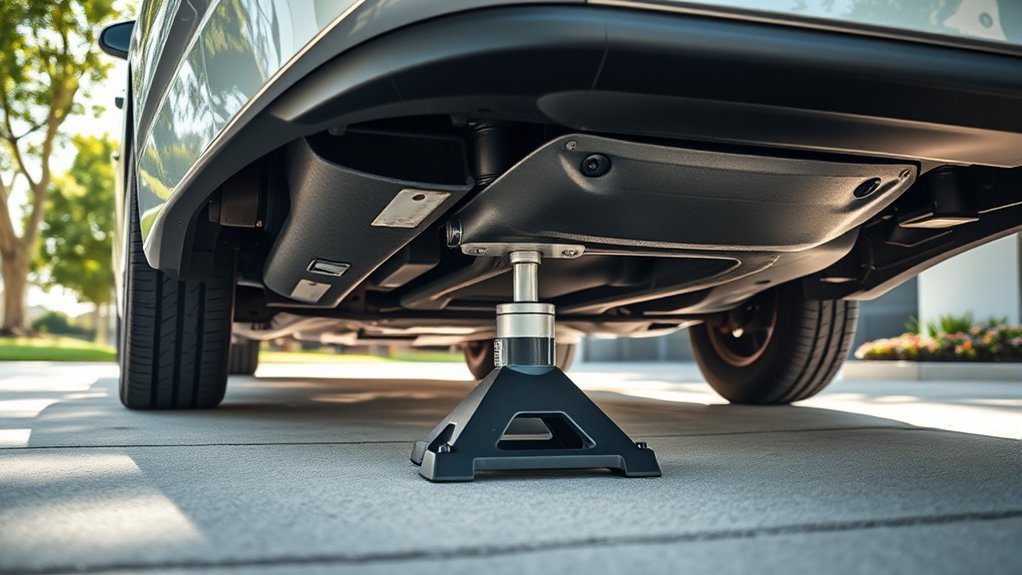
A Toyota Camry can have three different types of locations involved in lifting: emergency-jack points, central or designated floor-jack points, and jack-stand support points. These terms are not interchangeable.
Emergency-jack points are commonly marked by small notches near reinforced pinch-weld areas beneath the rocker panels. Toyota provides these locations primarily for roadside wheel changes with the supplied jack. A service procedure may direct a floor jack to a different central point and may specify separate points for the stands.
Model year and configuration matter. A diagram for a 2002 Camry should not be applied to a later-generation gasoline, hybrid, front-wheel-drive, or all-wheel-drive Camry. Underbody covers, suspension members, battery enclosures, exhaust routing, and approved contact areas can change.
Confirm Your Exact Camry Configuration
Before searching for a diagram, confirm the vehicle rather than relying only on its appearance. Record the model year and VIN, then check the compliance label near the driver’s door opening for production information. Also confirm whether the Camry is gasoline or hybrid and whether it is front-wheel drive or all-wheel drive.
Use the manual portal for the market in which the vehicle was sold. U.S. owners can use the Toyota Manuals and Warranties portal. Canadian owners can use Toyota Canada’s Owner’s Manuals and Emergency Response Guides page. If the production information falls near a model change or the manual’s applicability is unclear, ask a Toyota service department to confirm the correct document from the VIN.
Check the Exact Toyota Diagram First
Review the tire-changing and lifting sections in the owner’s manual. When the owner’s manual shows only emergency-jack points, consult Toyota’s Technical Information System or ask a Toyota service department for the approved floor-jack and support-point procedure. Some detailed Toyota service information may require account access or a subscription.
Do not select a point merely because it looks thick or strong. Plastic covers, exhaust parts, suspension links, steering components, oil pans, transmission cases, battery housings, motor units, wiring, and unmarked sheet metal are not assumed lifting or support points.
Identify the Different Types of Lift and Support Points
| Location | Typical Purpose | Safe Use |
|---|---|---|
| Side pinch-weld notches | Commonly identify a reinforced emergency-jack area | Use with a floor jack or stand only when the model-specific instructions and saddle or adapter design permit it. |
| Central or designated floor-jack point | Raises the front or rear so stands can be positioned | Use only the exact component and contact area identified in Toyota service information. |
| Specified jack-stand point | Supports the vehicle after it has been raised | Center the stand saddle fully, lock the stand, and confirm that the entire base remains flat. |
| Unmarked suspension or underbody part | Not an assumed lift or support point | Do not use it unless Toyota documentation identifies that exact location and purpose. |
Note: Small notches beside a pinch weld identify a reinforced area; they do not make the entire rocker seam a safe lifting surface. Center the compatible saddle or adapter at the specified area and avoid crushed, torn, or heavily corroded metal.
Prepare Your Camry and Equipment Before Lifting
A safe lift begins before the jack touches the vehicle. Complete these checks every time:
- Choose firm, level ground. Clean concrete is preferable. Do not lift on a slope, loose gravel, soft soil, or an unstable surface.
- Keep everyone out of the vehicle. Close the doors, switch the vehicle completely off, and remove the key or keep the smart key away from the car.
- Shift into Park. Apply the parking brake unless the repair procedure requires it to be released later. Do not release it until the vehicle is supported and the opposite wheels are securely chocked.
- Chock the wheels that stay on the ground. When lifting the front, secure the rear wheels. When lifting the rear, secure the front wheels.
- Read every equipment label. Confirm that the jack and stands have sufficient rated capacity and suitable lift ranges. Check whether the stand rating applies to one stand or to a pair.
- Use a matched pair when supporting an axle. The stands should be the same design and set to equal heights unless the Toyota procedure states otherwise.
- Inspect the equipment. Do not use a leaking jack, bent stand, damaged locking mechanism, cracked saddle, unreadable capacity label, or recalled product. Search current notices through the U.S. Consumer Product Safety Commission recall database, especially before using second-hand or unfamiliar equipment.
- Inspect the vehicle. Stop if an intended support point is rusty, crushed, torn, bent, contaminated, or obstructed in a way that prevents full saddle contact.
- Check the contact shape. A narrow pinch weld, flat pad, or shaped central point may require a different saddle or manufacturer-approved adapter.
The jack saddle must contact the approved lift point squarely. A purpose-built slotted rubber adapter may protect a pinch weld when the vehicle, jack, and adapter instructions allow it. Do not balance the Camry on loose lumber, stacked pads, or an adapter that prevents the saddle from seating correctly.
Pro Tip: Use a flashlight before rolling the jack under the Camry. Confirm the intended metal contact point from more than one viewing angle instead of judging its location from the jack handle or an underbody panel.
How to Lift and Support a Toyota Camry Step by Step
- Identify the approved points. Match the model year, production information, drivetrain, hybrid status, and market to the correct Toyota diagram.
- Prepare the work area. Park on a firm, level surface, switch the car off, keep occupants out, select Park, and chock the wheels at the opposite axle.
- Inspect the jack path. Make sure the jack can reach the point without contacting plastic panels, cables, hoses, exhaust parts, or other components.
- Position the floor jack. Roll it beneath the approved point and center the saddle. On a smooth, level floor, do not obstruct the jack’s casters from moving normally as the lifting arm changes angle.
- Raise the vehicle slowly. Watch the saddle, contact point, jack body, and vehicle continuously. Stop if the jack leans, the saddle shifts, a panel bends, or the Camry moves sideways.
- Position the stands. Set a matched pair to equal heights when supporting an axle and place their saddles at the corresponding approved support points.
- Lower the Camry onto the stands. Open the jack’s release valve gradually until the stands carry the load. Confirm that both bases remain fully flat and that the saddles do not move.
- Inspect the complete setup. Check saddle centering, stand height, locking mechanisms, wheel chocks, support-point condition, and vehicle balance from outside the underbody area.
- Perform a controlled stability check. From outside the vehicle’s footprint, apply a small sideways push to a solid body area. Do not kick the vehicle, climb into it, slam doors, or rock it vigorously. Any movement, settling, or unusual sound means the vehicle must be raised and supported again.
- Begin work only after every check passes. Never treat hydraulic pressure or the emergency jack as the primary support.
Lifting the Front of the Camry
Chock both rear wheels and use the approved front lifting point shown for the exact model. Raise the car only high enough to place a matched pair of stands at the approved front support points. Keep the stands at equal heights unless Toyota’s procedure specifically requires another arrangement.
Lifting the Rear of the Camry
Chock both front wheels and identify the approved rear lifting point from the correct manual or service diagram. Do not assume that a rear suspension arm, exhaust bracket, differential housing, electric motor unit, mounting bolt, or axle-like member is the correct point.
If rear brake work requires the parking brake to be released, first support the vehicle securely according to the repair procedure. Keep the front wheels firmly chocked and verify stability again after changing the parking-brake setting.
Lifting One Corner for Wheel Service
For a roadside wheel change, follow the emergency-jack procedure in the owner’s manual and use the reinforced side location identified for that wheel. Keep every person away from the underside of the vehicle.
A roadside emergency jack is not suitable for repairs that require a hand, arm, head, or tool to extend beneath the Camry. For repair work, use the approved floor-jack and stand procedure, even when only one wheel or corner requires attention.
How to Use a Hydraulic Floor Jack Safely
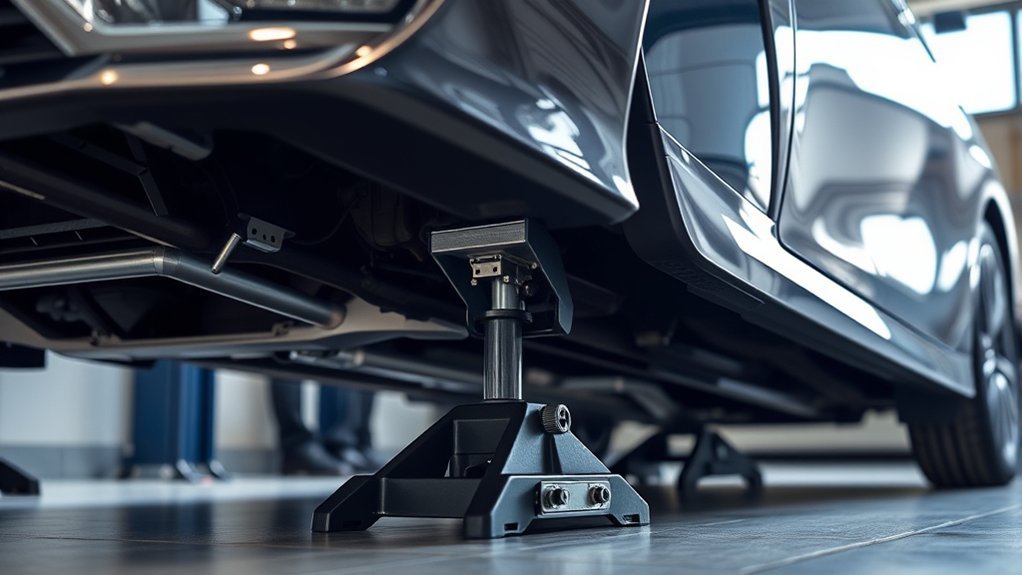
A hydraulic jack must have sufficient rated capacity to lift and sustain the intended load. The OSHA requirements for jacks also address rated capacity, travel limits, inspection, and promptly securing a raised load. These general rules do not replace Toyota’s vehicle-specific instructions or the equipment manufacturer’s manual.
| Step | Action | What to Check |
|---|---|---|
| 1 | Center the saddle at the approved point | Full contact with no plastic, wiring, hoses, cables, or exhaust parts beneath the saddle |
| 2 | Close the release valve according to the jack instructions | The valve operates smoothly and the jack shows no leaks or visible damage |
| 3 | Pump slowly while watching the contact point | No sliding, leaning, bending, crushing, or sideways vehicle movement |
| 4 | Stop at the minimum height needed | The jack remains below its marked travel limit and the stands can be positioned without overextension |
| 5 | Install and lock the stands | Equal height where required, centered saddles, flat bases, and fully engaged locks |
| 6 | Lower the Camry onto the stands | The stands accept the load evenly without tilting, sliding, or damaging the support points |
Do not treat a creak, pop, or visible movement as a normal signal to continue. Stop and lower the Camry if the jack, stand, pinch weld, adapter, or support point shifts or deforms.
How to Confirm the Jack Stands Are Stable
Before working beneath the Camry, inspect the setup from the front, rear, and both sides. Each stand’s center column should be upright, every foot should contact the floor fully, and the saddles should sit squarely beneath corresponding support points.
A jack raises the Camry. Properly placed and locked jack stands support it while you work.
Lower the vehicle and start again if you notice any of the following:
- One stand appears to carry substantially more weight than the other.
- A stand leans or sits partly on debris, a floor joint, or an uneven patch.
- The saddle touches only an edge of the approved support point.
- A pinch weld begins to fold, split, or slide out of the saddle or adapter.
- The vehicle rocks, settles, shifts, or produces an unusual sound during the controlled check.
- A wheel chock moves, turns, or loses firm contact with the tire.
- A plastic panel, underbody shield, cable, or hose is trapped between a saddle and the approved metal point.
- A stand lock is partly engaged or the two stands are set at unintended unequal heights.
Stay outside the area beneath the rocker panels, engine bay, suspension, and floor during the inspection and stability check. Do not enter the Camry or operate powered vehicle systems while it is supported on stands.
How to Lower a Toyota Camry from Jack Stands
- Complete the repair’s pre-lowering steps. Reinstall any wheel, shield, drain plug, or component that the repair procedure requires before the vehicle is lowered.
- Clear the area. Remove tools, parts, lights, drain pans, and people from beneath and around the Camry. Confirm that no cord or hose can catch on the vehicle.
- Keep the wheel chocks in place. Do not remove them while the vehicle remains raised.
- Position the floor jack at the approved lifting point. Use the same model-specific procedure used to raise the vehicle. Center the saddle and raise it slowly until it just takes the load off the stands.
- Remove the stands. Confirm that the jack is stable, then remove both stands from the supported axle. Keep your body outside the vehicle’s underside while retrieving them.
- Lower the Camry slowly. Open the release valve gradually and watch the jack, tires, body, and work area until all wheels rest fully on the ground.
- Remove the jack and chocks. Remove the jack only after the vehicle is fully down and stable. Remove the wheel chocks last.
- Perform the final repair checks. Follow the applicable procedure for wheel-nut torque, fluid level, fastener inspection, warning lights, or a short test drive. Never guess a torque specification.
Note: Raise the vehicle only enough to unload the stands. Lifting it unnecessarily high during stand removal adds movement and reduces the available safety margin.
Avoid These Common Mistakes When Lifting Your Vehicle
- Copying a diagram from another Camry generation: Similar body shapes do not confirm identical floor-jack or support points.
- Confusing production year with document applicability: Check the VIN, compliance label, drivetrain, and Toyota manual information rather than relying on registration paperwork alone.
- Calling every reinforced seam a frame rail: A unibody Camry uses designated reinforced areas; the entire rocker seam is not a support point.
- Placing stands beneath unapproved suspension arms: Arms and links can move as the vehicle is lowered, allowing a saddle to slip.
- Supporting the vehicle on plastic panels: Underbody covers can hide the correct point and can crack or collapse under load.
- Using loose wood under stands: Lumber can tilt, split, compress, or create an unstable footing on an otherwise firm floor.
- Working on asphalt, gravel, or a slope: The floor jack may roll unpredictably, and stand feet can sink or lean.
- Using mismatched stand designs or heights: Unequal support can shift weight to one side.
- Skipping wheel chocks: Park and the parking brake do not replace physical wheel restraint.
- Ignoring rust, cracks, or bent metal: A damaged support area may fail even if it was reinforced when new.
- Working under the emergency jack: The supplied jack is intended for temporary wheel-changing use, not underbody repairs.
- Rushing the lowering process: Tools, stands, or body parts can be trapped when the vehicle is lowered without a complete area check.
Troubleshooting Lift-Point Problems
The Pinch Weld Is Bent or Rusty
Do not place a jack or stand on severely rusted, split, crushed, or folded metal. Have the area inspected by a qualified repair shop and obtain an approved alternative support location before lifting the vehicle again.
The Floor Jack Will Not Fit Under the Camry
Use a properly rated low-profile jack with a suitable lift range. Do not drive onto loose blocks or improvised ramps. Purpose-built vehicle ramps may create access clearance, but they must be rated for the load, positioned on firm and level ground, and used exactly as their manufacturer directs.
An Underbody Panel Hides the Central Point
Check the Toyota procedure before removing a panel. Do not jack through plastic. If service information requires panel removal, use the specified fastener procedure and reinstall every clip, screw, and shield after the work.
You Cannot Match the Vehicle to an Online Diagram
Stop before lifting. Confirm the VIN, model year, production information, drivetrain, and hybrid status, then use the appropriate Toyota manual portal or Toyota Technical Information System. A Toyota service department can identify the correct procedure from the VIN when online diagrams remain unclear.
The Camry Is a Hybrid
Do not touch, lift against, or support the vehicle on high-voltage cables, connectors, battery enclosures, electric-drive components, or unmarked underbody parts. Orange-colored cables and connectors commonly identify high-voltage components, but their exact routing and protection vary. Use only the lift and support points shown for the exact hybrid model.
Consult the model-specific owner, emergency-response, dismantling, or service information before working near the hybrid system. If the approved point is hidden by or close to an unfamiliar electrical component, stop and obtain professional guidance.
The Parking Brake Must Be Released for Rear Brake Work
Keep the parking brake applied during initial setup unless the repair procedure states otherwise. After the Camry is securely supported, keep the front wheels chocked, release the parking brake as directed, and repeat the external stability inspection. Never release it while the rear of the vehicle is supported only by a hydraulic or emergency jack.
Frequently Asked Questions
Where should you put jack stands on a Toyota Camry?
Place them only at the support points identified for the exact model year, drivetrain, and configuration. Some Toyota procedures may use reinforced side areas with a compatible saddle or adapter, while others identify separate support points. Do not select a subframe, suspension part, crossmember, or bolt without Toyota documentation confirming the exact location.
Where should you place a jack stand after lifting the car?
Position the stand beneath the approved support point specified for that lifting procedure. Center the saddle, lock the height mechanism, and make sure the entire base sits flat before slowly lowering the vehicle onto it.
How do you determine the proper lift points for a Camry?
Confirm the VIN, model year, production information, drivetrain, and hybrid status. Then use the owner’s manual for that exact vehicle. When it does not identify repair-support points, consult Toyota service information or ask a Toyota service department to confirm the procedure from the VIN.
What is the 3/4 rule for floor jacks?
The cited OSHA jack standard does not contain a rule requiring a floor jack to be raised to three-quarters of its maximum height. Lift only to the minimum height needed, remain below the jack’s marked travel limit, and use equipment with sufficient rated capacity and lift range.
Can you place Toyota Camry jack stands under the subframe?
Only when Toyota service information identifies the exact subframe location as an approved support point. A mounting bolt, brace, suspension attachment, or broad section of the subframe is not automatically safe because it looks strong.
Should you use wood blocks with jack stands?
Do not place loose lumber under jack stands on an otherwise firm garage floor. It can tilt, compress, or split. Place the stands directly on clean, level, hard ground and use only a purpose-built saddle adapter approved for the vehicle contact point and support equipment.
How many jack stands do you need for a Toyota Camry?
Use the number and placement specified by the Toyota procedure. When supporting the front or rear axle, this normally means a matched pair at corresponding approved points. Do not improvise a single central stand or use one stand where the procedure calls for two.
How do you lower a Camry from jack stands?
Clear the work area, keep the wheels chocked, and place the floor jack at the approved lifting point. Raise the vehicle only enough to unload the stands, remove the stands from outside the underbody area, and lower the Camry slowly. Remove the jack and wheel chocks only after all tires are fully on the ground.
Sources
- Toyota Manuals and Warranties — U.S. model-year owner’s manuals, tire-changing instructions, and vehicle-specific guidance.
- Toyota Canada Owner’s Manuals and Emergency Response Guides — Canadian manual applicability, production-date guidance, and hybrid emergency information.
- Toyota Technical Information System — Toyota repair procedures, service information, and model-specific technical documentation.
- OSHA 29 CFR 1910.244: Jacks — jack capacity, marking, travel-limit, inspection, and raised-load securing requirements.
- U.S. Consumer Product Safety Commission Recalls — current recall and product-safety searches for jacks, jack stands, and other equipment.
Conclusion
Safe Toyota Camry jack stand placement depends on the exact vehicle, not one universal location that works for every generation. Confirm the VIN and configuration, use the applicable Toyota diagram, choose properly rated equipment, chock the grounded wheels, and place every stand only at an approved support point.
Never work beneath a Camry supported only by a hydraulic or emergency jack. If a point is rusty, damaged, hidden, electrically sensitive, or unclear, lower the vehicle and obtain Toyota service information or professional help. After the repair, clear the area, re-jack the vehicle at the approved point, remove the stands safely, and lower the Camry in a controlled manner.