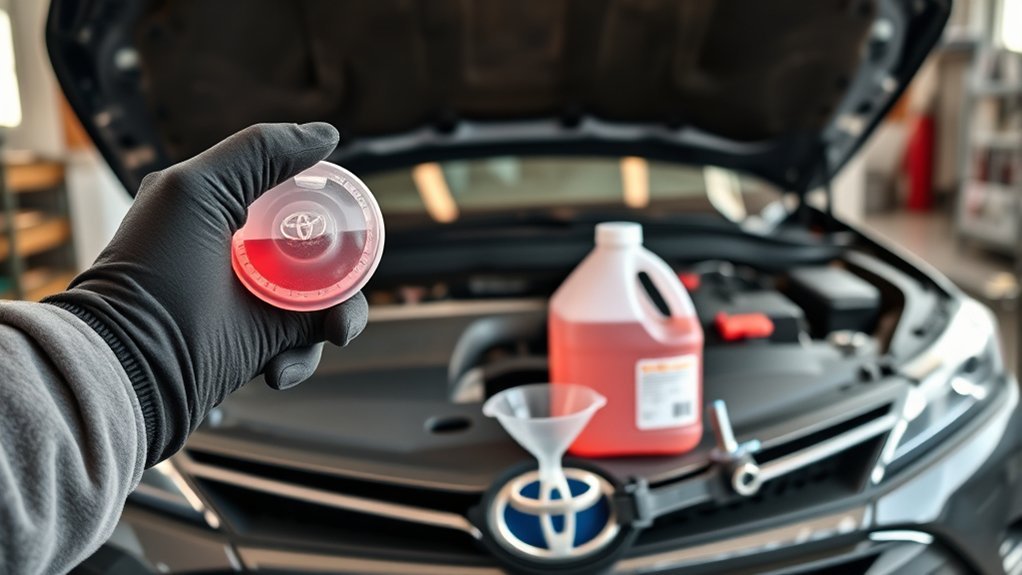
Your Toyota Camry’s coolant replacement schedule depends on the model year, the cooling circuit, and whichever limit comes first: mileage or time. The often-repeated “five years or 150,000 miles” rule is not the normal engine-coolant schedule for recent U.S. Camrys. Hybrid models can also have separate engine and inverter coolant intervals.
Quick Answer
For many recent U.S.-market Toyota Camrys, replace engine coolant first at 100,000 miles or 120 months, whichever comes first, then every 50,000 miles or 60 months. On hybrid models, inverter coolant may have a different first interval—often 150,000 miles or 180 months—so verify the schedule for your exact model year.
Key Takeaways
- For recent Camrys, the first engine-coolant replacement is commonly due at 100,000 miles or 10 years, not 150,000 miles.
- After the first replacement, Toyota commonly specifies a 50,000-mile or five-year interval.
- Hybrid engine and inverter cooling systems can have different first replacement dates.
- A sweet odor, falling coolant level, or overheating warning calls for diagnosis; it does not automatically mean the vehicle only needs a flush.
At a Glance
| Time Required | About 5 minutes for a cold-engine level and condition check; substantially longer for a model-specific drain, refill, and air-bleeding service |
| Difficulty | Easy for inspection; intermediate to advanced for replacement, especially on hybrid cooling circuits |
| Tools Needed | Flashlight and gloves for inspection; replacement also requires a drain pan, correct hand tools, exact coolant, and the model-specific filling and bleeding procedure |
| Cost | A visual inspection costs nothing; replacement cost depends on the model year, coolant capacity, number of cooling circuits, coolant price, and local labor |
What Does Engine Coolant Do for Your Toyota Camry?
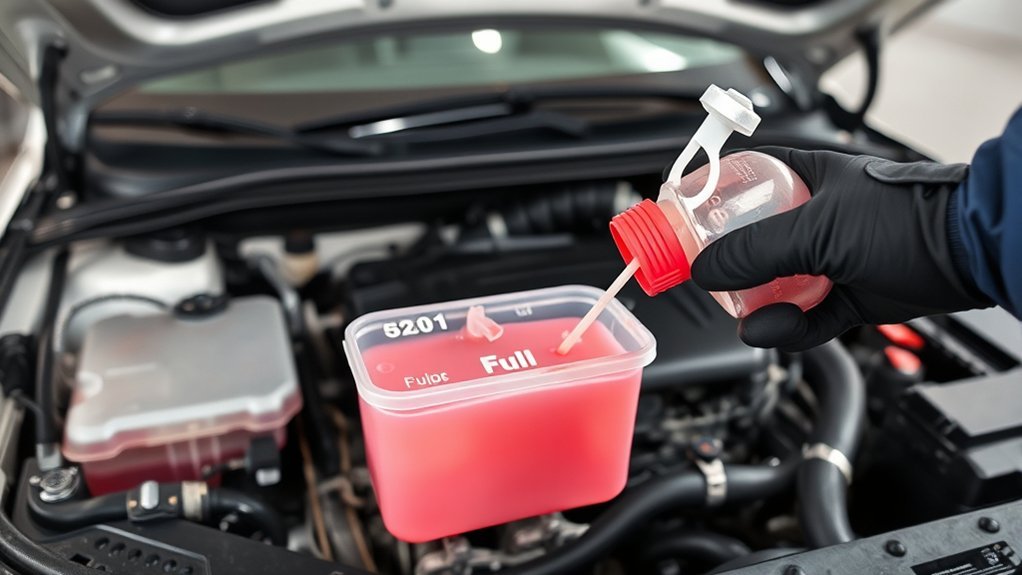
Engine coolant circulates through passages in the engine and radiator, carries away heat, helps prevent freezing, and contains inhibitors that protect cooling-system metals from corrosion. Correct coolant concentration also supports water-pump lubrication and raises the fluid’s boiling protection compared with plain water.
A hybrid Camry may have more than one cooling circuit. The engine cooling system controls gasoline-engine temperature, while a separate inverter cooling circuit removes heat from hybrid power-electronics components. The reservoirs and replacement schedules should not be assumed to be interchangeable.
Toyota’s 2026 U.S. Camry guide lists the first engine-coolant replacement at 100,000 miles or 120 months and the first applicable inverter-coolant replacement at 150,000 miles or 180 months.
Coolant vs. Antifreeze: What Toyota Camry Owners Should Know
Antifreeze is the concentrated glycol-based portion of the fluid. Engine coolant is the usable mixture of antifreeze, treated water, and corrosion-control additives. In everyday conversation, the two terms are often used interchangeably, but the product label matters when adding or replacing fluid.
Coolant Composition Differences
Recent Toyota maintenance guides call for Toyota Genuine Super Long Life Coolant or a similar high-quality ethylene-glycol coolant that meets Toyota’s specified long-life hybrid organic acid chemistry. The exact wording can vary by model year, so compatibility should be confirmed from the owner’s manual rather than inferred from color alone.
Older Camrys may specify a different Toyota coolant or replacement schedule. A red, pink, green, orange, or yellow appearance by itself does not prove that two coolants are chemically compatible.
Antifreeze Functionality Explained
| Function | Why It Matters | Owner Guidance |
|---|---|---|
| Transfers heat | Helps keep the engine and related components within their intended operating range | Check the level and investigate overheating promptly |
| Provides freeze and boil protection | Reduces freezing risk in winter and improves boiling protection under load | Use the concentration specified by the manual and product label |
| Controls corrosion | Protects aluminum and other cooling-system materials | Use Toyota SLLC or a fully compatible equivalent |
| Supports seals and pump operation | Correct coolant helps the system operate as designed | Do not run plain water as the permanent fill |
Do not create a 70/30 blend simply because the climate is cold. Many Toyota coolant products are supplied ready to use. Adding water to premixed coolant changes its concentration, while adding straight concentrate without calculating the final mixture can also produce the wrong result.
Mixing Coolants Risks
Different coolants can use different inhibitor packages. Mixing products that are not confirmed as compatible can shorten corrosion protection, create deposits, change service life, or make it difficult to know what replacement interval applies. A small emergency top-off with an unknown product is not the same as a correctly specified full fill.
Note: Select coolant by the specification in the exact model-year manual, not by color or a bottle’s “universal” wording alone. Toyota’s current guide specifies Toyota Genuine Super Long Life Coolant or a qualifying equivalent.
Recommended Coolant Replacement Intervals by Model Year and System
The mileage and month limits are paired. Service is due when the first limit is reached, even if the other limit is still far away. A low-mileage Camry can therefore need coolant replacement because of age.
| Camry / Cooling Circuit | First Replacement | Later Replacements | Important Note |
|---|---|---|---|
| 2025–2026 Camry engine coolant | 100,000 miles or 120 months | Every 50,000 miles or 60 months | Use whichever limit comes first |
| 2025–2026 Camry inverter coolant, if applicable | 150,000 miles or 180 months | Every 50,000 miles or 60 months | This is separate from the engine-coolant interval |
| 2023 Camry engine coolant | 100,000 miles or 120 months | Every 50,000 miles or 60 months | Applies to the schedule documented in Toyota’s 2023 guide |
| Other model years or markets | Check the exact guide | Check the exact guide | Coolant type, circuit design, and intervals can differ |
The figures above are documented in Toyota’s 2026 Camry Warranty & Maintenance Guide, 2025 Camry Warranty & Maintenance Guide, and 2023 Camry Warranty & Maintenance Guide.
Note: Do not apply a blanket “heavy-duty coolant change every 50,000 miles” rule. In the current Camry guide, 50,000 miles or 60 months is the interval used after the first scheduled coolant replacement.
How to Find the Exact Schedule for Your Camry
- Confirm the vehicle’s model year and whether it is gasoline-only or hybrid.
- Open the Warranty & Maintenance Guide for that exact year.
- Look separately for “Engine Coolant” and “Inverter Coolant” or “Intercooler Coolant.”
- Use the earlier of the listed mileage and month limits.
- Record the date, mileage, coolant used, and cooling circuit serviced.
How to Identify When Your Camry Needs Cooling-System Service
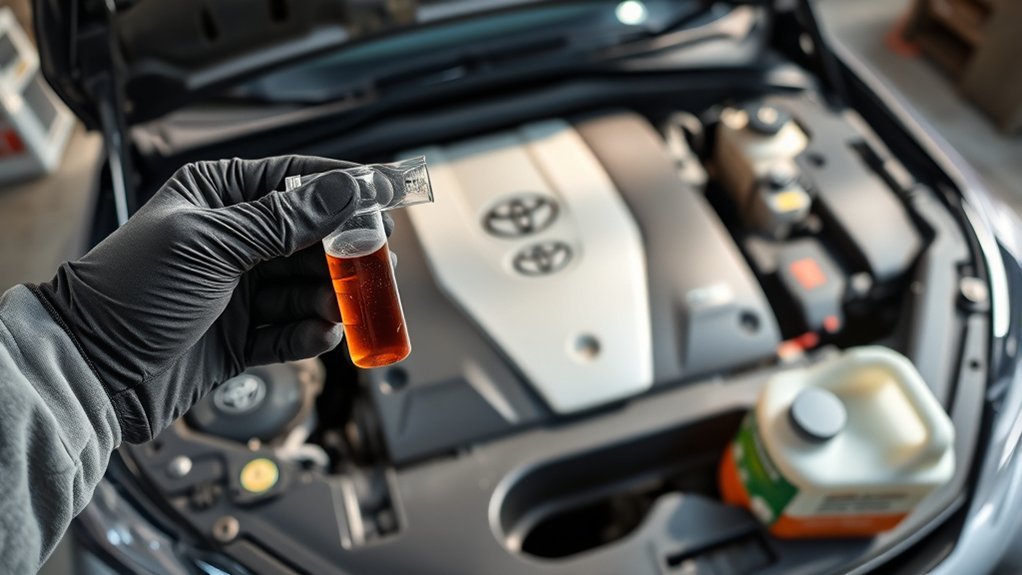
Symptoms can justify an early inspection, but they do not automatically prove that the coolant itself has reached its scheduled replacement age. A leak must be repaired, trapped air must be removed correctly, and an overheating engine must be diagnosed before a routine drain-and-refill can solve the problem.
Sweet Smell Indicator: Check for a Leak First
A sweet odor near the hood, wheel well, passenger compartment, or exhaust can indicate escaping coolant. Look for wet areas, dried pink or whitish residue, stains beneath the vehicle, steam, or a falling reservoir level. The source can be a hose, cap, radiator, water pump, heater core, reservoir, or another connection.
| Symptom | Possible Meaning | First Action |
|---|---|---|
| Sweet odor or dried coolant residue | Possible external or internal leak | Inspect and pressure-test as needed; do not assume a flush alone will fix it |
| Coolant level repeatedly drops | Leak, cap problem, trapped air, or internal coolant loss | Stop repeated top-offs and arrange diagnosis |
| Gurgling or poor cabin heat | Possible low coolant or air in the system | Check the cold level and have the system filled and bled correctly |
| Brown, cloudy, oily, or particle-filled coolant | Contamination, corrosion, incompatible coolant, or internal mechanical problem | Diagnose the contamination source before replacing the fluid |
| High-temperature warning or red gauge | The engine or hybrid system may be overheating | Pull over safely, stop driving, and follow the owner’s manual |
Engine Overheating Signs
Possible overheating signs include a red temperature warning, an “Engine Coolant Temp High” message, steam, reduced power, coolant odor, or abnormal fan operation. Low coolant is only one possible cause. A faulty fan, water pump, thermostat, cap, sensor, blockage, leak, or trapped air can also be involved.
Warning: If the temperature warning appears, move to a safe location and stop driving as directed by the owner’s manual. Never remove a radiator or pressurized coolant-reservoir cap while the system is hot. Hot coolant and steam can cause severe burns.
After the vehicle has cooled completely, inspect for an obvious leak and check the reservoir only as the manual permits. Do not continue driving an overheating Camry merely because coolant was added; the cause still needs to be identified.
Why Keeping Up With Coolant Maintenance Matters
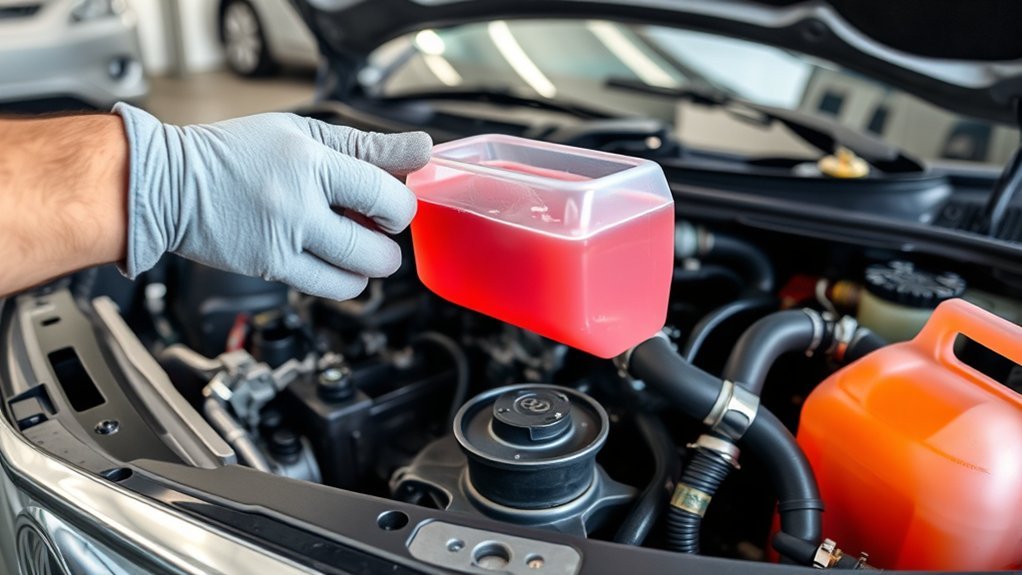
Coolant additives do not remain effective forever. Following the scheduled replacement interval restores the intended freeze protection, boiling protection, and corrosion-control package. It also gives the technician an opportunity to inspect hoses, connections, reservoirs, the radiator, and evidence of leakage.
Neglected or contaminated coolant can contribute to corrosion, deposits, seal deterioration, poor heat transfer, and overheating. Correct maintenance supports normal engine operation, but it should not be promoted with an unsupported promise of a specific fuel-economy improvement.
How to Check Coolant Levels and Condition in Your Camry
Perform the check with the vehicle parked on level ground and the engine or hybrid system completely cold. Depending on the model year, the reservoir may use “FULL” and “LOW” marks or “MAX” and “MIN” marks.
- Confirm the vehicle is cold. Do not loosen a pressurized cap to make a routine level check.
- Locate the reservoir. Use the owner’s manual to distinguish the engine-coolant reservoir from the inverter-coolant reservoir on a hybrid.
- Read the level through the reservoir. The cold level should be within the marked range specified by the manual.
- Inspect the fluid. Look for unexpected cloudiness, oil, sediment, rust-colored material, or mixed colors.
- Inspect the surrounding area. Check for wetness, crusted residue, swollen hoses, cracked plastic, or staining below the vehicle.
- Top up only with the correct product. Use the coolant specified for the exact model year and circuit. Do not add water to a ready-to-use premix unless the manual or product label expressly instructs it.
- Recheck abnormal loss. If the level falls again within a short period, have the system leak-tested instead of continuing to top it off.
Pro Tip: Photograph the reservoir level when the vehicle is cold and note the date and mileage. A comparison photo can help confirm whether the level is actually falling.
Which Coolant Types Are Best for Your Toyota Camry?
For a recent Camry, the safest default is Toyota Genuine Super Long Life Coolant when it is the product specified for that model year. An aftermarket coolant can be suitable only when its manufacturer confirms that it meets the exact Toyota chemistry and application requirements stated in the manual.
| Choice | Recommendation | Reason |
|---|---|---|
| Toyota coolant specified by the model-year manual | Preferred | Known formulation and application compatibility |
| Aftermarket exact-spec equivalent | Acceptable when compatibility is explicitly documented | Can meet the required chemistry without relying on color alone |
| Coolant selected only because it is pink or “universal” | Avoid unless the specification is confirmed | Color and broad marketing language are not complete compatibility standards |
| Straight water or an improvised 70/30 blend | Do not use as a routine fill | The final concentration and inhibitor level may not match Toyota’s specification |
If the existing coolant type is unknown or incompatible products may have been mixed, a qualified technician can determine whether a complete drain, repeated exchange, component repair, or contamination cleanup is appropriate.
DIY Coolant Flush and Drain-and-Refill Tips
Toyota’s scheduled-maintenance language calls for draining and refilling the cooling system. A chemical “flush” is not automatically required at every coolant interval. Flushing or repeated exchanges may be appropriate after incompatible coolant mixing, severe contamination, oil intrusion, corrosion, or major cooling-system repairs.
Flush or Drain and Refill?
- Routine scheduled service: Follow the model-specific Toyota drain-and-refill procedure.
- Wrong coolant or mixed coolant: Determine the products involved and use a corrective exchange procedure appropriate for the vehicle.
- Oil, rust, or heavy deposits: Diagnose and repair the source before refilling.
- Overheating: Find the failed component or leak first; fresh coolant alone may not correct it.
Warning: Toyota’s current maintenance guide recommends that a qualified technician perform coolant replacement. Incorrect draining, filling, or air bleeding can cause burns, spills, trapped air, warning messages, or overheating. Hybrid inverter-cooling work also requires the correct circuit-specific procedure.
Safety-First DIY Workflow
- Obtain the exact procedure. Confirm the model year, engine or inverter circuit, coolant capacity, drain locations, tightening specifications, and air-bleeding method.
- Let the vehicle cool completely. Park on level ground, set the parking brake, and wear eye protection and chemical-resistant gloves.
- Prepare a sealed collection container. Keep children and pets away from the work area. Ethylene-glycol coolant can cause serious poisoning if swallowed.
- Drain only at the points identified by the repair procedure. Capture all coolant and prevent it from reaching pavement, soil, storm drains, or waterways.
- Inspect before refilling. Check hoses, clamps, reservoirs, caps, the radiator, water-pump area, and drained coolant for evidence of leakage or contamination.
- Close and tighten the drains correctly. Replace required seals or gaskets and avoid overtightening plastic fittings.
- Refill with the exact specified coolant. Do not dilute a premixed product or combine unidentified leftovers.
- Bleed air using the model-specific method. Some vehicles require a particular operating sequence, service mode, vacuum-fill equipment, or additional verification. Do not substitute a generic “run it with the cap off” method.
- Verify operation. Check for leaks, normal cabin heat, stable temperature, correct reservoir level, and no cooling-system warning. Recheck the cold level after the vehicle has fully cooled.
- Recycle or dispose of the used coolant properly. Use an approved recycling facility or local household-hazardous-waste program. Do not mix it with oil, fuel, solvents, or other waste.
Note: The U.S. Environmental Protection Agency advises households to keep hazardous products in appropriate containers, avoid mixing wastes, and use local approved management programs. See the EPA’s household hazardous waste guidance.
When to Seek Professional Help for Coolant Service at James Toyota
Schedule service with James Toyota or another qualified Toyota repair facility when the coolant interval is due and you do not have the correct filling and bleeding equipment. Professional diagnosis is especially appropriate when:
- The engine or hybrid-system temperature warning appears.
- The coolant level falls repeatedly after being topped up.
- You see steam, wet coolant, dried residue, or a puddle.
- The coolant is oily, muddy, rusty, or contains particles.
- Different coolant types were mixed.
- The cabin heater alternates between hot and cold or gurgles after cooling-system work.
- A hybrid inverter-cooling circuit requires service.
- A hose, radiator, water pump, thermostat, heater core, or related component was replaced.
A technician can pressure-test the system, verify freeze protection and condition, identify the correct coolant circuit, use the proper air-bleeding procedure, and document the date and mileage of service. Current pricing and service offers can change, so they should be confirmed directly when the appointment is scheduled.
Related Guides
Frequently Asked Questions
How often should I change the coolant on my Toyota Camry?
For many recent U.S. Camrys, Toyota specifies the first engine-coolant replacement at 100,000 miles or 120 months, followed by replacement every 50,000 miles or 60 months. Follow whichever limit comes first and verify the exact model-year guide.
Is it normal to add coolant every two months?
No. A small level change between hot and cold conditions can be normal, but repeated coolant loss is not. It can indicate an external leak, weak cap, trapped air, heater-core leak, water-pump problem, or internal engine leak. Have the system inspected instead of continuing to top it off.
Is Toyota coolant a lifetime fluid?
No. Toyota Super Long Life Coolant has a long service interval, but Toyota still specifies scheduled replacement. The first interval is generally longer than later intervals.
Does a hybrid Camry have two coolant schedules?
It can. Recent hybrid Camrys have an engine cooling circuit and an inverter cooling circuit. Toyota’s 2026 guide lists the first engine-coolant replacement at 100,000 miles or 120 months and the first applicable inverter-coolant replacement at 150,000 miles or 180 months.
Can I mix Toyota pink coolant with another color?
Do not decide based on color alone. Use Toyota Super Long Life Coolant or an alternative whose manufacturer explicitly confirms that it meets the exact Toyota specification for your model year and cooling circuit. When compatibility is uncertain, avoid mixing and have the system evaluated.
Does my Camry need a coolant flush or only a drain and refill?
Toyota’s routine maintenance language specifies draining and refilling the cooling system. A more extensive flush or repeated exchange may be justified when the coolant is contaminated, incompatible products were mixed, or a major repair introduced debris. The cause of contamination should be corrected first.
Conclusion
For many recent Toyota Camrys, the correct engine-coolant schedule is an initial replacement at 100,000 miles or 120 months, followed by replacement every 50,000 miles or 60 months. Applicable hybrid inverter coolant can have a later first interval. Because schedules and coolant specifications can vary, the exact model-year Toyota guide should always control.
Check coolant levels only when the system is cold, use the specified product, treat repeated loss as a leak until proven otherwise, and stop driving when an overheating warning appears. A correct drain, refill, and air-bleeding procedure protects the system far more effectively than relying on coolant color, generic interval rules, or repeated top-offs.
Sources
- Toyota 2026 Camry Warranty & Maintenance Guide — engine and inverter coolant intervals, coolant specification, inspection guidance, and technician recommendation
- Toyota 2025 Camry Warranty & Maintenance Guide — 2025 engine and inverter cooling-system schedules
- Toyota 2023 Camry Warranty & Maintenance Guide — 2023 engine-coolant interval and coolant chemistry
- Genuine Toyota Super Long Life Coolant — official Toyota coolant product and application guidance
- U.S. Environmental Protection Agency: Household Hazardous Waste — safe storage, separation, and local disposal guidance
- CDC/ATSDR Ethylene Glycol ToxFAQs — health risks associated with ethylene-glycol exposure and ingestion
