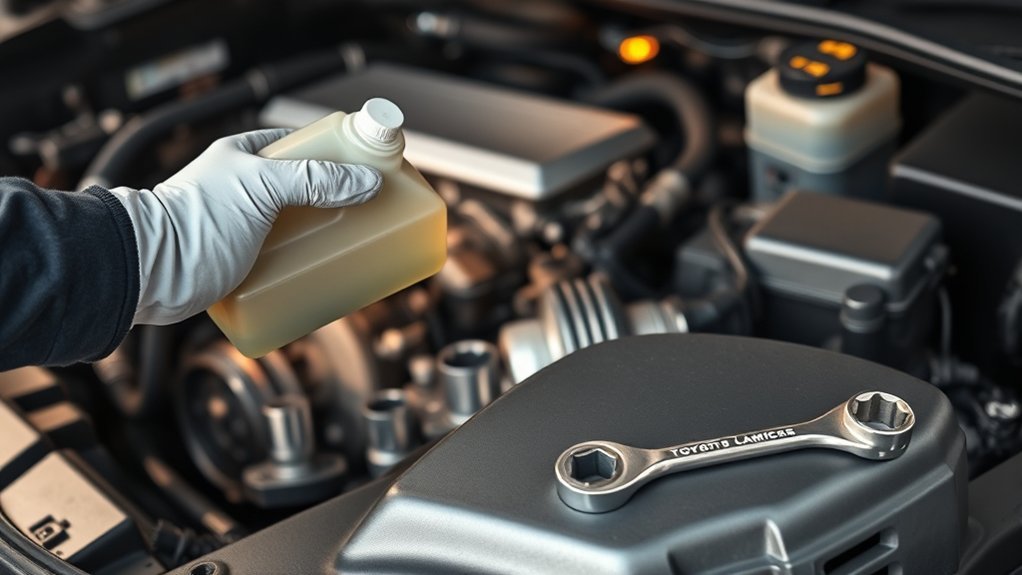
Toyota Camry transmission maintenance is not a one-size-fits-all job. The correct fluid, inspection method, and service interval depend on the model year, transmission, and how the car is used. Instead of relying on a blanket mileage rule, start with the Warranty & Maintenance Guide for your exact Camry and treat leaks, warning lights, harsh shifting, or unusual noises as reasons for diagnosis rather than automatic proof that the fluid simply needs changing.
Quick Answer
Do not use a universal 60,000-to-100,000-mile rule for every Toyota Camry. Check the maintenance guide for your exact model year and transmission. Newer Camrys use sealed transmissions, and Toyota may call for inspection during normal use but fluid replacement at specific mileages under special operating conditions.
Key Takeaways
- Use the maintenance schedule for your exact Camry year, drivetrain, and transmission instead of a generic interval.
- Many newer Camrys have sealed transmissions without a user-serviceable dipstick, so fluid level checks and refills can require a temperature-based service procedure.
- Use only the fluid specification listed for your vehicle; “Toyota transmission fluid” is not one universal product for every Camry generation.
- Slipping, delayed engagement, leaks, warning lights, burning odors, or unusual noises deserve diagnosis because fluid replacement alone may not correct the cause.
At a Glance
| Time Required | A few minutes to verify the schedule and inspect for leaks; fluid service time varies by model and procedure. |
| Difficulty | Easy for schedule and leak checks; moderate to advanced for sealed-transmission fluid service. |
| Tools Needed | Maintenance guide; for service, model-specific hand tools, drain container, refill equipment, safe lifting equipment, and any temperature/scan procedure required by the repair manual. |
| Cost | Varies by model year, fluid specification, capacity, labor rate, diagnostic work, and whether the service requires pan or sealed-level procedures. |
How to Change Your Transmission Fluid: Importance and Steps
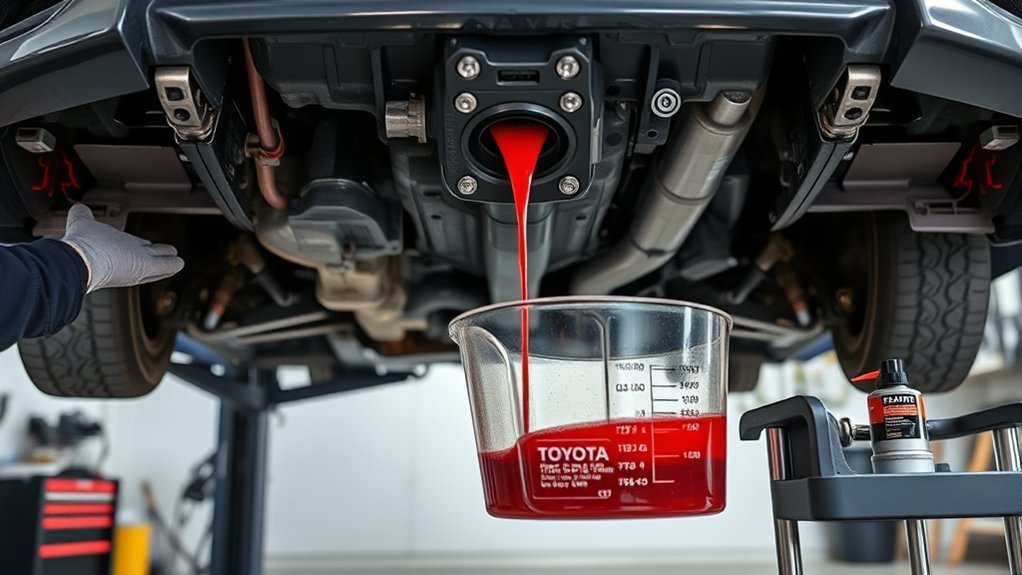
Transmission fluid lubricates, cools, and supports hydraulic or transaxle operation, but the correct service method depends on the Camry you own. Toyota does not publish one universal change interval or one universal DIY procedure for every Camry generation.
- Identify the exact vehicle. Confirm the model year, engine or hybrid system, drivetrain, and transmission. The Toyota Manuals and Warranties portal is the right starting point for U.S.-market vehicles.
- Read the factory maintenance schedule. Use the mileage and operating-condition table for your specific year. Do not copy an interval from a different Camry generation.
- Confirm the fluid specification. Use the exact fluid type listed in the owner’s manual or repair information. Toyota has used different transmission-fluid specifications across different vehicles and generations.
- Choose the correct service procedure. Older Camrys may have a dipstick and a conventional drain-and-fill procedure. Many newer Camrys use sealed transmissions that require a fill/overflow procedure and fluid-level verification at a specified temperature.
- Check for leaks and symptoms before service. A leak, warning light, harsh shift, delayed engagement, or unusual noise can require diagnosis before any fluid replacement.
- Refill and verify the level exactly as specified. Too little or too much fluid can cause problems, especially on sealed units where level depends on temperature.
Warning: Do not improvise a sealed-transmission level procedure or work beneath a vehicle supported only by a jack. Transmission fluid can be hot, and an incorrect fluid level can damage the transmission. If the factory procedure requires temperature monitoring or equipment you do not have, use a qualified technician.
Do not assume the transmission pan must be removed or the filter or strainer must be replaced at every fluid service. Toyota’s maintenance schedule may call for fluid inspection or replacement without listing a routine filter change. Pan removal, strainer replacement, and gasket work should be based on the exact repair procedure, leakage, contamination, or a diagnostic need.
Transmission Fluid Change Intervals for Your Toyota Camry
The safest answer is model-year specific. For example, the 2025 Camry Warranty & Maintenance Guide lists automatic-transmission-fluid inspections in the normal maintenance chart and calls for replacement at 60,000 miles under specified special operating conditions. Toyota’s 2023 Camry and 2024 Camry Hybrid guides likewise include fluid replacement at 60,000 miles for certain severe-use conditions. That is very different from saying every Camry must receive a fluid change every 60,000 to 100,000 miles.
For a 2025 Camry, Toyota’s factory schedule separates normal-use inspections from special-operating-condition fluid replacement. Your exact model-year guide—not a universal mileage rule—should control the maintenance decision.
Recommended Change Intervals
Use this hierarchy instead of a single mileage number:
- Factory schedule first: Follow the Warranty & Maintenance Guide for your exact model year.
- Special-use schedule second: Toyota may shorten or add service requirements when the vehicle is primarily used for conditions such as towing, carrying heavy loads, or prolonged low-speed/idling duty, depending on the model year.
- Condition and diagnosis third: Leakage, contamination, incorrect fluid level, warning lights, or drivability symptoms can justify inspection or service earlier than a scheduled replacement.
- Service history matters: If maintenance records are missing, do not assume the fluid has never been serviced or that a particular mileage automatically makes service unsafe. Have the transmission identified and inspected before deciding what work to perform.
Pro Tip: Enter your VIN or exact year and model in Toyota’s owner resources before buying fluid. This prevents you from applying an interval, fluid specification, or procedure from the wrong Camry generation.
Signs Of Fluid Degradation
Do not rely on fluid color alone to decide whether a Camry needs a transmission-fluid change. On a vehicle with an accessible dipstick, fluid that smells burnt, contains visible debris, or sits below the correct level deserves attention. On a sealed transmission, the more practical owner checks are the maintenance schedule, visible leaks, warning messages, and changes in operation.
Symptoms such as slipping, harsh or delayed engagement, shuddering, whining, or a burning odor can be associated with low, overheated, contaminated, or degraded fluid, but they can also come from mechanical, electrical, software, mount, axle, or engine-related problems. Diagnose the cause rather than assuming fresh fluid is a guaranteed cure.
Impact Of Driving Habits
Toyota’s maintenance guides use specific “special operating conditions,” not a vague definition of hard driving. Depending on the Camry year, these may include towing, using a car-top carrier, heavy vehicle loading, or extensive idling and low-speed operation for long distances. If your usage matches one of those conditions, follow the corresponding special-use schedule in your own guide.
Note: The 2025 and 2026 Camry lineups are all-hybrid and use an electronically controlled continuously variable transmission (ECVT). That system should not be treated as though it were the same as every conventional belt-type CVT used in other vehicles.
Signs That Indicate Your Transmission Fluid Needs Changing
A maintenance schedule is the best trigger for routine service. Symptoms are better treated as a trigger for inspection. Arrange diagnosis if you notice any of the following:
- Visible fluid leakage around the transmission, transaxle, cooler lines, or under the vehicle.
- Delayed engagement when selecting Drive or Reverse on a conventional automatic.
- Harsh, erratic, or slipping shifts on a transmission that normally changes fixed gears.
- New shuddering, whining, grinding, or other unusual noises.
- A burning odor or evidence of overheating.
- Transmission, hybrid-system, master-warning, or check-engine messages or lights.
- Low fluid level or abnormal contamination when the vehicle has a factory-approved means of checking it.
These signs do not prove that fluid replacement is the only repair needed. If the vehicle has a leak or an active fault, correcting the cause is more important than simply adding or replacing fluid.
How to Properly Check Your Toyota Camry’s Transmission Fluid?

First determine whether your Camry actually has a transmission-fluid dipstick. Older generations may have one, while many newer Camrys use a sealed system. Toyota’s newer maintenance guides specifically refer to inspecting sealed transmissions for signs of leakage.
If your Camry has a factory transmission dipstick:
- Read the owner’s manual before checking the level because the required fluid temperature, engine state, selector position, and procedure can vary.
- Park on level ground and follow the manual’s warm-up and selector instructions exactly.
- Remove, wipe, reinsert, and read the dipstick only if the manual specifies that method.
- Check the level against the correct range and look for obvious contamination or a burnt odor.
- Add only the exact specified fluid, and avoid overfilling.
If your Camry has a sealed transmission: do not search for a nonexistent dipstick or guess the level from the amount drained. The correct procedure can involve a fill plug, an overflow tube, and a narrow fluid-temperature window. Toyota’s owner information for sealed units directs attention to leakage and model-specific service procedures.
Warning: If you find a transmission leak, do not assume topping off the fluid is enough. Low fluid can damage the unit, and the leak source still needs to be repaired.
What Happens If You Don’t Change Your Transmission Fluid?
If your Camry’s factory schedule calls for transmission-fluid replacement and you skip it, or if the transmission is operated with low, overheated, or contaminated fluid, lubrication and heat control can deteriorate. The result may be poor operation and accelerated wear. However, a Camry that does not have a routine replacement requirement under normal use should not be described as neglected simply because it has passed an arbitrary mileage number.
Increased Transmission Wear
Transmission fluid must maintain the friction, lubrication, cooling, and hydraulic characteristics required by the unit. Fluid that has been overheated, contaminated, or run low can increase stress on internal components. The correct response is to identify why the fluid is abnormal and then perform the repair or service specified for that transmission.
Slipping Gears Occurrence
On conventional automatic transmissions, slipping or flare between gear changes can be a sign of a fluid-level, hydraulic, clutch, control, or internal mechanical problem. It is not proof that the vehicle merely needs fresh fluid. A scan for diagnostic trouble codes, leak inspection, and correct fluid-level check may be necessary before service.
For newer hybrid Camrys with ECVT, the powertrain does not operate like a conventional stepped automatic transmission. If the car feels abnormal, rely on warning messages and professional diagnosis rather than applying conventional “slipping gear” assumptions.
Overheating Risks Rise
Heat accelerates fluid stress, and low fluid can reduce lubrication and cooling. If you notice a burning smell, leakage, a warning message, or a sudden change in transmission behavior, stop treating the issue as routine maintenance and have the vehicle inspected. Continuing to drive with an active transmission problem can turn a manageable repair into a more serious one.
Transmission Fluid Change Costs for Toyotas
There is no reliable single price for a Toyota Camry transmission-fluid service. Cost changes with the model year, transmission, fluid specification, required quantity, local labor rates, and whether the job is a simple scheduled fluid replacement or includes diagnosis, pan removal, leakage repair, or a sealed-level procedure.
| Service | What Changes the Price | What to Confirm |
|---|---|---|
| Scheduled fluid replacement | Fluid type, capacity, sealed-level procedure, labor rate | Correct fluid specification and factory procedure |
| Pan or strainer service | Whether pan removal is actually required, gasket/sealant, parts, labor | Why the extra work is recommended for your exact transmission |
| Diagnostic visit | Scan time, leak tracing, road testing, level verification | Codes, findings, leak source, and recommended repair |
When comparing quotes, ask whether the service is a drain-and-fill, a factory-specified fluid replacement, a fluid exchange, or a pan/strainer job. Those are not automatically the same service. Also ask which exact Toyota fluid specification will be used and whether the final level will be checked using the required procedure.
Top Maintenance Tips for Your Toyota Camry’s Transmission
- Follow the factory schedule for your exact year. Toyota’s maintenance schedule and year-specific Warranty & Maintenance Guide are more reliable than generic interval advice.
- Use the exact specified fluid. Do not choose fluid only by color or by a broad “compatible with Toyota” label.
- Inspect for leaks. A sealed transmission is not the same as a transmission that can never leak or never need service.
- Do not replace a filter or strainer automatically. Follow the model-specific repair procedure and diagnostic findings.
- Do not ignore symptoms. Harsh operation, warning lights, delayed engagement, burning odor, or leakage call for diagnosis.
- Keep maintenance records. Record mileage, date, fluid specification, amount used, and the type of service performed.
- Check for recalls by VIN. Use the NHTSA recall lookup for U.S.-market vehicles rather than assuming a transmission complaint is ordinary wear.
Current Camry owners should also understand the powertrain they have. Toyota’s 2026 Camry information identifies the current lineup as all-hybrid, and the official brochure lists an electronically controlled continuously variable transmission. Older Camrys can use different transmissions and different fluids, so recommendations should never be copied blindly between generations.
Frequently Asked Questions
How Long Should a Transmission Last in a Toyota Camry?
There is no Toyota-guaranteed lifespan such as 150,000 or 200,000 miles for every Camry transmission. Longevity depends on the specific transmission, maintenance, operating conditions, heat exposure, leakage, driving history, and whether faults are repaired promptly.
Do Toyota Camrys Have Transmission Problems?
Any vehicle can develop transmission or transaxle problems, but it is not accurate to treat all Camry generations as having the same issue. Diagnose the specific symptom, check your VIN for open recalls, and review Toyota service information for your model year.
Is 100,000 Miles Too Late to Change Transmission Fluid?
No universal rule says 100,000 miles is automatically too late. The right decision depends on the model-year schedule, service history, fluid specification, transmission condition, and any current symptoms. If history is unknown or the transmission is already acting abnormally, have it inspected before choosing a service method.
Is Toyota CVT Transmission Fluid Lifetime?
Do not assume any Camry transmission fluid is “lifetime” without checking the exact maintenance guide. The 2025 Camry schedule includes transmission-fluid inspection and replacement under specified special operating conditions. Also remember that the current Camry uses a hybrid ECVT, which is not the same design as every conventional CVT.
Does Every Toyota Camry Have a Transmission Dipstick?
No. Some older Camrys use a dipstick, while many newer models have sealed transmissions without a user-level dipstick. Verify the procedure for your exact model before trying to check or add fluid.
Should I Drain and Fill or Flush the Transmission?
Use the service method specified for your transmission rather than choosing by a generic rule. Ask the shop exactly what it plans to do, which fluid it will use, and how the final level will be verified. If the transmission already has symptoms, diagnosis should come before an aggressive or unfamiliar service procedure.
Conclusion
The best way to protect a Toyota Camry transmission is to follow the maintenance information written for that exact vehicle. Check the factory schedule, use the specified fluid, inspect for leakage, keep service records, and investigate warning signs early. Avoid blanket mileage rules, automatic filter replacements, and generic dipstick instructions because Camry transmission designs and procedures have changed significantly across generations.
Sources
- Toyota 2025 Camry Warranty & Maintenance Guide — backs up normal-use transmission-fluid inspections, special-operating-condition replacement, and sealed-transmission leak inspection.
- Toyota Maintenance Schedule — factory-maintenance lookup and guidance to use the vehicle-specific schedule.
- Toyota 2026 Camry Brochure — confirms the current Camry’s hybrid powertrain and ECVT configuration.
- National Highway Traffic Safety Administration Recall Lookup — official U.S. VIN and model recall information.
