Last Updated: September 22, 2026 — added 2025–2026 Camry recall guidance and rechecked Toyota/NHTSA safety references.
If your Toyota Camry’s turn signals are not working, first identify whether the failure affects one lamp, one whole side, both directions, or the hazard lights too. One dead corner usually points toward the bulb or LED lamp section, socket, connector, local wiring, or ground. A whole direction can involve the turn-signal switch circuit, wiring, or electronic control. If both directions and the hazards fail, investigate shared power and control circuits before replacing lamps.
There is also an important current-model exception: certain 2025–2026 Camrys with a 7-inch combination meter are under a Toyota safety recall because the meter can go blank at startup and deactivate the turn-signal and hazard lamps. Check the VIN before buying parts if your instrument display is blank or the failure began at startup.
Quick Answer
Check which lamps fail, then compare the turn signals with the hazard lights. One dead corner usually points to a bulb or LED assembly, socket, connector, local wiring, or ground. One whole direction suggests the switch circuit, wiring, or electronic control. If both directions and the hazards fail, check shared power and control circuits. On certain 2025–2026 Camrys, also check for the combination-meter recall before replacing parts.
Key Takeaways
- Start with the symptom and your Camry’s model year instead of assuming every vehicle uses the same fuse, bulb, or flasher-control design.
- A failed lamp on one corner is usually a different problem from one whole direction or both turn signals failing at once.
- Certain 2025–2026 Camrys have a safety recall in which a blank 7-inch combination meter can also deactivate the turn signals and hazard lamps.
- Replace a fuse only with the exact type and amperage specified for the vehicle. Stop if the new fuse blows again.
- Do not replace a steering-column switch, relay, lamp assembly, combination meter, or control module until testing and a model-specific wiring diagram support that repair.
At a Glance
| Time Required | Basic visual, hazard-light, lamp, and fuse checks are usually brief; wiring, switch, combination-meter, or module diagnosis can take substantially longer |
| Difficulty | Beginner for operational checks and accessible bulbs or fuses; intermediate to advanced for powered circuit testing, steering-column work, or electronic diagnosis |
| Tools Needed | Exact owner’s manual, flashlight, clean gloves, fuse puller, and the specified replacement fuse or lamp; a test light or digital multimeter only when you know the correct test procedure |
| Cost | Inspection can cost nothing when tools are already available. Repair cost varies widely between a fuse or replaceable bulb and an integrated lamp assembly, switch, wiring repair, combination-meter service, or electronic diagnosis. |
Warning: Park safely, set the parking brake, and switch the vehicle off before removing a bulb, connector, or fuse. Never install a higher-rated fuse. Do not measure continuity on an energized circuit, probe orange high-voltage equipment on a Camry Hybrid, or disassemble the steering column without the correct airbag and service procedures. Avoid routine driving until the signals work properly.
2025–2026 Camry Recall Alert
On August 6, 2026, Toyota announced a U.S. safety recall involving approximately 508,000 certain 2025–2026 Camrys. The 7-inch combination meter may become blank at startup, which can also deactivate the turn-signal and hazard lamps. Toyota says dealers will update the combination-meter software free of charge. If your display is blank or the signals and hazards fail together at startup, check your VIN through Toyota’s recall lookup before replacing parts. See Toyota’s August 6, 2026 recall announcement.
Top Reasons Your Toyota Camry Turn Signals Fail
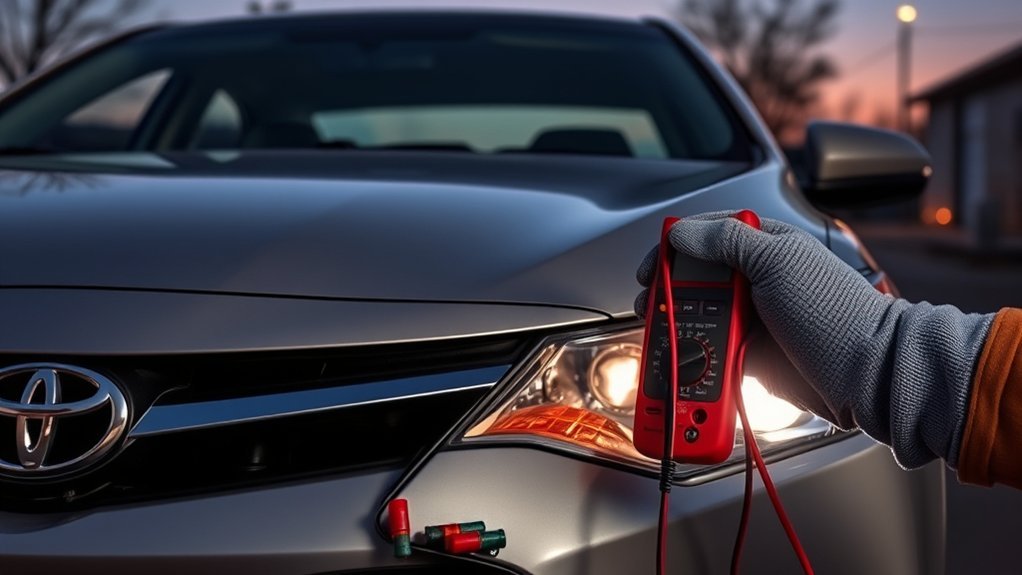
A Toyota Camry turn-signal fault usually comes from one of several areas, but the failure pattern and model year should determine which area you inspect first.
- Failed bulb or LED lamp section: A single front or rear signal may stop working because of a burned-out replaceable bulb or a failed section of an integrated LED lamp assembly.
- Damaged socket or connector: Heat, moisture, corrosion, loose terminals, or a partially seated connector can interrupt power or ground at one lamp.
- Blown fuse: A failed fuse can disable part or all of the signaling circuit. A fuse that blows again indicates an unresolved short or overload.
- Poor ground: A loose or corroded ground can cause a dim lamp, intermittent operation, unusual interaction with other rear lights, or failure on one corner.
- Turn-signal or combination switch problem: A worn switch or failed switch input may prevent one or both directional signals from activating even when the hazard lights still operate.
- Wiring damage: Collision repairs, water intrusion, rodent damage, pinched harnesses, or corroded splices can create open circuits or shorts.
- Flashing-control or electronic fault: Depending on the model year, flashing and lamp-failure detection may involve a serviceable relay, junction-block circuit, combination meter, body-control function, or lamp electronics.
- 2025–2026 combination-meter recall: On certain recalled vehicles with a 7-inch combination meter, a software problem can leave the display blank at startup and deactivate the turn signals and hazard lamps.
- Aftermarket equipment: Trailer wiring, alarms, remote-start systems, lighting conversions, and previous repairs can introduce poor connections or incorrect circuit loads.
- Low 12-volt system voltage: Consider the 12-volt battery or low-voltage power supply when the turn signals fail alongside several other electrical features.
Note: Use Toyota’s official Manuals and Warranties portal to select the exact model year. Do not rely on a fuse diagram, bulb number, relay location, or circuit layout from a different Camry generation.
Model-Year Clues That Change the Diagnosis
| Camry | Useful Diagnostic Clue |
| Earlier generations | Fuse, relay, bulb, and switch arrangements vary substantially. Confirm the exact year before looking for a flasher relay or copying a fuse location from another Camry. |
| 2018–2024 generation | Factory diagnostic information distinguishes bulb-type and LED-type lamp failures. One direction failing points toward the turn-signal switch circuit or meter/gauge system after lamp checks; all signals failing and incorrect flash speed also lead into combination-meter diagnosis. |
| 2025 Camry | Toyota’s owner guidance says to check that all turn-signal lights are flashing when the indicator flashes faster than usual. If every signal lamp works but the indicator remains abnormally fast, have the vehicle inspected. |
| Certain 2025–2026 Camrys | If the 7-inch combination meter is blank at startup and the turn signals or hazards also fail, check the current Toyota recall by VIN before ordinary parts replacement. |
Toyota Camry Turn Signals Not Working: Diagnose the Failure Pattern
Activate the left signal, right signal, and hazard lights while a helper observes every exterior lamp. You can also park near a wall or reflective surface, but do not rely only on the dashboard arrows.
| Symptom | More Likely Areas | First Check |
| One front or rear lamp is dead | Bulb or LED section, socket, connector, local wiring, or ground | Inspect that lamp and compare it with the working side |
| Front and rear signals fail on one side | Turn-signal switch circuit, shared wiring or connector, or electronic control for that direction | Test the hazards and inspect both lamps on the affected side |
| Both turn-signal directions fail, and hazards also fail | Shared power supply, fuse, wiring, junction-block or combination-meter/control fault; on certain 2025–2026 Camrys, the current combination-meter recall | Check whether the instrument display is blank, check the VIN for recalls when applicable, then use the correct fuse chart |
| Hazards work, but left and right signals do not | Turn-signal switch input, turn-only power path, connector, wiring, or electronic control | Confirm the problem in both directions before testing the switch circuit |
| Indicator flashes much faster, slower, stays on, or stays off | Failed lamp output, incorrect bulb or LED conversion, poor connection, or control fault | Inspect every signal lamp on the indicated side. On a 2025 Camry, seek inspection if all signal lamps work but the indicator remains abnormally fast. |
| A replacement fuse blows again | Shorted wiring, damaged socket, water intrusion, incorrect component, or aftermarket wiring fault | Stop replacing fuses and arrange circuit diagnosis |
For the 2025 Camry, Toyota’s owner guidance specifically says to confirm that all turn-signal lights are flashing when the indicator rate becomes unusually fast. If all signal lamps operate but the indicator still flashes abnormally fast, Toyota directs the owner to have the vehicle inspected. Use the manual for your exact Camry because earlier generations can behave differently.
A fast, slow, steady, or missing dashboard indicator is a clue—not proof that a particular relay, switch, bulb, LED assembly, or control module has failed.
Pro Tip: Photograph the fuse-box legend, bulb socket, connector orientation, and original part number before removing anything. This reduces the chance of installing the wrong component or reconnecting a socket incorrectly.
Why You Should Check Your Fuses and Lamps First
Fuses and exterior lamps are practical first checks because they can often be inspected without dismantling the steering column or replacing an electronic component. However, you must use the fuse chart and lamp specification for your exact Camry.
Check Whether Your Camry Has a Replaceable Bulb
Some Camry signal positions use a replaceable incandescent bulb, while others may use an integrated LED lamp assembly. An incandescent bulb may have a broken filament or darkened glass. An LED assembly has no replaceable filament and may require connector testing or assembly-level service.
Before buying a part:
- Confirm the model year, trim, lamp position, and market specification.
- Compare the failed lamp with the working side.
- Inspect the socket for melted plastic, discoloration, moisture, or green corrosion.
- Check that the connector locks firmly and no terminal has backed out.
- Use the vehicle’s VIN when checking fitment through the official Toyota parts catalog.
Check the Correct Fuse
A Camry may have more than one fuse panel, and the relevant fuse name and location can vary. Use the owner’s manual and the legend on the fuse-box cover rather than a generic online diagram.
- Switch the vehicle and exterior lights off.
- Identify the exact fuse listed for the affected circuit.
- Remove it with the fuse puller if the manual permits access.
- Inspect the element or test the removed fuse for continuity with the circuit unpowered.
- Replace a failed fuse only with the same type and amperage.
- Activate the signals and hazards to verify the repair.
If the replacement fuse blows immediately or fails again soon, do not install another fuse. The circuit may contain a short, damaged component, or incorrect aftermarket connection that needs proper diagnosis.
Step-by-Step Troubleshooting for Toyota Camry Turn Signal Issues
1. Record the Model Year and Exact Symptoms
Write down the model year and which front, rear, mirror, or side-marker lamps work. Note whether the dashboard arrow clicks, flashes quickly, remains steady, or does not illuminate. Also note whether the instrument display is blank, especially on a 2025–2026 Camry.
2. Test the Left Signal, Right Signal, and Hazards
Check all exterior lamp positions with the vehicle safely parked. The hazard test helps determine whether the lamp circuits can operate independently of the directional-signal command, but it does not identify a failed component by itself.
3. Inspect the Failed Lamp or Lamp Assembly
For a single failed corner, inspect the specified bulb or LED assembly, socket, connector, moisture seals, and local wiring first. A lamp that works when the connector is moved may have a loose terminal, but do not continue manipulating an energized connector.
4. Check the Specified Fuse
Use the exact fuse chart. Replace a failed fuse once with the specified rating, then retest. A fuse that fails again is evidence of an unresolved circuit problem rather than a need for a larger fuse.
5. Check Connectors, Grounds, and Visible Wiring
Look for damaged insulation, pinched harnesses, loose ground fasteners, corroded terminals, water tracks, overheated sockets, and previous splices. Pay extra attention to areas affected by collision repair, body-panel removal, trunk leaks, or aftermarket electrical work.
6. Consider the 12-Volt System When Other Features Also Fail
If the turn signals fail alongside dim lighting, weak accessories, repeated warning messages, or other electrical problems, the 12-volt battery or low-voltage power supply may need testing. If the vehicle’s power outlet also stopped working, use the same model-specific approach described in our Toyota Camry 12V outlet troubleshooting guide.
On a Camry Hybrid, lighting and instrumentation operate from the low-voltage electrical system, while the traction battery is a separate high-voltage system. Follow NHTSA hybrid and electric vehicle safety guidance and never attempt traction-battery service without proper training.
7. Use a Meter Only With the Correct Procedure
A digital multimeter or test light can verify power and ground, but the test points, switch position, and expected readings must come from a wiring diagram or repair manual.
- Voltage testing: The circuit is powered, so avoid shorting terminals or spreading connector pins.
- Continuity or resistance testing: The circuit must be de-energized and isolated as specified by the repair procedure.
- Electronic modules: Do not apply test voltage or jump terminals unless the procedure specifically instructs you to do so.
- High-voltage or airbag equipment: Stop and use a qualified technician.
8. Diagnose the Switch, Control Circuit, Combination Meter, or Module
Only move to the turn-signal switch, flashing-control circuit, junction block, combination meter, or body-control function after the lamps, fuses, accessible wiring, power, and grounds have been checked. On a recalled 2025–2026 Camry with a blank 7-inch combination meter, complete the VIN recall check before treating the meter as an ordinary component failure.
Toyota’s Technical Information System provides factory repair manuals, service bulletins, wiring diagrams, diagnostics, and other model-specific service information. A technician may also scan the relevant modules for diagnostic trouble codes and review live switch-input data where the vehicle supports it.
Key Repairs for Your Turn Signal System
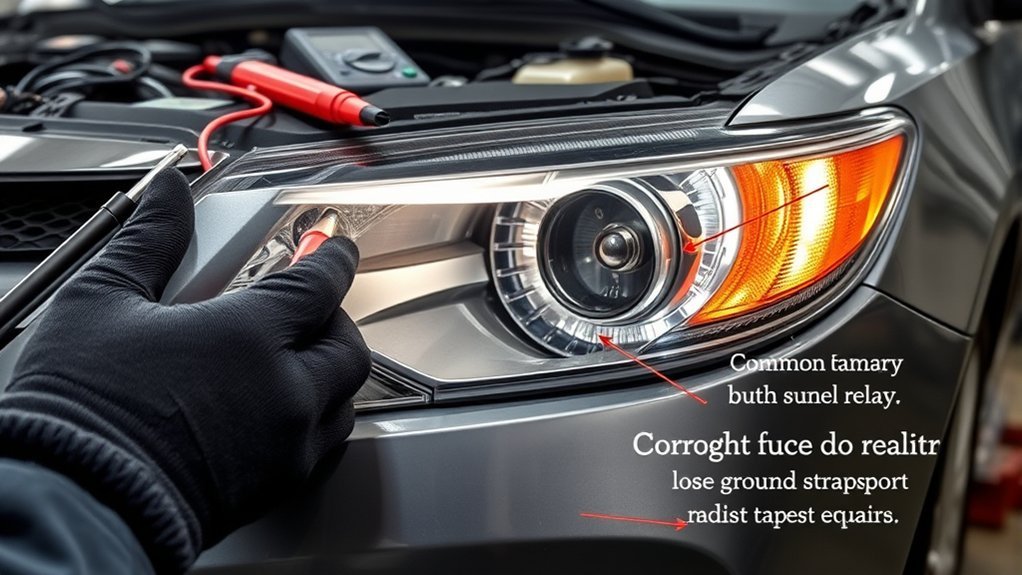
Replace a Failed Bulb
If the vehicle uses a replaceable bulb, install the exact specified type. Seat it fully, lock the socket, and confirm that the seal is clean and undamaged. Do not substitute a higher-wattage bulb or an unapproved LED conversion merely because it fits the socket.
Service a Damaged Socket or Connector
A melted socket, loose terminal, or corroded connector requires more than a new bulb. The damaged connection must be repaired with the correct terminal, connector, seal, and wiring method. Installing another bulb in an overheated socket can lead to another failure.
Replace a Blown Fuse After Correcting the Cause
A fuse is a protective device, not the underlying repair when a short or overload exists. If a fuse failed once without recurrence, monitor the circuit. If it fails again, inspect the affected wiring and components before installing another one.
Repair a Ground or Wiring Fault
Ground repairs should restore a clean, mechanically secure connection without removing protective coatings from a larger area than necessary. Wiring repairs should preserve conductor size, insulation, sealing, routing, and strain relief.
Replace the Turn-Signal Switch Only After Testing
A failed combination or turn-signal switch may cause intermittent signals, failure in one direction, or no directional signals while the hazards still work. Those symptoms do not prove the switch is faulty. Confirm switch inputs and outputs using the correct diagram before replacement.
Because the switch is mounted near steering-column and airbag components, replacement is not an appropriate first repair for an inexperienced DIYer.
Repair the Flashing-Control or Electronic System
Some Camry generations may use a separately serviceable flasher component, while others handle flashing and lamp-failure detection through integrated electronics. Confirm the exact architecture before buying a relay. Electronic-component replacement may require additional Toyota service procedures or initialization and should never be used as a guess.
Replace an Integrated LED Assembly When Required
If the failed signal is built into a sealed LED lamp assembly, the repair may involve the complete lamp rather than a bulb. Verify power, ground, connector condition, and part fitment first so a good assembly is not replaced unnecessarily.
When to Get Professional Help With Your Turn Signal Issues
Arrange professional diagnosis when basic lamp and fuse checks do not identify the fault or when the repair reaches a safety-critical or electronically controlled area.
Professional help is appropriate when:
- A replacement fuse blows again.
- Both turn-signal directions and the hazards are inoperative.
- A 2025–2026 Camry has a blank combination meter and the signals or hazards also fail; check the VIN for the current recall and arrange dealer service when applicable.
- The hazards work but both directional signals remain dead after the correct fuses and accessible connectors are checked.
- The fault is intermittent and changes with steering-column movement, bumps, moisture, or temperature.
- There is collision damage, flood exposure, melted wiring, or extensive corrosion.
- An integrated LED lamp, junction block, combination meter, body-control function, or network communication fault is suspected.
- The steering-column switch must be removed.
- You cannot safely identify powered and unpowered test procedures.
- The problem involves hybrid high-voltage equipment or nearby airbag wiring.
Before paying for a major repair, check the VIN through Toyota’s Safety Recall and Service Campaign lookup and the NHTSA recall database. A campaign may apply only to certain production ranges or equipment, so a general year-and-model search is not a substitute for a VIN check.
Turn Signal Maintenance Tips for Reliability
- Perform a lamp walk-around: Check the left signal, right signal, hazards, brake lamps, and exterior lighting periodically and before a long trip.
- Watch the dashboard indicator: A significant change in flashing rate, a steady arrow, or no indicator may signal a lamp-output or circuit problem. FMVSS 108 includes turn-signal failure-indication requirements; depending on the system, lamp failure can be indicated by a steady indicator, no indicator, or a significant change in flash rate.
- Keep lamp lenses clean: Dirt and road film reduce visibility even when the circuit is working.
- Investigate recurring condensation: Persistent water inside a lamp can damage sockets, terminals, LEDs, or wiring.
- Use specified parts: Match the bulb, fuse, socket, connector, and lamp assembly to the exact vehicle.
- Avoid unsupported lighting conversions: Incorrect LED replacements can cause poor output, warning behavior, hyperflash, electrical noise, or overheating.
- Protect repaired wiring: Route harnesses away from sharp edges, hinges, hot parts, and moving components.
- Check previous modifications: Inspect trailer wiring, alarms, remote-start systems, and other accessories if the problem began after installation or repair work.
The federal lighting standard covers original and replacement lamps, reflective devices, and associated equipment. Use parts designed for the vehicle rather than assuming that physical socket fit alone makes a replacement suitable. See 49 CFR 571.108 for the current U.S. federal lighting requirements.
Frequently Asked Questions
Is there a recall for 2025–2026 Toyota Camry turn signals?
Yes. Toyota announced a U.S. safety recall on August 6, 2026 involving certain 2025–2026 Camrys with a 7-inch combination meter. The meter can become blank at startup and may also deactivate the turn-signal and hazard lamps. Check the VIN through Toyota’s recall lookup to confirm whether a specific vehicle is included. Toyota says the remedy is a free dealer software update.
What causes both Toyota Camry turn signals to stop working?
When both left and right signals fail, check whether the hazards also fail. Possible causes include a shared fuse or power supply, the turn-signal switch input, wiring, a junction-block or combination-meter circuit, or another electronic-control fault. On certain 2025–2026 Camrys, a blank 7-inch combination meter and dead signals or hazards may also be related to the current Toyota recall.
Why are my Toyota blinkers not working on only one side?
If the front and rear lamps fail on one side, inspect both lamps and then investigate the turn-signal switch circuit, shared wiring or connectors, and the electronic output for that direction. If only one corner is dead, begin with that bulb or LED section, socket, connector, local wiring, and ground.
What is the most common cause of Toyota Camry turn-signal problems?
There is no single most common cause that applies to every Camry and every symptom. A single failed lamp often points to the lamp, socket, connector, or local wiring. Failure of both directions points toward a shared power path, switch input, wiring, combination-meter function, or other control circuit. The model year matters because the system design changes across generations.
Why do the hazard lights work when the turn signals do not?
Working hazards show that at least some lamps and output circuits can operate, but they do not prove that the directional-signal switch input, fuse or power path, wiring, or electronic control is good. Confirm that both left and right directions fail before moving into switch and circuit diagnosis.
Why is my Camry turn signal flashing fast?
A significantly faster flash rate can indicate that one or more lamps on that side are not producing the expected output, so inspect every turn-signal position for a failed bulb or LED section, incorrect replacement, loose socket, damaged connector, or poor ground. On the 2025 Camry, Toyota says to confirm that all turn-signal lights are flashing; if every lamp works but the indicator remains abnormally fast, have the vehicle inspected.
Where is the turn-signal fuse on a Toyota Camry?
The fuse name, rating, panel location, and circuit design vary by model year. Check the fuse-box cover and the official owner’s manual for your exact Camry. Do not use a fuse location copied from a different year, and never substitute a higher amperage.
How do I reset the turn signals on a Toyota Camry?
Toyota Camry turn signals generally do not have a universal owner reset. Repair the failed lamp, fuse, connection, wiring, switch, or control circuit and then retest the system. On a recalled 2025–2026 vehicle with the affected combination meter, follow the recall remedy rather than attempting an improvised reset. If another module stores diagnostic codes or requires initialization, follow the exact repair manual or have a qualified technician complete the procedure.
Can I keep driving when my Camry turn signals do not work?
Avoid routine driving until the signals are repaired. Hazard lights do not communicate a left or right turn and are not a normal substitute for functioning directional signals. If the failure occurs away from home, move the vehicle to a safe location and arrange repair or assistance.
Conclusion
A Toyota Camry turn-signal problem is easiest to solve when you begin with the failure pattern instead of guessing at a part. Check every lamp, compare the hazards, consult the exact fuse chart, and inspect accessible sockets, connectors, grounds, and wiring. For certain 2025–2026 Camrys, check the VIN for the current combination-meter recall before replacing parts, especially when the instrument display is blank and the turn signals or hazards fail at startup.
Replace only components supported by testing, and stop when the repair requires steering-column, combination-meter, module, high-voltage, or complex circuit work. A complete final test of the left signal, right signal, hazards, dashboard indicators, and all exterior signal positions confirms that the signaling system is ready for the road.
Sources
- Toyota: Recall of Certain Model Year 2025–2026 Camry Vehicles, August 6, 2026 — current combination-meter recall information, turn-signal/hazard failure risk, and remedy
- Toyota Manuals and Warranties — official model-year owner’s manuals, turn-signal operating guidance, vehicle instructions, and warranty information
- Toyota Technical Information System — factory repair manuals, service bulletins, wiring diagrams, diagnostics, and emergency-response information
- 49 CFR 571.108, Federal Motor Vehicle Safety Standard 108 — requirements for turn-signal lamps, indicators, failure indication, and replacement lighting equipment
- NHTSA Electric and Hybrid Vehicle Safety — low-voltage and traction-battery distinctions and high-voltage service precautions
- Toyota Safety Recall and Service Campaign Lookup — VIN-based Toyota recall and campaign information
- NHTSA Recall Lookup — recalls, investigations, complaints, and manufacturer communications
