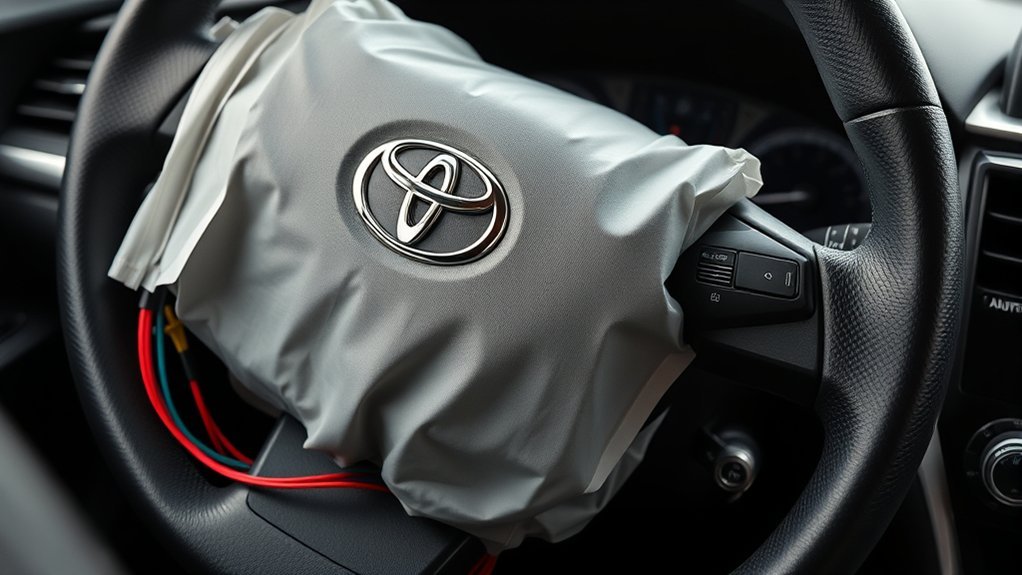
Toyota Camry airbag system components include airbag modules and inflators, crash sensors, a central SRS control unit, front-passenger occupant-classification sensors, seat-belt pretensioners, warning indicators, dedicated wiring, and power or backup provisions. Together, these parts form the Supplemental Restraint System (SRS), which works with seat belts to protect occupants during certain crashes. The exact layout and repair procedure vary by model year, trim, production date, and market, so use the owner’s manual and Toyota service information for your specific Camry.
Last updated: September 11, 2026 — refreshed with NHTSA’s September 2026 warning on banned DTN60DB replacement inflators.
Quick Answer
The main Toyota Camry airbag system components are the airbag modules and inflators, crash sensors, SRS control unit, front-passenger occupant-classification system, seat-belt pretensioners, warning and status indicators, wiring, and power or backup provisions. The control unit evaluates crash and occupant information before activating selected restraints. If the SRS warning light is abnormal, if an airbag has deployed, or if prior collision repairs are uncertain, the system needs qualified diagnosis rather than a DIY reset.
Key Takeaways
- Airbags supplement correctly worn seat belts; they do not replace them.
- Crash sensors, occupant sensors, the SRS control unit, inflators, pretensioners, wiring, and power supplies operate as one coordinated restraint system.
- An SRS warning light that remains on, flashes, appears while driving, or fails to illuminate during startup needs prompt professional diagnosis.
- Never probe, bypass, open, remove, or attempt to test an airbag, inflator, pretensioner, dedicated SRS connector, or related deployment circuit.
- A VIN recall search is important, but it cannot identify a counterfeit or prohibited aftermarket inflator installed during an earlier repair.
- After deployment, use genuine Toyota parts or legitimate replacement parts specified and installed according to Toyota repair information.
How the Toyota Camry Airbag System Protects Occupants
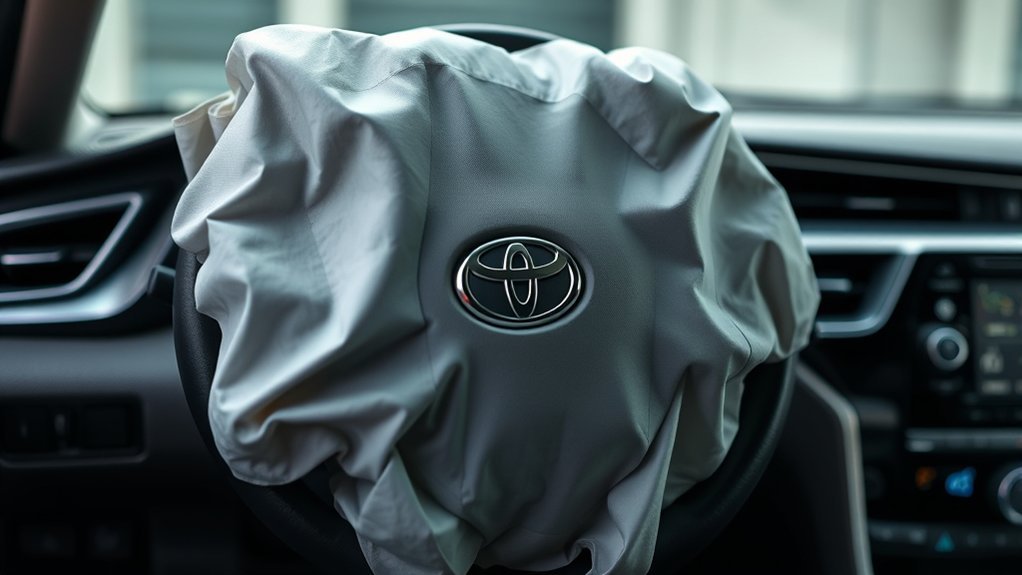
Airbags are supplemental restraints designed to reduce the chance that an occupant’s head or upper body will strike the steering wheel, dashboard, door, pillar, window area, or another interior surface during certain crashes. They work with seat belts, which help keep each occupant in the seating position for which the airbag was designed.
Depending on the model year and market, a Toyota Camry may have driver and front-passenger frontal airbags, front seat-mounted side airbags, side-curtain airbags, knee airbags, rear side airbags, or other restraint designs. Do not assume that every Camry has the same airbag count, sensor set, or deployment strategy. Check the Toyota Manuals and Warranties portal using your model year or vehicle information.
Airbags are not intended to deploy in every collision. The system evaluates factors such as impact direction, crash severity, sensor readings, restraint-system design, seat-belt information, and front-passenger classification. A low-speed impact may not require an airbag, while a more severe impact from a particular direction may activate several airbags and pretensioners.
When deployment is required, the SRS control unit sends an electrical command to the appropriate inflator or pretensioner circuit. An inflator rapidly fills the folded airbag cushion. The cushion then begins venting as the occupant contacts it, helping manage movement during the crash.
Airbags provide their best protection when every occupant sits upright, remains clear of the airbag covers, and wears a correctly positioned seat belt.
What Are the Toyota Camry Airbag System Components?
The Camry’s SRS is a network rather than one airbag assembly. Some people use “airbag module” to describe the cushion-and-inflator unit in the steering wheel, dashboard, seat, or roof area. The central computer that monitors and commands the system is the SRS control unit or airbag control unit. These are different components.
| Component | Main Function | Owner Guidance |
|---|---|---|
| Airbag modules | Contain a folded cushion, inflator, housing, electrical connection, and cover or deployment door for a particular seating area. | Do not open, remove, test, strike, or place accessories over an airbag cover. |
| SRS control unit | Monitors restraint circuits, evaluates sensor information, stores diagnostic faults, and commands selected restraints during a qualifying crash. | Its location, programming, replacement rules, and post-collision procedure vary by model year. |
| Crash sensors | Detect rapid changes and impact conditions associated with frontal, side, or other qualifying crashes. | Collision damage near a sensor or its mounting area may require inspection even when the airbag did not deploy. |
| Front-passenger occupant-classification system | Evaluates front-passenger seat conditions and helps determine whether the passenger frontal airbag should be enabled, suppressed, or otherwise controlled. | Use the seat normally, avoid unapproved cushions or seat modifications, and follow the exact manual if the AIR BAG ON/OFF result seems incorrect. |
| Seat-belt pretensioners | Remove belt slack during certain crashes to help position the occupant before peak crash forces. | A deployed or faulted pretensioner requires model-specific professional service. |
| Spiral cable or clock spring | Maintains the driver-airbag and other steering-wheel electrical connections while the wheel turns. | Steering-wheel removal and clock-spring service are not owner-performed airbag jobs. |
| SRS wiring and connectors | Carry sensor, diagnostic, power, and deployment signals throughout the system. | Never probe, splice, bypass, repair, or unplug a dedicated SRS circuit without the correct Toyota procedure. |
| Power and backup provisions | Supply and monitor the electrical energy required for system self-checks and deployment functions. | Disconnecting the 12-volt battery does not make SRS components safe to dismantle or test. |
| Warning and status indicators | Report startup self-test results, detected faults, and front-passenger airbag status. | An unexpected indicator requires diagnosis; erasing a code is not a repair. |
Airbag Control Unit Functions
The SRS control unit monitors designated restraint circuits while the vehicle is operating. During a crash, it evaluates sensor inputs and determines whether the programmed conditions require one or more airbags, seat-belt pretensioners, or other restraints to activate.
The unit can store SRS diagnostic trouble codes when it detects a monitored fault, such as an open circuit, short circuit, abnormal resistance, voltage problem, sensor fault, communication problem, or another condition covered by the vehicle’s diagnostic strategy. A code identifies the system or circuit that needs testing; it does not prove that the part named in a generic code description must be replaced.
Clearing a code, disconnecting the battery, or hiding the warning indicator does not correct the underlying fault. A technician must use the code, Toyota’s diagnostic flow, approved test equipment, and the exact wiring information for that Camry.
Crash Sensors and Occupant Sensors
Crash sensors and occupant sensors perform different jobs. Crash sensors help the control unit evaluate a collision. The front-passenger occupant-classification system evaluates seat conditions and can affect passenger-airbag status.
Occupant classification should not be described as a simple device that always raises or lowers airbag inflation pressure. Depending on the Camry generation, the information may be used to enable, suppress, or adjust a particular restraint strategy.
Note: An AIR BAG OFF indication may be normal when the front-passenger seat is empty or when the system classifies the seating condition for suppression. If the result does not match the actual occupant, remove loose cargo or an unapproved seat cushion, have the passenger sit upright as the manual directs, and recheck the indicator. Do not unplug or disturb wiring beneath the seat.
How Do Toyota Camry Airbag Sensors Decide Whether to Deploy?
The SRS does not depend on one simple impact switch. It evaluates multiple inputs against a deployment strategy developed for that vehicle. The number, type, and location of sensors vary across Camry generations.
| Input or Sensor | What It Helps Evaluate | Possible System Response |
|---|---|---|
| Frontal crash sensing | Frontal or near-frontal impact direction, severity, and timing | May activate frontal airbags, knee airbags, and seat-belt pretensioners as equipped |
| Side-impact sensing | Impact conditions on one side of the vehicle | May activate seat-mounted side airbags, curtain airbags, and related restraints on the affected side |
| Seat-belt buckle or restraint information | Whether a monitored occupant is using the seat belt | May influence the programmed restraint strategy |
| Front-passenger occupant classification | Front-passenger seat loading and classification conditions | May enable, suppress, or otherwise control the front-passenger restraint strategy |
| System electrical monitoring | Circuit continuity, resistance, voltage, power, and communication | Stores a diagnostic fault and illuminates the SRS warning light when required |
An airbag that does not deploy during a crash is not automatically defective. According to NHTSA’s airbag guidance, deployment depends on the crash characteristics, the vehicle’s restraint-system design, and sensor locations. Airbags are not intended to activate in every crash.
Vehicle speed alone does not determine deployment. A collision can produce different forces depending on impact direction, the object struck, the amount of vehicle deformation, the location of the impact, and other conditions measured by the system.
Do not rely on a generic diagram to find a Camry crash sensor or control unit. Incorrectly striking, moving, powering, or testing an SRS component can cause injury, damage, or loss of restraint protection.
What Does the Toyota Camry SRS Control Unit Do?
The SRS control unit coordinates the restraint system. It receives crash and occupant information, checks monitored electrical circuits, stores diagnostic faults, and commands selected airbags or pretensioners when programmed deployment conditions are met.
Airbags remain supplemental protection. A correctly worn seat belt helps manage the occupant’s movement and keeps the body in the intended position relative to the airbag. Without a belt, an occupant may move too close to the airbag, strike the interior, or be out of position when deployment begins.
The SRS warning light should illuminate as part of the startup self-check and then turn off according to the vehicle’s normal sequence. Depending on the model year, a light that remains on, flashes, appears while driving, or fails to illuminate can indicate that an airbag, pretensioner, sensor, wiring circuit, power source, or related function needs inspection. Toyota’s general warning-light guidance advises prompt inspection when an SRS safety-system warning does not operate normally.
Warning: Never use resistors, bypass devices, jumper wires, test lights, multimeters, or ordinary electrical probes on an SRS deployment circuit. Accidental activation can cause severe injury, while a bypass can hide a fault and prevent a restraint from operating in a crash.
Why SRS Wiring and the Clock Spring Matter
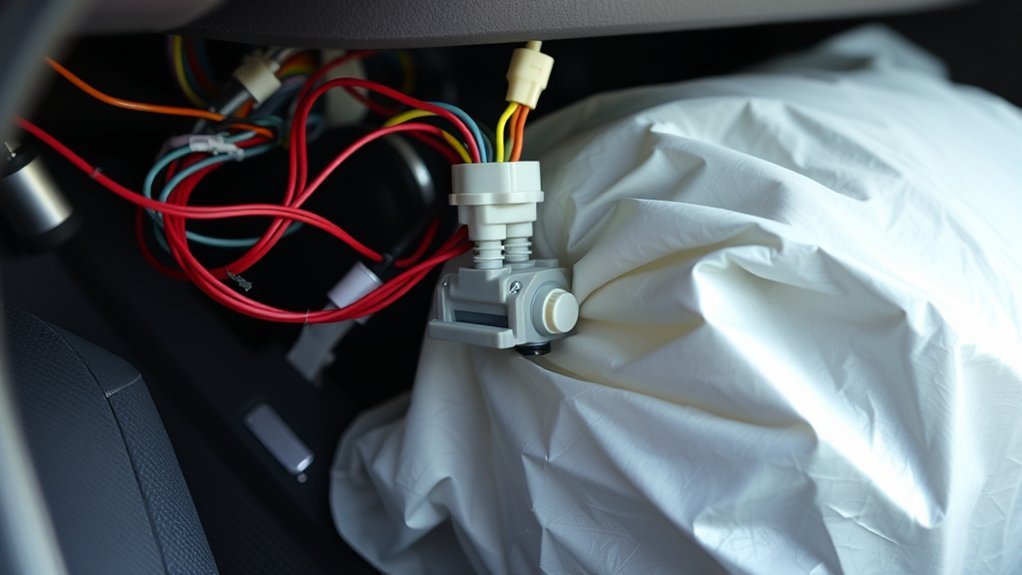
Dedicated wiring connects the SRS control unit with crash sensors, airbag inflators, seat-belt pretensioners, occupant sensors, power provisions, warning indicators, and other monitored components. Reliable connections are necessary for both the startup self-check and any deployment command.
SRS Wiring Connections
| Connection | Purpose | Possible Fault Result |
|---|---|---|
| Control unit to crash sensors | Carries monitored impact information | SRS warning light and a stored sensor or circuit code |
| Control unit to inflators | Provides monitored deployment circuits | One or more affected airbags may be unavailable or require service |
| Control unit to pretensioners | Allows coordinated seat-belt tightening | Pretensioner circuit fault and reduced restraint capability |
| Steering-wheel spiral cable | Maintains the driver-airbag connection while the steering wheel turns | Driver-airbag fault, sometimes accompanied by horn or steering-wheel-control symptoms |
| Seat and occupant-sensor wiring | Carries passenger-classification and belt-related information | Unexpected passenger-airbag status or an SRS warning |
| Power and ground circuits | Support control-unit monitoring and system operation | Voltage, power-supply, communication, or control-unit faults |
How Wiring Faults Affect Airbag Performance
A loose connector, damaged spiral cable, pinched harness, corroded terminal, collision-damaged wire, seat-related work, flood exposure, or an incorrect previous repair can trigger an SRS fault. When the control unit cannot verify a monitored circuit, one or more restraint functions may not be available as designed.
The warning light identifies that the system detected a problem; it does not identify the failed part by itself. A technician must retrieve the SRS-specific codes, follow the Toyota diagnostic procedure, inspect only the designated circuit, repair the cause, and confirm that the self-test completes normally.
When SRS Inspection and Calibration Are Needed
Airbag wiring is not a routine owner-service item. Do not remove interior trim, unplug seat connectors, dismantle the steering wheel, remove pillar trim, disturb the headliner, or inspect concealed harnesses merely as preventive maintenance.
Some seat, occupant-sensor, control-unit, or collision repairs may require model-specific initialization, calibration, or confirmation procedures. A warning light that turns off after parts are reconnected does not prove that occupant classification or deployment readiness has been restored correctly.
Arrange professional inspection when:
- The SRS warning light remains on, flashes, appears while driving, or does not illuminate during startup.
- The front-passenger AIR BAG ON/OFF indication behaves unexpectedly.
- The vehicle has collision damage, flood damage, a salvage or rebuilt title, or major interior electrical repairs.
- A seat, seat frame, dashboard, steering wheel, door, pillar trim, roof trim, or headliner has been removed, modified, or replaced.
- You suspect that a previous owner installed a bypass, removed a warning bulb, covered an indicator, or performed incomplete collision repairs.
- An airbag or seat-belt pretensioner has deployed.
- The repair history of a previously deployed airbag is unknown.
Pro Tip: Before buying a previously damaged, salvage-title, or rebuilt Camry, obtain its repair history and arrange an SRS inspection by a Toyota dealer or reputable repair facility familiar with Toyota restraint systems. A disabled or covered warning light can conceal a missing, counterfeit, or incorrectly installed component.
What the SRS and Passenger-Airbag Lights Mean
Your Camry may display an SRS warning light and a separate front-passenger airbag status indicator. They perform different functions.
- SRS warning light: Reports a detected malfunction involving a monitored airbag, pretensioner, sensor, wiring, power, control, or related restraint-system function.
- Passenger-airbag status indicator: Shows whether the front-passenger airbag is currently enabled or suppressed according to the occupant-classification system.
For a warning-light-specific diagnostic overview, see Toyota Camry Airbag Warning Light On: Causes & Fixes. For other dashboard symbols, use the Toyota Camry dashboard warning lights guide.
| What You See | What It Can Mean | Safe Next Step |
|---|---|---|
| AIR BAG OFF with an empty front-passenger seat | Often normal occupant-classification behavior. | Confirm the indicator matches the owner’s manual. Do not disturb seat wiring. |
| SRS warning light stays on, appears while driving, or fails its startup check | The system has detected a restraint-system malfunction or cannot confirm normal operation. | Minimize unnecessary driving and arrange prompt SRS-capable diagnosis. Do not clear codes as a substitute for repair. |
| Airbag deployment, exposed SRS parts, or a confirmed DTN60DB replacement inflator | The vehicle needs repair before normal use; a DTN60DB inflator presents a rupture hazard. | Do not drive. Arrange towing or other safe transport to a qualified facility. |
An AIR BAG OFF indication can be normal when the passenger seat is empty or when the system determines that suppression is appropriate. Seat loading, an unapproved cushion, an unusual seating position, or a child-restraint situation may affect the result. The exact conditions and corrective steps vary by model year, so follow the instructions in the manual for that Camry.
Do not reach beneath the seat to manipulate connectors or wiring. Do not use a code-clearing tool as a repair. If the fault remains, the warning may return, and the restraint system may still be unavailable even if someone has temporarily erased or hidden the indicator.
What to Do When the Toyota Camry SRS Light Comes On
- Observe the warning’s behavior. Note whether it failed to illuminate at startup, stayed on after the self-check, began flashing, or appeared while driving. Also note whether the AIR BAG ON/OFF indicator is behaving unexpectedly.
- Do not reset or disturb the system. Do not disconnect connectors, install a resistor, clear codes, remove the steering wheel, or probe wiring. Disconnecting the 12-volt battery is not a repair and does not make SRS components safe to dismantle.
- Correct only obvious, nontechnical seat conditions. Remove loose cargo or an unapproved cushion from the front-passenger seat and have an occupant sit normally if the passenger-status result seems wrong. Do not remove the seat or touch its wiring.
- Arrange prompt SRS-capable diagnosis. A Toyota dealer or qualified repair facility should retrieve the restraint-system codes and follow Toyota’s procedure for your model year.
- Minimize unnecessary driving. The Camry may move normally, but one or more airbags or pretensioners may not protect occupants as designed.
- Use a tow when the risk is greater. Do not drive after an airbag deployment, with exposed or damaged SRS components, after serious collision or flood damage, or when a technician confirms that a prohibited DTN replacement inflator is installed.
Warning: A vehicle that drives and brakes normally can still have a serious restraint-system fault. The absence of unusual driving symptoms does not confirm that its airbags and pretensioners are available.
Dangerous Replacement Airbag Inflators: September 2026 Update
Replacement-airbag safety requires more than checking the dashboard light or searching the VIN. NHTSA banned the sale and import of defective frontal driver inflators marked DTN60DB on April 29, 2026. In a September 3, 2026 update, the agency reported 11 deaths and three severe injuries in 14 crashes involving vehicles fitted with these replacement inflators.
The known fatalities now involve Chevrolet Malibu, Hyundai Sonata, and Chevrolet Equinox vehicles rather than Toyota Camrys. NHTSA still warns that the risk cannot be assumed to be limited to those makes and models because the inflators were likely imported outside normal regulated supply channels. See NHTSA’s September 2026 consumer alert and its April 2026 ban announcement.
A VIN recall search cannot reveal whether a DTN60DB or another illegitimate aftermarket inflator was installed after a previous crash. NHTSA states that these replacement inflators are not tied to a vehicle’s VIN. Its deadly replacement-airbag guidance therefore emphasizes repair history and professional inspection.
Consider an inspection by a Toyota dealer or reputable SRS repair facility when:
- The vehicle had an airbag deployment in 2020 or later and the repair was not performed through the vehicle manufacturer’s dealership.
- The vehicle has a salvage or rebuilt title.
- You do not know who repaired a previously deployed airbag.
- The steering wheel, dashboard, seat, or airbag cover appears mismatched, poorly fitted, or recently replaced.
- The SRS warning light does not illuminate during startup, has been covered, or behaves abnormally.
- The vehicle history shows a collision but no clear record of restraint-system replacement.
Do not remove an airbag cover, dismantle the steering wheel, or attempt to read the inflator label yourself. NHTSA specifically directs owners to have this inspection performed by a reputable mechanic or dealership.
Note: A clean VIN recall result does not authenticate replacement airbags, inflators, pretensioners, sensors, or control units installed during an earlier collision repair. NHTSA also notes that recently announced recalls may not yet include every affected VIN, so owners should check regularly.
What to Do After a Collision or Airbag Deployment
A deployed airbag is a single-use component. Seat-belt pretensioners and other restraint parts may also require replacement or inspection after a qualifying collision. The correct component list depends on the crash, deployment record, model year, and Toyota repair instructions.
- Do not fold, reinstall, or reuse a deployed airbag. Once an airbag has deployed, it cannot provide a second deployment.
- Do not return the vehicle to normal use before evaluation. Arrange towing to a Toyota dealer or qualified collision-repair facility when an airbag has deployed or SRS components are exposed.
- Have the complete restraint system inspected. The repair may involve deployed modules, inflators, pretensioners, sensors, wiring, seats, trim, mounting points, the steering wheel, dashboard, control unit, and related structural areas.
- Use the correct replacement parts and procedures. Use genuine Toyota parts or legitimate replacement parts specified and installed according to Toyota’s model-specific repair information. Avoid unknown online inflators, counterfeit modules, bypass devices, and unverified salvaged components.
- Complete required programming or calibration. Seat, occupant-classification, sensor, and control-unit work may require initialization, calibration, or confirmation steps specified by Toyota.
- Confirm that the underlying faults were repaired. The technician should verify the startup self-test, warning indicators, stored codes, and any model-specific post-repair checks. A cleared warning light alone is not proof of a safe repair.
- Check for open recalls. Use both the NHTSA recall lookup and the Toyota recall and service-campaign lookup. Contact a Toyota dealer for any required remedy.
- Verify the replacement-airbag history separately. Recall searches do not identify counterfeit, prohibited, or incorrectly installed aftermarket inflators.
NHTSA has documented replacement inflators that can rupture, fail to provide correct inflation, or send metal fragments toward occupants. This risk deserves particular attention when evaluating a used vehicle with a collision, salvage, rebuilt-title, or unknown repair history.
Maintenance and Safety Tips for Camry Airbag Systems
You do not need to dismantle the SRS for routine maintenance. Focus on correct seating, normal warning-light operation, repair history, recall status, and professional inspection after damage or interior work.
- Wear the seat belt correctly. Keep the lap belt low across the hips and the shoulder belt across the center of the chest and shoulder.
- Maintain distance from frontal airbags. NHTSA recommends at least 10 inches between your breastbone and the frontal-airbag cover. Drivers should move the seat back as far as practical while retaining safe control of the pedals, steering wheel, and other controls.
- Keep children in the rear seat. Children under 13 should ride in the back using the child restraint, booster seat, or seat belt appropriate for their age and size.
- Never place a rear-facing child seat in front of an active frontal airbag.
- Sit upright. Do not lean against a door or pillar, place feet on the dashboard, or ride in a position that puts the body close to an airbag cover.
- Keep deployment paths clear. Do not place hard objects, phone mounts, dashboard mats, decorations, or accessories over an airbag door or between an occupant and an airbag.
- Use compatible seat covers. An unapproved cover can obstruct a seat-mounted side airbag or interfere with seat and occupant-sensing functions.
- Do not modify the steering wheel or seats casually. Aftermarket steering wheels, racing seats, seat frames, emblems, covers, and bypass devices can remove or interfere with required SRS components.
- Protect curtain-airbag areas. Pillar trim, headliner work, roof accessories, and hanging objects must not interfere with the curtain-airbag deployment path.
- Do not disable an airbag casually. Airbag deactivation is appropriate only in limited circumstances and must follow applicable NHTSA and manufacturer procedures.
- Check recalls at least twice a year. Search by VIN because recall eligibility depends on the specific vehicle, not simply the model year.
- Use the exact repair information. Airbag layouts, torque values, waiting periods, calibration steps, component replacement rules, and diagnostic procedures differ across Camry generations.
For national seating and restraint recommendations, review the official NHTSA seat-belt guidance.
Modifications That Can Interfere With Airbags
Interior accessories can become projectiles or obstruct an airbag’s deployment path. Avoid hard steering-wheel badges, rigid wheel covers, dashboard ornaments, passenger-side dash mats, pillar-mounted accessories, and noncompatible seat covers.
Aftermarket seats or steering wheels can also remove airbags, buckle switches, occupant sensors, pretensioners, or wiring required by the original system. A warning-light resistor does not replace any of those safety functions.
Before adding mobility equipment, specialized seating, audio wiring, remote-start equipment, or another modification near SRS components, consult a qualified installer who has the correct Toyota information for the vehicle.
Frequently Asked Questions
What are the main parts of a Toyota Camry airbag system?
The main parts include airbag modules and inflators, the SRS control unit, crash sensors, front-passenger occupant-classification sensors, seat-belt pretensioners, the steering-wheel spiral cable, dedicated wiring, warning indicators, and power or backup provisions. The exact equipment varies by model year, trim, market, and production date.
What components are inside an individual airbag module?
An individual airbag module generally includes a folded cushion, inflator and igniter assembly, housing, electrical connection, and a cover or deployment door. The central SRS control unit is a separate computer that monitors and coordinates the overall restraint system.
What is the 5-10-20 rule for airbags?
NHTSA’s public airbag guidance does not use a general “5-10-20” seating rule. It recommends at least 10 inches between the breastbone and a frontal-airbag cover, an upright seating position, correct seat-belt use, and as much seat distance as practical while the driver can safely reach the controls.
How do you fix an SRS airbag-system malfunction in a Toyota Camry?
A qualified technician should retrieve the SRS-specific diagnostic codes, follow Toyota’s procedure for that model year, inspect only the designated circuits, repair the underlying cause, complete any required programming or occupant-classification calibration, and confirm that the startup self-test and warning indicators operate normally. Clearing a code alone does not repair the fault.
Can you drive a Camry with the SRS warning light on?
The vehicle may move normally, but one or more airbags or pretensioners may not operate as designed. Minimize unnecessary driving and arrange prompt diagnosis. Use a tow after airbag deployment, serious collision or flood damage, exposed SRS components, or confirmation that a prohibited replacement inflator is installed.
Why does the passenger-airbag-off light appear?
The indicator may appear when the passenger seat is empty or when the occupant-classification system determines that suppression is appropriate. Seat loading, an unapproved cushion, unusual seating, or a child-restraint situation may affect the result. Follow the model-year manual when the indicator does not match the actual seating condition.
Do all Toyota Camry models have the same airbags?
No. The number, type, placement, sensor set, and control strategy have changed across Camry generations, markets, trims, and production dates. Check the manual for your exact vehicle and use the VIN to check for open recalls.
Will disconnecting the battery or clearing a code reset the airbag system?
Battery disconnection or code clearing may remove or interrupt some stored information, but it does not repair a damaged sensor, inflator, pretensioner, clock spring, connector, wiring circuit, seat system, or control unit. SRS components can also retain hazardous deployment capability after vehicle power is disconnected.
Can a VIN recall search detect a counterfeit replacement airbag?
No. A VIN search can identify open manufacturer safety recalls associated with that VIN, but it cannot authenticate an airbag or inflator installed during an earlier repair. NHTSA states that the prohibited DTN replacement inflators are aftermarket equipment and are not tied to a vehicle’s VIN.
Can a Toyota Camry have a banned DTN60DB replacement inflator?
NHTSA’s known fatal DTN60DB cases have involved Chevrolet Malibu, Hyundai Sonata, and Chevrolet Equinox vehicles, not Toyota Camrys. However, NHTSA says it cannot assume the risk is limited to those models. If a Camry had an airbag deployment since 2020 and the repair history is unknown or the repair was not performed through the vehicle manufacturer’s dealership, have a reputable mechanic or Toyota dealer inspect the replacement airbag. Do not inspect the inflator yourself.
Conclusion
Your Toyota Camry’s airbag system depends on coordinated airbags, inflators, crash sensors, occupant sensors, seat-belt pretensioners, the SRS control unit, warning indicators, wiring, and power provisions. These components supplement correctly worn seat belts and should never be treated as ordinary DIY electrical parts.
Watch the SRS and front-passenger airbag indicators, maintain a safe seating position, keep children under 13 in the rear seat, and check the VIN for recalls at least twice a year. Remember that a recall search cannot verify a previously installed replacement airbag. If the vehicle had an airbag deployment or has an uncertain collision-repair history, verify the replacement-airbag history separately. After a collision, deployment, abnormal warning, or questionable prior repair, have the system inspected and restored by a qualified facility using the correct Toyota procedures and legitimate replacement components.
Sources
- Toyota Manuals and Warranties — Model-specific Camry airbag, occupant-classification, warning-light, and safety instructions.
- Toyota Dashboard Warning Lights — Toyota guidance for SRS warning-light operation and inspection.
- National Highway Traffic Safety Administration: Air Bags — Airbag operation, deployment, seating distance, child safety, replacement, and counterfeit-part guidance.
- NHTSA: Deadly Air Bag Replacements — Current DTN inflator identification, inspection, VIN-search limitations, and owner precautions.
- NHTSA September 3, 2026 Consumer Alert — Latest DTN60DB fatality count and affected-vehicle warning.
- NHTSA Recall Lookup — VIN- and license-plate-based safety recall information.
- NHTSA Seat-Belt Safety — Correct belt use, child seating, and the relationship between seat belts and airbags.
