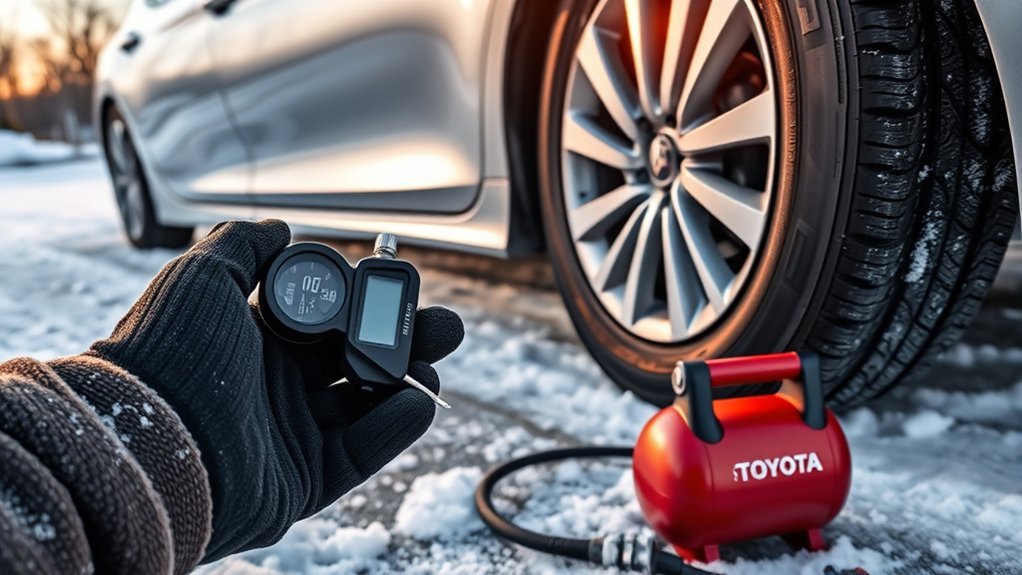
Cold weather can lower the air pressure in your Toyota Camry’s tires, but the safe response is not to guess at a new winter PSI. You should check each tire while it is cold and inflate it to the pressure printed on your Camry’s Tire and Loading Information label. That model-specific number remains your target throughout winter.
Quick Answer
For winter driving, inflate your Toyota Camry’s tires to the cold PSI printed on the Tire and Loading Information label inside the driver’s door jamb. Do not automatically add 3–4 PSI or lower pressure for snow. Check all tires cold at least monthly and after major temperature drops.
Key Takeaways
- Use the cold-tire PSI on your Camry’s driver-door label, not a generic 32–35 PSI range.
- Cold weather may reduce pressure by roughly 1 PSI for each 10°F temperature drop, although the actual change can vary.
- Add only enough air to restore the placard pressure. Do not add an automatic winter buffer.
- Do not lower tire pressure for snow. Proper tires, adequate tread, and slower driving provide safer winter traction.
- TPMS is a warning system, not a substitute for checking pressure with an accurate gauge.
At a Glance
| Time Required | About 5–10 minutes |
| Difficulty | Easy |
| Tools Needed | Accurate tire-pressure gauge and an air compressor if pressure is low |
| Cost | Usually no added cost if you already own a gauge and compressor; service-station fees vary |
Understanding Tire Pressure: Why It Matters for Your Camry
Your Camry’s tires support the vehicle, absorb road impacts, and provide the grip needed for steering and braking. Correct inflation helps each tire carry its intended load and maintain a stable contact patch with the road.
Underinflation allows the tire to flex more than intended. That extra movement can increase heat buildup, accelerate shoulder wear, reduce fuel efficiency, and affect handling. Severe underinflation can also damage the tire internally.
Overinflation can create a harsher ride, reduce impact absorption, and contribute to uneven wear. That is why you should use the vehicle manufacturer’s pressure rather than choosing a higher or lower number based on weather alone.
The correct winter pressure is your Camry’s specified cold pressure, not a separate seasonal target.
The National Highway Traffic Safety Administration recommends checking all tires, including the spare, at least once a month while the tires are cold.
Recommended Tire Pressure for a Toyota Camry
Toyota Camry tire pressure is not one universal number. The correct value can vary by model year, trim, tire size, and whether Toyota specifies different pressures for the front and rear tires.
Open the driver’s door and find the Tire and Loading Information label on the door jamb or nearby pillar. Look for the cold inflation pressure listed beside the original front and rear tire sizes. Use those values unless Toyota or a qualified tire professional has provided different instructions for an approved replacement tire setup.
You can also find model-specific information through Toyota’s official manuals and warranties portal.
Note: The pressure molded into a tire’s sidewall is not your Camry’s normal inflation target. Use the vehicle placard for the recommended cold PSI.
| Pressure Source | How to Use It |
|---|---|
| Driver-door placard | Your primary source for the recommended cold front and rear pressure. |
| Owner’s manual | Provides model-specific instructions, TPMS information, and spare-tire guidance. |
| Tire sidewall | Shows tire specifications and limits. It is not the vehicle’s recommended everyday PSI. |
| TPMS display or warning | Helps identify low pressure but does not replace checking against the placard with a gauge. |
Understanding How Cold Weather Affects Your Tire Pressure
As the outside temperature falls, the air inside a tire contracts and the measured pressure usually falls with it. A common rule of thumb is a decrease of roughly 1 PSI for each 10°F drop in ambient temperature, although the exact change can vary.
The tire may not have a leak. It may simply have been set correctly on a warmer day and become underinflated when colder weather arrived. You still need to add air if its cold reading is now below the placard value.
Cold Air Effects
Suppose a tire matched the door-jamb specification during mild weather. After a strong cold front, the same tire may read several PSI lower the next morning. Add only enough air to return it to the listed cold pressure.
Do not automatically add 3–4 PSI above Toyota’s specification. A temperature-related pressure loss is already corrected when you restore the tire to its placard value.
Pressure Drop Factors
Temperature is only one possible reason for low pressure. Other causes include natural air loss, a puncture, a damaged valve stem, a leaking wheel bead, wheel corrosion, or impact damage from a pothole.
If one tire loses much more pressure than the others, or needs air repeatedly, have it inspected. A weather change generally affects all four tires in a similar direction, while a single-tire loss often points to a leak or damage.
What’s the Best Tire Pressure for Your Toyota Camry?
The best pressure is the cold front and rear PSI printed on your specific Camry’s Tire and Loading Information label. Do not replace those values with a generic online range.
- Check the label before adding or releasing air.
- Follow separate front and rear values when the label lists them.
- Measure pressure before driving or after the vehicle has remained parked for at least three hours.
- Use the owner’s manual for an approved nonstandard wheel-and-tire setup.
- Check the spare according to its own label or Toyota’s instructions.
If a cold tire is below its specified value, add air until it reaches the placard pressure. If it is above that value because you intentionally overfilled it while cold, release small amounts and recheck with the gauge.
Warning: Do not drive on a visibly flat tire or a tire with a bulge, exposed cord, deep cut, or severe impact damage. Install the spare when safe and permitted, or arrange roadside assistance.
Recognizing Low Tire Pressure: Signs and Remedies
A steady TPMS warning usually means at least one tire is significantly underinflated. Pull over somewhere safe, inspect the tires, and check each one with a gauge as soon as practical.
Federal TPMS rules are intended to warn about significant underinflation. The system may not alert you as soon as a tire falls slightly below its recommended pressure, so you should not wait for the warning light before performing maintenance.
The federal TPMS standard requires warning under defined significant-underinflation conditions, including a threshold based on approximately 25% below the vehicle manufacturer’s recommended cold pressure, subject to regulatory minimums.
If the TPMS Light Stays On
- Stop in a safe location.
- Inspect each tire for visible damage or severe deflation.
- Check all four tire pressures with a gauge.
- Inflate low tires to the door-jamb cold specification.
- Recheck the pressure when the tires are cold if you adjusted them after driving.
- Arrange an inspection if the warning returns or one tire keeps losing air.
If the TPMS Light Flashes
A warning that flashes for roughly a minute and then remains on commonly indicates a TPMS malfunction rather than pressure alone. A sensor, wheel, communication component, or system registration issue may require professional diagnosis.
You should still check the tires manually because a TPMS malfunction can prevent the system from warning you correctly.
How to Check Your Tire Pressure Properly
Use an accurate digital, dial, or pencil-style gauge. A personal gauge is helpful because service-station gauges may be exposed to weather and heavy use.
Use a Reliable Pressure Gauge
- Park the Camry on a safe, level surface.
- Locate the recommended front and rear PSI on the driver-door label.
- Remove the valve cap from the first tire.
- Press the gauge squarely onto the valve stem until air stops hissing.
- Record the reading and repeat for every tire.
- Add or release air as needed, then measure again.
- Reinstall each valve cap.
Bridgestone’s tire-pressure guidance also recommends starting with cold tires and comparing each reading with the vehicle manufacturer’s specification.
Measure When the Tires Are Cold
A cold tire is generally one that has not been driven for at least three hours. Driving generates heat, and that heat normally raises pressure. A warm reading can therefore be higher than the same tire’s cold reading.
Do not release air from a properly inflated warm tire merely because its reading has risen above the placard number. Recheck it after the vehicle has cooled.
Pro Tip: Keep a trusted gauge in the glove compartment and check the tires early in the morning before driving, especially after an abrupt temperature change.
Compare With the Recommended PSI
Compare each cold reading with the corresponding front or rear value on the placard. Do not assume all four tires require the same pressure unless the label says so.
- If the reading is low, add air in short bursts and recheck.
- If the cold reading is high, release a small amount and measure again.
- If the tire was warm when adjusted, verify it again after the vehicle has remained parked for at least three hours.
- If one tire cannot hold pressure, arrange a leak inspection.
Adjusting Tire Pressure for Winter Conditions
Winter adjustment means restoring the cold pressure to Toyota’s specification after the temperature causes it to fall. It does not mean adding a fixed amount above that specification.
For example, if the placard requires a particular cold pressure and your gauge shows that a tire is 3 PSI below it on a cold morning, add approximately the missing 3 PSI and recheck. Stop when the gauge matches the placard.
If you must add air after driving, avoid releasing air simply because the tire is warm. NHTSA advises drivers to recheck and make the final adjustment once a cold reading is available.
Do Not Lower Pressure for Snow
Lowering pressure below the vehicle specification is not a safe road-driving traction strategy. It can increase tire flex, heat, wear, and handling problems.
For better winter control, focus on tires suited to your climate, adequate tread depth, smooth steering and braking, slower speeds, and increased following distance. NHTSA’s winter-driving guidance recommends maintaining manufacturer-specified pressure and considering winter tires for snowy conditions.
Common Winter Tire Pressure Mistakes to Avoid
- Using the tire sidewall number: The sidewall value is not your Camry’s recommended everyday pressure.
- Adding 3–4 PSI automatically: Add only enough air to reach the door-jamb cold specification.
- Lowering PSI for snow: Keep the manufacturer-specified pressure and use suitable tires for winter traction.
- Checking only after driving: Warm readings are higher and can lead you to release needed air.
- Waiting for the TPMS light: A tire can be below its target before the system warns you.
- Ignoring a flashing TPMS light: Flashing commonly indicates a system malfunction that needs diagnosis.
- Forgetting the spare: Check its own label or the owner’s manual because spare requirements vary.
- Repeatedly topping up one tire: Recurring loss may indicate a puncture, valve leak, bead leak, or wheel damage.
- Checking pressure but ignoring condition: Inspect the tread and sidewalls for cuts, cracks, bulges, punctures, and abnormal wear.
Pressure Cannot Replace Suitable Winter Tires
Correct inflation helps your tires work as designed, but it cannot turn worn or warm-weather tires into effective snow tires. If you regularly drive in freezing temperatures, snow, or ice, consider tires designed for those conditions.
Inspect tread depth monthly and before long winter trips. Replace tires that are worn to the legal minimum or show damage, and consider replacing them earlier when winter traction has become inadequate.
Frequently Asked Questions
What PSI should my Toyota Camry tires be during winter?
Use the cold front and rear PSI printed on the Tire and Loading Information label inside the driver’s door jamb. The correct winter target is normally the same manufacturer-specified cold pressure used throughout the year. Check it more frequently because cold weather can lower the reading.
Are all Toyota Camry tire pressures between 32 and 35 PSI?
No single range safely covers every Camry model year, trim, and tire package. Many passenger vehicles use values in the low-to-mid 30s, but you should follow the exact cold pressure on your own vehicle’s placard rather than a generic range.
Should tire pressure be higher or lower in snow?
Neither. Maintain the pressure specified by Toyota. Do not lower pressure to increase the contact patch, and do not add an arbitrary amount above the specification. Use suitable winter tires, maintain adequate tread, reduce speed, and increase following distance.
Is 40 PSI too high for a Toyota Camry?
Compare the reading with your door-jamb placard and consider whether the tire is cold or warm. A cold reading of 40 PSI may be above specification on many Camrys, but a properly inflated tire can temporarily approach that level after driving. Do not bleed a warm tire before checking it again cold.
Why does the TPMS light appear on a cold morning and turn off later?
A marginally low tire may fall below the warning threshold overnight and rise again as the day warms or the tire heats during driving. Check the tires cold instead of assuming the problem corrected itself.
How often should I check my Camry’s tire pressure in winter?
Check all tires at least once a month, before long trips, and after a significant temperature change. Check sooner if the TPMS light appears, the vehicle has hit a pothole, or one tire seems to be losing air.
Sources
- NHTSA TireWise — cold-pressure checks, door-jamb specifications, TPMS limitations, tire inspection, and monthly maintenance.
- NHTSA Winter Weather Driving Tips — winter pressure changes, placard use, tread inspection, and winter-tire guidance.
- Toyota Manuals and Warranties — official model-specific owner’s manual lookup.
- 49 CFR §571.138 — federal TPMS warning and malfunction requirements.
- Bridgestone Tire-Pressure Guide — gauge use, cold-tire measurements, inflation steps, and warm-tire cautions.
Conclusion
Cold weather can reduce your Toyota Camry’s tire pressure, but it does not create a separate universal winter PSI. Check the tires cold and restore each one to the front or rear pressure shown on the driver-door label. Do not add an automatic 3–4 PSI, lower pressure for snow, or rely only on the TPMS light.
Monthly checks, suitable winter tires, adequate tread, and prompt attention to repeated pressure loss will do more for winter safety than changing Toyota’s specified pressure. Have any damaged or frequently deflating tire inspected before continuing to drive on it.