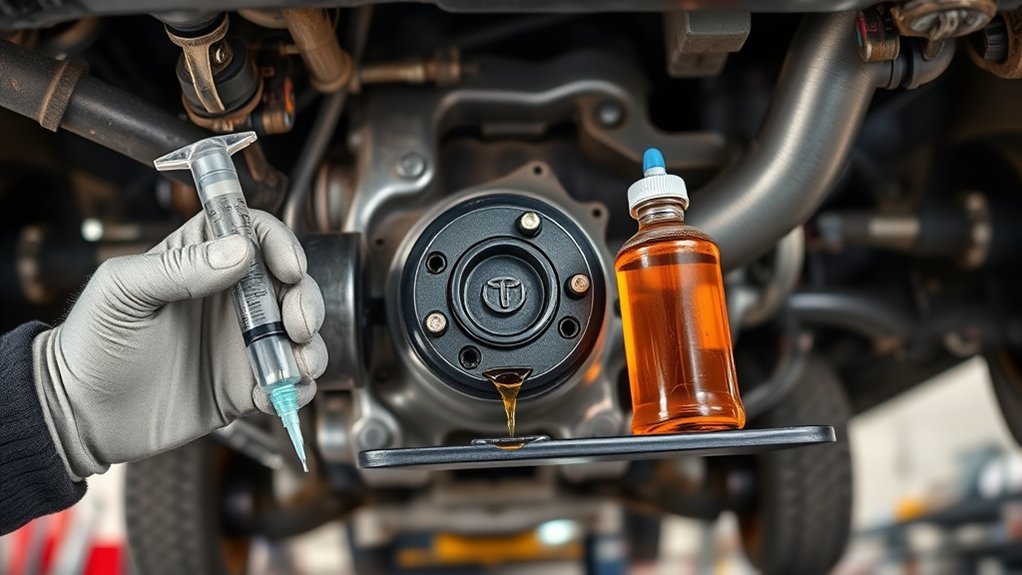
Your Toyota Tacoma’s transfer case sends engine torque to the front and rear axles when four-wheel drive is engaged. The fluid inside it reduces friction, carries heat away from gears and bearings, and helps the shift mechanism operate correctly. The most important rule is simple: match the fluid to your exact model year and drivetrain instead of choosing by brand name alone.
Quick Answer
Use the exact transfer-case fluid specification listed for your Tacoma’s model year and drivetrain. Some newer part-time 4WD Tacomas call for a low-viscosity SAE 75W API GL-4 fluid, while older trucks may list a different viscosity or service category. Never assume GL-4 or GL-5 is universal; verify the owner’s manual before buying fluid.
Key Takeaways
- Transfer-case fluid specifications vary by Tacoma generation, transfer case, and drivetrain.
- Match the viscosity, API service category, and manufacturer specification shown in your owner’s manual.
- A GL-5 label does not automatically make a fluid a better replacement for an application that specifies GL-4.
- Remove the fill plug before the drain plug so you know the case can be refilled.
- Check the transfer case after water crossings, leaks, heavy towing, or frequent off-road use.
At a Glance
| Time Required | About 45 to 90 minutes |
| Difficulty | Moderate DIY job |
| Tools Needed | Correct sockets or hex bits, ratchet, torque wrench, drain pan, fluid pump, gloves, rags, and approved lifting equipment if needed |
| Cost | Varies by fluid specification, quantity, replacement gaskets, and local labor rates |
What Is Transfer Case Fluid and Its Purpose?

Transfer-case fluid lubricates the gears, shafts, bearings, chain, and other moving parts inside the case. It also helps control heat and carries wear particles toward the drain-plug magnet on transfer cases equipped with one.
On a part-time four-wheel-drive Tacoma, the transfer case routes torque to the front driveline when you select 4H or 4L. Some newer configurations use different transfer-case designs, including full-time four-wheel-drive systems. That design difference is one reason fluid type and capacity cannot be treated as universal.
Use Toyota’s owner-manual and maintenance-guide lookup to find the specifications for your model year. Confirm all three details before buying fluid: the SAE viscosity grade, the API service category or Toyota specification, and the required quantity.
The safest fluid choice is not the most expensive bottle. It is the fluid that matches every specification in your Tacoma’s manual.
Why GL-4 Fluid May Be Required for Your Tacoma
Some newer Tacoma transfer-case applications specify a low-viscosity SAE 75W fluid meeting API GL-4 requirements or Toyota’s stated equivalent. GL-4 describes a performance category for certain gear sets and operating conditions. It is not simply a lower-quality version of GL-5.
Viscosity matters as much as the GL category. A 75W low-viscosity transfer-case fluid and a 75W-90 axle lubricant can behave differently, especially during cold starts. Using a thicker or differently formulated product may increase drag or change shift feel even when the bottle carries a familiar gear-oil label.
When the manual calls for Toyota Genuine Transfer Gear Oil LF or an equivalent, an aftermarket product should explicitly match the viscosity and service requirement. Do not rely on a store fitment screen, forum post, or the phrase “works in transfer cases” without checking the product data sheet.
Note: The transfer case, front differential, rear differential, manual transmission, and automatic transmission may require different fluids. Never assume one gear oil services every driveline component.
Why You Should Not Treat GL-5 as a Universal Upgrade
GL-5 fluids are designed for severe gear-loading conditions, especially hypoid axle gears. That does not make every GL-5 product a correct substitute in a transfer case that specifies GL-4. The additive package, friction behavior, viscosity, and OEM requirement all matter.
Brass and Copper Compatibility
The original warning that every GL-5 oil will corrode brass is too broad. Older sulfur-phosphorus formulations created legitimate yellow-metal concerns, but modern formulations vary, and some products are designed to meet copper-corrosion tests. You still should not substitute solely because a label claims broad compatibility.
If your Tacoma manual specifies GL-4, use a fluid that clearly meets that requirement. This avoids guessing about additive chemistry and friction characteristics. It also keeps the service aligned with Toyota’s published specification.
The Bigger Risk Is a Specification Mismatch
Corrosion is only one possible concern. A fluid can protect metal well and still be wrong because it is too thick, uses a different friction package, or does not meet the transfer case’s intended operating requirements. That can contribute to cold-weather drag, poor shift quality, noise, or inefficient operation.
- Wrong viscosity: A thicker fluid may not flow as quickly when cold.
- Wrong service category: GL-4 and GL-5 are designed for different gear-service demands.
- Unsupported equivalence: A product may be suitable for some transfer cases but not your Tacoma’s unit.
- Mixed fluids: Topping up with an unknown fluid can alter the final blend’s behavior.
Why the Owner’s Manual Comes First
Toyota has changed Tacoma drivetrains and transfer-case designs over the years. A recommendation that fits one generation may not fit another. Check the manual by model year, then compare the bottle label and technical data sheet line by line.
If the specification is unclear, use the Toyota fluid listed in the manual or ask a Toyota parts department to confirm the current part number using your VIN. A VIN check is especially useful when a model year includes more than one drivetrain or transfer-case configuration.
AMSOIL vs. Red Line: Comparing Transfer-Case Fluids

Brand comparisons are useful only after you identify the required specification. Red Line MT-LV is marketed as a low-viscosity 70W/75W GL-4 lubricant. It may be a candidate where the manual allows an equivalent low-viscosity GL-4 product. Review the current Red Line MT-LV product information before use.
AMSOIL Severe Gear 75W-90 belongs to a different viscosity and application category. It is formulated for high-load gear service and contains friction modifiers for limited-slip applications. It should not be treated as a direct replacement for every SAE 75W GL-4 transfer-case requirement.
| Comparison Point | Red Line MT-LV | AMSOIL Severe Gear 75W-90 |
|---|---|---|
| Published viscosity class | 70W/75W | 75W-90 |
| Published service focus | Low-viscosity GL-4 manual-transmission and transfer-case applications | High-load gear and axle service |
| Universal Tacoma substitute? | No; verify the exact manual specification | No; verify viscosity and service category |
Do not choose based on price, online popularity, or a claim that one product “shifts better.” Choose the product whose published data matches Toyota’s requirement for your truck.
How Often Should You Change Tacoma Transfer-Case Fluid?
A fixed 30,000- to 60,000-mile rule is not accurate for every Tacoma. Toyota’s maintenance schedule varies by model year and operating conditions. Some schedules call for periodic inspection during normal service and replacement under special operating conditions.
Inspect the fluid and case sooner when your truck regularly tows, hauls heavy loads, drives off-road, operates in deep dust or mud, or crosses water. Water contamination requires prompt attention because milky fluid can no longer protect internal parts properly.
Also inspect the case after finding oil spots under the truck, hearing a new whine or grinding noise, or seeing wetness around the plugs, seals, or case halves. A leak should be repaired instead of repeatedly topping off the fluid.
Changing Your Tacoma’s Transfer Case Fluid: Tips and Techniques
You can change the fluid at home if you can safely access the transfer case and have the correct tools. The truck must remain level during draining and filling so the final level is accurate.
Warning: Never work under a truck supported only by a jack. Use rated ramps or jack stands on a solid, level surface, chock the wheels, and allow hot driveline components to cool before touching the plugs.
Essential Tools Required
- The exact fluid and quantity listed for your Tacoma
- New drain- and fill-plug gaskets or sealing washers when specified
- Correct sockets, hex bits, and ratchet
- Torque wrench covering the required plug torque
- Drain pan and a hand pump or squeeze-fill system
- Gloves, eye protection, rags, and brake cleaner for the exterior only
- Skid-plate tools if the transfer case is covered
A punch-type can opener is unnecessary for most current fluid containers. A sealed hand pump or flexible squeeze pack is cleaner and reduces the chance of introducing dirt.
Fluid Change Steps
- Verify the specification. Confirm the fluid type, capacity, plug torque, and gasket requirements in the owner’s or repair manual.
- Warm the fluid slightly. A brief drive can help old fluid drain, but let the exhaust and transfer case cool to a safe working temperature.
- Park level and secure the truck. Apply the parking brake, chock the wheels, and use rated supports if extra clearance is required.
- Remove the skid plate if needed. Support it while removing the final fasteners.
- Clean around both plugs. Keep dirt from entering the case.
- Loosen the fill plug first. Stop if it will not open. Draining a case that you cannot refill can leave the truck undriveable.
- Remove the drain plug. Let the fluid drain fully into a suitable pan.
- Inspect the old fluid and plug. Fine gray paste on a magnetic plug can be normal. Metal flakes, chips, a burnt smell, or milky fluid need further diagnosis.
- Install the drain plug. Use the correct new gasket when required and tighten the plug to the exact model-specific torque.
- Fill the transfer case. Pump in the specified fluid. On many designs, the correct level is near the lower edge of the fill opening with the truck level, but follow your manual if it gives a different method.
- Install the fill plug. Use the correct gasket and torque specification.
- Clean and check. Reinstall the skid plate, drive briefly, and inspect both plugs and the case for leaks.
Pro Tip: Before draining, take a clear photo of the fluid bottle, lot number, mileage, and plug locations. Keep the receipt with your maintenance records so the next service starts with verified information.
Common Mistakes and Troubleshooting
Overfilling or Underfilling
Underfilling can starve bearings and gears. Overfilling can cause aeration, heat, or leakage through the vent. Keep the truck level and use the manual’s fill procedure rather than adding a guessed quantity.
Confusing Transfer-Case and Differential Fluids
The front and rear differentials often use a different viscosity or performance category from the transfer case. Label each bottle before starting, especially when servicing several driveline components on the same day.
Hard Shifting or a 4WD Warning After Service
Do not assume new fluid caused every engagement problem. A low battery, actuator fault, wiring problem, damaged position sensor, driveline bind, or incorrect operating procedure can also prevent 4WD engagement. Recheck the fluid specification and level, scan for diagnostic codes, and seek professional diagnosis if the warning remains.
Metal or Water in the Old Fluid
A small amount of smooth gray paste on a magnetic drain plug can reflect normal wear. Shiny flakes, chunks, heavy bronze-colored debris, or milky fluid are not normal. Limit driving and have the case inspected before internal damage spreads.
Exploring Cost-Effective Alternatives for Transfer Case Maintenance
You can control maintenance cost without compromising the specification. Compare product data sheets rather than brand reputation alone, buy only the quantity you need, and replace inexpensive sealing washers to reduce the chance of leaks.
- Use an approved equivalent: Choose an aftermarket fluid only when its published viscosity and service category match the manual.
- Buy the correct quantity: Capacity varies, so verify it before ordering.
- Reuse tools, not dirty fluid: A quality hand pump and drain pan can serve future maintenance jobs.
- Fix leaks early: A seal or plug leak is usually less expensive to address before the fluid level drops.
- Recycle used oil: Take drained fluid to a local used-oil collection center. The U.S. EPA explains proper used-oil handling and recycling.
Frequently Asked Questions
What does transfer-case fluid do?
It lubricates gears, bearings, shafts, chains, and shift components inside the transfer case. It also helps manage heat and carries wear particles away from loaded surfaces.
What happens when transfer-case fluid is low?
Low fluid can reduce lubrication and increase heat, noise, and wear. You may notice a leak, whine, grinding sound, or difficult engagement, but some transfer-case problems produce few early symptoms.
How often should I change the transfer-case fluid on my Tacoma?
Follow the maintenance guide for your exact model year and driving conditions. Inspect it sooner after towing, frequent off-road use, deep-water crossings, leaks, or evidence of contamination.
Do I need to service the fluid if I rarely use 4WD?
Yes. Internal components can still rotate, and the fluid ages from heat, moisture, and contamination. Follow Toyota’s inspection and replacement schedule even when 4WD use is limited.
Can I use 75W-90 instead of SAE 75W?
Only when Toyota’s specification for your exact transfer case permits it. SAE 75W and 75W-90 are not automatically interchangeable, even when both products are sold as gear oil.
Can I mix GL-4 and GL-5 fluids?
Avoid mixing unknown fluids. Mixing can change viscosity and additive performance. If the wrong fluid was added, drain it and refill with the correct specification rather than trying to correct the blend by topping off.
Conclusion
Transfer-case maintenance protects your Tacoma’s four-wheel-drive system, but the correct fluid depends on the truck’s exact configuration. Verify the manual, match every specification, remove the fill plug first, keep the truck level, and use the proper torque and sealing washers. Those steps matter more than choosing a popular brand or assuming GL-5 is an upgrade over GL-4.
Sources
- Toyota Owner’s Manuals and Warranty Guides — model-specific fluid specifications, capacities, and maintenance schedules.
- Toyota Technical Information System — official repair information and torque procedures.
- Red Line MT-LV Product Information — published viscosity and GL-4 product claims.
- AMSOIL Severe Gear 75W-90 Product Information — product viscosity, intended service, and formulation details.
- U.S. Environmental Protection Agency: Managing Used Oil — safe handling and recycling guidance.
