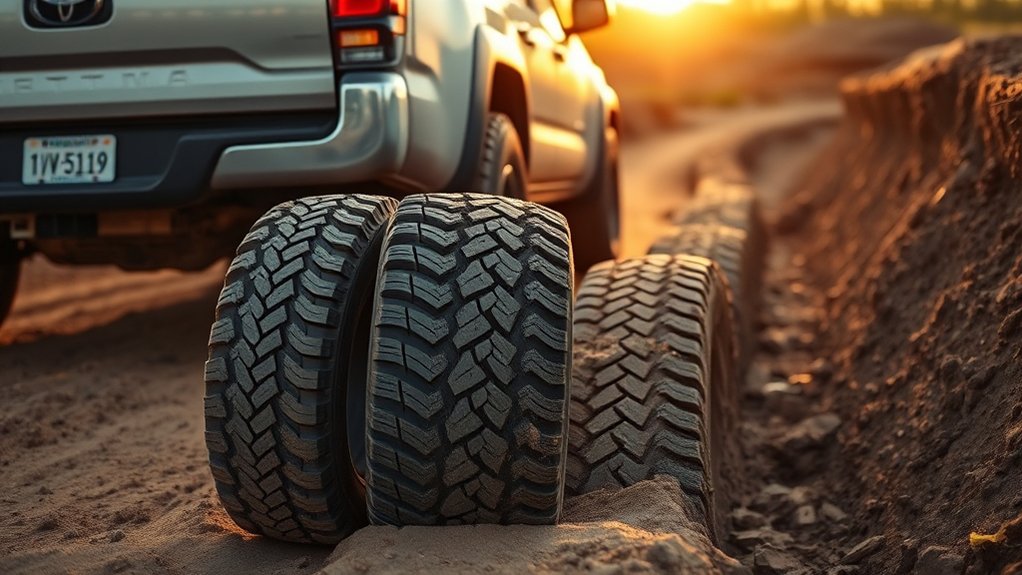
Choosing between all-terrain and mud-terrain tires for your Toyota Tacoma comes down to where you drive most, not which tread looks more aggressive. All-terrain tires usually suit daily driving, highway trips, gravel roads, and moderate trails. Mud-terrain tires make more sense when deep mud, loose soil, rocks, and difficult trails dominate your use.
Quick Answer
Choose all-terrain tires for a Tacoma that spends most of its time on pavement but still sees gravel, dirt, snow, or moderate trails. Choose mud-terrain tires when demanding off-road traction matters more than road noise, ride comfort, fuel use, and tread life. Always match Toyota’s approved size and load requirements.
Key Takeaways
- All-terrain tires offer the better overall balance for commuting, towing, road trips, and occasional off-road use.
- Mud-terrain tires provide stronger bite and self-cleaning ability in deep mud and loose terrain, but usually create more on-road compromise.
- Mileage warranties, construction, snow ratings, tread life, and road noise vary by tire model. They are not guaranteed by the A/T or M/T label alone.
- Use your Tacoma’s door-jamb placard and owner’s manual to confirm tire size, load capacity, and cold inflation pressure.
- A heavier or larger tire can affect acceleration, braking, steering feel, fuel economy, clearance, gearing, and speedometer accuracy.
Understanding All-Terrain and Mud-Terrain Tires for Your Tacoma
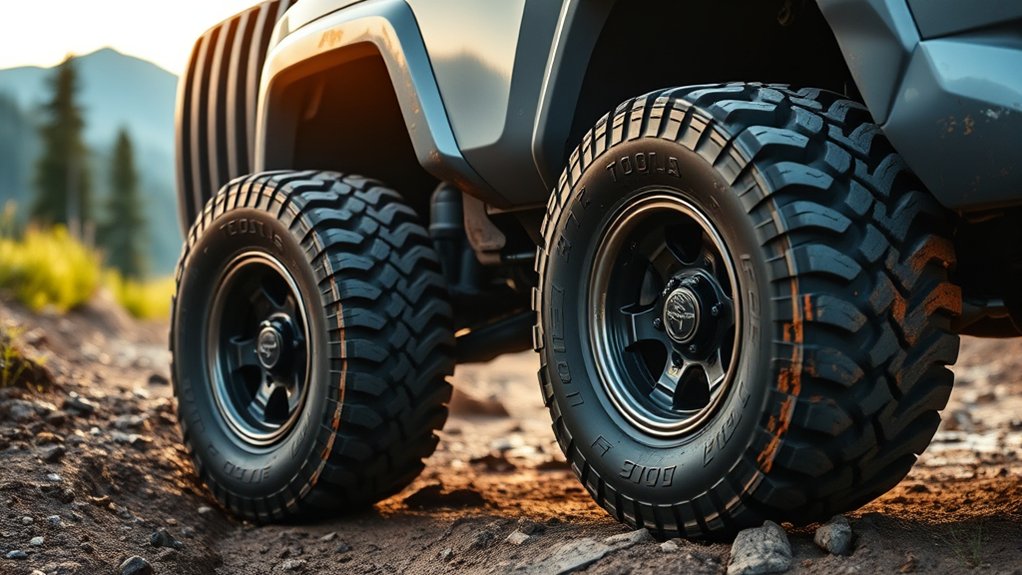
All-terrain tires use a mixed-purpose tread designed to work on pavement and unpaved surfaces. Their tread blocks and voids are generally less extreme than those on mud-terrain tires. Many models also use siping, variable tread pitches, and other features intended to improve wet-road grip, snow traction, wear, or noise control.
Mud-terrain tires use larger tread blocks, wider voids, and more aggressive shoulder patterns. That open design helps the tread release mud and maintain bite in soft ground. Some models also add reinforced sidewall features for rocks, roots, and trail hazards.
These labels describe broad categories, not identical construction. Rubber compounds, sidewall plies, tread depth, snow certification, load range, mileage warranty, and expected wear all vary by brand, model, and size.
All-Terrain vs. Mud-Terrain Tires: Quick Comparison
| Factor | All-Terrain (A/T) | Mud-Terrain (M/T) |
|---|---|---|
| Best use | Daily driving plus moderate off-road travel | Frequent difficult trails, deep mud, rocks, and loose soil |
| Road comfort | Usually smoother and quieter | Usually firmer and louder |
| Mud clearing | Moderate, depending on tread design | Stronger self-cleaning from wider voids |
| Wet and snow performance | Often more road-focused; verify model ratings | Varies widely; aggressive mud tread does not guarantee good rain, packed-snow, or ice grip |
| Tread life | Often longer in mixed road use | Often shorter with substantial pavement use |
| Fuel economy | Usually the smaller penalty when size and weight are comparable | May create a larger penalty because of weight, tread movement, and rolling resistance |
Warning: Do not choose a tire by diameter or appearance alone. Confirm the correct size, load index, speed rating, wheel compatibility, clearance, and cold inflation pressure for your exact Tacoma year and trim. Oversized or under-rated tires can affect vehicle control and safety.
Benefits of All-Terrain Tires: A Versatile Choice for Everyday Driving
All-terrain tires are usually the practical choice when your Tacoma serves as a commuter, family vehicle, tow vehicle, or road-trip truck. Their tread patterns are designed to preserve useful off-road grip without giving up as much pavement comfort as a typical mud-terrain tire.
On gravel, forest roads, sand, and moderate trails, an A/T tire can provide enough traction for many owners. On pavement, its smaller tread voids and more controlled block movement generally support steadier handling, lower noise, and more predictable braking.
Many all-terrain models include sipes for wet or snowy surfaces. Some also carry the three-peak mountain snowflake symbol, which indicates that the tire has met a defined severe-snow traction test. Check the exact model and size because not every all-terrain tire carries the same winter rating.
For most Tacoma owners, an all-terrain tire provides the strongest balance of road manners, trail capability, tread life, and year-round usefulness.
Mileage warranties also depend on the specific product. For example, the BFGoodrich All-Terrain T/A KO3 lists a 50,000-mile limited mileage warranty, but that number should not be applied to every A/T tire.
Mud-Terrain Tires: Best for Off-Road Performance
Mud-terrain tires make sense when your Tacoma regularly encounters deep mud, loose soil, rocky climbs, rutted trails, or other terrain where an open tread pattern provides a real advantage. They prioritize traction and toughness over quiet highway behavior.
The tradeoff becomes more noticeable when the truck spends substantial time on pavement. Depending on the model and size, you may experience more tread noise, firmer ride quality, heavier steering, longer stopping distances in some road conditions, and faster or less even wear.
Superior Traction Capabilities
M/T tires typically use deep tread blocks and wide channels that can move loose material away from the contact area. Their shoulder designs may also improve forward bite when the truck is climbing through ruts or soft ground.
- Wide tread voids help release mud rather than packing the tread solid.
- Large shoulder blocks add bite in ruts and loose terrain.
- Sidewall tread features can add traction in deep tracks.
- Robust tread designs can resist chipping and impact damage, depending on the model.
- Some tires are designed to flex more effectively over rocks when used within the manufacturer’s approved off-road pressure guidance.
A current product example is the BFGoodrich Mud-Terrain T/A KM3, which uses an open mud-focused tread and shoulder features intended to release compacted mud. That does not mean every M/T tire uses the same technology or performs the same way.
Enhanced Durability Features
Many mud-terrain tires use reinforced sidewall or tread-area features because trail impacts can be severe. However, “mud-terrain” does not automatically mean three-ply construction, maximum puncture resistance, or a specific load range. Check the specification sheet for the exact size you plan to install.
| Feature to Check | Why It Matters |
|---|---|
| Sidewall construction | Affects resistance to cuts, flex, weight, and ride quality |
| Load index and load range | Must support the truck, passengers, cargo, tongue weight, and towing use |
| Tread depth and void ratio | Influence loose-surface bite, mud clearing, noise, and tread movement |
| Mileage warranty | Varies by product; many extreme off-road tires offer only a materials-and-workmanship warranty |
| Wheel and clearance requirements | Prevent rubbing, poor bead seating, and unsafe fitment |
Key Differences in Tread Design and Performance
Tread appearance provides a useful clue, but it does not tell the entire performance story. Compound design, casing construction, tire weight, size, inflation pressure, load, temperature, and tread wear also change how a tire behaves.
- A/T tires generally use closer tread blocks for a broader on-road contact pattern.
- M/T tires generally use deeper blocks and wider voids to dig and clear mud.
- Siping can improve the number of biting edges available on wet roads and snow.
- Large, unsupported blocks can move more on pavement, affecting steering response and heat.
- Sidewall design varies by model, so compare published specifications rather than relying on the category name.
Wet Roads, Snow, and Ice
Do not assume that an aggressive mud tread is automatically better in winter. Deep mud, packed snow, slush, rain, and ice require different tread behavior. Wide voids can help in deep loose material, while siping and tested winter compounds matter more on packed snow and ice.
Look for the three-peak mountain snowflake symbol when severe-snow performance matters. Even then, a 3PMSF-rated all-terrain tire is not the same as a dedicated winter tire, especially on ice. Compare the exact product’s wet-braking and winter information before buying.
Highway Handling and Braking
All-terrain tires usually feel more stable and responsive during normal highway driving because their tread blocks move less. Mud-terrain tires can feel less precise, especially when they are new, heavily loaded, underinflated, or fitted in a larger and heavier size than stock.
No category guarantees a specific stopping distance. Wet and dry braking depend on the individual tire, vehicle setup, road surface, temperature, tread depth, and pressure.
Noise Levels: How They Affect Your Driving Experience
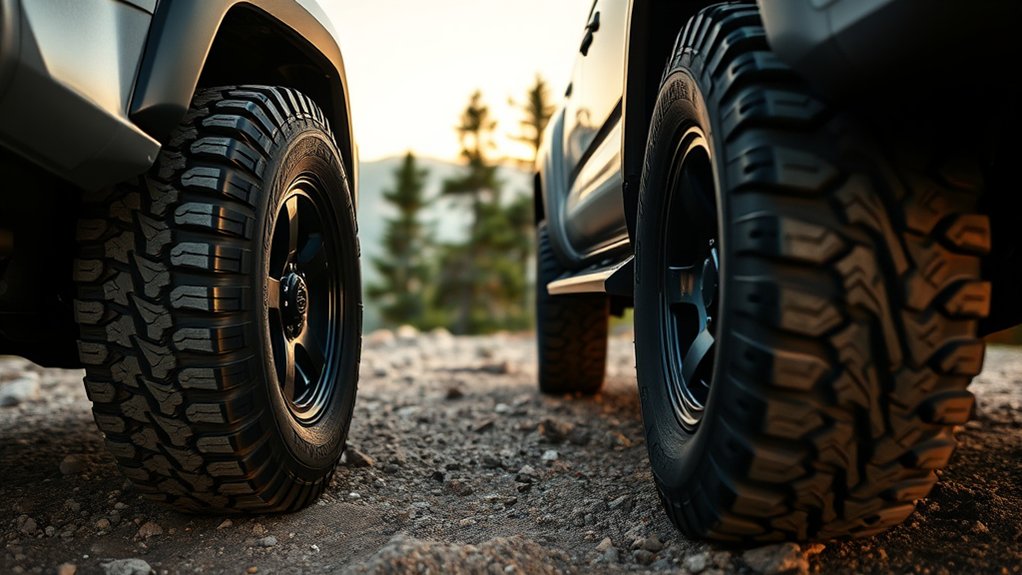
Road noise comes mainly from air moving through the tread, tread blocks contacting the road, and vibration through the tire and suspension. The larger voids and blocks used by many mud-terrain tires tend to create a more noticeable hum or drone on pavement.
All-terrain tires are often quieter because manufacturers can use tighter tread spacing, variable pitch patterns, and smaller blocks. Noise still varies widely among products, and an aggressive A/T can be louder than a road-focused M/T alternative.
Noise alone does not prove that a tire is wearing out quickly. A sudden increase in noise, vibration, pulling, or air loss can signal irregular wear, imbalance, damage, or another mechanical problem. The U.S. Tire Manufacturers Association recommends professional inspection when a noticeable performance change appears.
Fuel Economy, Tire Weight, and Ride Quality
Tire category can influence fuel use, but it is not accurate to promise a fixed MPG difference. NHTSA explains that tire materials, construction, tread design, inflation, and rolling resistance all affect efficiency. It estimates that a 10% reduction in rolling resistance can improve vehicle fuel economy by about 1% to 2%, not by one to two MPG.
A larger LT tire with a higher load range may weigh substantially more than the original tire. Extra rotating mass and a larger outside diameter can make acceleration feel slower and may increase braking effort. A stiffer casing can also make the ride harsher when the tire is not needed for the truck’s actual load.
For the smallest effect on fuel economy and drivability, stay close to the original overall diameter and choose the lightest tire that still meets your load, durability, and terrain needs.
What to Think About: Tire Longevity, Maintenance, and Costs
Tread life cannot be predicted from the A/T or M/T label alone. A mud-terrain tire used mostly on pavement often wears faster than an all-terrain tire, but alignment, pressure, rotation, load, driving style, heat, road surface, and compound design can change the result.
Do not treat 50,000 miles for A/T tires or 30,000 miles for M/T tires as category standards. Some A/T products carry mileage warranties, while some M/T products do not. A warranty is also not a promise that every owner will reach the stated mileage.
Maintenance That Protects Tread Life
NHTSA’s TireWise guidance recommends checking pressure and tread at least monthly. It also advises using the vehicle manufacturer’s cold-pressure specification, balancing new tires, correcting alignment problems, and following the owner’s manual for rotation.
- Check all tires, including the spare, when they are cold.
- Use the pressure on the Tacoma’s placard, not the maximum pressure molded on the tire sidewall.
- Rotate according to Toyota’s schedule and the tire maker’s warranty terms.
- Inspect for cuts, bulges, cracks, missing tread, punctures, and irregular wear.
- Have vibration, pulling, or rapid pressure loss inspected promptly.
- Replace a tire when it reaches 2/32 inch of tread or earlier when damage, weather needs, or local requirements call for replacement.
Pro Tip: Compare total ownership cost, not only purchase price. Include mounting, balancing, possible alignment work, expected tread life, fuel use, replacement frequency, and whether a larger spare will fit in the factory location.
Tacoma Tire Size, Load Rating, and Clearance
Tacoma tire sizes vary by generation, year, trim, wheel package, and market. That is why LT265/70R17 cannot be recommended as a universal “good Tacoma size.” Start with the Tire and Loading Information Label on the driver’s door area and your exact Toyota owner’s manual.
A replacement tire should meet the required load capacity and fit the wheel correctly. When towing or carrying cargo, account for the truck’s actual axle loads, payload, passengers, accessories, and trailer tongue weight. A tire professional can verify the load index and inflation requirements for a proposed replacement.
Larger tires may rub the body, frame, suspension, mud flaps, or upper control arm during steering or suspension travel. They can also affect speedometer and odometer readings, shift behavior, effective gearing, spare-tire fit, and driver-assistance calibration. Check clearance at full steering lock and through suspension travel before regular use.
Note: Airing down can improve off-road comfort and traction, but an unsafe pressure can cause heat buildup, tire damage, or loss of the bead. Use tire- and wheel-specific guidance, drive slowly off-road, and reinflate to the correct cold road pressure before highway travel.
How to Choose the Right Tire for Your Driving Needs
Choose the tire that matches your most common conditions while still covering your hardest realistic trip. A tire selected for rare extreme use can make every normal drive louder, rougher, and more expensive.
Assess Driving Conditions
- Estimate the percentage of miles driven on pavement, gravel, dirt, mud, rock, sand, and snow.
- Consider highway speed, commute length, towing, payload, and winter weather.
- Decide how much road noise and ride firmness you can accept every day.
- Identify the worst terrain you encounter regularly, not a trail you might drive once.
- Confirm whether local winter rules require approved snow tires, chains, or specific markings.
Evaluate Tire Lifespan
Review the manufacturer’s mileage warranty, service conditions, rotation requirements, and exclusions for the exact size. Then compare owner-reported wear only as supporting context because use patterns vary.
All-terrain tires often provide better tread life for mixed driving. Mud-terrain tires may wear faster on pavement because of their tread design and intended use, but no reliable universal mileage number applies to the entire category.
Consider Noise Levels
If your Tacoma spends hours on highways or carries passengers regularly, road noise deserves significant weight. Look for professional road tests of the exact tire and size, and remember that noise may grow as the tread wears.
For a trail-focused truck driven short distances on pavement, the extra noise of an M/T tire may be an acceptable trade for stronger mud and rock performance.
Choose All-Terrain Tires If
- Most of your mileage is on pavement.
- You use gravel roads, campsites, job sites, or moderate trails.
- You value quieter travel, predictable road handling, and longer mixed-use life.
- You need one tire for commuting, towing, road trips, and occasional off-road driving.
- You want a 3PMSF option for added snow capability, while understanding it is not a dedicated winter tire.
Choose Mud-Terrain Tires If
- You regularly drive through deep mud, loose soil, rocks, or severe ruts.
- Getting stuck off-road creates a bigger problem than extra highway noise.
- You accept possible reductions in comfort, efficiency, wet-road refinement, and tread life.
- Your Tacoma is modified and used mainly for difficult trail travel.
- You have confirmed the tire’s road, load, wheel, and winter suitability for your use.
Consider a Hybrid or Rugged-Terrain Tire If
Some manufacturers sell rugged-terrain or hybrid tires positioned between A/T and M/T designs. These may offer larger shoulder lugs and wider voids than a typical A/T without going as far as a full mud-terrain tread. Category names are not standardized, so compare actual specifications, test results, and warranties.
Related Guides
Frequently Asked Questions
Should I get all-terrain or mud-terrain tires for my Tacoma?
Choose all-terrain tires when most driving is on pavement with occasional gravel, snow, dirt, or moderate trails. Choose mud-terrain tires when deep mud, rocks, and difficult off-road conditions are frequent enough to justify more noise, weight, and possible wear.
What is a good tire for a Toyota Tacoma?
A good Tacoma tire fits the wheel, matches Toyota’s approved size or a professionally verified alternative, meets the required load and speed ratings, and suits your terrain. No single tire size or model is correct for every Tacoma year and trim.
Do all-terrain tires get better gas mileage than mud tires?
Often, but not always. A/T tires commonly use less aggressive tread and may be lighter than comparable M/T tires. Actual fuel economy depends on size, weight, inflation, rolling resistance, alignment, speed, load, and driving conditions. A fixed MPG improvement cannot be promised.
What are the disadvantages of all-terrain tires?
A/T tires usually provide less bite and self-cleaning ability than M/T tires in deep mud and severe loose terrain. They may also be noisier, heavier, and less efficient than highway-terrain tires. Wet, snow, and ice performance varies by model.
Are mud-terrain tires good in rain and snow?
Not automatically. An M/T tread may work well in deep loose snow but can perform poorly on wet pavement, packed snow, or ice if it lacks enough siping and an appropriate compound. Check the exact tire’s wet testing and winter certification.
Can I install larger tires on my Tacoma without modifications?
Sometimes, but fitment depends on the Tacoma’s generation, trim, wheel width and offset, suspension, alignment, and actual tire dimensions. Check clearance at full steering lock and suspension travel, and verify load, speedometer, spare-tire, and safety-system effects before installation.
Conclusion
All-terrain tires are the better fit for most Tacoma owners because they handle daily road use while remaining capable on gravel, dirt, snow, and moderate trails. Mud-terrain tires earn their compromises when your truck regularly faces deep mud, rocks, ruts, and loose ground.
Make the final choice by comparing exact tire models, not broad labels. Confirm size, load rating, wheel fit, clearance, winter certification, warranty, and cold pressure for your Tacoma. That approach protects road manners, off-road capability, safety, and long-term value.
Sources
- NHTSA TireWise — tire selection, placard pressure, tread, rotation, fitment, and fuel-efficiency guidance
- Toyota Manuals and Warranties — model-specific owner’s manuals and vehicle guidance
- U.S. Tire Manufacturers Association Tire Care & Safety — replacement factors, inspections, pressure, tread, alignment, and professional service
- BFGoodrich All-Terrain T/A KO3 — example A/T features, snow rating, and product-specific mileage warranty
- BFGoodrich Mud-Terrain T/A KM3 — example M/T tread features and product-specific warranty