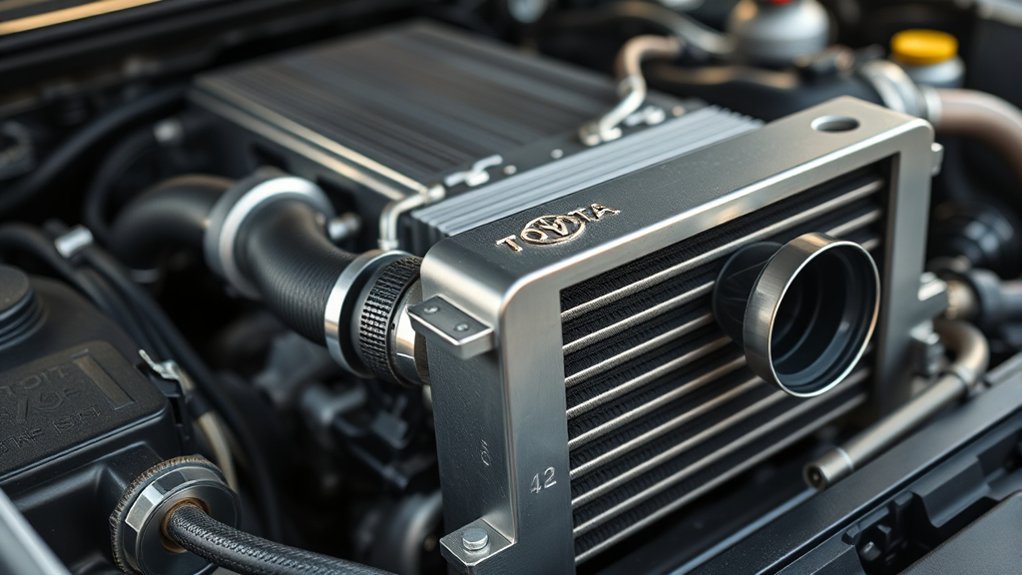
A Toyota Tacoma intercooler cools the compressed air leaving the turbocharger before that air enters the engine. On U.S.-market 2024–2026 Tacomas, Toyota uses turbocharged 2.4-liter i-FORCE or i-FORCE MAX powertrains with an air-cooled intercooler. Earlier factory U.S.-market Tacomas used naturally aspirated engines, so an intercooler on those trucks normally indicates an aftermarket forced-induction setup.
Last updated: September 19, 2026 — refreshed with current 2024–2026 Tacoma powertrain information, factory intercooler layout, Tacoma-specific test data, and troubleshooting guidance.
Quick Answer
The 2024–2026 Toyota Tacoma uses a front-mounted, air-to-air intercooler with its turbocharged 2.4-liter powertrains. The intercooler removes heat from boosted intake air before it reaches the engine. Its main benefit is more consistent charge temperature under load; a larger core does not create boost or guarantee extra horsepower by itself.
Key Takeaways
- Factory U.S.-market 2024–2026 Tacomas use a front-mounted air-to-air intercooler; earlier factory Tacomas did not use a turbo intercooler.
- A good intercooler balances heat removal, outside-airflow exposure, and controlled pressure loss.
- Low power, hissing, warning lights, smoke, or oil consumption can have causes beyond the intercooler.
- Use only a regulated test source and the vehicle or kit manufacturer’s pressure limit when checking for boost leaks.
- Upgrade decisions should rely on logged temperatures, boost behavior, fitment, tuning needs, and repeated-load performance rather than advertised percentages.
What Is an Intercooler and What Does It Do?
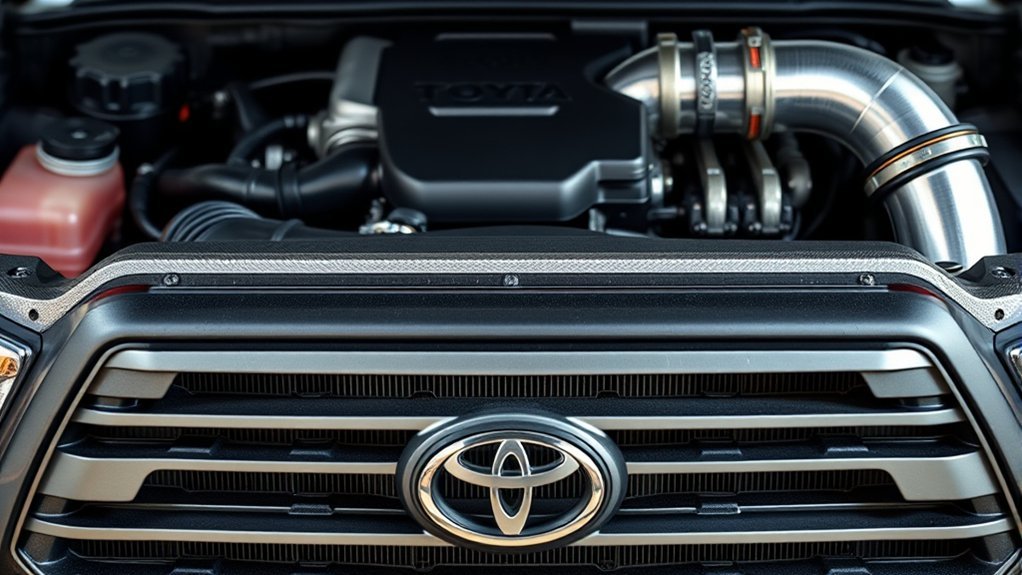
A turbocharger uses exhaust energy to drive a compressor that forces more air into the engine. Compressing that air also raises its temperature. The intercooler, also called a charge-air cooler, transfers some of that heat away before the air reaches the intake manifold.
Cooling the charge increases its density, allowing a greater mass of oxygen to occupy the same volume. That can help the engine management system deliver stable combustion and repeatable performance. Garrett’s explanation of turbocharger operation describes compressed air passing through a charge-air cooler before entering the engine.
An intercooler must do more than lower temperature. It also needs adequate airflow, durable construction, properly sealed end tanks, and a reasonable pressure drop. A cooler that restricts airflow or uses poorly designed piping may reduce the benefit of its larger core.
Note: Do not assume that every Tacoma uses the same charge-air system. Identify the model year, engine, market, and any aftermarket turbo or supercharger equipment before ordering parts or following a test procedure.
Which Toyota Tacoma Models Use an Intercooler?
For the U.S. market, the factory-intercooler dividing line is the fourth-generation Tacoma introduced for 2024. Toyota launched that generation with a turbocharged 2.4-liter i-FORCE engine and an available i-FORCE MAX turbo-hybrid. Toyota’s current 2026 Tacoma information continues those powertrains, and Toyota’s 2026 brochure identifies an air-cooled intercooler across the lineup.
Factory U.S.-market 2023 and earlier Tacomas used naturally aspirated gasoline engines rather than the current turbocharged 2.4-liter engine, so they did not use this factory turbo intercooler. An older Tacoma may still have an intercooler if a turbocharger or supercharger system was added later.
That does not mean one intercooler pipe, sensor, coupler, or test value fits every truck. Equipment can differ by model year, engine output, trim, transmission, production revision, sales market, and aftermarket hardware.
Before servicing the system, check the under-hood emissions label, VIN-specific parts information, owner documentation, and any installation manual supplied with an aftermarket kit. Toyota provides model-specific documents through its manual and warranty portal. More detailed repair specifications may require Toyota service information or a qualified repair facility.
Is the 2024+ Tacoma Intercooler Air-to-Air or Air-to-Liquid?
The factory 2024–2026 Tacoma uses an air-to-air, or air-cooled, intercooler. Outside air passes through the front-mounted core while compressed turbo air flows through sealed passages inside it. Air-to-liquid intercooling is useful as a general comparison and may appear in custom forced-induction systems, but it is not the normal factory layout for the current Tacoma.
| Feature | Air-to-Air | Air-to-Liquid |
|---|---|---|
| Tacoma relevance | Factory layout for U.S.-market 2024–2026 Tacoma turbo powertrains | Mainly relevant to custom or aftermarket forced-induction systems, not the current factory Tacoma layout |
| Cooling medium | Outside air flowing through the core | A dedicated liquid circuit and separate heat exchanger |
| Main advantages | Fewer components, no coolant pump, and relatively simple maintenance | Flexible packaging, short charge paths in some designs, and strong short-duration heat absorption |
| Main trade-offs | Needs direct airflow and may require longer piping or a large frontal area | Adds a pump, hoses, coolant, wiring, heat exchanger, weight, and possible leak points |
| Heat-soak concern | Can struggle when airflow is low or hot air recirculates around the core | The liquid circuit can become saturated if its heat exchanger or coolant capacity is insufficient |
| Maintenance | Inspect the core, fins, mounts, pipes, couplers, and clamps | Inspect those items plus coolant level, pump operation, wiring, hoses, and the secondary heat exchanger |
Why the 2024+ Tacoma Uses Air-to-Air Cooling
On the 2024–2026 Tacoma, the factory intercooler is mounted in the front cooling stack and uses outside airflow to remove heat from the compressed intake charge. This layout does not need a separate intercooler coolant pump or reservoir, which keeps the charge-cooling system comparatively simple.
Its performance depends heavily on core exposure and airflow. A front-mounted core may receive strong airflow at road speed, but its size and position must not excessively block the radiator or air-conditioning condenser. Long pipes, sharp bends, poor end-tank transitions, and an oversized core can add volume or pressure loss.
When Air-to-Liquid Intercooling Applies
An air-to-liquid system transfers charge heat into a separate liquid circuit. A pump moves that liquid through another heat exchanger, where the heat is released to outside air. This can solve packaging or short-duration heat-absorption problems in custom builds, but it adds hardware that the factory 2024–2026 Tacoma air-to-air intercooler does not use.
The design is more complex because the pump, electrical supply, reservoir, hoses, coolant, and secondary heat exchanger must all work correctly. Its cooling remains consistent only while the liquid circuit can continue rejecting the collected heat. A small or poorly ventilated secondary heat exchanger can eventually become heat-soaked during sustained towing, climbing, off-road use, or repeated acceleration.
Garrett’s intercooler technical information emphasizes thermal effectiveness, airflow, durability, packaging, and controlled pressure drop rather than naming one design as universally superior.
How Does a Toyota Tacoma Intercooler Affect Performance?
A properly functioning intercooler supports the complete turbo system in several ways:
- Lower charge temperature: It removes heat added during compression before the air reaches the engine.
- Greater charge density: Cooler air is denser, which supports the oxygen mass needed for combustion.
- More consistent operation under load: Effective cooling can reduce the performance loss that occurs when intake temperatures rise during repeated acceleration, towing, climbing, or hot-weather use.
- Additional calibration margin: Lower charge temperatures can help the engine-management system control knock, but the intercooler cannot guarantee that knock will never occur.
- Protection of expected operation: A sealed, unrestricted charge path helps the engine reach its intended boost and airflow targets.
A larger intercooler is not automatically a better intercooler. Effective design balances heat removal, airflow, pressure drop, packaging, and durability.
An intercooler does not create boost, command more fuel, or change ignition timing by itself. A replacement may restore lost performance if the original unit leaks or is damaged. An upgrade may improve temperature control and repeatability, but peak power changes depend on the original system, engine calibration, fuel, boost target, ambient conditions, and supporting hardware.
Fuel economy is not a guaranteed intercooler benefit. Your result still depends on engine calibration, vehicle load, tire condition, speed, terrain, and driving behavior.
What Do Tacoma-Specific Intercooler Tests Show?
Tacoma-specific data is more useful than a generic claim that “bigger is better.” In its 2025 development testing for a 2024+ Tacoma replacement core, Mishimoto reported about 2.9 psi peak pressure drop through the stock intercooler versus about 1.9 psi with its larger replacement. Its published testing also showed lower intercooler outlet temperatures during repeated-load runs. These are manufacturer-generated results for one product and test setup, not a guarantee that every truck or intercooler will produce the same numbers.
Use that kind of test structure when judging an upgrade: compare inlet and outlet temperature, pressure drop, ambient temperature, vehicle speed, boost, and repeat-run behavior. Mishimoto’s Tacoma intercooler engineering report is one example of a test that publishes both thermal and flow-related measurements.
Why Does the 2024+ Tacoma Use a Front-Mount Intercooler?
The factory 2024–2026 Tacoma uses a front-mounted intercooler in the cooling stack. Front placement exposes the core to outside airflow through the grille, which is useful during towing, climbing, trail driving, and repeated boost. The trade-off is packaging: the intercooler must share airflow and space with the radiator, A/C condenser, ducts, shutters, sensors, and nearby structure.
Front-Mount Intercoolers
A front-mount intercooler sits near the front air opening, where it can receive outside airflow. This location can support strong cooling at road speed. However, a large core may reduce airflow to the radiator or condenser, and exposed fins may be vulnerable to rocks, mud, insects, and trail debris.
Longer charge pipes can increase system volume and create more couplers and joints that could leak. Pipe diameter, bend quality, end-tank design, mounting strength, and bumper clearance all matter.
Top-Mount Intercoolers: Not the Factory Tacoma Layout
A top-mounted cooler may allow a shorter route between the compressor and intake manifold. It normally needs a properly sealed hood scoop or duct so outside air passes through the core instead of around it.
Because the cooler sits close to the engine, it may absorb under-hood heat when the truck is stopped or moving slowly. Effective duct sealing, heat shielding, fan strategy, and escape paths for hot air can be as important as core size.
Factors That Affect Intercooler Efficiency
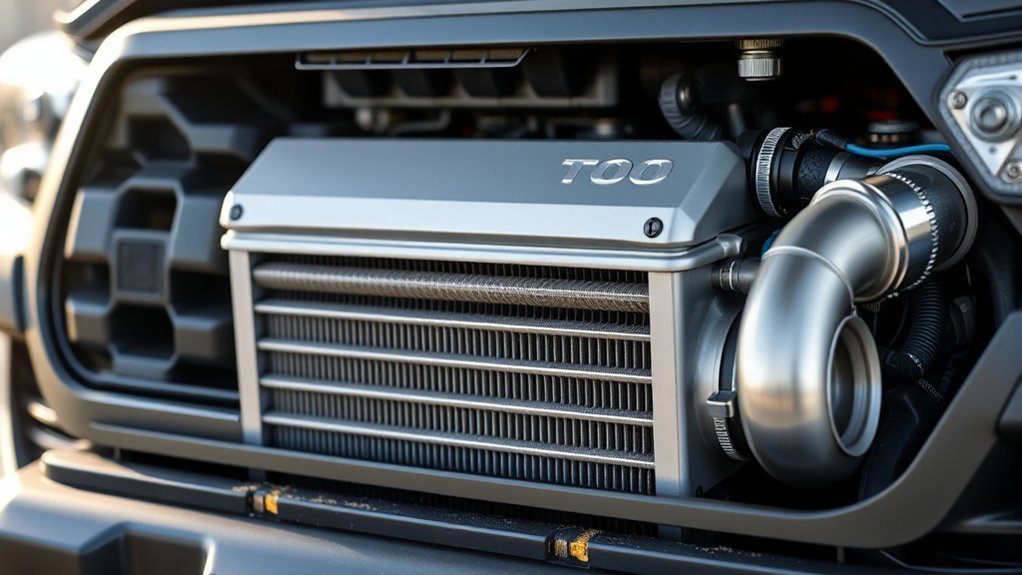
Intercooler performance depends on the complete charge-air path rather than one advertised core dimension. Review these factors together:
- Core design and condition: Fin density, internal passages, construction, cleanliness, and damage affect heat transfer and airflow.
- Pressure drop: The cooler and piping should not create an excessive difference between compressor outlet pressure and intake-manifold pressure.
- Outside airflow: Grilles, lights, winches, bumpers, mud, bent fins, and poor ducting can reduce the air passing through the core.
- Charge-pipe routing: Unnecessary length, abrupt bends, crushed sections, and weak couplers can hurt response or create leak points.
- Sealing: Loose clamps, damaged O-rings, split couplers, cracked end tanks, and poorly seated pipes can release compressed air.
- Heat rejection: The cooler must release heat fast enough for the truck’s actual duty cycle, including towing, climbing, sand, mud, and low-speed trail use.
- Engine calibration: Boost, throttle, fuel, ignition, torque control, and temperature-protection strategies affect the result.
How to Diagnose and Fix Common Intercooler Problems
Start with identification and inspection before buying a replacement. A lack of power or unusual noise does not prove that the intercooler has failed. Air filters, charge pipes, fuel delivery, exhaust restrictions, sensors, crankcase ventilation, lubrication faults, and the turbocharger can produce overlapping symptoms.
Warning: Let the engine cool before touching turbo or charge-air components. Wear eye protection, secure every test plug, and use a regulated air source. Never exceed the pressure specified for your exact vehicle or aftermarket kit. An unsecured plug can become a dangerous projectile, while excessive pressure can damage the cooler, hoses, seals, or sensors.
Common Symptoms to Investigate
- Reduced power or slower-than-normal boost response
- A hissing or rushing-air sound during acceleration
- A check-engine light or an underboost-related diagnostic code such as P0299
- A loose, collapsed, split, or oil-wet charge-air coupler
- Visible core damage, cracked end tanks, or rubbed-through pipes
- Higher-than-normal intake temperatures during comparable driving
- Black smoke, blue smoke, increased oil use, or oil collecting in the charge path
Garrett’s turbo-system diagnostic guidance recommends checking hoses, pipes, connections, filters, exhaust restrictions, lubrication, crankcase pressure, and other engine systems instead of assuming that one component caused every symptom.
Visual Inspection
- Park safely, switch off the engine, and allow hot components to cool.
- Confirm the charge-air route for your engine or aftermarket kit.
- Inspect the intercooler face for bent fins, impact damage, packed mud, insects, or blocked airflow.
- Check mounts and brackets for cracks, looseness, or contact with nearby parts.
- Follow every charge pipe and inspect its clamps, clips, O-rings, hoses, and couplers.
- Look for polished rub marks, splits, loose connections, or concentrated oily residue around a joint.
- Check nearby wiring and sensors for damaged connectors or harnesses.
Repair loose or damaged connections with the correct part and installation procedure. Do not use tape, household sealant, or an improvised clamp as a permanent charge-pipe repair.
Pressure and Smoke Testing Methods
A pressure test can locate a leak that is difficult to see. The exact isolation point, test adapter, and allowable pressure depend on the vehicle or kit.
- Obtain the correct service specification before beginning.
- With the engine off and cool, isolate the section being tested using pressure-rated adapters and securely retained plugs.
- Connect a regulated air supply with an accurate gauge.
- Raise pressure slowly and stop at the manufacturer-approved test value.
- Close the air supply and watch for pressure decay.
- Apply a soap-and-water leak-detection solution to accessible joints and look for growing bubbles.
- Release pressure completely before loosening an adapter, clamp, or plug.
A low-pressure automotive smoke machine can also reveal leaks as smoke escapes from a joint, crack, or seal. Follow the smoke-machine and vehicle manufacturers’ instructions, especially around sensors and closed intake components.
Do not substitute a vacuum pump for a positive-pressure boost-leak test unless a model-specific service procedure explicitly requires it. Vacuum and boost place seals, hoses, and check valves under different conditions.
Cleaning and Maintenance Tips
For exterior cleaning, remove loose debris gently and straighten accessible fins only with a suitable fin tool. If the component can be cleaned safely in place, use low-pressure water and avoid directing a pressure washer at the fins. Protect electrical connectors and follow the vehicle manufacturer’s instructions.
Do not pour water, detergent, solvent, or loose debris into the intake side of an installed intercooler. Internal cleaning may require removing the component, using an approved cleaner, rinsing as directed, and drying it completely. If you cannot confirm an approved procedure, use a qualified technician.
If an older or modified Tacoma uses a custom air-to-liquid intercooler system, inspect that separate circuit for coolant loss, hose damage, pump operation, wiring faults, trapped air, and restricted airflow through its secondary heat exchanger. This does not describe the factory air-to-air intercooler used on U.S.-market 2024–2026 Tacomas.
What Does Oil Inside the Intercooler Mean?
A light oily film can appear in some turbocharged intake systems because crankcase vapors pass through the intake tract. However, pooled oil, rapid accumulation, blue smoke, falling oil level, or heavy oil at several joints requires diagnosis.
Possible causes include a crankcase-ventilation problem, restricted oil drain, turbocharger fault, excessive crankcase pressure, overfilled engine oil, or another engine condition. Cleaning the intercooler without correcting the source will not solve the problem.
When Should You Use a Professional Technician?
Stop testing and seek qualified help when you find substantial oil, metal fragments, repeated underboost codes, heavy smoke, abnormal turbo noise, damaged compressor plumbing, uncertain test limits, or a problem involving engine calibration. Professional diagnosis is also appropriate when test adapters cannot be secured safely.
When and Why Should You Upgrade a Tacoma Intercooler?
Consider an upgrade only after identifying a measurable limitation or a failed component. A larger core may help a modified truck control charge temperature, but it can also add pressure drop, weight, system volume, fitment problems, and obstruction in front of other heat exchangers.
For a stock 2024–2026 Tacoma that holds stable charge temperatures and has no leaks, replacement is not automatically necessary. An upgrade becomes easier to justify when repeatable logs show heat soak or excessive pressure loss during towing, long grades, hot-weather off-road use, repeated acceleration, or higher-than-stock airflow demand.
| Situation | Recommended Next Step |
|---|---|
| Stock truck with normal temperatures and no leak | Maintain and inspect the factory system rather than replacing it solely for advertised gains. |
| Damaged, leaking, or internally contaminated cooler | Diagnose the cause, then repair or replace the affected parts with compatible components. |
| Modified boost or engine calibration | Work with the calibrator and choose a cooler tested for the intended airflow, pressure, and power range. |
| Repeated temperature rise during comparable heavy-load runs | Check airflow, debris, ducting, fan operation, mixture, timing, boost behavior, and the complete cooling system before selecting a larger core. |
| Aftermarket bumper, winch, lights, or skid system restricts airflow | Correct the airflow and mounting conflict before assuming the intercooler itself is undersized. |
Before purchasing an upgrade, verify the following:
- Exact model-year, engine, trim, transmission, and bumper compatibility
- Core pressure rating and expected pressure drop
- Pipe diameter, sensor provisions, coupler quality, and clamp type
- Clearance around the radiator, condenser, grille, bumper, hood, and crash structure
- Effects on radiator and air-conditioning airflow
- Need for engine calibration or supporting hardware
- Warranty and emissions implications in your jurisdiction
- Availability of replacement couplers, brackets, pumps, and other service parts
Pro Tip: Record intake-air temperature, ambient temperature, boost, throttle position, vehicle speed, and ignition corrections during repeatable tests before and after a change. Similar test conditions provide more useful evidence than a single peak-temperature reading or an advertised horsepower percentage.
Do not raise boost simply because a larger intercooler has been installed. Unauthorized performance changes can push the turbocharger or engine outside its intended operating range. Use a knowledgeable calibrator and address fuel, ignition, cooling, transmission, and drivetrain limits as a complete system.
Related Guides
Frequently Asked Questions
What is the main purpose of a Toyota Tacoma intercooler?
Its main purpose is to remove heat from the turbocharger’s compressed intake air before the air reaches the engine. A cooler, denser charge helps the complete engine-management system maintain efficient and consistent operation.
Do 2024–2026 Toyota Tacomas have an intercooler?
Yes. U.S.-market fourth-generation 2024–2026 Tacomas use turbocharged 2.4-liter i-FORCE or i-FORCE MAX powertrains with a factory air-cooled intercooler. Earlier factory U.S.-market Tacomas used naturally aspirated engines, although modified trucks may have aftermarket intercoolers.
Is the 2024+ Tacoma intercooler air-to-air or air-to-water?
The factory 2024–2026 Tacoma uses a front-mounted air-to-air intercooler. Outside air cools the core directly. Air-to-water systems use a separate pump, coolant circuit, and heat exchanger and are mainly relevant to custom or different forced-induction layouts.
Can I run a turbocharged Tacoma without an intercooler?
Do not remove or bypass a factory charge-air cooler. Doing so raises intake temperature and may cause reduced power, protective engine-management intervention, knock risk, or component damage. Any custom non-intercooled setup requires professional engineering and calibration.
What are the symptoms of a leaking or damaged intercooler?
Possible symptoms include reduced power, slow boost response, hissing under load, an underboost code such as P0299, loose or oily couplers, and visible core damage. These signs are not conclusive because filters, pipes, sensors, exhaust restrictions, crankcase ventilation, and turbocharger faults can cause similar problems.
Does an intercooler increase horsepower?
It can support power by lowering charge temperature and helping the engine maintain performance under repeated load. However, it does not create boost or guarantee a horsepower increase. The result depends on the original cooler, airflow, pressure drop, calibration, fuel, ambient conditions, and supporting hardware.
Does a Tacoma need a tune after an intercooler upgrade?
Not automatically. A direct-fit intercooler that keeps the factory sensors and intended airflow path may be designed for the stock calibration, but tuning requirements depend on the specific product and any other engine modifications. Follow the intercooler manufacturer’s instructions and the calibrator’s requirements for your exact setup.
Is oil inside a Tacoma intercooler normal?
A light film can occur in some turbocharged intake systems, but pooled oil, rapid accumulation, smoke, or increased oil consumption needs diagnosis. Possible causes include crankcase-ventilation trouble, excessive crankcase pressure, a restricted turbo oil drain, overfilled oil, or a turbocharger fault.
Conclusion
On a U.S.-market 2024–2026 Toyota Tacoma, the factory front-mounted air-to-air intercooler helps control compressed-air temperature before the charge reaches the engine. Its effectiveness depends on the complete intake and cooling path, so correct fitment, clear airflow, sealed piping, manageable pressure drop, suitable calibration, and regular inspection matter more than core size alone.
Confirm your truck’s exact configuration before testing or replacing components. Diagnose leaks and related engine problems methodically, follow the applicable pressure limits, and base any upgrade on measured temperature and boost behavior. That approach is more reliable than assuming a larger intercooler will automatically add power, improve economy, or solve every turbo-system symptom.
Sources
- Toyota: 2024 Tacoma Is the Ultimate Adventure Machine — supports the fourth-generation launch and turbocharged i-FORCE powertrain information.
- Toyota: The 2026 Toyota Tacoma — Adventure Awaits — supports current 2026 i-FORCE and i-FORCE MAX powertrain availability.
- Toyota 2026 Tacoma Brochure — identifies the twin-scroll turbocharger and air-cooled intercooler in current Tacoma feature specifications.
- Toyota Tacoma Official Model Page — supports current Tacoma model information.
- Toyota Warranty and Owner’s Manuals — provides access to model-specific owner documentation.
- Garrett Motion Intercooler Technical Information — supports charge-air cooling, design, airflow, packaging, and pressure-drop explanations.
- Garrett Motion: How a Turbo Works — supports the explanation of compression and charge-air cooling.
- Garrett Motion Turbo Diagnostics — supports broader troubleshooting for low power, noise, smoke, oil use, pipework, and intercooler leaks.
- Mishimoto: 2024+ Tacoma Intercooler Engineering — provides vendor-generated Tacoma-specific pressure-drop and repeated-load temperature test data.
