As an Amazon Associate I earn from qualifying purchases.
Toyota Tacoma trailer sway usually starts when the trailer has too little tongue weight, is loaded rear-heavy, is traveling too fast for conditions, or is affected by wind, tires, hitch geometry, brakes, or shifting cargo. For conventional towing, Toyota Tacoma owner manuals specify a 9% to 11% tongue-weight target; the exact model-year manual and the lowest-rated component still control. Prevent sway by weighing the loaded combination, balancing and securing cargo, keeping the trailer properly set up, using required towing equipment, and reducing speed before instability grows.
Last updated: September 19, 2026 — towing figures and sway-response guidance checked against current Toyota and NHTSA information.
Quick Answer
Toyota Tacoma trailer sway is commonly triggered by low tongue weight, rear-heavy loading, excessive speed, crosswinds, incorrect hitch height, tire problems, or worn towing equipment. For a 2026 Tacoma, Toyota specifies 9% to 11% tongue weight for conventional towing, requires adequate sway control above 2,000 lb gross trailer weight, and requires a sufficient weight-distributing hitch above 5,000 lb. If sway begins, steer straight, ease off the accelerator gradually, do not accelerate or apply the Tacoma’s brakes while the trailer is swaying, then stop safely and inspect the combination after it stabilizes. Check the manual for your exact model year because requirements can differ.
Key Takeaways
- Use actual loaded weights, not the trailer’s empty or advertised weight.
- Toyota Tacoma manuals specify 9% to 11% tongue weight for conventional towing; verify the exact model-year manual before setup.
- For the 2026 Tacoma, gross trailer weight above 2,000 lb requires adequate sway control, and weight above 5,000 lb requires a sufficient weight-distributing hitch.
- The lowest rating among the Tacoma, receiver, ball mount, hitch ball, trailer, tires, and related equipment controls the setup.
- If sway begins, hold a straight path, ease off the accelerator, avoid accelerating or applying the Tacoma’s brakes during the sway, then stop and inspect after the combination stabilizes.
At a Glance
| 2026 Conventional Tongue Weight | 9% to 11% of actual gross trailer weight; verify the manual for your exact Tacoma model year |
| 2026 Sway-Control Threshold | Required when gross trailer weight is over 2,000 lb (900 kg) |
| 2026 Weight-Distribution Threshold | A sufficient weight-distributing hitch is required when gross trailer weight is over 5,000 lb (2,200 kg) |
| 2026 Maximum Towing Capability | Up to 6,500 lb when properly equipped; the exact truck’s TWR, payload, axle, tire, hitch, and GCWR limits still apply |
Warning: Do not test a visibly unstable trailer at highway speed. Stop towing if the coupler, receiver, safety chains, tires, wheel bearings, brakes, frame, suspension, or cargo restraints appear damaged or incorrectly installed.
What Causes Trailer Sway in Toyota Tacoma?
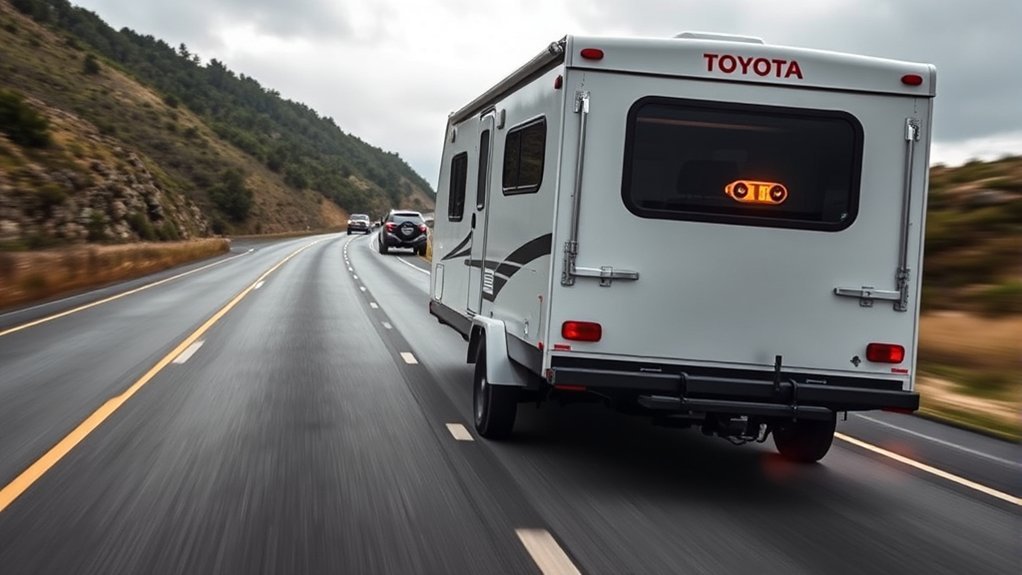
Trailer sway is a repeated side-to-side movement around the hitch. A small movement may start after a steering correction, road bump, wind gust, or passing truck. If the combination lacks enough natural stability, each swing can become larger.
Sway rarely has only one cause. Loading, speed, tire condition, hitch setup, trailer design, suspension condition, and weather can combine to create the problem.
Low or Excessive Tongue Weight
Tongue weight is the downward force the loaded trailer places on the hitch ball. Too little tongue weight can make a conventional trailer more willing to pivot and oscillate behind the Tacoma.
Toyota Tacoma owner manuals specify a conventional trailer tongue-weight target of 9% to 11% of actual gross trailer weight. Use that Tacoma-specific range instead of a generic trailer rule, then follow the exact model-year manual, trailer instructions, receiver label, and hitch manufacturer’s limits.
Excessive tongue weight is also unsafe. It can overload the Tacoma’s rear axle, tires, suspension, payload allowance, receiver, or hitch components. It may also reduce front-axle load and affect steering and braking.
Rear-Heavy or Uneven Loading
Heavy cargo placed behind the trailer axles reduces tongue weight and increases leverage at the rear. This is one of the most common setup conditions associated with sway.
Side-to-side imbalance can also affect handling. Place heavy items low, close to the trailer’s axle area, and slightly forward when permitted by the trailer manufacturer. Secure every item so it cannot slide, roll, or shift during braking and cornering.
Speed, Wind, and Road Inputs
Higher speed gives a swaying trailer more energy and leaves less time for correction. Crosswinds, passing buses or tractor-trailers, bridge openings, downhill curves, potholes, and abrupt steering can start or worsen movement.
No single speed is safe in every situation. The current-generation Tacoma towing guidance limits the combination to 65 mph (104 km/h) on a flat, straight, dry road and also requires obeying any lower posted towing limit or trailer-specific limit. Slow further when wind, visibility, traffic, curves, grades, or road conditions reduce stability, and verify the rule in your exact model-year manual.
Tire, Hitch, Brake, and Suspension Problems
Underinflated, overloaded, damaged, mismatched, or worn tires can reduce stability. Check the Tacoma’s tires cold using the pressure on its Tire and Loading Information label. Set trailer tires according to the trailer or tire manufacturer’s instructions and confirm their load capacity.
The National Highway Traffic Safety Administration advises checking tire pressure when tires are cold and using the vehicle label or owner’s manual rather than the maximum pressure molded on a vehicle tire’s sidewall. Review NHTSA tire-safety guidance.
Other possible causes include excessive coupler play, the wrong hitch-ball size, loose mounting hardware, an incorrect ball height, worn wheel bearings, weak shocks, damaged suspension parts, dragging or uneven trailer brakes, and an out-of-level trailer.
Common Mistakes That Lead to Sway Issues
Most preventable sway problems begin before the truck moves. The table below connects common setup mistakes with their likely effects and corrections.
| Common Mistake | Possible Effect | Correction |
|---|---|---|
| Loading heavy cargo at the rear | Low tongue weight and stronger side-to-side movement | Move suitable cargo forward, secure it, and measure tongue weight again |
| Guessing trailer or tongue weight | Overloaded axles, receiver, tires, or payload | Weigh the fully loaded combination and compare every result with its rating |
| Ignoring cold tire pressure | Heat buildup, poor response, or tire failure | Set pressure cold and inspect tread, sidewalls, valves, age, and load rating |
| Using the wrong ball height | Poor axle loading and reduced stability | Adjust the ball mount so the loaded trailer sits at the angle specified by its manufacturer |
| Treating electronic control as prevention | Unsafe loading or speed remains uncorrected | Correct the mechanical setup first and treat electronic assistance as a backup |
| Failing to test trailer brakes | Uneven braking, pushing, or instability during stops | Test brake operation and controller response at low speed in a safe area |
Improper Weight Distribution
Improper weight distribution affects both the trailer and the Tacoma. Rear-heavy trailer loading can reduce tongue weight, while excessive hitch load can overload the truck’s rear axle and reduce available payload.
Remember that passengers, bed cargo, accessories, the hitch assembly, and trailer tongue weight all consume the Tacoma’s payload allowance. A trailer may remain below its advertised tow rating while the truck exceeds its payload or rear-axle rating.
Inadequate Sway Control
Mechanical or electronic sway control can help, but it cannot make an overloaded or poorly balanced combination safe. For the 2026 Tacoma, Toyota requires a sway-control device with sufficient capacity when gross trailer weight is over 2,000 lb. A friction-style sway-control device, integrated sway-control hitch, or electronic system must also be compatible with the trailer, coupler, brakes, and operating procedure.
Some systems require removal or release before backing, tight turns, or slippery conditions. Follow the equipment manufacturer’s instructions rather than applying one setup to every trailer.
How to Load Your Trailer for Maximum Stability
Load and weigh the trailer in the same condition in which you will tow it. Include water, propane, batteries, tools, food, luggage, recreational equipment, and all other cargo.
- Find every rating. Record the Tacoma’s GVWR, front and rear GAWR, payload information, GCWR or combination limit where provided, trailer weight rating, receiver rating, hitch rating, ball rating, trailer GVWR, and tire load limits.
- Load heavy items low and near the axle area. Keep suitable heavy cargo slightly forward of the trailer axles rather than against the rear wall.
- Balance the load from side to side. Avoid placing most heavy equipment on one side.
- Secure all cargo. Use restraints rated for the load so nothing can shift during a stop or turn.
- Measure the fully loaded trailer. Use a certified public scale or another method approved for the trailer.
- Measure tongue weight. Use a suitable tongue-weight scale or a verified weighing procedure.
- Calculate the percentage. Divide tongue weight by actual loaded trailer weight and multiply by 100.
- Compare the results with every limit. Do not exceed the lowest-rated component or any axle, payload, trailer, tire, or combination rating.
- Recheck after changes. Adding water, bicycles, generators, coolers, or rear storage can alter tongue weight and axle loads.
For example, a trailer weighing 4,000 pounds when fully loaded corresponds to 360 pounds of tongue weight at 9% and 440 pounds at 11%. This illustrates the Tacoma calculation only. It does not confirm that a specific Tacoma can carry that hitch load; payload, rear-axle, tire, receiver, hitch, and combination limits still have to pass.
Pro Tip: Weigh the Tacoma and trailer with the passengers, bed cargo, hitch, fuel, water, and travel gear already aboard. Empty-trailer and brochure weights cannot reveal your actual axle or payload load.
What to Do If Trailer Sway Starts
If the trailer begins moving from side to side, focus on reducing energy without adding another abrupt input.
- Grip the steering wheel firmly and steer straight ahead. Do not try to cancel the sway with rapid countersteering.
- Begin releasing the accelerator immediately but very gradually. Let the combination slow as smoothly as possible.
- Do not increase speed. Accelerating adds energy to an unstable combination.
- Do not apply the Tacoma’s brakes while the trailer is swaying. Toyota’s Tacoma guidance specifically warns against vehicle braking during the sway event.
- After the sway stops, move off the roadway and stop in a safe place. Do not continue at highway speed simply because the movement ended.
- Inspect the combination before continuing. Check the truck and trailer tires, shifted cargo, tongue weight if possible, vehicle loading, coupler, hitch hardware, safety chains, electrical connection, brakes, wheel bearings, and suspension.
- If no defect or loading problem is found, continue only at a lower stable speed. Toyota notes that the speed at which sway occurred may be beyond the stable limit of that vehicle-trailer combination under those conditions.
Warning: Do not resume highway towing simply because the sway stopped. If the cause is unknown, the movement was severe, or any component is damaged, arrange a professional inspection or another safe method of transporting the trailer.
Key Equipment for Effective Trailer Sway Prevention
The correct equipment depends on actual loaded weight, tongue weight, trailer design, receiver type, Tacoma configuration, and manufacturer approval.
- Correctly rated receiver, ball mount, and hitch ball: Every component must fit properly and carry the required trailer and tongue loads.
- Weight-distribution hitch: Spring bars transfer part of the hitch load across the combination. For the 2026 Tacoma, Toyota requires a sufficient WDH above 5,000 lb gross trailer weight; for other model years, follow that Tacoma’s manual and confirm receiver/trailer compatibility.
- Mechanical sway control: Friction or cam-style systems resist unwanted articulation. For the 2026 Tacoma, sway control with sufficient capacity is required above 2,000 lb gross trailer weight. The device still needs correct adjustment and may have operating restrictions.
- Integrated sway-control hitch: Some WDH designs combine weight distribution with mechanical sway resistance.
- Trailer brake controller: A compatible proportional or factory-integrated controller helps the trailer contribute to smooth braking.
- Electronic sway-control system: A trailer-mounted system may detect motion and apply trailer braking. It remains a supplement to correct loading.
- Tongue-weight scale or public scale access: Measuring weight is more reliable than judging the trailer by appearance.
- Cold tire-pressure gauge: Use it on the Tacoma, trailer, and spare tires before travel.
Note: A heavier or stiffer rear stabilizer bar on the Tacoma may reduce truck body roll, but it is not a substitute for correcting trailer loading, tongue weight, hitch geometry, tires, or brakes.
Effective Use of Weight Distribution Hitches

A weight-distribution hitch can improve load distribution when it is approved, correctly sized, and properly adjusted. For the 2026 Tacoma, the owner’s manual requires a weight-distributing hitch with sufficient capacity when gross trailer weight is over 5,000 lb. Older Tacoma requirements can differ, so use the rule for your exact model year rather than an arbitrary universal threshold.
Importance of Weight Distribution
Trailer tongue weight presses down behind the Tacoma’s rear axle. This can raise the front of the truck, increase rear-axle load, and change steering or braking response.
A WDH uses spring-bar tension to transfer part of that load toward the Tacoma’s front axle and the trailer axles. Current Tacoma guidance calls for the front axle load to be restored appropriately when a WDH is used. The hitch does not reduce the trailer’s actual weight, tongue weight, or total combination load.
A WDH also does not automatically provide sway control. Some units distribute weight only, while others include separate sway-control features.
Proper Hitch Adjustment Techniques
Begin with the Tacoma and trailer on level ground. Load both as they will travel, then follow the hitch manufacturer’s measurement and adjustment procedure.
- Confirm that the receiver is approved for weight-distributing use.
- Select spring bars rated for the measured tongue weight and trailer application.
- Set the ball height so the loaded trailer sits as specified by its manufacturer.
- Measure the Tacoma’s front and rear reference heights before and after coupling.
- Adjust spring-bar tension according to the Tacoma and hitch instructions.
- Check clearance between the bars, frame, coupler, propane equipment, and other components.
- Verify that the setup permits required turning and backing movements.
- Use the required torque values, fasteners, lubrication, and inspection schedule.
Do not use a WDH to hide an overloaded rear axle or excessive tongue weight. Correct the loading first.
Sway Control Features Explained
Mechanical sway control creates resistance at the hitch or uses geometry to help keep the trailer aligned. Electronic control detects motion and may apply braking. Vehicle-based control may reduce engine output or apply selective braking where the Tacoma is equipped and the system detects a sway pattern.
These systems are reactive. They cannot increase payload, tire capacity, axle ratings, receiver capacity, or the safe towing limit.
How to Keep Your Tacoma Towing-Ready
Your exact Tacoma matters. Towing limits and available features can change with the model year, cab, bed, drivetrain, engine, transmission, axle ratio, factory equipment, and trim.
For 2026, Toyota lists Tacoma towing capability up to 6,500 pounds when properly equipped, but that maximum does not apply automatically to every truck. The exact TWR varies by configuration, and payload, occupants, cargo, hitch equipment, axle loads, tires, and GCWR can become the controlling limit before the advertised maximum. See Toyota’s current towing information.
A published tow rating is a ceiling for a specific configuration, not a promise that every load below that number will be stable or within the truck’s payload and axle limits.
Complete these checks before every towing trip:
- Confirm the Tacoma’s model-specific towing and payload information.
- Check actual truck, trailer, tongue, and axle weights.
- Inspect the receiver, ball mount, hitch ball, coupler, locking pin, and fasteners.
- Cross the safety chains beneath the coupler unless the equipment instructions specify another approved arrangement.
- Connect and test the breakaway cable without wrapping it around the safety chains.
- Test trailer lights, brakes, controller response, and electrical connections.
- Check the cold pressure and condition of all truck and trailer tires, including spares.
- Inspect wheel-lug torque according to the wheel or trailer manufacturer’s procedure.
- Look for bearing heat, grease leakage, damaged suspension parts, or uneven tire wear.
- Confirm that cargo, doors, ramps, jacks, steps, awnings, and accessories are secured.
- Adjust mirrors and verify that required visibility equipment is installed.
- Check local laws for trailer brakes, breakaway devices, mirrors, lighting, and speed restrictions.
Equipment That Can Help Prevent Trailer Sway
Choose towing equipment by measured load, compatibility, model-year requirements, and component rating rather than brand popularity. No product can compensate for an overloaded or incorrectly loaded combination.
- Weight-distribution hitch: For the 2026 Tacoma, use a sufficient WDH when gross trailer weight is over 5,000 lb; for other years, follow the model-year manual and confirm receiver, trailer, and hitch compatibility.
- Mechanical sway-control device: For the 2026 Tacoma, use a device with sufficient capacity above 2,000 lb gross trailer weight. It must still be approved for your coupler, trailer frame, braking system, and operating conditions.
- Brake controller: A factory-integrated controller or a properly installed proportional aftermarket controller can improve coordinated braking. An example such as the Tow-Pro Elite must still be matched, installed, and adjusted for the specific truck and trailer.
- Tongue-weight scale: This helps replace estimates with a measured hitch load.
- Quality tire-pressure gauge: A gauge allows cold-pressure checks before travel.
- Rated cargo restraints: Proper straps, nets, or tie-downs prevent load movement that can change balance during a trip.
Upgraded Tacoma sway bars may reduce body roll during cornering, but they should not be purchased as the primary cure for trailer sway.
Top Towing Practices for Various Conditions
Crosswinds and Passing Vehicles
Expect movement when leaving a sheltered area, crossing a bridge, or being passed by a large vehicle. Keep both hands on the wheel, hold a steady path, and create extra space around the combination.
Reduce speed before entering exposed areas. Avoid sudden steering after a passing vehicle’s pressure wave reaches the trailer.
Descents, Curves, and Mountain Roads
Slow before the descent or curve. Select an appropriate gear early and use engine braking as directed in the Tacoma manual. Avoid riding the brakes, which can overheat the truck or trailer braking system.
Enter curves at a conservative speed and use smooth steering. A trailer’s higher center of gravity and shifting cargo can increase rollover or sway risk.
Rain, Rough Roads, and Poor Visibility
Increase following distance and reduce speed in rain. Avoid standing water, sharp lane changes, and sudden braking.
Slow before potholes, bridge joints, construction zones, or uneven shoulders. If visibility becomes too poor to identify hazards early, stop in a safe location.
Tips for Safe Driving With a Towed Trailer
- Accelerate, steer, and brake gradually.
- Leave substantially more following distance than you would without a trailer.
- Look farther ahead so you can slow before hazards.
- Avoid unnecessary lane changes.
- Use wider turns without crossing into another lane.
- Do not use cruise control when wind, hills, traffic, or slippery roads require frequent speed changes.
- Stay within all legal limits and equipment speed ratings.
- Stop periodically to inspect tires, hubs, cargo restraints, hitch components, and connections.
- Recheck the setup immediately after any unusual movement, impact, braking event, or cargo change.
Related Guides
Frequently Asked Questions
What Is the Main Cause of Trailer Sway?
Trailer sway does not have one universal cause. Rear-heavy loading and insufficient tongue weight are frequent setup problems, while speed, crosswinds, passing vehicles, tire issues, loose hitch parts, brake problems, and abrupt steering can trigger or worsen the movement.
What Is Trailer Sway Control on Tacoma?
On Tacoma models equipped with the feature, Trailer Sway Control works with vehicle stability systems to respond when the truck detects a sway pattern. Depending on the model year, it may reduce engine output or apply braking. It is a reactive aid and does not replace correct loading, suitable equipment, or lower speed.
How Much Tongue Weight Should a Tacoma Trailer Have?
Toyota Tacoma owner manuals specify 9% to 11% of actual gross trailer weight for conventional towing. Measure the load rather than estimating it, use the exact model-year Tacoma manual, and confirm that tongue weight does not cause payload, axle, tire, receiver, hitch, or combination limits to be exceeded.
At What Trailer Weight Does a 2026 Tacoma Require Sway Control?
The 2026 Tacoma owner’s manual requires a sway-control device with sufficient capacity when gross trailer weight is over 2,000 lb (900 kg). This does not replace correct tongue weight, loading, tire pressure, hitch setup, or safe speed.
How Fast Should You Tow With a 2026 Toyota Tacoma?
Toyota’s current-generation Tacoma guidance limits towing to 65 mph (104 km/h) on a flat, straight, dry road, or any lower posted towing limit or trailer-specific limit. Reduce speed further for wind, rain, curves, grades, traffic, or any sign of instability.
Do I Need a Weight-Distribution Hitch With a Toyota Tacoma?
For the 2026 Tacoma, Toyota requires a weight-distributing hitch with sufficient capacity when gross trailer weight is over 5,000 lb. For other model years, use the exact Tacoma manual and also confirm receiver and trailer compatibility, measured tongue weight, axle loading, and hitch ratings.
Should I Brake When My Trailer Starts Swaying?
Toyota’s Tacoma guidance says to hold the steering wheel firmly, steer straight ahead, begin releasing the accelerator very gradually, and not apply the vehicle brakes while the trailer is swaying. After the sway stops, pull over safely and inspect the tires, trailer load, tongue weight if possible, and Tacoma loading before continuing.
Conclusion
Preventing trailer sway with a Toyota Tacoma starts with measurements, not guesses. Verify the truck’s exact ratings, weigh the loaded combination, measure conventional tongue weight against Toyota’s 9% to 11% target, secure the cargo, inspect the tires and hitch, and use the towing equipment required for your exact model year.
Electronic Trailer Sway Control and hitch equipment can provide useful support, but they cannot correct overloading, poor balance, excessive speed, or damaged components. If sway begins, steer straight, ease off the accelerator gradually, do not accelerate or apply the Tacoma’s brakes during the sway, then pull over after the combination stabilizes and identify the cause before returning to the road.
Sources
- Toyota Owners: 2026 Tacoma Trailer Towing — current Tacoma tongue weight, sway response, towing-equipment thresholds, speed guidance, ratings, and warnings
- Toyota: Vehicles for Towing — current 2026 Tacoma maximum towing capability and towing-limit caveats
- Toyota USA Newsroom: 2026 Toyota Tacoma — current maximum towing and payload figures
- NHTSA Tire Safety — cold tire-pressure, tire-label, tread, and maintenance guidance
- SAE International J2807 — technical framework for tow-vehicle combination and trailer weight ratings
- NHTSA: Towing a Trailer, Being Equipped for Safety — trailer loading, tongue weight, equipment, and towing-safety fundamentals
