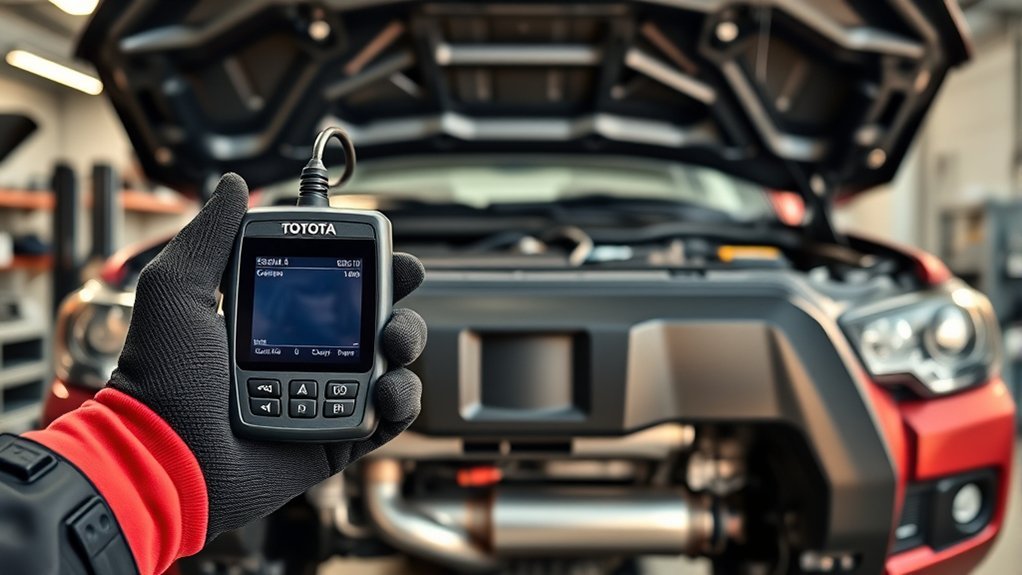
The P0420 code on a Toyota Tacoma means the engine computer has detected that the Bank 1 catalytic converter is not reducing emissions as effectively as expected. The code does not automatically prove that the converter or an oxygen sensor is bad, so complete the checks below before buying parts.
Quick Answer
Start by reading every stored and pending code, saving the freeze-frame data, and checking for misfires, fuel-control problems, exhaust leaks, damaged wiring, and abnormal sensor readings. Replace the catalytic converter only after testing shows that the engine, exhaust system, and sensors are working correctly.
Key Takeaways
- P0420 means catalyst efficiency is below the programmed threshold on Bank 1, but it does not identify the failed part.
- Diagnose misfires, rich or lean operation, oil burning, coolant loss, and exhaust leaks before condemning the converter.
- Do not replace or swap oxygen sensors unless testing confirms a sensor, heater, connector, or wiring fault.
- A flashing check-engine light can indicate a catalyst-damaging misfire and requires immediate attention.
- Check your Tacoma’s emissions warranty, recalls, and model-specific service information before paying for a converter.
At a Glance
| Time Required | About 30–90 minutes for preliminary checks; advanced testing may take longer |
| Difficulty | Intermediate; professional equipment may be needed for a conclusive diagnosis |
| Tools Needed | OBD-II scan tool with live data, flashlight, basic hand tools, and optional smoke-testing or electrical-testing equipment |
| Cost | Depends on whether the fault is a leak, wiring problem, sensor, engine issue, or catalytic converter |
What the P0420 Code Means on a Toyota Tacoma

P0420 is a standardized powertrain code commonly described as Catalyst System Efficiency Below Threshold, Bank 1. Your Tacoma’s engine computer runs a catalyst monitor and compares information from the exhaust sensors before and after the converter.
The upstream sensor helps the computer manage the air-fuel mixture. The downstream sensor helps monitor the converter’s performance. When the downstream activity indicates that the converter is no longer storing and processing oxygen as expected, the computer may store P0420.
On an inline four-cylinder engine, Bank 1 is the engine’s only cylinder bank. On a V-type engine, Bank 1 is the side containing cylinder 1. The exact sensor and converter locations vary by engine and model year, so use the appropriate Toyota owner information and Toyota Technical Information System.
Note: P0420 applies to Bank 1. Some V-engine vehicles may store P0430 when the same type of efficiency problem is detected on Bank 2.
Symptoms and Driving Safety
Many Tacomas with P0420 appear to drive normally. The first symptom may be a steady check-engine light with no obvious change in acceleration, idle quality, or fuel economy.
Other symptoms depend on the underlying problem and may include:
- Reduced power or sluggish acceleration
- Rough idle, hesitation, or engine misfire
- Lower fuel economy
- Rattling from a damaged converter substrate
- Excessive exhaust heat
- A sulfur-like, fuel-rich, oil-burning, or coolant-related exhaust odor
- Failure of an emissions inspection
Warning: If the check-engine light flashes, the engine runs roughly, or the truck loses substantial power, reduce speed and stop driving when it is safe. A flashing light can warn of an active misfire that may overheat and damage the catalytic converter. Follow the guidance in your model-year owner’s manual.
A steady light does not automatically mean the problem is harmless. You may be able to drive a short distance for diagnosis when the truck runs normally, but delaying the repair can increase emissions and allow an engine problem to damage the converter.
Common Causes of P0420 in Tacoma Models
The converter itself is one possible cause, but it should not be the only component considered. Common causes include:
- A deteriorated catalytic converter: The catalyst coating may lose its ability to process exhaust gases, or the internal substrate may crack, melt, become contaminated, or break apart.
- An exhaust leak: A leak near the manifold, flange, gasket, weld, flex section, converter, or sensor can introduce outside air and affect the catalyst monitor.
- Misfire or improper combustion: Ignition-coil, spark-plug, injector, compression, or timing problems can send unburned fuel into the converter.
- Rich or lean fuel control: Intake leaks, fuel-delivery faults, air-metering problems, leaking injectors, or excessive fuel pressure can interfere with catalyst operation.
- Oil or coolant entering the exhaust: Internal engine problems can contaminate the converter and shorten its life.
- Sensor or wiring faults: A slow, biased, contaminated, or electrically faulty sensor can provide misleading data, but it must be tested before replacement.
- Incorrect or damaged emissions parts: An unsuitable aftermarket converter, damaged exhaust component, or previous emissions modification can affect monitor results.
- Model-specific calibration or service issue: Some conditions require checking Toyota service information for applicable diagnostic updates or technical bulletins.
P0420 describes the result of the catalyst monitor. It does not tell you whether the converter, sensor, wiring, exhaust system, or engine caused that result.
What to Check Before Replacing Parts
Do not clear the code immediately. Clearing it can erase freeze-frame information and reset readiness monitors, removing evidence that may help identify when the fault occurred.
Before testing the converter:
- Record all stored, pending, and permanent trouble codes.
- Save the freeze-frame engine speed, load, temperature, speed, and fuel-trim data.
- Check whether the catalyst, oxygen-sensor, and misfire monitors are ready.
- Resolve misfire, fuel-trim, air-metering, sensor-heater, or temperature-related codes first.
- Verify that the engine reaches normal operating temperature.
- Check the engine-oil and coolant levels for unexplained loss.
- Inspect recent repairs, exhaust work, or aftermarket modifications.
Pro Tip: Photograph or export the scan-tool report before clearing anything. Freeze-frame and readiness information can help a technician reproduce the conditions that triggered the code.
How to Diagnose the Toyota Tacoma P0420 Code

1. Read All Codes and Diagnostic Data
Connect a capable scan tool and record the complete results. A misfire code, fuel-trim code, sensor-heater code, coolant-temperature code, or air-metering code may explain why the catalyst monitor failed.
Do not diagnose P0420 in isolation when other codes are present. Correct the faults that can affect combustion or exhaust composition first, then allow the monitors to run again.
2. Check Engine Operation
Confirm that the engine idles smoothly and does not misfire under acceleration or load. Review short-term and long-term fuel trims at idle and at a steady higher engine speed.
Large or inconsistent corrections may point to intake leaks, exhaust leaks, fuel-delivery problems, injector faults, air-metering errors, or other engine conditions. Exact acceptable values and test conditions depend on the engine and model year.
Investigate unexplained oil consumption, coolant loss, blue smoke, white smoke, or spark-plug deposits. Installing a new converter without correcting contamination can cause another failure.
3. Inspect the Exhaust System for Leaks and Damage
Inspect the exhaust manifold, flanges, gaskets, welds, pipes, converter housings, and sensor mounting areas. Look for soot marks, corrosion, cracks, loose hardware, damaged threads, or signs of previous repair.
Listen for ticking, hissing, or puffing during a cold start and light acceleration. A smoke test can reveal small leaks that are difficult to see.
Repair confirmed leaks before using sensor data to judge the converter.
4. Inspect Sensors, Wiring, and Connectors
Check the upstream and downstream sensor harnesses for melted insulation, contact with the exhaust, corrosion, loose terminals, or previous splices. Confirm that connectors are fully seated and that heater-circuit faults are not present.
Do not swap the upstream and downstream sensors. A Tacoma may use an air-fuel-ratio sensor before the converter and a conventional oxygen sensor after it. These components can have different operating principles, connectors, calibrations, and part numbers.
5. Review Live Sensor Data
Warm the engine fully and follow the model-specific test conditions. Review the upstream air-fuel-ratio or oxygen-sensor response and compare it with downstream activity.
A healthy converter normally dampens rapid changes reaching the downstream sensor. A downstream pattern that closely follows upstream exhaust changes may support a weak-catalyst diagnosis, but it is not conclusive by itself.
Confirm sensor response, heater operation, wiring integrity, fuel trims, exhaust sealing, and readiness status before making a decision. Generic voltage rules may not apply to wide-range air-fuel-ratio sensors.
6. Test the Catalytic Converter
If the engine, exhaust, wiring, and sensors pass inspection, perform the appropriate catalyst tests. Depending on the equipment and Tacoma model, a technician may evaluate:
- Manufacturer-specific catalyst-monitor test results
- Upstream and downstream sensor behavior
- Converter temperature under controlled conditions
- Exhaust backpressure or restricted flow
- Rattling or loose internal substrate
- Evidence of overheating, impact damage, melting, or contamination
No single temperature or sensor reading should replace the full Toyota diagnostic procedure. Use the repair information for the exact model year, engine, emissions certification, and exhaust configuration.
7. Complete the Repair and Verify It
After completing the repair, clear the codes only when appropriate and operate the truck under the conditions required for its readiness monitors. The repair is not verified merely because the warning light remains off for a few minutes.
Confirm that:
- No stored or pending codes return.
- Fuel trims and engine operation remain normal.
- The catalyst monitor completes successfully.
- The truck does not develop new misfire or sensor codes.
- No exhaust leaks are present.
Diagnostic Results and Next Actions
| Finding | Likely Direction | Next Action |
| Misfire or rough running | Ignition, fuel, compression, or timing fault | Repair the engine fault before evaluating or replacing the converter |
| Abnormal fuel trims | Air leak, exhaust leak, injector, fuel-pressure, or metering problem | Identify and correct the fuel-control fault |
| Exhaust leak found | Outside air may be affecting monitor data | Repair the leak and rerun the monitor |
| Sensor circuit or response fails testing | Sensor, heater, connector, or wiring problem | Repair the circuit or replace only the confirmed faulty component |
| Engine and sensors pass, but catalyst test fails | Converter efficiency or internal condition is inadequate | Replace the affected converter with the correct compliant part |
Effective Repairs for the P0420 Code
Repair Engine-Performance Problems
Correct misfires, improper fuel control, injector problems, air-metering faults, compression problems, and oil or coolant consumption before replacing emissions hardware. These faults can trigger P0420 or damage a replacement converter.
Repair Exhaust Leaks
Replace failed gaskets, repair cracked pipes or welds, tighten loose connections to the specified torque, and correct damaged sensor mounting areas. Rerun the catalyst monitor after the exhaust is sealed.
Replace a Confirmed Faulty Sensor
Replace an air-fuel-ratio or oxygen sensor only when testing confirms a slow response, biased signal, open heater, damaged wiring, failed connector, or another specific fault. Match the replacement to the VIN, engine, emissions specification, sensor position, connector, and part number.
A compatible Toyota Genuine part can reduce fitment uncertainty, but any replacement must meet the correct technical and emissions requirements.
Replace a Failed Catalytic Converter
Replace the converter when the engine, fuel control, exhaust system, wiring, and sensors are operating correctly but model-appropriate testing confirms inadequate catalyst efficiency, restriction, or physical damage.
Before paying for the repair, check the applicable Toyota Warranty and Maintenance Guide. Emissions coverage can vary by model year, mileage, vehicle certification, state, and component.
Warning: Do not remove the catalytic converter, hollow it out, install an oxygen-sensor spacer to hide the code, or use software that disables emissions monitoring. Such modifications can violate emissions laws and will not correct the underlying problem.
Preventing Future P0420 Codes
You cannot prevent every converter failure, but you can reduce the risk by correcting engine problems before they overheat or contaminate the catalyst.
- Respond promptly to a flashing check-engine light or active misfire.
- Use the fuel type specified in the owner’s manual.
- Maintain the ignition, fuel, cooling, and air-induction systems.
- Investigate unexplained oil or coolant consumption.
- Repair exhaust leaks before they worsen.
- Keep sensor wiring secured away from hot exhaust components.
- Avoid unapproved emissions modifications.
- Use the correct converter and sensors for the truck’s VIN and emissions certification.
If P0420 returns after a converter replacement, do not assume the new converter is defective. Check for unresolved misfires, fuel-control problems, contamination, leaks, incorrect parts, damaged wiring, and incomplete monitor operation.
Check Warranty, Recalls, and Service Information
Before purchasing expensive emissions parts, enter your Tacoma’s year or VIN in Toyota’s manuals and warranty portal. Review the applicable emissions-warranty section because federal and California coverage can differ.
You can also check your VIN through the National Highway Traffic Safety Administration recall lookup. A recall is different from a technical service bulletin, so use Toyota’s Technical Information System or ask a Toyota dealer to check for model-specific diagnostic bulletins and software information.
Frequently Asked Questions
What is the most common cause of a P0420 code?
A converter that no longer meets the programmed efficiency threshold is a common cause, but the code can also result from exhaust leaks, sensor or wiring faults, misfires, improper fuel control, oil burning, coolant contamination, or an unsuitable replacement converter. Testing is required before identifying the failed part.
How do I fix P0420 on a Toyota Tacoma?
Read all codes and freeze-frame data, repair related engine faults, inspect for exhaust leaks, test the sensor circuits, review live data, and evaluate the converter. Replace only the component that fails the correct test, then verify the repair by completing the catalyst monitor.
Can a bad oxygen sensor cause P0420?
Yes, a slow, biased, contaminated, electrically faulty, or incorrectly installed sensor can affect catalyst-monitor data. However, P0420 alone does not prove sensor failure. Test the sensor, heater circuit, connector, wiring, exhaust sealing, and fuel control before replacing it.
Can I drive my Tacoma with a P0420 code?
A short trip for diagnosis may be reasonable when the light is steady and the engine runs normally. Stop driving when the light flashes, the engine misfires, power drops sharply, the converter glows, or you notice excessive heat or a strong burning smell.
Will catalytic-converter cleaner fix P0420?
A cleaner cannot repair a melted, cracked, restricted, contaminated, or chemically depleted converter. A temporary change in the warning light does not confirm a repair. Diagnose the engine, exhaust system, sensors, and converter instead of relying on an additive.
Why did P0420 return after I replaced the converter?
The original cause may still be present. Check for misfires, rich operation, oil or coolant contamination, exhaust leaks, sensor faults, incorrect parts, damaged wiring, or an incomplete readiness cycle. A low-quality or incorrectly specified converter may also fail the monitor.
Conclusion
A Toyota Tacoma P0420 code calls for diagnosis, not an automatic converter or oxygen-sensor replacement. Start with the complete code report, freeze-frame data, engine performance, fuel control, exhaust sealing, wiring, and sensor operation. Replace the converter only when the supporting systems pass and proper testing confirms that it cannot meet the required efficiency.
Stop driving if the check-engine light flashes or the engine misfires. For exact connector pinouts, test conditions, specifications, drive patterns, and repair procedures, use service information for your Tacoma’s model year, engine, VIN, and emissions certification.
Sources
- Toyota Manuals and Warranties — model-specific owner manuals and warranty information
- Toyota Technical Information System — model-specific repair procedures, diagnostics, and service information
- National Highway Traffic Safety Administration Recall Lookup — VIN-based safety recall checks
- U.S. Environmental Protection Agency Vehicle and Engine Enforcement — emissions requirements, tampering, warranties, testing, and enforcement
- Electronic Code of Federal Regulations, 40 CFR Part 86 — federal vehicle-emissions and onboard-diagnostic requirements
