Toyota Tacoma shock absorbers do not have one factory replacement mileage that applies to every year, trim, and driving style. Many remain serviceable beyond 50,000 miles, while off-road use, heavy loads, corrosion, fluid leaks, and repeated impacts can wear them sooner. Regular inspection and condition, not the odometer alone, should determine when you replace them.
Quick Answer
Toyota does not specify one universal replacement interval for Tacoma shocks. Start paying closer attention to them as mileage rises, especially after 50,000 miles, but replace them when inspection reveals leakage, damage, poor damping, unstable handling, or persistent ride problems. Off-road driving, towing, heavy accessories, and corrosion can shorten their service life.
Key Takeaways
- Treat 50,000 miles as an inspection milestone, not an automatic replacement deadline.
- Fluid leaks, repeated bouncing, nose-diving, poor stability, clunking, and uneven tire wear deserve investigation.
- Tires, alignment, bushings, ball joints, wheel bearings, springs, and sway-bar links can create similar symptoms.
- Replace left and right dampers on the same axle together unless a model-specific repair procedure says otherwise.
- Match replacement parts to the Tacoma’s year, trim, drivetrain, suspension package, ride height, and added weight.
Last updated: July 13, 2026.
Signs Your Toyota Tacoma Shocks May Be Worn

Worn shock absorbers usually reveal themselves through changes in control, tire contact, or ride behavior. One symptom alone does not always prove that a shock has failed, so look for patterns and inspect the surrounding suspension components.
| Symptom | What It May Indicate | What to Check |
|---|---|---|
| Repeated bouncing after a bump | Weak damping | Shock condition, springs, mounts, tire pressure |
| Nose-diving during braking | Reduced front damping or another suspension fault | Front shocks, control-arm bushings, tires, brakes |
| Excessive body movement in turns | Weak shocks or worn stabilizer components | Shocks, sway-bar links, bushings, tire condition |
| Cupped or scalloped tire wear | Poor damping, imbalance, or alignment trouble | Shocks, balance, alignment, wheel bearings |
| Fluid running down the shock body | Possible seal failure | Confirm that the area is wet with shock oil rather than road grime |
| Clunking over bumps | Loose or worn mounting hardware | Shock mounts, bushings, ball joints, sway-bar links |
Warning: Stop driving at normal road speeds if your Tacoma feels unstable, pulls unpredictably, continues bouncing, or produces a loud suspension knock. Have it inspected before towing, carrying a heavy load, or returning to highway traffic.
How Long Do Toyota Tacoma Shocks Last?
No mileage number can predict the condition of every Tacoma shock. A lightly loaded highway truck may retain acceptable damping for many years. A truck exposed to washboard roads, hard off-road impacts, oversized tires, heavy accessories, salt, mud, or frequent maximum payload can need attention much sooner.
Use Mileage as an Inspection Reminder
As your Tacoma passes roughly 50,000 miles, include the shocks in routine tire and suspension inspections. Do not replace a properly functioning shock only because the odometer reaches a certain number. Likewise, do not keep a leaking or damaged shock simply because it has low mileage.
| Use Pattern | Recommended Approach |
|---|---|
| Mostly paved-road driving | Inspect during routine service and whenever handling or tire wear changes. |
| Frequent off-road or washboard driving | Inspect after hard trips and watch for heat damage, leaks, dents, loose mounts, and fading control. |
| Regular towing or heavy payload | Inspect more often and confirm that the shocks match the truck’s actual loaded use. |
| Snow, road salt, mud, or coastal exposure | Check bodies, shafts, mounts, and fasteners for corrosion and trapped debris. |
| Lifted truck or added bumper, winch, camper, or rack | Use shocks with the correct extended length, compressed length, travel, and load tuning. |
Does a Tacoma Have Shocks or Struts?
“Strut” is often used loosely in parts listings for a complete front coil-over assembly. However, you should not assume that every Tacoma uses a conventional MacPherson-style strut. Identify the correct part through the VIN, model year, drivetrain, trim, suspension package, and ride height.
The redesigned 2024 Tacoma added an available multi-link coil-spring rear suspension while retaining leaf springs on selected grades. Toyota also uses different shock designs across grades, including conventional, remote-reservoir, adjustable, and adaptive units. Review your exact vehicle through the Toyota manuals and warranties portal before ordering parts.
Note: A shock that fits physically may still have the wrong travel, mounting style, damping, electronic connection, or load calibration for your Tacoma.
When Replacement Is Justified
Replacement becomes reasonable when a technician confirms a failed seal, bent shaft, damaged body, broken mount, seized movement, poor damping, or internal noise. Persistent handling problems that remain after correcting tire, alignment, steering, and suspension faults can also justify replacement.
Replace shocks on the same axle as a pair. A new shock on one side and a weak shock on the other can produce uneven response during bumps, turns, and braking.
How Driving Conditions Affect Shock Life
Shock absorbers control spring and axle movement by converting suspension motion into heat. Rough terrain, repeated high-speed compression, and corrugated roads create more heat than smooth highway use. As temperatures rise, heavily worked shocks may temporarily lose damping or suffer accelerated seal and fluid wear.
- Off-road impacts: Rocks, ruts, and sudden drop-offs can dent shock bodies, bend shafts, damage mounts, or force the suspension to its travel limits.
- Washboard roads: Fast, repeated movement creates sustained heat and may expose weak bushings or mounting hardware.
- Heavy loads: Payload, trailers, campers, bumpers, and winches change how often and how far the suspension moves.
- Oversized tires: Added unsprung weight can make the dampers work harder and expose weak steering or suspension parts.
- Mud and corrosion: Debris can hide leaks, while corrosion can weaken bodies, brackets, shafts, and fasteners.
The harder your Tacoma works, the more useful frequent condition checks become. Mileage alone cannot show how much heat, impact, contamination, or load a shock has experienced.
How to Inspect Tacoma Shocks Safely
At a Glance
| Time Required | About 15 to 30 minutes for a basic driveway check |
| Difficulty | Easy visual screening; professional diagnosis may require lifting and testing |
| Tools Needed | Flashlight, tire-pressure gauge, gloves, and a clean cloth |
| Cost | No cost for a visual check; professional inspection charges vary |
- Park on firm, level ground. Set the parking brake, turn off the engine, and let hot suspension components cool.
- Inspect the tires first. Check pressure, tread depth, cupping, one-sided wear, bulges, and damage. Tire problems often imitate suspension faults.
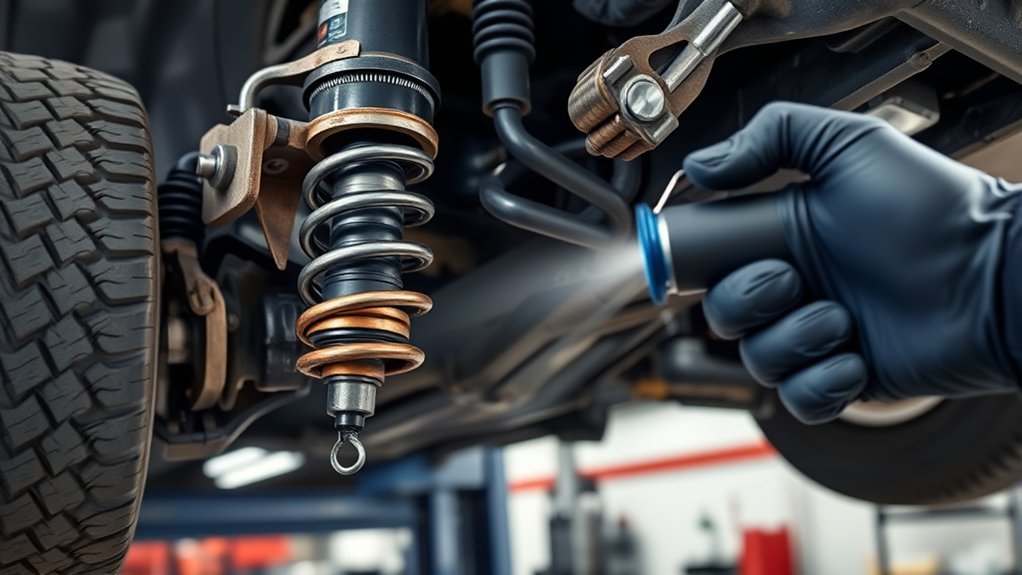
- Look at each shock body. Check for dents, severe corrosion, a bent shaft, damaged boots, loose bushings, broken mounts, or wet oil running down the body.
- Check ride height visually. A leaning corner may indicate a spring, mount, or load-distribution problem rather than a failed shock.
- Perform a gentle screening test. Push down firmly on one corner and release it. Continued oscillation can suggest weak damping, but a quick settling motion does not prove that every internal component is healthy.
- Take a controlled road test. On a safe route, notice repeated bouncing, steering correction, body movement, clunks, and instability. Do not perform abrupt maneuvers to test a suspected failure.
- Request a professional inspection when needed. A technician can safely lift the truck and check mounts, bushings, ball joints, tie rods, springs, bearings, alignment, and shock operation.
Warning: Never crawl under a Tacoma supported only by a hydraulic jack. Use correctly rated jack stands at approved support points, or have a qualified shop perform the underbody inspection.
Risks of Delaying Shock Replacement
A badly worn shock allows more uncontrolled wheel, axle, or body movement. That can reduce confidence during emergency braking, lane changes, rough corners, and towing. It can also worsen tire cupping and place extra stress on mounts, bushings, springs, and other suspension parts.
- Reduced tire contact on rough surfaces
- More body movement during braking and cornering
- Faster or irregular tire wear
- Increased stress on mounts and surrounding components
- Poor control when towing or carrying a load
- Greater risk of damage if a mount or shock body fails completely
Do not rely on an exact stopping-distance claim. The real effect depends on speed, tires, road surface, load, brakes, shock condition, and the rest of the suspension.
Choosing OEM or Aftermarket Tacoma Shocks
OEM-style shocks generally make sense when you want to preserve the truck’s original ride height, comfort, and handling balance. Confirm fitment through the VIN or a trusted Toyota parts catalog rather than relying only on a broad year range.
Aftermarket shocks may suit a Tacoma with a lift, added weight, larger tires, frequent towing, or regular off-road use. However, “heavy-duty” does not automatically mean more comfortable or better for every driver. A shock tuned for added payload may feel firm on an unloaded truck.
| Option | Best Fit | Check Before Buying |
|---|---|---|
| OEM or OEM-equivalent | Stock-height daily driving | VIN, trim, drivetrain, suspension package |
| Load-tuned aftermarket | Constant added weight or frequent towing | Actual loaded weight and spring compatibility |
| Extended-travel or lift-compatible | Modified ride height | Compressed length, extended length, brake lines, bump stops, and control-arm clearance |
| Remote-reservoir or adjustable | Sustained rough-road or performance use | Service needs, mounting clearance, adjustment range, and intended use |
Pro Tip: Weigh a heavily accessorized Tacoma in its normal travel configuration. Knowing the actual front and rear axle loads helps you choose springs and shocks that match the truck instead of relying on appearance or marketing labels.
What Else Should Be Checked During Replacement?
A shock replacement provides a useful opportunity to inspect the entire corner. Replacing a damper without correcting a worn mount, damaged spring, loose bushing, or alignment problem may leave the original symptom unchanged.
- Upper and lower shock mounts
- Rubber or spherical bushings
- Dust boots and bump stops
- Coil springs or leaf-spring packs
- Leaf-spring shackles and U-bolts where equipped
- Upper and lower control-arm bushings
- Ball joints and tie-rod ends
- Sway-bar links and frame bushings
- Wheel bearings and tire condition
- Brake hoses, ABS wiring, and nearby lines
Have the alignment checked after front suspension work, whenever adjustable geometry has moved, or when the truck pulls and the tires show uneven wear. Follow the repair procedure and torque specifications for the exact model year.
Warning: A compressed front coil spring stores enough energy to cause severe injury. Do not disassemble a coil-over assembly without the correct spring compressor, training, protective equipment, and model-specific procedure. A complete preassembled unit or professional installation may be safer.
Maintenance Tips to Extend Suspension Life
- Maintain correct tire pressure. Use the pressure on the driver’s door placard unless your tire or loading setup requires qualified guidance.
- Correct alignment problems promptly. Pulling, an off-center steering wheel, and one-sided wear deserve attention.
- Inspect after hard impacts. Check the suspension after hitting a deep pothole, rock, curb, or trail obstacle.
- Wash away mud and road salt. Clean exposed shock bodies, shafts, mounts, and spring hardware without directing high pressure into seals.
- Stay within load limits. Payload includes passengers, cargo, accessories, tongue weight, and equipment added to the truck.
- Secure heavy cargo. Shifting weight can create abrupt suspension loads and unstable handling.
- Service rebuildable shocks as directed. Some performance shocks need periodic seal, oil, or nitrogen service from an approved specialist.
- Record inspection findings. Notes about mileage, tire wear, leaks, and handling changes make gradual deterioration easier to recognize.
Also check your VIN for open safety campaigns through the NHTSA recall lookup. A handling or suspension concern may involve a component other than the shocks.
Related Guides
Frequently Asked Questions
How long should Toyota Tacoma shocks last?
No single mileage applies to every Tacoma. Inspect them regularly as mileage rises, especially after about 50,000 miles, and replace them when leaks, damage, weak damping, abnormal noise, tire wear, or handling problems confirm that they are no longer performing correctly.
Does a Toyota Tacoma have shocks or struts?
Tacomas use shock absorbers, including front coil-over shock assemblies and rear shocks. Some retailers loosely call the front assembly a strut. Use the VIN, model year, trim, drivetrain, suspension package, and ride height to identify the correct component.
What is the most common suspension problem with a Toyota Tacoma?
No single suspension problem applies to every Tacoma generation. Depending on age and use, symptoms may come from shocks, bushings, ball joints, tie rods, sway-bar links, wheel bearings, springs, alignment, tires, or loose hardware. Diagnose the truck instead of assuming the shocks are responsible.
How much does it cost to replace Tacoma shocks?
The total depends on the model year, front or rear location, shock design, electronic features, corrosion, local labor rates, alignment, and related parts. Obtain written estimates using your VIN and confirm whether each quote includes both sides, hardware, taxes, and alignment.
When replacing Tacoma front shocks, what else should be replaced?
Inspect the mounts, bushings, boots, bump stops, springs, hardware, control arms, ball joints, sway-bar links, tie rods, and tires. Replace only the parts that are worn, damaged, single-use, or required by the model-specific repair procedure.
Should Tacoma shocks be replaced in pairs?
Yes, replacing the left and right shocks on the same axle together generally provides more balanced damping. You do not automatically need all four unless both axles show wear or you are making a planned suspension upgrade.
Do I need an alignment after replacing Tacoma shocks?
Rear shock replacement alone normally does not change alignment settings. Front work may disturb suspension geometry, especially when coil-over assemblies, control arms, ride height, or adjustable components are involved. Check alignment after front suspension work or whenever pulling and uneven tire wear remain.
Conclusion
Your Tacoma’s odometer can remind you to inspect the shocks, but it cannot confirm their condition. Look for leaks, damage, repeated bouncing, unusual noise, unstable handling, and abnormal tire wear. Then rule out tires, alignment, steering parts, springs, bushings, and bearings before replacing anything.
Use model-specific Toyota information, replace dampers in axle pairs, and match new parts to the truck’s actual suspension and load. If handling has become unpredictable or a mount appears damaged, stop using the truck for highway driving, towing, or heavy loads until a qualified technician inspects it.
Sources
- Toyota Manuals and Warranties — model-specific owner, warranty, and maintenance information.
- Toyota USA Newsroom: 2024 Toyota Tacoma — fourth-generation suspension layouts and grade-specific shock systems.
- National Highway Traffic Safety Administration Recall Lookup — VIN-based open safety recall checks.
- Toyota Genuine Parts — vehicle-specific Toyota replacement-part lookup.