Your Toyota Tundra’s cabin air filter helps reduce dust, pollen, road debris, and other airborne particles entering through the ventilation system. Replacement timing depends on the truck’s model year, market, operating conditions, and filter condition. Reduced airflow, easy window fogging, persistent odors, or a visibly loaded filter can justify earlier inspection.
Quick Answer
For a 2026 U.S.-market Toyota Tundra, Toyota schedules cabin air filter replacement at 30,000 miles. Inspect or replace it sooner after heavy traffic, dirt-road, dusty, desert, or urban driving, or when airflow drops or windows fog easily. Check your model-year maintenance guide before buying or installing a filter.
Key Takeaways
- Toyota Tundra replacement schedules vary by model year, so a single mileage interval does not fit every truck.
- Toyota’s 2026 U.S. maintenance chart lists cabin air filter replacement at 30,000 miles under its standard schedule.
- Heavy traffic, dirt roads, and dusty, desert, or urban conditions can shorten filter life.
- Reduced airflow and easy window fogging are recognized reasons to inspect the filter sooner.
- Persistent problems after replacement may point to debris, an evaporator issue, a blower fault, or another HVAC problem.
What Is a Cabin Air Filter and What Does It Do in a Toyota Tundra?

The cabin air filter cleans outside air before it reaches the Tundra’s passenger compartment through the heating, ventilation, and air-conditioning system. It is separate from the engine air filter, which protects the engine’s air intake.
A standard cabin filter mainly captures particles such as dust, pollen, soot, leaves, and other debris. It does not sterilize the cabin or guarantee that the air is free from every pollutant, microorganism, or gas.
Some replacement filters include activated carbon or charcoal. These filters may reduce certain odors and gaseous pollutants in addition to collecting particles. A controlled Environmental Health study found that an activated-charcoal combination filter reduced particulate and gaseous diesel-exhaust components more effectively than the particle-only filter tested. Performance still varies by filter design, fit, condition, and airflow.
Note: A cabin air filter can reduce exposure to some airborne contaminants, but it cannot replace ventilation, vehicle cleaning, leak repair, or professional HVAC service.
Why Changing Your Cabin Air Filter Matters
Improved Cabin Air Quality
As the filter collects particles, its available surface area gradually decreases. Replacing a heavily loaded or damaged filter helps the HVAC system continue filtering incoming air effectively.
A clean, correctly fitted filter can be especially helpful during pollen season or when you drive through dusty areas. An activated-carbon filter may also help with some outside odors, although it will not correct an odor caused by moisture, mildew, a blocked evaporator drain, or contamination elsewhere in the HVAC system.
Better HVAC Airflow and Defogging
A filter packed with dust and debris can restrict the air moving through the vents. You may notice weaker heating, cooling, or windshield-defogging performance even when the fan is set to a higher speed.
Replacing the filter can restore airflow when the filter is the restriction. It will not repair a weak blower motor, a damaged blend door, a blocked evaporator, low refrigerant, or another mechanical fault.
| Condition | Clean, Correctly Fitted Filter | Heavily Loaded Filter |
|---|---|---|
| Vent airflow | Air can pass through the media as designed | Airflow may become restricted |
| Particle control | Captures particles within the filter’s rated capability | Performance may decline if air bypasses damaged or poorly fitted media |
| Defogging | Supports normal HVAC airflow | Windows may take longer to clear |
| Odor | Should not introduce a musty smell | Trapped moisture or debris may contribute to odor |
Warning Signs Your Cabin Air Filter Needs Attention
No single symptom proves that the cabin filter is responsible. However, the following signs make an inspection worthwhile:
- Reduced airflow: Less air comes from the vents at a familiar fan setting.
- Slow window clearing: The windshield or side windows fog easily or take longer to clear.
- Persistent musty odor: The smell becomes stronger when the fan starts.
- Visible debris: The pleats contain heavy dust, leaves, insects, or other material.
- Damaged media: The filter is torn, crushed, wet, warped, or no longer seals against its frame.
- Increased cabin dust: Dust returns quickly after cleaning, although door seals, open windows, and interior contamination can also cause this.
- New HVAC noise: Leaves or debris may be touching the blower fan, but the blower motor or another component may also be responsible.
Note: A new filter may not remove an odor caused by a damp evaporator, clogged drain, rodent contamination, coolant leak, or another source inside the HVAC housing.
Toyota Tundra Cabin Air Filter Replacement Intervals
The correct interval depends on the model year and market. Toyota’s 2026 U.S. Tundra Warranty & Maintenance Guide places cabin air filter replacement at 30,000 miles in its normal maintenance chart.
The 2024 U.S. Tundra guide calls for inspection at 15,000 miles or 18 months and replacement at 30,000 miles or 36 months. It also identifies reduced airflow and easy window fogging in Fresh mode as reasons the filter may need earlier replacement.
| Vehicle or Condition | Guidance |
|---|---|
| 2026 U.S.-market Tundra | Replace at 30,000 miles and at later intervals shown in the maintenance chart. |
| 2024 U.S.-market Tundra | Inspect at 15,000 miles or 18 months; replace at 30,000 miles or 36 months. |
| Heavy traffic, dirt roads, or dusty, desert, or urban use | Inspect sooner because these conditions may shorten filter life. |
| Other model years or markets | Follow the maintenance guide that applies to the truck’s model year, VIN, and production market. |
Pro Tip: Record the installation date and mileage on the filter frame or in your maintenance log. That gives you a reliable starting point for the next inspection.
U.S. owners can select their truck through Toyota’s manuals and warranties portal. Canadian owners can use Toyota Canada’s owner-manual portal and production-date guidance to locate the correct document.
How to Inspect Your Cabin Air Filter for Damage and Contamination

Switch off the ignition before opening the filter compartment. Remove the filter carefully so loose debris does not fall into the blower housing.
Inspect the filter for:
- Heavy dust or soot packed between the pleats
- Leaves, seeds, insects, or rodent material
- Torn, separated, bent, or crushed media
- A damaged frame or seal that allows unfiltered air to bypass the media
- Moisture, mold-like growth, oil, or another unusual contaminant
- An incorrect size or a filter that has shifted out of position
Do not rely only on color. Some new activated-carbon filters are gray or dark before use. The amount of light passing through the media is also not a dependable test because filter thickness and pleat density differ.
Warning: A wet or oily filter can indicate water entry, a drain problem, or contamination inside the HVAC system. Replace the filter and identify the source instead of installing another filter without investigation.
What Happens If You Ignore a Dirty Cabin Air Filter?
A heavily loaded filter can reduce the volume of air reaching the vents. That can make heating, cooling, and windshield clearing feel slower, particularly at lower fan speeds.
Moist debris may also contribute to unpleasant smells. A torn or poorly fitted filter can allow more dust to pass around the media and enter the HVAC housing or cabin.
A clogged cabin filter does not directly control the engine’s air supply, fuel mixture, or tailpipe emissions. Claims that it automatically causes higher fuel consumption or engine damage should not be used to decide when to replace it.
Replace the filter when required by the applicable maintenance schedule, when its condition warrants replacement, or when symptoms support earlier service. If replacing it does not improve the problem, continue diagnosing the HVAC system.
How to Replace a Toyota Tundra Cabin Air Filter
On many Toyota Tundra model years, the cabin filter is located behind the glovebox. The exact stops, damper arm, cover clips, and airflow direction can vary, so review the manual for your truck before releasing any parts.
At a Glance
| Time Required | About 10 to 20 minutes on many model years |
| Difficulty | Easy |
| Tools Needed | Gloves and a flashlight; a plastic trim tool or screwdriver only when the model-specific instructions require one |
| Cost | Varies by model year, brand, and filter media |
Warning: Turn off the ignition and do not force the glovebox, damper arm, stops, or filter cover. Plastic parts can crack when bent in the wrong direction.
- Confirm fitment. Match the replacement filter to the truck’s model year, trim, VIN, and market. Compare its dimensions with the old filter before installation.
- Park safely. Place the truck on a level surface, apply the parking brake, switch off the ignition, and remove the key or keep the smart key away from the controls.
- Empty the glovebox. Remove its contents so nothing falls when the box is lowered.
- Release the glovebox as directed. Disconnect the damper arm and compress or release the stops only when your model’s instructions call for it.
- Open the filter housing. Release the cover tabs without prying harder than necessary.
- Note the old filter’s orientation. Check the airflow arrow or orientation marking before pulling the filter out slowly.
- Clean loose debris. Use a vacuum with light suction around the accessible compartment. Do not push tools deeply into the blower or evaporator area.
- Install the new filter. Follow the airflow arrow and make sure the filter sits flat without folded pleats or gaps around the frame.
- Reassemble the glovebox. Refit the cover, stops, and damper arm in reverse order.
- Test the HVAC system. Run the fan at several speeds and check for normal airflow, rattling, or air escaping around the filter cover.
Pro Tip: Take a photo of the old filter and its arrow before removal. The photo gives you a reference if the replacement filter uses different wording or markings.
Tools for a Successful Cabin Air Filter Replacement
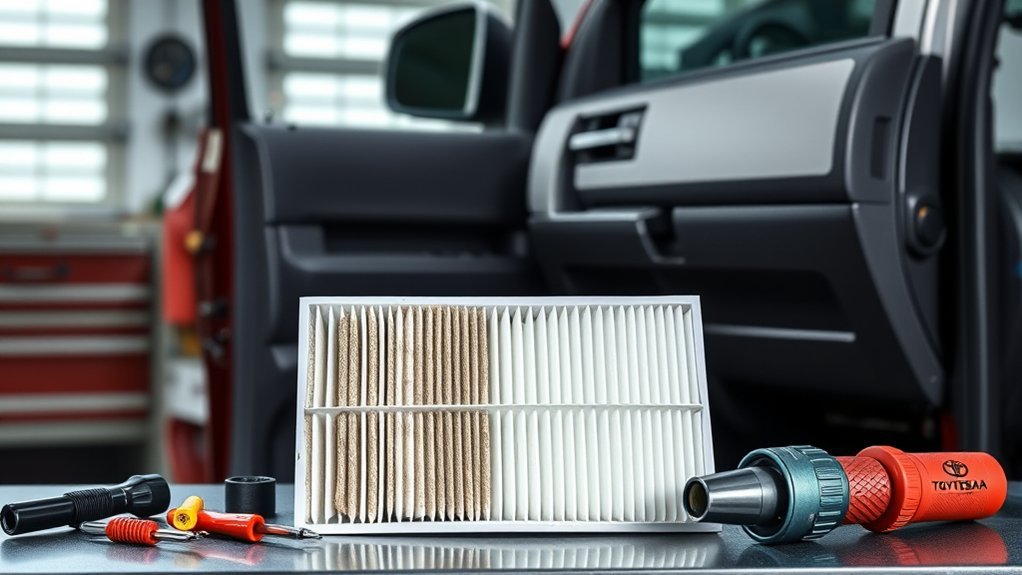
Essential Tools and Supplies
Many Tundra cabin filters can be replaced without metal hand tools. Gather the following before opening the glovebox:
- A replacement filter confirmed for your model year and trim
- Protective gloves
- A flashlight
- A small vacuum with a hose attachment
- A clean bag for the used filter
- A plastic trim tool or screwdriver only if required by the applicable manual
- Your owner’s or maintenance manual
Avoid choosing a filter only because its length and width look close. A filter that is too small can leave bypass gaps, while a filter that is too thick may restrict airflow or prevent the cover from closing.
Safety Precautions to Follow
- Switch off the ignition before reaching near the blower intake.
- Wear gloves if the old filter contains heavy dust, rodent material, or unknown contamination.
- Do not shake the filter inside the cab.
- Do not use high-pressure compressed air to clean the housing or a disposable paper filter.
- Do not wash a disposable filter unless its manufacturer specifically identifies it as washable and provides cleaning instructions.
- Never stack two filters in the housing.
- Keep moisture and cleaning liquid away from the blower motor and electrical connectors.
- Dispose of the old filter in a sealed bag according to local waste rules, especially if it contains unusual contamination.
How to Choose the Right Replacement Filter
Begin with fitment. Check the model year, trim, market, and VIN rather than relying only on the word “Tundra” in a product description. Canadian owners may also need the truck’s production date to identify the applicable manual or part application.
You will generally see two broad filter types:
- Particle filter: Designed mainly to capture dust, pollen, soot, and debris.
- Activated-carbon filter: Adds carbon media that may help reduce some odors and gaseous pollutants.
A carbon filter can be useful in traffic or areas with frequent smoke and odors. However, labels such as “premium,” “high efficiency,” or “HEPA-style” do not by themselves establish how a filter performs in your Tundra. Use a reputable filter with documented fitment and installation directions.
Inspect the new filter before installation. Do not use it if the frame is warped, the media is torn, or the pleats are crushed enough to leave open gaps.
How to Keep the New Cabin Air Filter Working Properly
Check the filter according to the applicable Toyota maintenance guide and sooner after unusually dusty trips, wildfire-smoke exposure, off-road driving, or long periods in congested traffic.
Keep leaves and debris away from the exterior air intake near the base of the windshield. Avoid spraying fragrance, disinfectant, oil, or cleaner directly onto the filter because liquid can damage the media or create odors.
Recirculation mode can temporarily reduce the amount of outside air entering the system, but it is not a substitute for filter maintenance. Follow the vehicle manual for ventilation and defogging operation, especially when visibility is affected.
If the replacement filter becomes wet or unusually dirty soon after installation, inspect for water entry, damaged seals, debris buildup, or another underlying cause.
When to Schedule Professional Cabin Air Filter Service
A cabin filter replacement is often suitable for DIY maintenance when you can access the housing without force, confirm the correct filter, and follow the model-specific instructions.
Use the Applicable Replacement Schedule
Do not schedule service from a universal online interval alone. Use the maintenance guide for your Tundra’s model year and inspect earlier when operating conditions or symptoms justify it.
You can have the work completed by Toyota of Clermont if that dealership is convenient, another Toyota dealer, or a qualified independent repair shop. The filter itself does not require installation by one specific dealership.
When the HVAC System Needs More Than a Filter
Schedule a professional inspection when:
- Airflow remains weak after installing a correctly fitted filter.
- Windows still fog excessively when the HVAC controls are used correctly.
- A musty, chemical, burning, or coolant-like odor continues.
- The blower rattles, squeals, works intermittently, or fails at certain speeds.
- The filter or housing is wet.
- You find rodent nesting, droppings, chewed wiring, or extensive contamination.
- The filter cover, glovebox damper, or retaining tabs are broken.
- The air-conditioning system is not cooling even though vent airflow is strong.
These symptoms may involve the blower, evaporator, drainage system, wiring, doors inside the HVAC case, refrigerant system, or another component that a filter replacement cannot repair.
Related Guides
Frequently Asked Questions
How do I know when my Toyota Tundra cabin air filter needs replacing?
Inspect it when vent airflow decreases, windows fog more easily, a musty odor appears, or the filter contains heavy debris. Replace it at the interval in the applicable Toyota maintenance guide or earlier when its condition and operating environment justify replacement.
How often should I change the cabin air filter in a Tundra?
The interval varies by model year. Toyota’s 2026 U.S. Tundra maintenance chart lists replacement at 30,000 miles. The 2024 U.S. guide lists inspection at 15,000 miles or 18 months and replacement at 30,000 miles or 36 months. Check the guide for your truck and inspect sooner in dusty or severe conditions.
How can I tell whether the cabin filter or another HVAC part is causing the problem?
Inspect the filter for heavy loading, damage, moisture, and poor fit. If a correct new filter does not restore airflow or remove the symptom, check for debris near the blower and arrange diagnosis of the blower motor, evaporator, air doors, drain, or other HVAC components.
Will a dirty cabin filter affect the air conditioner?
A heavily loaded filter can restrict the air reaching the vents, making cooling and defogging feel less effective. It does not control refrigerant temperature, so weak cooling with strong airflow usually points to a different air-conditioning problem.
Is the cabin air filter the same as the engine air filter?
No. The cabin air filter cleans air entering the passenger compartment through the HVAC system. The engine air filter cleans air entering the engine. They use different housings, parts, inspection procedures, and maintenance schedules.
Can I clean and reuse a Toyota Tundra cabin air filter?
Replace a disposable paper or carbon filter rather than washing it. Water, compressed air, and aggressive brushing can damage its media. Reuse a filter only when its manufacturer specifically identifies it as washable and provides a cleaning and drying procedure.
Conclusion
Your Toyota Tundra’s cabin air filter should be serviced according to the maintenance guide for its model year, not a universal online interval. For the 2026 U.S. Tundra, Toyota’s standard chart lists replacement at 30,000 miles, while harsh operating conditions or symptoms can justify an earlier inspection.
Check for heavy debris, damage, moisture, reduced airflow, and slow window clearing. Install a correctly fitted filter in the proper direction, and seek HVAC diagnosis when the problem continues after replacement.
Sources
- Toyota 2026 Tundra Warranty & Maintenance Guide — current U.S. replacement chart and severe-condition guidance.
- Toyota 2024 Tundra Warranty & Maintenance Guide — inspection interval, replacement interval, airflow, and fogging guidance.
- Toyota U.S. Manuals and Warranties — model-specific owner and maintenance documents.
- Toyota Canada Owner’s Manuals — Canadian manual lookup and production-date guidance.
- Environmental Health: Vehicle Cabin Air Inlet Filter Study — particle-filter and activated-charcoal filtration findings.