
Last updated: September 22, 2026
Co-witnessing sights means mounting a red-dot or holographic sight so usable iron sights remain visible through the optic window as a backup aiming system. With absolute co-witness, aligned iron sights appear near the center of the window. With lower 1/3 co-witness, the irons appear lower, leaving more open space through the center of the optic. Co-witness describes the physical sight relationship; it does not prove that either sighting system is correctly zeroed.
Quick Answer
Co-witnessing means your usable iron sights remain visible through a red-dot or holographic sight. Absolute co-witness places the aligned irons near the center of the optic window, while lower 1/3 keeps them in the lower portion for a less cluttered primary view. The optic and irons should still be zeroed and verified independently.
Key Takeaways
- Co-witness describes where usable iron sights appear through a non-magnified optic; it is not proof of zero.
- Absolute co-witness places aligned irons near the center of the optic window.
- Lower 1/3 co-witness places aligned irons lower in the window, leaving more open space around the primary red-dot sight picture.
- AR-style rifle setups are relatively standardized, while pistol co-witness height depends much more on the slide cut, optic, mounting plate, and iron-sight height.
- Co-witnessed irons can provide a backup when the electronic reticle fails and the optic window remains usable.
- Always handle firearms safely, follow local laws, and confirm each sighting system only in a lawful, controlled shooting environment.
At a Glance
| Co-Witness Tells You | Where usable iron sights appear through the optic window when you obtain a normal iron-sight picture. |
| Absolute | Aligned iron sights appear near the center of the optic window. |
| Lower 1/3 | Aligned iron sights appear in the lower portion of the window, leaving the center less visually crowded. |
| Co-Witness Does Not Tell You | Whether the optic or iron sights are correctly zeroed. Each system still needs independent range verification. |
| Platform Caveat | Do not assume a rifle mount-height label transfers directly to a pistol. Pistol optic and iron-sight geometry varies substantially by model and mounting system. |
What Is Co-Witnessing?

Co-witnessing refers to the physical relationship between iron sights and a compatible red-dot or holographic sight. When the setup co-witnesses, the iron sights remain visible and usable through the optic window. SIG Sauer’s co-witness glossary identifies absolute and lower-third as the two common arrangements.
On many AR-style rifles, you achieve a particular co-witness by matching the optic mount height to the established iron-sight height. With absolute co-witness, aligned irons sit near the center of the optic window. With lower 1/3 co-witness, aligned irons sit lower in the window. Vortex’s co-witness guide explains that changing red-dot mount height on a standardized rifle platform changes where the irons appear through the optic.
Co-witness is separate from zero. Your optic and iron sights can appear to have the expected physical relationship without either system being correctly zeroed. Confirm each one independently before relying on it.
Safety note (U.S.): Always follow federal, state, and local laws; observe range rules; and use appropriate eye/ear protection.
Warning: Before mounting, adjusting, or inspecting any sighting system, confirm the firearm is unloaded, keep the muzzle pointed in a safe direction, and follow the safety rules for your range or training environment.
Why Co-Witnessing Matters: Redundancy, Not Extra Accuracy

Co-witnessing does not make a properly zeroed optic inherently more accurate. Its main benefit is redundancy: if an electronic reticle stops working while the optic window remains clear enough to see through, properly installed and zeroed iron sights may still provide a usable backup sight picture.
That distinction matters. A dead battery or electronic failure can leave the optic window physically usable. A lens that is fully obscured, badly damaged, or otherwise impossible to see through may also prevent you from using iron sights through the optic.
Co-witnessing therefore complements—not replaces—proper zeroing, marksmanship fundamentals, equipment inspection, and safe firearm handling. Its value is that your backup sighting system is already physically positioned where it can be accessed through the optic when the setup allows it.
Note: A co-witnessed view is not the same thing as a confirmed zero. Always verify your optic and iron sights independently in a safe, lawful range setting.
Types of Co-Witnessing: Absolute vs. Lower 1/3
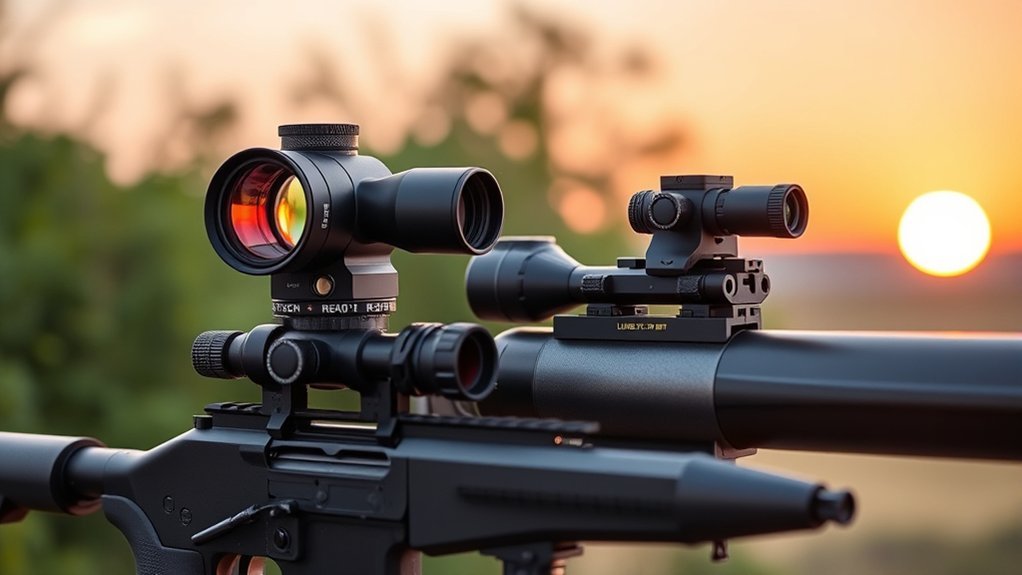
The two most common terms are absolute co-witness and lower 1/3 co-witness. They describe where properly aligned iron sights appear within the optic window. The exact hardware that produces either view depends on the firearm, optic, mount, and iron sights.
| Type | Iron-Sight Position | Main Trade-Off |
|---|---|---|
| Absolute Co-Witness | Aligned irons appear near the center of the optic window. | Immediate centered iron-sight reference, but more of the irons occupy the center of the window. |
| Lower 1/3 Co-Witness | Aligned irons appear in the lower portion of the optic window. | Cleaner central optic view, with the backup irons positioned lower in the window. |
Neither arrangement is automatically better. The useful choice depends on the firearm platform, optic design, available mounting options, iron-sight height, cheek weld or presentation, and how much of the optic window you want occupied by the backup sights.
When Absolute Co-Witness Makes Sense
Absolute co-witness can make sense when you want the aligned iron sights to occupy the same central portion of the optic window that you already use for a traditional iron-sight picture. On compatible rifle setups, it can provide a familiar and immediately visible backup reference.
When Lower 1/3 Co-Witness Makes Sense
Lower 1/3 co-witness can make sense when the red dot is your primary sight and you prefer the center of the optic window to remain less crowded. The backup irons remain visible lower in the window when the firearm, optic, mount, and sight heights are compatible.
Pro Tip: Check the optic, mount, and iron-sight specifications before buying parts. Do not assume that an “absolute” or “lower 1/3” measurement used on one firearm platform will create the same sight picture on another.
How Does Co-Witnessing Differ on Rifles and Pistols?
Co-witness terminology is easiest to apply to flat-top AR-style rifles because iron-sight and rail geometry are comparatively standardized. On these rifles, changing the red-dot mount height often determines whether the irons appear centered or lower in the window. Vortex notes that pistol setups are much less standardized because iron-sight heights, optic dimensions, slide cuts, and mounting methods vary widely.
| Setup | What Determines the Sight Picture | Important Caveat |
|---|---|---|
| AR-Style Rifle + Red Dot | Rail-height iron sights plus the optic’s mount height. | Use the optic or mount manufacturer’s stated co-witness configuration rather than assuming every mount uses identical dimensions. |
| Optics-Ready Pistol | Slide cut or plate thickness, optic deck height, and front/rear iron-sight height. | Factory sights may be too short to remain visible through some pistol optics. |
| Red Dot + Magnifier | The red dot and magnifier mounts must be vertically compatible. | The magnifier adds finite eye-relief requirements and should not be treated as a normal magnified iron-sight system. |
For pistols in particular, avoid choosing iron sights from a generic “lower 1/3” label alone. Check compatibility information for the exact pistol, slide or plate, optic, and sight set. Vortex’s pistol co-witness explanation describes why there is no single universal pistol sight height.
How to Set Up Co-Witnessing Sights
Start by confirming that your optic, mount, firearm, and iron sights are designed to create the co-witness relationship you want. On an AR-style rifle, the optic mount is usually the main height variable. On a pistol, the mounting cut or plate, optic body, and iron-sight height all affect whether the irons are visible.
Install the hardware according to the relevant manufacturer instructions. A safe visual check can tell you whether the irons occupy the expected part of the optic window, but it cannot establish final zero.
At a lawful range, verify the iron sights and optic independently rather than adjusting one system only until it happens to overlap the other visually. Aimpoint’s zeroing guide likewise calls for live-fire point-of-impact confirmation. For a broader explanation of zero, see our guide to what zeroing a rifle means.
Basic Co-Witness Setup Steps
- Confirm the firearm is unloaded and safe to handle.
- Confirm that the optic, mount, and iron sights are compatible with the desired co-witness arrangement.
- Install or raise the iron sights and make sure they are secure.
- Install the optic and mount according to the manufacturer’s instructions.
- From a normal shooting position, check where the aligned iron sights appear within the optic window.
- If the sight picture is not where expected, recheck component compatibility before making unnecessary sight adjustments.
- At a lawful range, confirm the optic’s zero and the iron sights’ zero independently.
- Recheck mounting hardware and sight stability after the initial range session.
Common Mistakes to Avoid
Most co-witness problems come from misunderstanding sight geometry, using incompatible component heights, loose mounting hardware, or treating visual alignment as proof of zero. Check the hardware relationship first, then verify each sighting system independently.
Mounting the Optic Incorrectly
A mount that is not seated or secured as its manufacturer specifies can shift under normal use and change the optic’s point of impact. Use the correct hardware, mounting interface, and manufacturer instructions for your exact optic and firearm.
Do not compensate for a mounting problem by making large sight adjustments simply to force the dot into a particular visual relationship with the irons. First confirm that the mount and sight heights are actually compatible with the co-witness arrangement you want.
Ignoring Eye Relief When a Magnifier Is Added
Non-magnified red-dot sights commonly provide very forgiving or unlimited eye relief. A separate magnifier or magnified optic is different: it has a defined eye-relief range and must be positioned so you can obtain a complete sight picture safely.
That means adding a magnifier introduces another fit variable beyond co-witness height. Keep the red dot and magnifier at compatible mounting heights, then position the magnifier according to its own manufacturer instructions rather than moving your head into an awkward position.
Treating Every Firearm Platform as the Same
Rifle and pistol co-witness setups should not be treated as interchangeable. Flat-top AR-style rifles commonly use standardized rail-height backup sights and mounts specifically described as absolute or lower-third. Pistols vary far more because slide cuts, adapter plates, optic deck heights, and factory iron sights differ.
If you are setting up a pistol, verify compatibility for the exact combination of pistol, mounting interface, optic, and iron sights. A sight set that gives a useful lower-window view with one optic may sit too low or too high with another.
Using the Wrong Mount Height
The wrong mount height is one of the most common reasons a rifle co-witness setup does not produce the expected view. If the optic sits too low, the sight picture may feel cramped or may not match the intended configuration. If it sits too high, standard-height irons may sit too low to be usable through the optic window.
Use the optic or mount manufacturer’s stated configuration and confirm that it is intended to work with the type of iron sights installed on your firearm.
Assuming Co-Witness Means Zeroed
A matching-looking sight picture does not prove that your optic and irons are both correctly zeroed. Co-witnessing describes sight geometry. Zeroing describes the relationship between point of aim and point of impact at a chosen distance. Verify the optic and iron sights independently in a safe range setting.
Tips for Optimizing Your Co-Witnessing Setup
A dependable co-witness setup comes from compatible geometry, secure hardware, and separate zero verification. Use the checks below instead of judging the setup only by whether the dot appears near the front sight during a quick visual inspection.
| Check | Why It Matters | What to Verify |
|---|---|---|
| Mount and Sight Geometry | Determines where the irons appear in the optic window. | Manufacturer-stated mount configuration and compatible iron-sight height. |
| Secure Mounting | Loose hardware can allow the optic or sights to shift. | Hardware is installed according to the relevant manufacturer instructions. |
| Independent Zero | Visual co-witness alone does not confirm point of impact. | Optic and irons are each confirmed at the range. |
| Post-Impact or Post-Removal Check | Travel, impacts, or removing a mount can change alignment or zero. | Mount stability, sight position, and confirmed zero when needed. |
| Backup-Sight Function | A backup sight is useful only if it can deploy and remain secure. | Folding sights lock correctly and remain unobstructed enough to use. |
How to Check Your Co-Witness After Setup
After installation, inspect the setup from your normal shooting position. Do not force your head into an unnatural position simply to make the sights appear in a particular part of the window. With the iron sights properly aligned, their location in the optic window should tell you whether the setup is behaving like an absolute or lower-third arrangement.
Then check physical stability. Make sure the optic mount does not shift and the iron sights remain secure. At the range, verify the optic and irons independently. If the expected co-witness view changes after an impact, mount removal, or other hardware change, inspect the mounting system before relying on the setup again.
When Co-Witnessing May Not Be Needed
Co-witnessing is useful, but it is not required for every firearm or optic setup. Some users choose taller optic mounts for a more upright head position or specialized equipment compatibility, while others use an optic-only configuration for a narrowly defined purpose.
The important distinction is intentional setup versus accidental incompatibility. If you deliberately choose a non-co-witness height, understand that standard-height iron sights may no longer be usable through the optic window. If backup irons are part of your intended system, verify that the complete setup actually supports them.
Maintenance and Rechecking
Co-witnessing is not a one-time inspection. Recheck the hardware after hard use, travel, cleaning, mount removal, or a noticeable impact. A change in mount position or sight hardware can alter both the visual relationship and the confirmed zero.
Also inspect the optic battery, lens clarity, mount hardware, sight posts, folding-sight hinges, and any quick-detach mechanism. If something is loose, damaged, or inconsistent, correct the equipment issue before relying on the sighting system.
Frequently Asked Questions
What does co-witness mean on a red dot?
Co-witness means usable iron sights remain visible through the red-dot sight’s window. Depending on the optic, mount, firearm, and iron-sight height, the aligned irons may appear near the center of the window or lower in it.
What is the difference between absolute and lower 1/3 co-witness?
With absolute co-witness, properly aligned iron sights appear near the center of the optic window. With lower 1/3 co-witness, the aligned irons appear in the lower portion of the window, leaving more open space through the center.
Do the red dot and iron sights have to line up?
The iron sights must form their normal aligned sight picture when you use them, but the red dot does not need to remain visually stacked on the front sight during normal red-dot use. More importantly, the optic and irons should each be zeroed independently rather than relying on visual overlap alone.
Do you need taller iron sights with a pistol red dot?
Sometimes. Whether factory pistol sights remain visible depends on the slide cut or mounting plate, the optic’s body and deck height, and the height of the front and rear sights. There is no universal pistol co-witness height, so verify the exact component combination.
Does co-witness mean the optic is zeroed?
No. Co-witness describes the physical relationship between the optic window and the iron sights. Zero describes where shots impact relative to the point of aim at a chosen distance. Confirm the optic and irons separately at a safe range.
Sources
- SIG Sauer — Co-Witness Glossary — defines absolute and lower-third co-witness and their backup-sight purpose.
- Vortex Optics — Everything You Ever Wanted to Know About Co-Witnessing, Part One — explains rifle co-witness geometry and absolute versus lower-third arrangements.
- Vortex Optics — Everything You Ever Wanted to Know About Co-Witnessing, Part Two — explains why pistol iron-sight and optic heights are less standardized.
- EOTECH Help Center — explains model-dependent center versus lower-third co-witness and the need for final live-fire zero verification.
- Aimpoint Zeroing Guide — supports safe handling and independent live-fire zero confirmation.
- Vortex SPARC II Red Dot — provides an example of a manufacturer offering multiple mounting heights and unlimited eye relief on a non-magnified red dot.
Conclusion
Co-witnessing sights are primarily about geometry and redundancy, not automatic accuracy. Absolute co-witness keeps aligned irons near the center of the optic window, while lower 1/3 keeps them lower for a cleaner central view. Neither arrangement proves that the optic or irons are zeroed.
Choose components that are compatible with your exact firearm platform, follow the relevant manufacturer instructions, verify each sighting system independently at a lawful range, and recheck the hardware after removal, impact, or other changes. That approach gives you a dependable backup sight relationship without confusing co-witness with zero.
