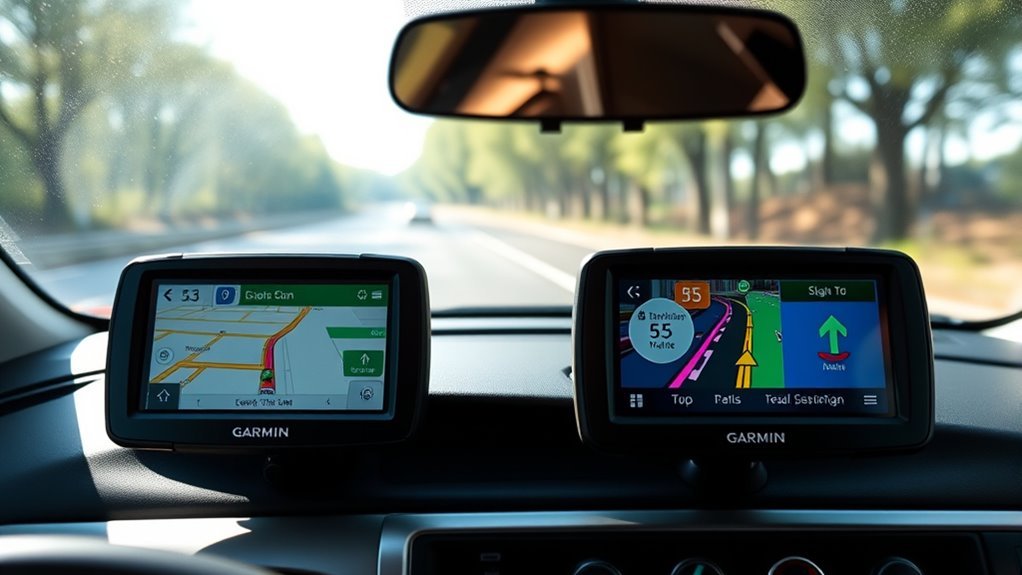
The Garmin Drive 53 and Garmin Drive 55 are compact dedicated GPS navigators, but they are not identical and the model names can be confusing. The Drive 53 is a newer 5-inch model, while the Drive 55 uses a larger 5.5-inch, higher-resolution display. Traffic and connected features also vary by model version and region, so checking the exact SKU matters before you buy.
Quick Answer
The Garmin Drive 53 is a newer, compact 5-inch GPS with an 800×480 display, while the Drive 55 has a larger 5.5-inch, higher-resolution screen. Both provide core Garmin navigation, lane guidance and driver alerts. Traffic, Wi-Fi and smartphone features depend on the exact regional version, and Drive 55 should not be confused with DriveSmart 55.
Key Takeaways
- Drive 53: 5-inch glass touchscreen with 800×480 resolution.
- Drive 55: 5.5-inch display with substantially more pixels and more map space.
- The Drive 53 was announced by Garmin in April 2023, so the Drive 55 is not the newer model.
- Traffic support on the Drive 53 depends on the exact version and market.
- Do not confuse Garmin Drive 55 with Garmin DriveSmart 55; DriveSmart 55 has features such as voice-activated navigation that should not automatically be attributed to Drive 55.
Garmin Drive 53 Vs 55: What’s Different?
The biggest differences between the Garmin Drive 53 and Drive 55 are the screen, model generation and the way connected features are packaged in different markets.
Note: Garmin Drive 55 and Garmin DriveSmart 55 are different product names. Many specifications commonly attributed to Drive 55 online—especially voice commands and hands-free calling—actually belong to the DriveSmart 55 product family.
| Feature | Garmin Drive 53 | Garmin Drive 55 |
|---|---|---|
| Display | 5-inch glass touchscreen | 5.5-inch touchscreen |
| Resolution | 800×480 | 1280×720 |
| Generation | Announced April 2023 | Earlier Drive generation |
| Lane guidance | Lane assist with junction view | Lane guidance/junction information |
| Traffic | Depends on SKU/region; U.S. traffic model used a traffic-enabled power cable | Live traffic available through the Garmin Drive app on supported versions |
| Wi-Fi updates | Available on supported regional/live-services versions | Yes |
| Voice commands | Not a core Drive 53 feature | Do not confuse with voice-enabled DriveSmart 55 |
Garmin officially introduced the Drive 53 in April 2023. The U.S. announcement described a 5-inch 800×480 glass touchscreen and offered both a standard Drive 53 and a Drive 53 & Traffic version.
The Drive 55 is therefore not simply a newer Drive 53 with extra features. Its main hardware advantage is the larger, sharper display, while exact traffic and connectivity behavior depends on the regional version.
Display Size, Resolution, and Touchscreen Feel
The display is one of the clearest reasons to choose one model over the other.
Screen Size Comparison
The Garmin Drive 53 uses a 5-inch glass touchscreen. Garmin specifies a physical display area of approximately 4.25 by 2.55 inches.
The Garmin Drive 55 uses a 5.5-inch screen, giving maps, junction information and on-screen buttons more room.
The difference is modest in overall dashboard space, but it can matter if you prefer larger map details or frequently navigate complicated motorway interchanges.
Resolution And Clarity
The Drive 53 runs at 800×480 pixels. That resolution is adequate for turn-by-turn navigation, street names and map symbols on a 5-inch display.
The Drive 55’s 1280×720 panel provides considerably more pixels. In normal driving, this means its map can present fine lines, labels and interface elements with greater visual definition.
The Drive 55’s clearest hardware advantage is not voice control—it is its larger, higher-resolution display.
Touchscreen Responsiveness
Both devices use touchscreen controls designed for straightforward automotive navigation. There is not enough manufacturer evidence to claim that one is categorically more responsive than the other.
For most buyers, screen dimensions and resolution are more meaningful differences than speculative claims about touch sensitivity.
Traffic Features: 55 Vs 53
Traffic is more complicated than a simple “Drive 55 has it and Drive 53 does not” comparison because Garmin sells different versions in different regions.
Traffic Antenna Included
When Garmin launched the Drive 53 in the United States, it offered two versions. The standard Drive 53 did not include traffic, while Drive 53 & Traffic included a vehicle power cable with a traffic receiver. Garmin said that version could report roadwork, accidents and other delays and offer alternative routes.
This means a buyer looking at a Drive 53 should check the complete model name and included power cable instead of assuming all Drive 53 units have identical traffic capability.
Live Traffic Alerts
The Garmin Drive 55 can receive live traffic information when connected to a compatible smartphone running the Garmin Drive app. Garmin’s manual explains that the app can send traffic incidents, delays and other live information to the navigator.
Some regional Drive 53 versions also use the Garmin Drive app for live traffic, weather and related connected services. This is why market and SKU information matters when comparing the two.
| Traffic Method | How It Works |
|---|---|
| Traffic-enabled power cable | Receives supported broadcast traffic without using the phone’s mobile-data connection. |
| Garmin Drive app traffic | Uses a paired smartphone and the Garmin Drive app to provide live information. |
Alternate Route Guidance
When traffic data is available, Garmin navigation can use that information to identify delays and provide an alternate route when appropriate.
The practical difference is therefore not that only one navigator can reroute. The important question is how your exact unit receives traffic data and whether that service is supported in your region.
Pro Tip: When buying used, ask the seller for the full part number and a photo of the power cable. That is more reliable than relying only on “Drive 53” or “Drive 55” in the listing title.
Route Guidance, Lane Assist, and Alerts
Both navigators provide Garmin’s core turn-by-turn navigation features. These include spoken route guidance, speed-limit information and driver alerts for relevant road conditions.
The Drive 53 officially includes Garmin Real Directions landmark guidance, lane assist with junction view, speed-limit information and driver alerts for conditions such as sharp curves and school zones.
The Drive 55 also provides lane guidance and route information. There is no reliable basis for saying that the ordinary Drive 55 has a fundamentally more advanced lane-assist system than the Drive 53.
For everyday navigation, both models are designed to show the route, prepare you for turns and help position the vehicle correctly at supported junctions.
Maps, Updates, and Wi-Fi
Both products include preloaded road maps appropriate to the region in which they are sold, but map coverage is SKU-specific. A European Drive 55 should not be assumed to include the same map package as a North American Drive 53.
The Drive 55 supports direct map and software updates over Wi-Fi. Garmin also allows updates through Garmin Express on a compatible computer.
Garmin documentation for supported Drive 53 regional/live-services variants likewise describes Wi-Fi updating. However, feature packaging differs by market, so buyers should verify the exact part number rather than assuming that every Drive 53 sold worldwide has identical wireless features.
Note: Garmin Support listed map version 2027.20 for both North America and Europe during 2026. Whichever navigator you use, installing the latest available maps is more important than comparing the map version originally installed at the factory.
Voice Control and Phone Pairing
This is where model-name confusion causes many inaccurate comparisons.
Garmin DriveSmart 55 supports voice-activated navigation and hands-free calling. Garmin’s official DriveSmart 55 specifications specifically list voice navigation, smart notifications and connected services.
The ordinary Garmin Drive 55 should not automatically be given those DriveSmart features. Its manual instead documents smartphone pairing with the Garmin Drive app for services such as live traffic information.
The same caution applies to the Drive 53. Spoken navigation prompts are not the same thing as voice-command control: a GPS can speak directions without allowing you to operate menus or search for destinations by voice.
Warning: Set destinations and change detailed settings while parked whenever possible. Do not interact with phone notifications or complex GPS menus while driving.
Drive 55 vs DriveSmart 55: Do Not Mix Them Up
Garmin’s naming makes this comparison easy to get wrong:
- Garmin Drive 55 is the model discussed in this comparison.
- Garmin DriveSmart 55 is a different product family with extra connected features including documented voice-command and hands-free functions.
- Garmin Forerunner 55 is a running watch and has nothing to do with Garmin’s automotive Drive 55 navigator.
If a specification page mentions voice command, hands-free calling or DriveSmart branding, confirm that you have not accidentally switched to DriveSmart 55 specifications.
Which Garmin Fits Your Driving Style?
The Drive 53 makes sense for drivers who want a compact dedicated GPS and do not need the largest screen. Its 5-inch panel keeps the unit relatively unobtrusive while still providing Garmin’s normal route guidance, junction information and driver alerts.
The Drive 55 is more attractive if your priority is display size and resolution. Its 5.5-inch screen provides more map area and sharper graphics.
- Choose Drive 53 if compact size and a newer 2023-era model are priorities.
- Choose Drive 55 if the larger 5.5-inch, higher-resolution display matters more.
- Check the exact SKU if traffic or smartphone connectivity is essential.
- Check map region before importing a unit from another country.
- Consider DriveSmart instead if voice-command and hands-free features are requirements.
Price and Availability
Price should be compared carefully because these models have been sold in different regions and configurations.
At the Drive 53’s U.S. launch in April 2023, Garmin listed the standard Drive 53 at $149.99 and Drive 53 & Traffic at $169.99. The $169.99 figure therefore referred to a traffic-equipped Drive 53—not to the Drive 55.
Drive 55 pricing varies by country and remaining stock, so comparing an imported or older European Drive 55 directly with current U.S. Drive 53 pricing can be misleading.
When shopping today, compare the actual selling price, included maps, traffic method, warranty coverage and part number rather than relying on the original MSRP alone.
What About the Newer Garmin Drive Models?
Neither the Drive 53 nor Drive 55 represents Garmin’s newest Drive hardware in late 2026.
On September 9, 2026, Garmin announced a redesigned Garmin Drive generation with 7.1- and 8.8-inch ultrawide displays. Garmin says the new models add an updated interface, supported voice commands, connected live traffic and weather, EV charging information and Wi-Fi map updates.
That does not make a Drive 53 or Drive 55 unusable. It simply means buyers paying near-new-product prices should also compare the current Garmin Drive lineup before purchasing older stock.
Which Garmin Should You Buy?
The Garmin Drive 53 is the better fit when you want a compact 5-inch navigator with Garmin’s core navigation features and you can find the correct traffic version for your needs.
The Garmin Drive 55 makes more sense when the larger 5.5-inch, higher-resolution screen is your priority and the regional map package suits where you drive.
Neither should be selected on the assumption that Drive 55 is automatically newer or that it includes DriveSmart 55’s voice-command and hands-free features.
For traffic, Wi-Fi and smartphone functions, verify the exact part number and regional version before purchasing. If advanced voice control is a must-have feature, compare a genuine DriveSmart model or Garmin’s newer 2026 Drive lineup instead.
Frequently Asked Questions
How old is the Garmin Drive 53?
Garmin announced the Drive 53 on April 12, 2023. It introduced a 5-inch 800×480 glass touchscreen and was offered in the U.S. as both a standard model and a Drive 53 & Traffic version.
Is the Garmin Drive 55 newer than the Drive 53?
No. The Drive 55 belongs to an earlier generation, while Garmin announced the Drive 53 in April 2023. Model numbers do not indicate release order.
Does Garmin Drive 53 have live traffic?
It can, depending on the version. Garmin’s U.S. Drive 53 & Traffic package included a traffic-enabled vehicle power cable, while supported regional versions can use connected live services. Check the exact SKU before buying.
Does Garmin Drive 55 have voice control?
Do not confuse Drive 55 with DriveSmart 55. Garmin specifically documents voice-activated navigation on the DriveSmart 55 family. The ordinary Drive 55 documentation focuses on navigation, Wi-Fi updating and Garmin Drive app live services rather than the DriveSmart voice-command feature set.
Can Garmin Drive 55 update maps over Wi-Fi?
Yes. Garmin’s Drive 55 manual allows supported map and software updates directly through a Wi-Fi network. Garmin Express on a computer is another update method.
Which is the best Garmin sat nav?
That depends on screen size, traffic needs, map region and connected features. Between these two, Drive 53 favors compactness while Drive 55 favors screen size and resolution. Garmin also introduced newer 7.1- and 8.8-inch Drive navigators in September 2026.
Is the Garmin Forerunner 55 outdated?
The Forerunner 55 is a GPS running watch, not a car navigator, so it is unrelated to this Drive 53 vs Drive 55 comparison. Do not use Forerunner specifications when researching Garmin Drive products.
Conclusion
The Garmin Drive 53 and Drive 55 share the same basic purpose but differ in important ways. The Drive 53 is a newer 5-inch model with an 800×480 display, while the Drive 55 gives you a larger 5.5-inch, higher-resolution screen.
The bigger buying complication is connectivity. Traffic, Wi-Fi and smartphone services can vary by regional SKU, so those features should be checked against the exact part number rather than inferred from the model name.
Most importantly, do not confuse Drive 55 with DriveSmart 55. If your priority is voice-controlled navigation or other DriveSmart features, verify that you are buying the DriveSmart product rather than the standard Drive 55.
Sources
- Garmin — Drive 53 launch announcement — launch date, 5-inch display, 800×480 resolution, traffic versions and original U.S. pricing.
- Garmin — Drive 53 product page — current product identity and traffic configuration.
- Garmin — Drive 55 product page — Drive 55 product identity and regional model information.
- Garmin — Drive 55 map and software updates — Wi-Fi and Garmin Express update methods.
- Garmin — Drive 55 smartphone traffic instructions — live traffic through the Garmin Drive app.
- Garmin — September 2026 Garmin Drive announcement — current-generation 7.1- and 8.8-inch Drive models and connected features.
