
Affiliate Disclosure:. As an Amazon Associate I earn from qualifying purchases. This roundup is reader-supported. When you click through Amazon links, we may earn a referral commission on qualifying purchases.
Auto body work demands control, consistency, and the right tools for thin sheet metal, patch panels, brackets, and structural repairs. When you choose a Hobart welder that matches your material thickness, welding process, power supply, and workspace, you spend less time fixing messy seams and more time finishing panels correctly. This guide compares Hobart MIG and multiprocess machines that make the most sense for clean panel welds, controlled heat, and reliable garage repairs.
Quick Verdict
If you want one flexible machine for garage auto body work, the Hobart Multi-Handler 200 is the easiest all-around pick because it covers MIG, DC TIG, and stick in one unit. If you mainly need shop power and smoother MIG control, the Hobart Ironman 240 is the stronger fixed-shop choice. If aluminum repair matters, the Hobart Ironman 240 with SpoolRunner 200 is the most complete setup. For everyday garage MIG work, the Hobart Handler 210 MVP, Hobart Handler 190, and Hobart Handler 125 cover different power needs and budgets.
Top Picks
|
Category |
Product |
Score |
|---|---|---|
|
🏆 Best Overall Multiprocess |
95 |
|
|
🎯 Best Shop MIG Control |
91 |
|
|
🎨 Best for Aluminum |
92 |
|
|
🔌 Best Voltage Flexibility |
88 |
|
|
💰 Best 230V Value |
86 |
|
|
⭐ Best 120V Starter |
84 |
How We Picked These Welders
You want a welder that fits the real demands of auto body work: thin-gauge control for panels, steady wire feed, enough power for brackets, and aluminum support when you need it. We compared each Hobart machine by power range, supported welding processes, duty-cycle practicality, arc control, voltage flexibility, portability, included accessories, spool-gun support, and warranty coverage.
For sheet metal, MIG is usually the most practical process because it gives you easier heat control and faster tacking. TIG can help with precise thin-metal work when your setup and skill level support it. Stick welding is better suited to heavier brackets, rougher steel, and outdoor utility repairs, so this final list focuses on Hobart options that better match clean auto body repair intent.
Before You Buy
- For thin body panels: prioritize low-end amperage control, short tack welding, clean wire feed, and a stable MIG setup.
- For heavier repairs: choose a 230V or 240V-capable machine with more output headroom and a suitable duty cycle.
- For aluminum: look for spool-gun or SpoolRunner support to reduce soft-wire feeding problems.
- For home garages: confirm circuit capacity before expecting full output from a 120V outlet.
- For portability: check machine weight, input voltage, lead length, and whether you need a cart or fixed shop setup.
- For cleaner welds: plan for shielding gas, spare tips, correct drive rolls, clean metal prep, and practice pieces before welding a visible panel.

This is the kind of all-in-one machine that makes garage work easier. You can switch between MIG, TIG, and stick without buying separate units, and the color LCD plus Quick Select drive roll helps you get started faster.
For everyday jobs like patching rusted panels, tacking brackets, or doing small frame repairs, you’ll appreciate that it can run on 120 V for lighter work. You can also plug into 240 V when you need more punch. It comes with a MIG gun, TIG torch, and useful accessories, so it suits buyers who want one versatile Hobart welder for most auto body tasks.
What People Say
Buyer feedback commonly centers on the convenience of having MIG, TIG, and stick capability in one machine. The LCD interface, solid build, and 120 V usability are also frequent positives for home-shop users.
Some buyers may still want extra TIG accessories, so check the included package details before ordering.
Overall Sentiment: Positive

DIY Tips
For auto body work, use lower amperage and thin wire sizes for sheet metal to avoid burn-through. Tack weld in several spots instead of running one long bead, which helps limit panel warping. Start with the MIG setup for most patch panels, then use TIG for thinner or more precise joins when your skill level and setup support it.
Keep surfaces clean of paint and rust, clamp parts firmly, and practice on scraps to dial in wire speed and voltage before touching a fender.
Who Should Buy This
Choose this model if you want one Hobart unit that can grow with your skills. It is especially useful when you move between sheet metal, brackets, and occasional TIG tasks.
Who Should Avoid This
Skip it if you only need a simple, low-cost 120V MIG setup for basic patch panels. A dedicated Handler model may be easier and more budget-friendly.
Durability
The Multi-Handler is built with a sturdy chassis and components meant for shop use, and Hobart backs it with a 5/3/1 warranty. Inspect new units on arrival, confirm the included accessories, and register the warranty.
Key Benefits
- Multiprocess flexibility: MIG, flux-cored, stick, and DC TIG in one unit
- MVP dual-voltage plug lets you use 120 V or 240 V without separate adapters
- Color LCD and Quick Select drive roll simplify setup and changeover
- Includes MIG gun, TIG torch, and essential accessories to get started
- Run-In technology and fan-on-demand help reduce spatter and noise
Ratings, review counts, package contents, and availability can change. Check the current Amazon listing before buying.
Check Product Details on Amazon

If you do auto body work often, this is a machine that earns its keep. You get 30–280 amps with an arc tuned to reduce spatter and create cleaner beads, so you spend less time grinding and more time fitting panels.
It handles thin patch panels and has enough power for thicker mild steel work. The infinite voltage and wire-feed controls make it easier to fine-tune for different materials. The dual-geared, reversible drive roll and spool-gun readiness make wire changes and aluminum work simpler. For serious garage work like rust repair, bracket tacking, and frame patching, it is a dependable shop-focused choice.
What People Say
Buyer feedback often focuses on strong arc quality, smoother wire feeding, and less cleanup when settings are dialed in correctly. The robust wire drive and spool-gun compatibility are useful benefits for frequent shop use.
Because it is a heavy, shop-style machine, inspect delivery condition and confirm that your workspace and electrical setup are ready before ordering.
Overall Sentiment: Positive

DIY Tips
For auto body panels, use lower amperage and thinner wire to avoid burn-through. Tack weld in several spots to reduce warping. Clean paint and rust from the joint, clamp parts firmly, and practice on scrap pieces to dial in voltage and wire feed before you weld the actual panel.
Use the reversible drive roll or a spool gun for aluminum, and use the infinite controls to find the settings that minimize spatter for each sheet thickness.
Who Should Buy This
Pick the Ironman 240 if you want a shop-style MIG welder for frequent repairs, thicker brackets, and smoother control than a smaller beginner machine can offer.
Who Should Avoid This
Skip it if portability matters most. It is a heavy machine, so it makes more sense in a fixed garage or workshop setup.
Durability
The Ironman is built with a heavy chassis and commercial-style components and comes with Hobart’s 5/3/1 warranty. Inspect the unit on arrival and register the warranty to protect yourself.
Key Benefits
- Wide output range covers thin sheet metal to thicker structural work
- Optimized arc and infinite voltage/wire-feed control reduce spatter and cleanup
- Dual-geared, reversible drive roll simplifies wire changes and improves feed reliability
- Spool-gun ready for easier aluminum work without extra adapters
- Fan-on-demand reduces noise and helps limit contaminants inside the machine
Ratings, review counts, package contents, and availability can change. Check the current Amazon listing before buying.
Check Product Details on Amazon

This is the kind of MIG setup that makes serious auto body and restoration work feel easier. You get a wide power range so you can dial in light sheet work or step up for thicker patches, plus infinite voltage and wire-feed control so you’re not guessing settings.
The SpoolRunner 200 is ready for aluminum, and the spool hub handles different spool sizes, which saves you from constant changeovers. It is hefty and built to sit in a shop. Built-in running gear and a cylinder rack mean you can organize your setup instead of chasing gear around. For day-to-day rust repair, bracket tacking, panel patches, and occasional bigger jobs, it has the power and stability to make cleaner beads with less cleanup.
If you want a durable, shop-oriented MIG that behaves more like a pro machine than a hobby unit, this is one to consider.
What People Say
Buyer feedback commonly highlights the arc quality, reduced cleanup, spool-gun support, and robust wire drive. Those features matter when you want aluminum capability without fighting soft wire through a long liner.
Check the unit, included accessories, and delivery condition right away because this is a large shop-style package.
Overall Sentiment: Positive

DIY Tips
For thin auto panels, start low on amperage and do short tack welds spaced around the patch to limit heat and warping. Clean paint and rust back to bare metal, clamp parts tightly, and test on scrap to find the sweet spot for wire speed and voltage. Use the SpoolRunner for aluminum to reduce bird-nesting and pick the drive roll groove that matches your wire.
Let the panel cool between passes and grind only minimal weld to preserve fit and alignment.
Who Should Buy This
Buy this version if aluminum work matters and you want a more complete Ironman setup from the start.
Who Should Avoid This
Skip it if you rarely weld aluminum or need a compact machine. The standard Ironman or Handler series may fit better.
Durability
This unit is built like a shop machine: heavy, stable, and designed for frequent use. The dual-geared drive and aluminum housing feel solid, but you should still inspect everything when it shows up and keep the packaging until you’re satisfied.
Key Benefits
- Wide amperage range covers thin sheet up to thicker mild steel work
- Infinite voltage and wire-feed controls for finer tuning and less spatter
- SpoolRunner 200 included for aluminum work
- Dual-geared wire drive with reversible, dual-groove roll reduces feed issues
- Fan-on-demand cooling lowers power use and helps keep contaminants out of the machine
Ratings, review counts, package contents, and availability can change. Check the current Amazon listing before buying.
Check Product Details on Amazon
If you want a welder that handles everyday auto body work without fuss, this is a strong pick. You get the convenience of a multi-voltage plug, so you can run it from a standard 120 V outlet or step up to 230 V when you need more punch.
The seven output settings and infinite wire-feed control mean you can dial in thin sheet metal without roasting panels and still have enough power for patch panels and brackets. It is heavy for a portable unit, but that weight adds stability and a durable feel for regular rust repair, welding bracketry, or occasional heavier jobs.
The built-in spool hub, gas solenoid, and regulator also make switching between flux-core and gas MIG straightforward, so you won’t be juggling parts just to get a decent bead.
What People Say
Buyer feedback often praises the solid build, consistent arc, and convenience of the multi-voltage plug. Spool-gun readiness also adds useful flexibility if you plan to work with aluminum later.
It is not the lightest portable welder, so check the weight and storage space before choosing it as a carry-around machine.
Overall Sentiment: Positive

DIY Tips
For auto body work, clean paint and rust back to bare metal and clamp panels tightly to keep gaps closed. Start low on voltage and use short tack welds around a patch to avoid warping, then fill with short runs while letting the metal cool between passes.
If you’re doing aluminum, use the spool gun and the correct drive-roll groove for the wire size. For steel, shield gas gives cleaner beads and less grinding than flux core. Always test settings on scrap before working on the panel and watch circuit limits if you’re on 120 V.
Who Should Buy This
Choose the Handler 210 MVP if you want a dedicated MIG machine that can work in a home garage today and step up to 230V power later.
Who Should Avoid This
Skip it if you need the lightest portable welder. It is manageable, but not a compact carry-anywhere machine.
Durability
This welder feels built for regular garage or light-shop use. The chassis and dual-geared drive are sturdy, the fan helps keep things cool, and Hobart backs it with a limited warranty. Inspect the unit and test accessories when it shows up.
Key Benefits
- Multi-voltage plug gives flexibility between garage outlets and shop power
- Seven voltage steps and infinite wire-feed control for finer tuning on thin auto panels
- Spool hub and spool-gun readiness make aluminum and specialty jobs easier
- Dual-groove quick-change drive roll improves feed reliability and reduces bird-nesting
- Built-in gas solenoid and dual-gauge regulator get you set up for shielded MIG quickly
Ratings, review counts, package contents, and availability can change. Check the current Amazon listing before buying.
Check Product Details on Amazon

If you’re working on auto body repairs, this Hobart makes those jobs less stressful. It is a 230 V unit with enough power for patch panels, brackets, and light framework, while still giving you seven preset voltage options and infinite wire-feed control for thin sheet metal.
The built-in spool-gun circuitry means you can add a spool gun for aluminum without hunting down extra electronics, and the dual-groove drive roll helps keep feed problems to a minimum. It is heavier than a tiny hobby welder, but that weight gives it stability and a robust feel. If you already have 230V power and want a reliable, no-nonsense machine for everyday auto body projects, this one is a practical choice.
What People Say
Buyer feedback often points to clean arc performance, reduced spatter once settings are dialed in, and useful setup guidance under the cover. The built-in spool-gun circuitry is also a helpful upgrade path for aluminum work.
A 230V outlet is required, so this is not the right pick if you only have standard 120V garage power.
Overall Sentiment: Positive

DIY Tips
For auto body work, strip paint and rust back to clean metal and clamp panels tightly so edges don’t move. Use short tack welds around a patch to hold things true, then fill with short runs while letting metal cool between passes to avoid warping. Start with lower voltage and increase gradually until the bead looks right. Use the correct drive-roll groove for your wire size, and switch to a spool gun for aluminum.
Who Should Buy This
Pick the Handler 190 if you already have 230V power and want a strong, simple MIG setup for regular garage repair work.
Who Should Avoid This
Skip it if you need 120V plug-in convenience. The Handler 210 MVP or Multi-Handler 200 gives you more input-voltage flexibility.
Durability
The Handler 190 feels built for regular garage and light-shop use. The chassis and drive hardware are solid, and Hobart backs it with a limited warranty. Fans and thermal protection help keep things running, but inspect and test accessories when it arrives.
Key Benefits
- Seven voltage settings and infinite wire-feed control for finer tuning on thin panels
- Built-in spool-gun circuitry lets you add an aluminum spool gun easily
- Dual-groove quick-change drive roll reduces feeding issues
- Welds from 24 ga up to 5/16 in for common auto body and light structural work
- Sturdy chassis and useful duty-cycle headroom for regular garage use
Ratings, review counts, package contents, and availability can change. Check the current Amazon listing before buying.
Check Product Details on Amazon

If you work on cars in a home garage, this Hobart is the sort of tool that makes patch panels and small repairs feel doable. It runs on standard 120 V power, has a 25–130 amp range, and has four voltage settings so you can tune it for thin sheet metal or slightly heavier spots.
The factory-installed gas solenoid means swapping between flux-core and MIG is easier, and the built-in contactor keeps the wire electrically cold until you pull the trigger. That makes setup safer and easier to handle. It is compact enough to move around the shop or take to a generator on a job, and the durable feed head with a quick-release tension lever helps keep wire feeding smooth.
For straightforward auto body tasks, tack welds, small patches, and light structural touchups, this is a practical, user-friendly choice you can grow into.
What People Say
Buyer feedback often highlights dependable performance on everyday projects, a solid wire feed, and useful setup guidance under the lid. The gas solenoid is a helpful feature if you want cleaner MIG welds with shielding gas.
It is still limited compared with larger 230V machines, so choose it for small garage repairs rather than frequent thick-steel work.
Overall Sentiment: Positive

DIY Tips
Strip paint and rust back to clean metal and clamp panels tightly so nothing shifts while you tack. Use short tack welds around a patch to hold alignment, then run short beads and let the metal cool between passes to reduce warping. Start with a lower voltage setting and increase until the bead looks steady. The chart on the lid is a handy starting point.
Pick the correct drive-roll groove for your wire size, and use flux-core when you’re working outside or in the wind. Switch to shielding gas for cleaner welds and less grinding when you can.
Who Should Buy This
Choose the Handler 125 if you want a beginner-friendly Hobart welder for small garage jobs and basic 120V convenience.
Who Should Avoid This
Skip it if you expect frequent thick-steel work or long weld sessions. A 230V machine gives you more output and duty-cycle headroom.
Durability
This unit feels built to handle regular garage use. The chassis and feed components are solid, and Hobart backs it with a multi-year warranty. Thermal protection and a robust feed head help it cope with repeated short runs, but give everything a quick check when it arrives.
Key Benefits
- Runs on 120 V so you can plug into typical garage outlets
- 25–130 amp range and four voltage settings for common auto body thicknesses
- Factory-installed gas solenoid makes switching to MIG straightforward
- Built-in contactor and durable feed head simplify setup and improve safety
- Compact, portable design that works well for small garage repairs
Ratings, review counts, package contents, and availability can change. Check the current Amazon listing before buying.
Check Product Details on Amazon
Which Hobart Welder Should You Choose?
Choose based on the work you do most. For thin sheet metal and simple panel repair, a MIG-focused machine like the Handler 125, Handler 190, or Handler 210 MVP usually feels easier to control. For a wider mix of MIG, TIG, and occasional stick work, the Multi-Handler 200 gives you more flexibility. For heavier shop repairs, the Ironman 240 models provide more output and smoother adjustment.
If you only have standard garage power, start with the Handler 125 or the Multi-Handler 200 on 120V, while understanding that output and duty cycle will be more limited. If you already have 230V or 240V service, the Handler 190, Handler 210 MVP, and Ironman 240 options give you more headroom for brackets, reinforcement plates, and longer repair sessions.
Safety Note for Auto Body Welding
Always remove paint, undercoating, sealers, and flammable materials near the weld area before starting. Wear proper eye, hand, and respiratory protection, and keep a fire extinguisher nearby. Auto body panels can warp quickly, so use short tack welds, move around the panel, and let the metal cool between passes.
Also check what is behind the panel before striking an arc. Fuel lines, wiring, interior trim, sound deadener, and seam sealer can create fire or fume risks if you weld without careful prep.
FAQ
Which Welder Is Best For Auto Body Work?
MIG welders are usually the go-to for most auto body projects because they let you control heat and lay down neat tack welds on thin sheet metal. Machines like the Handler 125, Handler 190, and Handler 210 MVP give you straightforward MIG performance, while the Multi-Handler 200 adds multiprocess flexibility so you can switch to TIG or stick when the job calls for it. If you need more headroom for structural repairs, the Ironman 240 gives you more power.
Can I Use These Welders On Household 120V Circuits Or Do I Need 240V?
You can do a lot on 120V, especially thin body panels and spot repairs with models designed for 120V input like the Handler 125 or the Multi-Handler 200 when you use its 120V plug. Expect reduced maximum amperage and a shorter duty cycle compared with 240V. Machines with MVP multi-voltage plugs let you swap to 240V when you need more heat for thicker metal. Test settings on scrap before you start, avoid tripping household breakers by keeping bead length short, and step up to 240V for continuous or heavier work.
What Accessories And Maintenance Should You Expect For Reliable Auto Body Results?
You should plan to have a quality regulator and gas for MIG welding, spare contact tips, drive rolls sized for your wire, a strong ground clamp, and a spool gun if you’ll weld aluminum. Many machines include helpful items like sample wire and a parameter chart, but consumables wear out fast, so keep spares on hand. Prep and technique matter as much as gear: remove paint and rust, tack and stitch weld to avoid warping, work on scraps to dial in voltage and wire speed, and keep the unit clean with vents clear.
Is Stick Welding Good For Auto Body Panels?
Stick welding can work for brackets, thicker steel, and outdoor repair jobs, but it is usually harder to control on thin exterior panels. For clean body-panel work, MIG is usually the easier choice because it gives you more control over heat, wire feed, and tack placement.
Do You Need A Spool Gun For Aluminum Auto Body Work?
A spool gun is strongly useful when welding aluminum because soft aluminum wire can feed poorly through a standard MIG liner. If aluminum repair is part of your plan, choose a welder with spool-gun or SpoolRunner support and practice on scrap aluminum before working on a real panel.
Buyers Top Picks
When choosing between the Hobart Multi-Handler 200, Ironman 240, Ironman 240 with SpoolRunner, Handler 210 MVP, Handler 190, and Handler 125, you are really choosing between flexibility, shop power, aluminum readiness, voltage convenience, and budget. The Multi-Handler is the best all-around choice if you want MIG plus extra process flexibility. The Ironman 240 models are better for fixed-shop output and smoother MIG control. The Handler 210 MVP is the best bridge between home-garage convenience and stronger 230V performance, while the Handler 190 is a strong value if you already have 230V power. The Handler 125 is the most approachable starter option for lighter 120V repair work.
Wrapping Up
Choosing the right welder speeds up repairs and improves fit and finish. If you need one machine that does it all, the Multi-Handler 200 gives you the flexibility to move between MIG, TIG, and occasional stick work. If you prioritize arc quality and power for thicker brackets and structural work, the Ironman 240 models deliver stronger shop performance and SpoolRunner support for aluminum.
For home-garage MIG work, the Handler 125, Handler 190, and Handler 210 MVP give you practical options at different power levels. Use the categories above to match a model to how you actually work: process, voltage, output, aluminum support, portability, and included accessories will determine how fast and clean you can complete an auto body project.
| Product | Image | Best For | Power Amperage | Welding Thickness | Weight | Warranty |
|---|---|---|---|---|---|---|
| Hobart 500578 Multi-Handler 200 |
 |
Best overall multiprocess pick | 200 Amps | MIG & Stick: up to 3/8 inch; TIG: up to 3/16 inch | 38.4 pounds | Hobart 5/3/1 Warranty |
| Hobart Ironman 240 |
 |
Best shop MIG control | 30-280 Amps | Up to 1/2 inch mild steel | 186 pounds | Hobart 5/3/1 |
| Hobart Ironman 240 with SpoolRunner 200 (500574001) Tools |
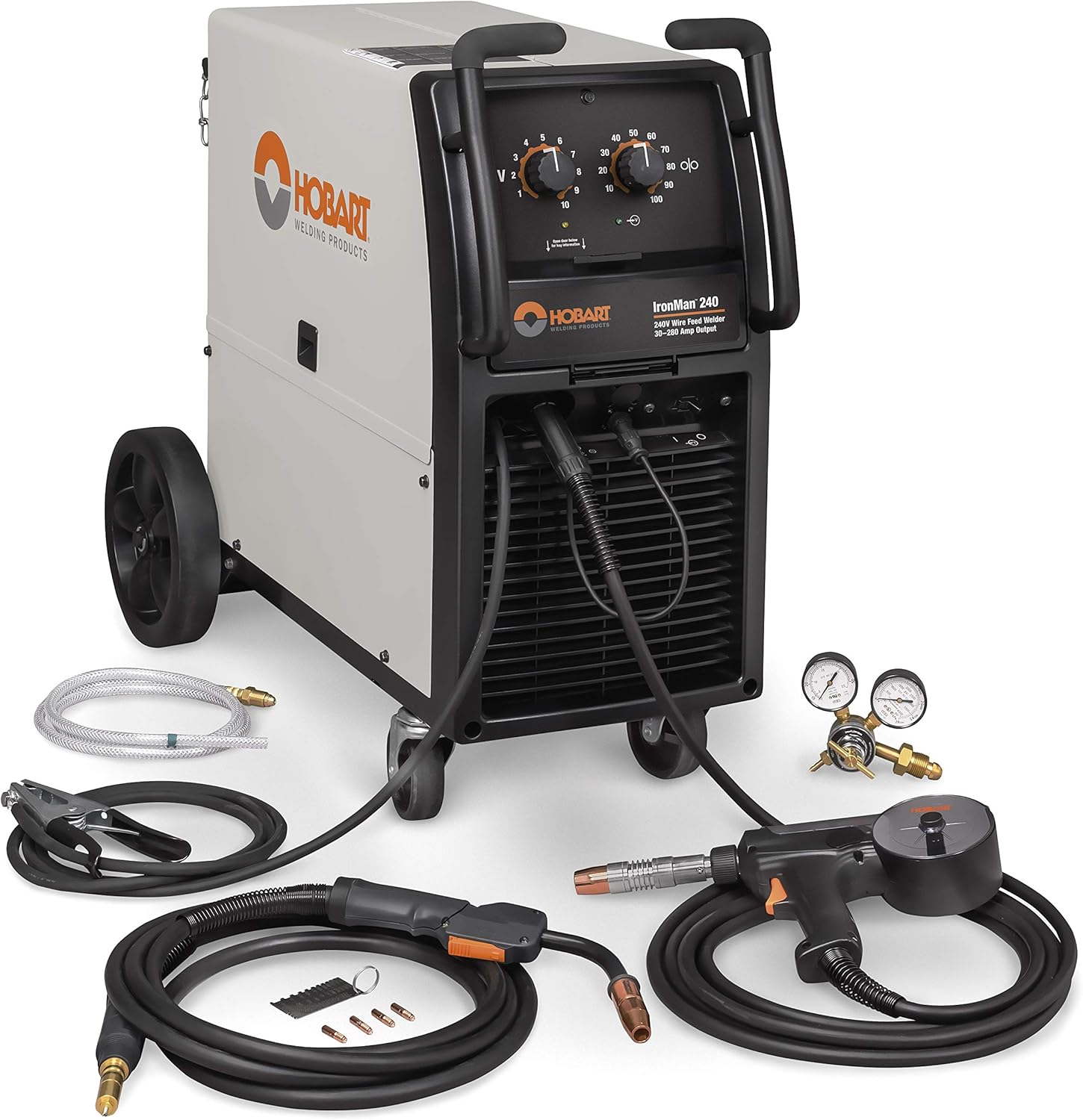 |
Best aluminum-ready bundle | 30-280 Amps | Up to 1/2 inch mild steel | 194.3 pounds | Hobart 5/3/1 |
| Hobart 500553 Handler 210 MVP MIG Welder |
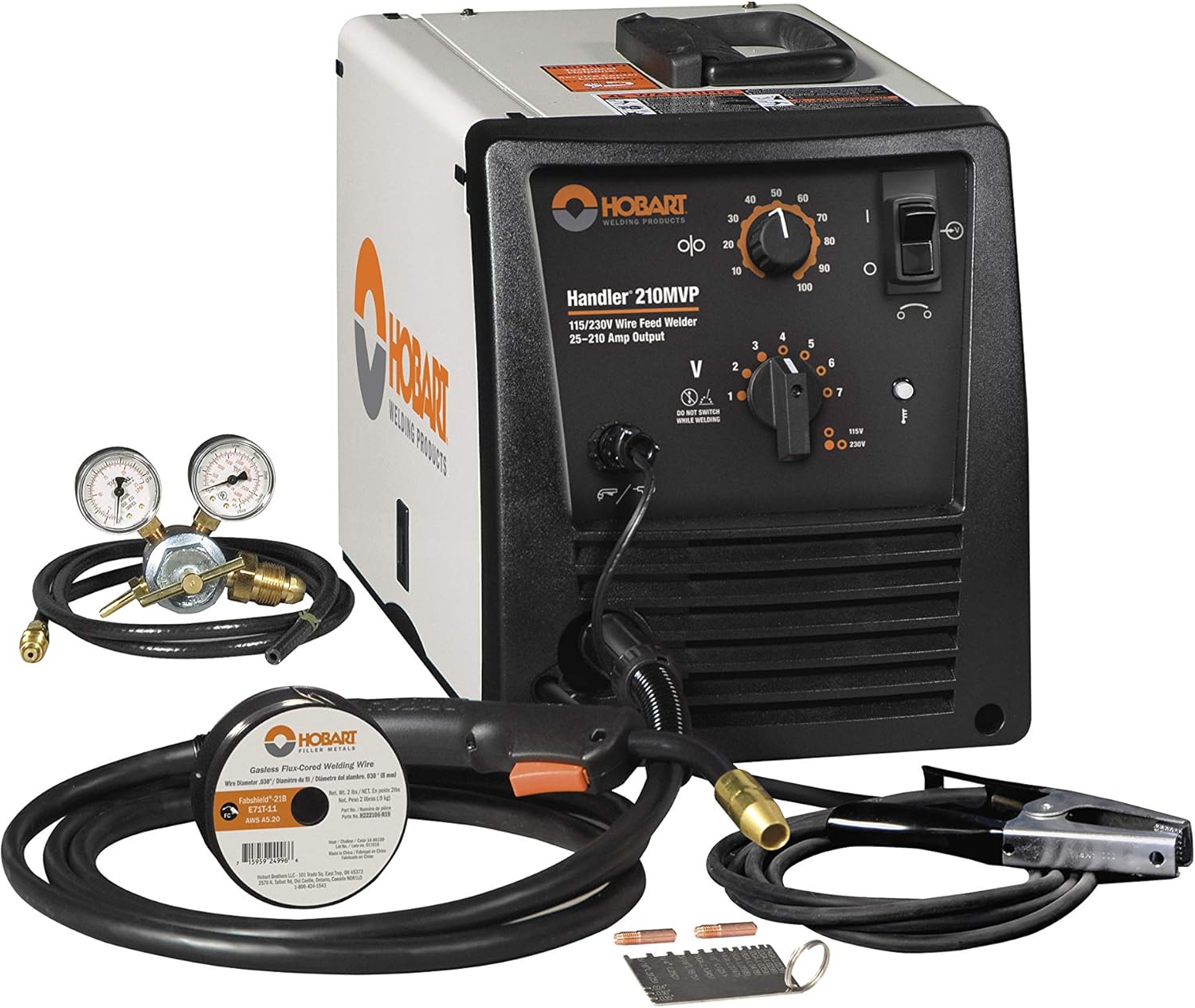 |
Best voltage flexibility | 210 Amps | 24 ga. to 3/8 inch steel | 79 pounds | 3 year limited warranty |
| Hobart 500554 Handler 190 MIG Welder 230V |
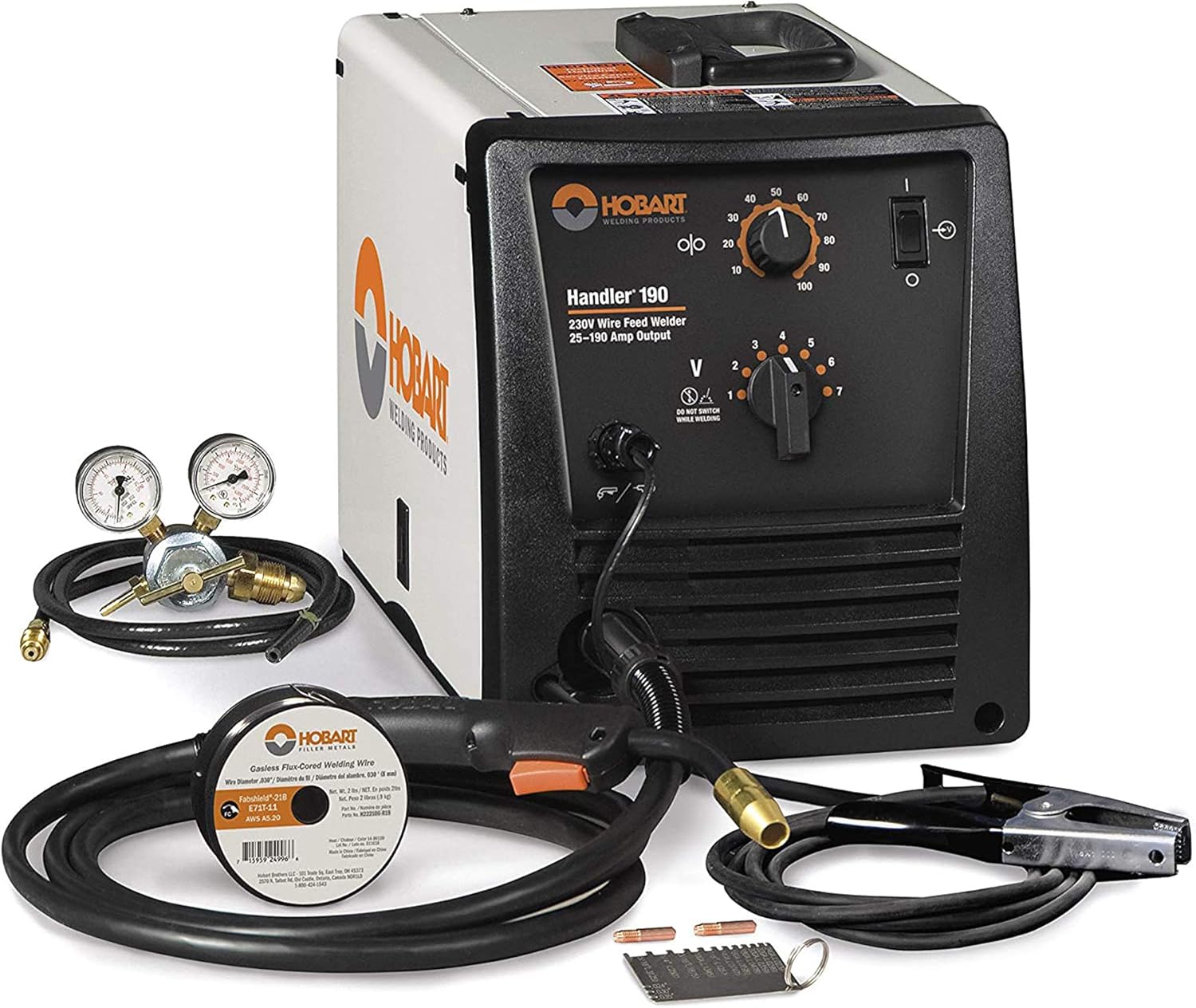 |
Best 230V value | 190 Amps | 24 ga. to 5/16 inch steel | 68 pounds | 5 year limited warranty |
| Hobart Handler 125 Wire Feed Welder Package |
 |
Best 120V starter | 120 Amps | Up to 3/16 inch mild steel | 58 pounds | 5 year limited warranty |