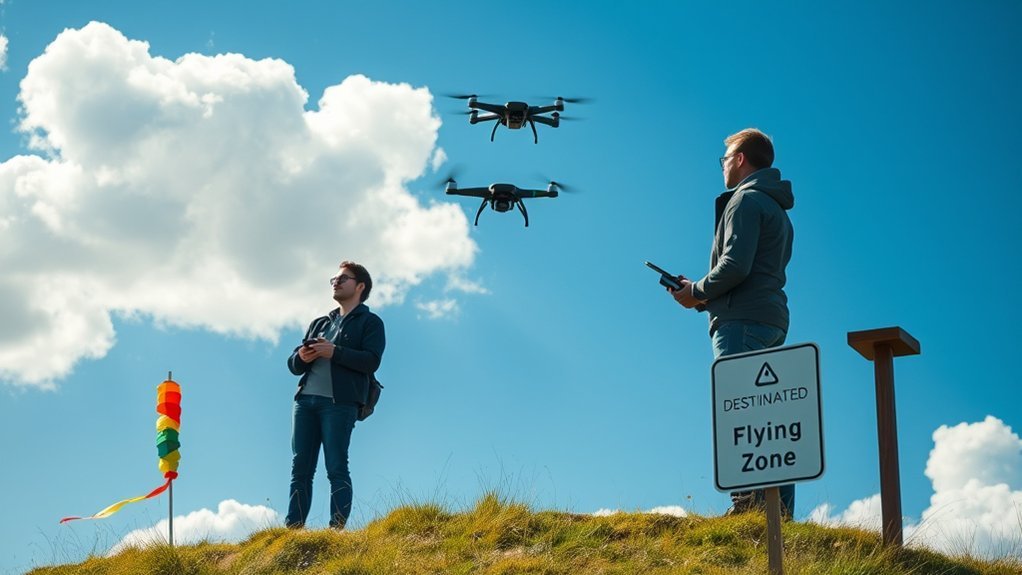
Visual Line of Sight (VLOS) means keeping your drone within a visual range that lets you understand where it is, how it is moving, and what hazards are around it throughout the flight. Under FAA Part 107, the remote pilot in command, visual observer if one is used, and person manipulating the controls must remain able to see the aircraft with unaided vision other than corrective lenses. The active visual-observation duty may be exercised by the pilot and control manipulator or by the visual observer.
Last updated: September 11, 2026
Quick Answer
Under FAA Part 107, the remote pilot in command, visual observer if one is used, and person manipulating the flight controls must remain able to see the drone throughout the flight with unaided vision other than corrective lenses. You must be able to determine the drone’s location, attitude, altitude, direction of flight, and nearby air traffic or hazards. The active visual-observation duty may be exercised by the pilot and control manipulator or by the visual observer.
Key Takeaways
- Part 107 requires the aircraft to remain within unaided visual capability throughout the flight; ordinary corrective lenses are allowed, but binoculars cannot be the means used to satisfy VLOS.
- The FAA does not set one fixed VLOS distance because visibility depends on drone size, lighting, weather, obstacles, background, and the pilot’s eyesight.
- A visual observer can perform the active observation duty under Part 107 when all applicable §107.31 and §107.33 requirements are met.
- Recreational operations use a different rule: if a visual observer is used under 49 U.S.C. §44809, the observer must be co-located with and in direct communication with the operator.
- As of September 11, 2026, proposed Part 108 BVLOS rules had not yet become effective final rules; routine Part 107 BVLOS operations generally still require an applicable FAA waiver or authorization.
At a Glance
| Rule Type | FAA Part 107 VLOS requirement for small UAS operations |
| Main Requirement | Keep the drone close enough to determine its location, attitude, altitude, direction, and surrounding air traffic or hazards |
| Visual Aids | Corrective lenses are allowed; binoculars, telescopes, cameras, or similar vision-enhancing devices cannot be the means used to meet VLOS |
| Best Practice | Fly in clear conditions, maintain a wide view of surrounding airspace, use a visual observer when appropriate, and bring the aircraft closer or land if compliant visual awareness becomes doubtful |
What Is Visual Line of Sight (VLOS)?

Visual Line of Sight (VLOS) is a critical requirement for drone pilots. Under FAA Part 107, the aircraft must remain within visual capability throughout the flight so the required crew members can understand its position, movement, and surrounding hazards.
Under FAA Part 107 §107.31, the remote pilot in command, visual observer if one is used, and person manipulating the flight controls must be able to see the aircraft throughout the entire flight using vision unaided by anything except corrective lenses. The rule requires enough visual awareness to know the drone’s location, attitude, altitude, and direction of flight, observe other air traffic or hazards, and determine that the aircraft does not endanger life or property.
Section 107.31 also distinguishes between being able to see the aircraft and who is actively exercising that visual-observation duty. During the flight, the required visual capability must be exercised either by the remote pilot in command together with the person manipulating the controls, or by the visual observer.
The rule allows normal corrective lenses, such as prescription glasses or contact lenses. It does not allow pilots to rely on binoculars, telescopes, camera zoom, or similar vision-enhancing devices as the means of satisfying VLOS.
Note: VLOS is more than seeing a tiny dot in the sky. You need enough visual awareness to understand what the drone is doing and to scan the surrounding airspace for hazards.
Typical VLOS Distance

Maintaining Visual Line of Sight (VLOS) means keeping your drone close enough that you can see it well enough to judge its position, attitude, movement, and surroundings. The usable distance varies with the aircraft, lighting, weather, background, terrain, and your own vision.
There is no single fixed maximum VLOS distance under FAA Part 107. The aircraft must remain within the visual capability required by §107.31 in the actual conditions of the flight.
The FAA does not specify one universal VLOS range because the same distance is not workable for every pilot or aircraft. A larger or more visible drone may be easier to track than a small gray aircraft against an overcast sky. Fog, haze, rain, glare, low light, trees, buildings, terrain, or visually complex backgrounds can reduce useful range quickly.
Use a practical test rather than a target distance. If you can no longer confidently determine which way the aircraft is facing, whether it is climbing or descending, where it is in relation to nearby hazards, or whether other aircraft are entering the operating area, reduce the distance immediately.
Role of Visual Observers

When operating a drone under Part 107, a visual observer can enhance safety and may exercise the active visual-observation duty when the operation complies with §§107.31 and 107.33.
Visual observers are especially useful during first-person view (FPV) operations. An FPV camera feed or headset does not, by itself, satisfy the VLOS requirement. The FAA’s current Part 107 guidance states that if FPV or similar technology is used, a visual observer must keep the drone within unaided sight.
Under Part 107 §107.33, the remote pilot in command, person manipulating the controls, and visual observer must maintain effective communication at all times. They must coordinate to scan the operating airspace for collision hazards and maintain awareness of the drone’s position through direct visual observation.
Part 107 §107.33 does not use the specific co-location language found in the recreational rule. That distinction matters because recreational operators using a visual observer are subject to a separate statutory requirement discussed below.
Pro Tip: Before takeoff, agree on simple phrases with your visual observer, such as “hold position,” “climb,” “descend,” “return,” and “land now.” Clear wording reduces delay when quick action matters.
Part 107 vs. Recreational VLOS: What Is Different?
U.S. drone pilots should first know which operating rules apply to their flight. Part 107 generally covers non-recreational small-UAS operations, while purely recreational flights may qualify for the statutory exception in 49 U.S.C. §44809.
For Part 107, §§107.31 and 107.33 govern VLOS and visual-observer use. The applicable crew members must remain able to see the aircraft as required by §107.31, and an observer must maintain effective communication with the pilot and control manipulator.
For recreational operations, FAA recreational-flyer guidance states that the aircraft must remain within the visual line of sight of the operator or a visual observer who is co-located and in direct communication with the operator.
Key distinction: Do not assume that every Part 107 visual-observer detail applies identically to a recreational flight. Check the rules governing the specific operation you are conducting.
Why Is Maintaining VLOS Important?

VLOS is designed to give a drone crew enough awareness to detect conflicts before they become emergencies. Simply spotting the drone is not enough; the pilot or observer performing the visual duty also needs to watch surrounding airspace and hazards.
In an FAA safety briefing updated in April 2026, the agency reported at least 17 confirmed or probable collisions between drones and airplanes, helicopters, or hot-air balloons since 2017. FAA investigations found that the drone pilots involved were not complying with Part 107 VLOS operating requirements, even when some believed they were.
The FAA also emphasizes the danger posed by low-flying aircraft, particularly helicopters. Trees, buildings, hills, power lines, towers, glare, smoke, haze, and other obstructions can reduce the time available to detect and avoid conflicting traffic.
The practical lesson is simple: choose an operating position that lets you see not just the drone but enough surrounding airspace to react to other aircraft or hazards in time.
[Amazon Products Picked for You]

[Fits All Drones] Strobe light compatible with DJI Neo 2/Avata 2/Flip/Mini 5 Pro/Mini 4 Pro/Mini 3/Mini 4K/Air 3S/Mavic Air 2/Air 2S/ Air 3S / Mavic 4 Pro / Mavic 3 / Phantom 3/4, compatible with Skyrover S1/ X1/ Antigravity A1/ Potensic ATOM 2/ Holystone HS720/720E/720G/HS440/RUKO F11S/ drones/remote-controlled quadcopters and multirotor accessories, etc.

ADVANCED GPS & SMART FLIGHT MODES – The Contixo F23 Drone Navigates with precision using built-in GPS features including Follow Me, Waypoint Flight, Orbit Mode, and Return to Home, hands-free control at any skill level, giving you total control and safety during every flight.

【Camera Drone】The mini drone with camera which is 1080p HD dual cameras and the front camera can be rotated 90°. Take pictures and videos whenever you want and share them on social media as soon as possible. Remote Control FPV Transmission, 50 X Zoom, Gesture Photo & Video, One-Click Sharing to Social Networks. There are numerous features to provide a fun photography experience.
Restrictions on Visual Aids

Devices such as binoculars or telescopes cannot be the means used to maintain VLOS under Part 107. Section 107.31 requires vision unaided by any device other than corrective lenses.
This matters because VLOS is not only about enlarging the appearance of the drone. You must also maintain awareness of surrounding airspace, traffic, obstacles, and hazards. A narrow magnified view can reduce that wider situational awareness.
Warning: A controller display, FPV feed, binoculars, or camera zoom does not replace the VLOS requirement. If compliant visual awareness cannot be maintained, bring the aircraft back into view or land safely.
Consequences of VLOS Violations
Failing to follow VLOS rules can create safety and regulatory consequences. The exact enforcement outcome depends on the circumstances of the operation and violation.
- Certificate Action: FAA enforcement can affect a remote pilot certificate when applicable.
- Civil Penalties: Monetary penalties may apply depending on the violation and surrounding circumstances.
- Civil Liability: A collision, injury, or property-damage event may create additional liability depending on the facts.
- Operational Setbacks: A poor compliance history can complicate future requests for advanced operating authority or waivers.
For Part 107 operations that need to go beyond the visual capability required by §107.31, the FAA’s current Part 107 waiver guidance identifies §107.31 as a regulation for which an applicable waiver may be required.
[Amazon Products Picked for You]

Pre-Printed with FAA Drone Pilot on the back.

✅【MATERIALS】DRONE PILOT vest MATERIALS: 100% polyester high visibility reflective material, lightweight and breathable, washable and durable.Black edging is not easy to dirty easier to match. Customers who prefer a looser fit should order 1-2 sizes larger. Please check the size chart before placing an order!

Observer vest MATERIALS: 100% polyester high visibility reflective material, lightweight and breathable, washable and durable.Black edging is not easy to dirty easier to match. Customers who prefer a looser fit should order 1-2 sizes larger. Please check the size chart before placing an order!
Tips for New Drone Pilots
As a new drone pilot, your goal is not only to memorize the rule but to build habits that keep the aircraft and surrounding airspace visible enough for safe decisions. Good VLOS begins before takeoff.
Essential Safety Practices
Plan your operating position and flight path so you can maintain the visual capability required for the operation.
- Know Your Limits: There is no fixed FAA distance; keep the aircraft close enough to meet the applicable VLOS requirements in the actual conditions.
- Check the Environment: Look for trees, buildings, poles, wires, hills, glare, smoke, haze, and other obstructions before launch.
- Scan Beyond the Drone: Watch the surrounding airspace for airplanes, helicopters, other drones, obstacles, and changing conditions.
- Use a Visual Observer When Appropriate: An observer can improve situational awareness when used in accordance with the rules governing your operation.
- Communicate Clearly: If a visual observer is involved, establish immediate and unambiguous communication before takeoff.
- Return Early: If visibility begins to fade, the aircraft blends into the background, or its orientation becomes uncertain, bring it closer before the situation becomes harder to recover.
Understanding Visual Limitations
Practical VLOS distance changes from one flight to another. Drone size, color, lighting, sky background, terrain, weather, sun angle, and your eyesight can all affect how well you can determine what the aircraft is doing.
Be especially careful around obstructions such as buildings, trees, hills, fences, signs, towers, and utility lines. They can block your view of the aircraft and can also prevent you from seeing low-flying crewed aircraft soon enough to react.
What to Do If You Lose VLOS
If compliant visual contact is lost, do not continue flying farther away. Focus on recovering the aircraft into a safe, compliant position as promptly as conditions allow.
- Stop Increasing the Distance: Avoid continuing farther away or making unnecessary aggressive control inputs.
- Use the Last Known Position: Look toward the aircraft’s last known location. Controller mapping or telemetry may help you reorient, but it does not replace the VLOS requirement.
- Coordinate With Your Observer: If an authorized visual observer is involved and has the required visual awareness, use clear directions to recover the aircraft safely.
- Return or Land Safely: Use an appropriate safe-return or landing procedure if reliable visual awareness cannot be promptly restored.
- Review the Cause: After landing, identify whether excessive distance, glare, weather, terrain, background, or another factor caused the loss of visual awareness before flying again.
Frequently Asked Questions
What is Visual Line of Sight (VLOS)?
Visual Line of Sight (VLOS) means keeping a drone within the visual capability required by the rules governing the flight. Under Part 107, the required crew members must be able to see the aircraft throughout the flight with vision unaided by anything except corrective lenses and be able to determine its location, attitude, altitude, direction, and surrounding hazards.
Can a VLOS pilot use binoculars?
Binoculars, telescopes, and similar vision-enhancing devices cannot be the means used to meet the Part 107 VLOS requirement. Corrective lenses such as ordinary prescription glasses or contact lenses are allowed.
Is there a fixed FAA VLOS distance?
No. The FAA does not set one fixed maximum VLOS distance for every Part 107 drone flight. Practical VLOS depends on the aircraft, lighting, weather, terrain, background, obstructions, and the crew’s ability to maintain the visual awareness required by §107.31.
Does FPV flying meet VLOS rules by itself?
No. An FPV camera feed or headset does not by itself satisfy Part 107 VLOS. FAA guidance states that when FPV or similar technology is used, a visual observer must keep the drone within unaided sight while the applicable Part 107 visual-observer requirements are followed.
Do recreational drone pilots follow the same visual-observer rule?
Not exactly. Recreational operations conducted under 49 U.S.C. §44809 must keep the drone within the visual line of sight of the operator or a visual observer who is co-located with and in direct communication with the operator. Part 107 uses its own requirements in §§107.31 and 107.33.
What is the FAA Part 108 BVLOS rule?
As of September 11, 2026, the FAA and TSA had proposed a framework commonly referred to as Part 108 for routine Beyond Visual Line of Sight operations, but the final rules had not yet been published and become effective. Current Part 107 operators still need to follow existing VLOS rules unless an applicable waiver or other FAA authorization permits the operation.
What is the FAA Beyond Visual Line of Sight rule?
Beyond Visual Line of Sight (BVLOS) describes operations that go beyond the visual capability required for ordinary VLOS operations. As of September 11, 2026, routine Part 107 BVLOS operations generally still required an applicable §107.31 waiver or other FAA authorization because the proposed Part 108 framework had not yet become an effective final rule.
Conclusion
Keeping a drone within visual line of sight means more than being able to spot it in the sky. Under Part 107, you need the visual capability required to understand the aircraft’s location and movement while also watching the surrounding airspace for traffic and hazards. Use conservative distances, choose operating positions with a clear view, understand the different rules for Part 107 and recreational flights, and bring the aircraft closer or land whenever reliable visual awareness becomes doubtful.
Sources
- 14 CFR §107.31 — FAA visual line of sight aircraft operation requirement.
- 14 CFR §107.33 — FAA visual observer requirements for small UAS operations.
- FAA Part 107 Regulations — current FAA operating guidance, including VLOS and FPV.
- FAA Recreational Flyers — recreational VLOS and co-located visual-observer guidance.
- FAA: There’s More to VLOS Than Meets the Eye — 2026 FAA safety discussion and collision evidence.
- FAA Part 107 Waivers — current waiver guidance for operations including BVLOS.
- Federal Register BVLOS NPRM — proposed framework for normalizing unmanned aircraft systems beyond visual line of sight operations.
- Federal Register, September 4, 2026 — notice confirming FAA and TSA BVLOS final rules were still forthcoming.
