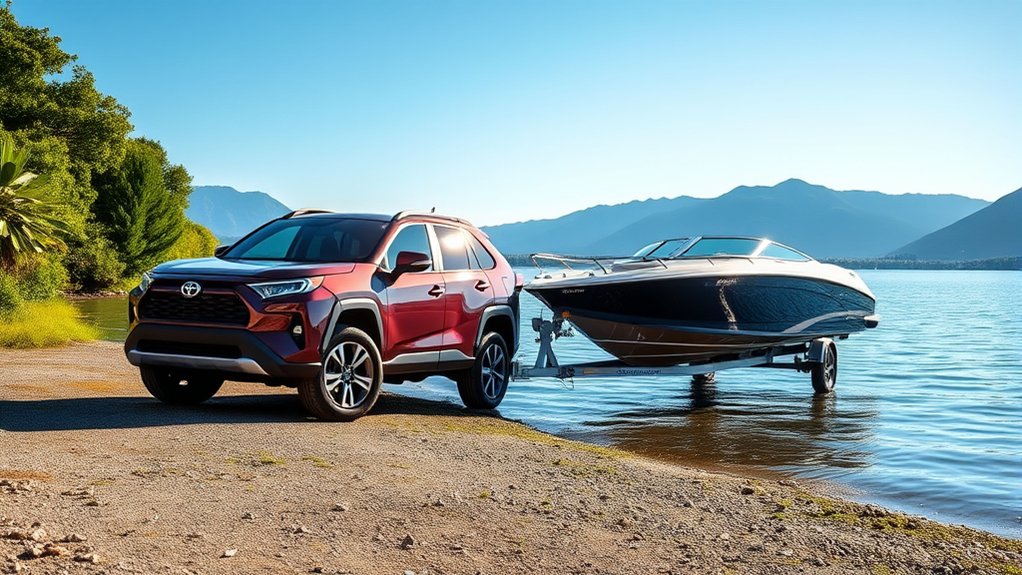
Yes, a Toyota RAV4 can tow many small boats, but the safe answer depends on the complete loaded boat-and-trailer weight and the rating for your exact model year, trim, drivetrain, and market. For U.S.-market 2026 RAV4 models, Toyota publishes a 1,750-pound towing capacity for front-wheel-drive models and the LE AWD, while specified AWD grades are rated up to 3,500 pounds. Earlier RAV4 gas, Hybrid, and Plug-in Hybrid models use different limits.
Last updated: September 19, 2026. Reviewed against current Toyota U.S. RAV4 model information and Toyota towing guidance.
Quick Answer
A Toyota RAV4 can tow a small boat when the complete loaded trailer stays within the exact vehicle’s limits. For U.S.-market 2026 models, Toyota lists 1,750 pounds for FWD models and the LE AWD, while specified AWD grades are rated up to 3,500 pounds. Do not compare the tow rating with boat dry weight alone—include the trailer, motor, fuel, batteries, water, gear, and accessories.
Key Takeaways
- Use the towing rating for your exact model year, trim, drivetrain, and country. Do not rely on a general RAV4 figure.
- Count the trailer, boat, motor, batteries, fuel, water, safety equipment, fishing gear, and all other cargo.
- Tongue weight presses on the RAV4 and reduces the payload available for passengers and cargo.
- Selected 2026 AWD RAV4 grades can tow up to 3,500 pounds, while other configurations have lower limits.
- Use only approved towing equipment and follow the Toyota owner’s manual, trailer instructions, and local brake laws.
How Much Can a Toyota RAV4 Tow for a Boat?
Toyota RAV4 towing capacity is not one fixed number. The rating changes with the model year, powertrain, drivetrain, trim, equipment, and sales market. For boat towing, use the rating for the exact vehicle and compare it with the trailer’s measured ready-to-launch weight.
The sixth-generation 2026 RAV4 changes the comparison significantly. Toyota’s U.S. launch information states that FWD models and the LE AWD are rated at 1,750 pounds, while specified AWD grades can tow up to 3,500 pounds. Toyota’s later grade information explicitly lists 3,500 pounds for XLE Premium AWD, Woodland, and SE AWD configurations. Other 2026 AWD grades must still be matched to the exact vehicle documentation before towing.
| Model year and configuration | Published maximum | Important context |
|---|---|---|
| 2026 RAV4 FWD models | 1,750 lb | Toyota’s U.S. launch information assigns this rating to 2026 front-wheel-drive models. |
| 2026 RAV4 LE AWD | 1,750 lb | Do not assume AWD alone means a 3,500-pound rating. |
| 2026 RAV4 XLE Premium AWD | 3,500 lb | Toyota explicitly lists 3,500 pounds for this AWD configuration. |
| 2026 RAV4 Woodland AWD | 3,500 lb | Toyota lists a standard 2-inch rear tow hitch receiver and wiring harness for Woodland. |
| 2026 RAV4 SE AWD | 3,500 lb | Toyota identifies the 3,500-pound rating for AWD. |
| 2026 RAV4 XSE AWD and Limited AWD | Up to 3,500 lb | Toyota’s 2026 launch announcement includes these AWD grades in the 3,500-pound group. Confirm the exact powertrain and final vehicle documentation. |
| 2025 RAV4 gas models | Up to 1,500 lb | Applies to specified fifth-generation gas configurations. Adventure and TRD Off-Road were not offered for model year 2025. |
| 2025 RAV4 Hybrid | Up to 1,750 lb | Verify the rating and equipment instructions in the applicable manual. |
| 2025 RAV4 Plug-in Hybrid | Up to 2,500 lb | This fifth-generation PHEV figure should not be applied automatically to a 2026 model. |
| Selected earlier Adventure and TRD Off-Road models | Up to 3,500 lb | Availability and ratings depend on the specific earlier model year. Confirm them in that vehicle’s manual. |
Note: These are U.S.-market maximum published figures, not recommended target weights. Check the Toyota owner’s manual for your exact vehicle before choosing a trailer or buying towing equipment.
Can a Toyota RAV4 Tow a Boat? Weight Limits Explained
A RAV4 can tow a boat only when the complete loaded trailer remains within every applicable vehicle and equipment limit. Comparing the RAV4’s rating with the boat’s advertised dry weight is not enough.
Your loaded trailer weight should include:
- The empty boat trailer
- The boat and installed motor
- Fuel in the boat’s tank
- Marine batteries
- Water stored on board
- Anchors, lines, life jackets, tools, and safety equipment
- Fishing tackle, coolers, food, and personal gear
- Any spare tire or accessories attached to the trailer
For example, a boat advertised at 1,050 pounds may sit on a 350-pound trailer and carry a motor, battery, fuel, and equipment. The ready-to-launch combination can therefore weigh much more than the boat’s brochure figure.
Boat-and-trailer weight check: Loaded trailer weight = trailer + boat + motor + fuel + batteries + water + safety gear + personal gear + attached accessories. Your remaining trailer-weight margin is the exact RAV4’s verified trailer-weight rating minus the measured loaded trailer weight. You must still check tongue weight, payload, axle ratings, hitch ratings, and brake requirements separately.
The number that matters is the actual loaded trailer weight at the hitch, not the boat’s empty or advertised weight.
Tongue Weight, Payload, and Combined Limits
Tongue weight is the downward force the trailer places on the hitch. It counts as weight carried by the RAV4, so it uses part of the vehicle’s payload capacity.
Passengers, luggage, roof cargo, accessories, and tongue weight must remain within the payload and gross vehicle weight limits shown in the manual and on the vehicle labels. A trailer can be under the maximum towing figure while the RAV4 itself is overloaded.
You must also respect the ratings of the receiver, ball mount, hitch ball, coupler, trailer axle, tires, and other equipment. The lowest applicable rating controls the setup.
Do Trailer Brakes Change the RAV4 Towing Limit?
They can. Toyota trailer-towing instructions distinguish the normal trailer weight rating from an unbraked trailer weight rating. If the loaded trailer exceeds the unbraked limit for your exact RAV4, trailer service brakes are required, and state or provincial law may impose additional requirements. Do not assume the full published towing capacity applies to a trailer without its own brakes.
Warning: Never use the maximum towing number by itself to approve a combination. Confirm loaded trailer weight, tongue weight, vehicle payload, axle limits, hitch ratings, and all instructions in the exact Toyota owner’s manual.
Which RAV4 Configurations Give a Boat Trailer the Most Towing Margin?
For a boat trailer, the most useful RAV4 is the configuration with enough verified capacity for the measured loaded trailer while still keeping the vehicle within payload, axle, hitch, and tongue-weight limits. A higher tow rating gives more room for fuel, batteries, safety gear, coolers, and other trip-to-trip weight changes.
Best Current RAV4 for Heavier Small-Boat Trailers
Among the 2026 configurations Toyota has described, selected AWD grades with a 3,500-pound rating provide the greatest towing flexibility. The 2026 Woodland is especially towing-focused because Toyota lists a 2-inch rear receiver and wiring harness as standard equipment.
You can review the published grade information in Toyota’s 2026 RAV4 model announcement. Confirm final specifications for the vehicle you are buying because equipment can vary by grade, powertrain, production date, and market.
Best RAV4 for a Very Light Boat
A lower-rated RAV4 may be suitable for a lightweight jon boat, utility boat, personal watercraft, canoe trailer, or similar setup when its measured loaded weight remains comfortably below the vehicle’s rating.
Do not choose by boat style alone. Two boats with similar lengths can have very different hull materials, motors, trailers, fuel loads, and equipment weights.
Best Used RAV4 for Towing
Some earlier Adventure and TRD Off-Road models carried ratings as high as 3,500 pounds. The 2025 Adventure and TRD Off-Road should not be listed as options, however, because Toyota did not offer those gas grades for model year 2025.
When shopping for a used RAV4, verify the vehicle identification details, drivetrain, trim, factory equipment, owner’s manual, hitch condition, maintenance history, and any aftermarket modifications.
What Types of Boats Can a RAV4 Tow?
Depending on the RAV4’s verified rating, possible matches may include:
- Kayaks or canoes carried on a small purpose-built trailer
- Personal watercraft on a lightweight trailer
- Small aluminum fishing or utility boats
- Lightweight inflatable boats with a compact trailer
- Some small fiberglass fishing boats
- Some lightweight skiffs or micro-boats
This list does not guarantee compatibility. A large outboard, extra batteries, a heavy steel trailer, fuel, fishing equipment, or a full cooler can change the result significantly.
Larger bowriders, cabin boats, wake boats, offshore fishing boats, and heavily equipped pontoon boats commonly require more towing capacity than many RAV4 configurations provide. Compare actual scale weights rather than relying on boat length or a seller’s estimate.
How to Match Your Boat and Trailer to the RAV4
- Identify the exact RAV4. Record the model year, trim, drivetrain, powertrain, and market.
- Read the towing section of its manual. Note the maximum trailer weight, loading instructions, equipment requirements, and any restrictions.
- Find the trailer’s ratings. Check its certification plate for gross vehicle weight rating, axle rating, and tire information.
- Calculate an initial loaded estimate. Add the trailer, boat, motor, fuel, batteries, water, and every item carried on or in the boat.
- Measure the completed setup. Use a suitable public scale or professional weighing service after loading the trailer as it will travel.
- Check the RAV4’s loaded weight. Include passengers, luggage, accessories, roof cargo, and trailer tongue weight.
- Compare every rating. Stay within the RAV4, hitch, ball, coupler, trailer, axle, and tire limits.
Pro Tip: Weigh the combination with the boat fueled and packed for a normal trip. An empty-trailer measurement can hide the weight of batteries, anchors, coolers, safety equipment, and fishing gear.
Hitch and Towing Equipment Requirements
A safe setup normally requires more than a receiver attached to the vehicle. The exact parts depend on the RAV4, trailer, and local rules.
- A receiver approved for the specific RAV4 and its published towing use
- A correctly rated ball mount and hitch ball
- A coupler that matches the hitch-ball size
- Crossed safety chains or cables attached to approved points
- A working trailer-light connector
- Trailer brakes and a compatible control system when required
- A breakaway system when required for the trailer
- Mirrors that provide the legally required rearward view
Do not assume that an accessory or activity mount is approved for trailer towing. For example, Toyota described the 2025 Hybrid Woodland’s 1¼-inch mount as an activity mount intended for equipment such as a bike rack. A towing receiver must be explicitly rated for the proposed trailer use.
Do not add a weight-distributing hitch merely because the trailer feels unstable. Use only hitch equipment permitted by Toyota and by the manufacturers of the receiver and trailer. Instability can result from overloading, low or excessive tongue weight, poor load placement, worn tires, excessive speed, or incorrect equipment.
How to Tow Safely and Effectively With Your RAV4
Complete a full inspection before every launch trip, especially when the trailer has been parked for an extended period.
Pre-Tow Inspection
- Confirm that the coupler is fully seated and locked on the correct hitch ball.
- Attach the safety chains without letting them drag on the road.
- Connect the wiring and test brake lights, turn signals, and running lights.
- Check the trailer-brake and breakaway systems when equipped.
- Set the RAV4 and trailer tire pressures according to their labels or manuals.
- Inspect trailer tires for age, cracks, damage, and unusual wear.
- Check wheel bearings, lug nuts, suspension parts, and visible fasteners.
- Secure the bow eye, winch strap, transom tie-downs, motor, and loose equipment.
- Verify that the jack, stabilizers, and steps are raised and secured.
- Confirm that the load has not changed since it was weighed.
Driving With a Boat Trailer
Accelerate smoothly and leave more space for braking. A trailer adds weight, length, and another axle that can react to bumps, crosswinds, steering inputs, and passing trucks.
Reduce speed before curves and downhill sections. Avoid abrupt steering, hard acceleration, and sudden lane changes. If the trailer begins to sway, remain calm, ease off the accelerator, keep the vehicle pointed straight, and avoid sharp steering corrections. Follow the instructions supplied with your vehicle and trailer-brake system.
Plan fuel, charging, parking, and turning space before the trip. Towing increases energy demand, so fuel economy or electric range will normally decline. The amount depends on speed, wind, terrain, trailer shape, traffic, temperature, and total weight.
Electronic traction or stability systems may help the driver maintain control, but they do not increase the RAV4’s published towing, payload, axle, hitch, or tire ratings.
Boat Ramp and Steep-Ramp Safety
Launching and retrieving a boat can be more demanding than normal road towing. A wet, sandy, muddy, algae-covered, or damaged ramp can reduce traction even when the RAV4 has all-wheel drive.
- Inspect the ramp surface, slope, water depth, and turnaround space before backing down.
- Prepare the boat away from the ramp so you do not block other users.
- Back slowly and keep the vehicle and trailer as straight as practical.
- Keep unnecessary passengers away from the vehicle’s path and the waterline.
- Use the parking brake and follow the transmission and launch procedures in the manual.
- Do not submerge the RAV4, its exhaust, electrical parts, or wheel hubs beyond safe limits.
- Avoid spinning the tires because it can reduce control and damage the ramp surface.
- Stop if the vehicle cannot retrieve the boat without excessive wheelspin, overheating, warning lights, or loss of control.
AWD may improve low-speed traction, but it cannot correct an overloaded trailer, worn tires, poor load balance, or an unsafe ramp. A lighter trailer or a more capable tow vehicle may be the safer choice for steep or slippery launches.
Comparing Towing Capacities Across RAV4 Trims
The main lesson from comparing RAV4 trims is that the badge alone does not establish towing capacity. “RAV4,” “Hybrid,” “PHEV,” or “AWD” can describe vehicles with different ratings across model years.
For 2025, gas models were rated lower than the Plug-in Hybrid, while selected earlier Adventure and TRD Off-Road trims reached 3,500 pounds. Toyota then changed the picture for 2026 by introducing a new electrified generation and assigning 3,500-pound ratings to several selected AWD configurations.
The most reliable process is:
- Start with the model year.
- Identify the exact trim, drivetrain, and powertrain.
- Confirm the rating in Toyota’s official material and owner’s manual.
- Compare it with the measured loaded trailer weight.
- Check payload, tongue weight, axle, hitch, and equipment limits separately.
A higher-capacity trim provides more flexibility, but it does not turn the RAV4 into a full-size tow vehicle. Braking distance, stability, payload, cooling demands, and ramp conditions still require careful planning.
What Changes When You Tow a Boat With a RAV4?
Individual experiences vary because boat trailers differ in weight, aerodynamics, tongue load, brake equipment, and maintenance. Route conditions, wind, hills, speed, and driver technique also change how a RAV4 feels while towing.
What to Expect on the Road
With a properly matched lightweight trailer, a driver can expect slower acceleration, longer stopping distances, wider turns, and reduced fuel economy or electric range. The RAV4 may feel stable on level roads while working noticeably harder on steep grades or into strong headwinds.
A trailer close to the vehicle’s maximum rating leaves less room for extra equipment and weight variation. Fuel, batteries, coolers, anchors, and water can push a combination beyond an estimate that originally appeared acceptable.
Common Towing Challenges
- Trailer sway: Often worsened by excessive speed, poor load placement, incorrect tongue weight, worn tires, or wind.
- Payload limits: Passengers, cargo, accessories, and tongue weight can overload the RAV4 before the trailer reaches its maximum rating.
- Longer braking: The combination needs more distance to slow or stop.
- Ramp traction: Water, algae, sand, and steep grades can make retrieval difficult.
- Reduced efficiency: Added weight and aerodynamic drag increase energy use.
- Equipment mismatch: An incorrect ball size, underrated receiver, faulty wiring, or unsuitable brake setup can make an otherwise light trailer unsafe.
Careful weighing, regular maintenance, conservative driving, and a meaningful margin below all applicable limits provide a better foundation than relying on a model badge or another owner’s experience.
Related Guides
Frequently Asked Questions
What types of boats can a Toyota RAV4 tow?
A correctly equipped RAV4 may tow a lightweight personal-watercraft trailer, small aluminum fishing boat, compact skiff, inflatable boat, kayak trailer, or similar setup. Compatibility depends on the complete loaded trailer weight, tongue weight, vehicle payload, equipment ratings, and exact RAV4 configuration rather than boat length alone.
Do I need a special hitch to tow with a RAV4?
You need a receiver, ball mount, hitch ball, wiring, chains, and any brake equipment that are approved and correctly rated for the exact RAV4 and trailer. Do not assume an activity mount or bicycle-rack receiver is approved for towing. Follow Toyota’s manual and the equipment manufacturers’ instructions.
Can a RAV4 handle a steep boat ramp while towing?
Some properly loaded AWD RAV4 configurations can manage suitable ramps, but slope, algae, water, sand, tire condition, weather, and trailer weight affect traction. AWD does not raise the towing rating or guarantee retrieval. Stop if the vehicle loses traction, overheats, or cannot move the trailer under control.
How does towing affect RAV4 fuel economy or electric range?
Towing normally increases fuel or electrical consumption because the vehicle must move more weight and overcome additional aerodynamic drag. Speed, terrain, wind, temperature, trailer shape, traffic, and total weight determine the size of the reduction.
Is towing covered under the Toyota RAV4 warranty?
Towing does not automatically cancel the RAV4’s warranty. Coverage depends on the failed part, the cause, maintenance, equipment installation, and the terms in the applicable Warranty and Maintenance Guide. Damage caused by overloading, misuse, unapproved equipment, or improper installation may not be covered.
How do I find my exact RAV4 towing capacity?
Identify the model year, trim, drivetrain, powertrain, and sales market, then read the trailer-towing section of that vehicle’s Toyota owner’s manual. Also inspect the driver-door labels and verify the receiver and trailer ratings. A dealership can help identify the configuration, but the official documents and vehicle labels should control your calculation.
Can a RAV4 tow a 2,000-pound boat and trailer?
Only a RAV4 configuration with a verified trailer-weight rating above the complete loaded trailer weight should be considered. A 2,000-pound loaded trailer exceeds 1,500- and 1,750-pound RAV4 ratings, so it requires a higher-rated configuration and must still pass payload, tongue-weight, axle, hitch, brake, and equipment checks.
Does AWD automatically mean a RAV4 can tow 3,500 pounds?
No. AWD alone does not establish the towing capacity. For example, Toyota lists the 2026 RAV4 LE AWD at 1,750 pounds while specified 2026 AWD grades are rated up to 3,500 pounds. Always match the rating to the exact model year, grade, powertrain, and vehicle documentation.
Conclusion
A Toyota RAV4 can tow a small boat when the exact vehicle, hitch, and trailer are correctly matched. For U.S.-market 2026 models, published ratings range from 1,750 pounds for FWD models and the LE AWD to as much as 3,500 pounds for specified AWD grades.
Before towing, confirm the exact RAV4 manual, weigh the boat and trailer in ready-to-launch condition, account for tongue weight and payload, and verify every hitch and trailer component. If the measured setup exceeds any vehicle, hitch, axle, tire, brake, or trailer limit—or the ramp cannot be used without excessive wheelspin or loss of control—use a lighter setup or a more capable tow vehicle.
Sources
- Toyota USA Newsroom: 2026 RAV4 model information — supports current grade, drivetrain, receiver, and towing-capacity information.
- Toyota USA Newsroom: All-new 2026 RAV4 debut — supports the 2026 U.S. 1,750-pound and 3,500-pound towing-capacity groups.
- Toyota USA Newsroom: 2025 Toyota RAV4 — supports the 2025 lineup, powertrain choices, AWD systems, and removal of Adventure and TRD Off-Road for that model year.
- Toyota USA Newsroom: 2025 RAV4 Plug-in Hybrid — supports the PHEV naming, trims, drivetrain, and powertrain information.
- Toyota Manuals and Warranties — provides model-specific owner’s manuals, trailer-towing instructions, and applicable warranty information.
- National Highway Traffic Safety Administration: Towing a Trailer — provides federal trailer-loading, hitching, inspection, and driving-safety guidance.

