
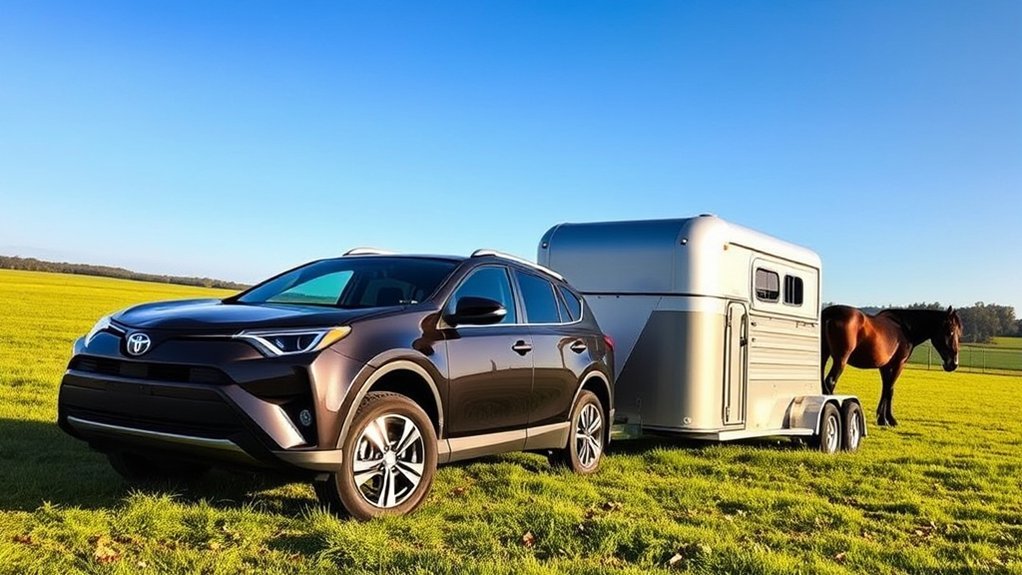
A Toyota RAV4 can pull a horse trailer only in limited cases. For U.S.-spec 2026 RAV4s, Toyota lists a 1,750-pound towing capacity for front-wheel-drive versions and the LE AWD, while selected AWD grades are rated up to 3,500 pounds. The 2025 gas, Hybrid, and Plug-in Hybrid models were rated at 1,500, 1,750, and 2,500 pounds respectively. Because even a small one- or two-horse trailer commonly weighs thousands of pounds before the horse and gear are added, the trailer’s actual loaded weight must be compared with every limit for your exact RAV4.
Last updated: September 19, 2026. This update rechecked current U.S. Toyota RAV4 towing ratings, clarified which 2026 configurations receive the 1,750- and 3,500-pound ratings, and added source-backed horse-trailer weight examples.
Quick Answer
Sometimes. A RAV4 can tow a horse trailer only when the exact vehicle, hitch, and fully loaded trailer remain within every applicable rating. For 2026, Toyota lists 1,750 pounds for FWD models and the LE AWD, while selected AWD grades reach 3,500 pounds. Many conventional horse-trailer combinations exceed even 3,500 pounds after the horse, tack, feed, water, and equipment are loaded.
Key Takeaways
- The 2026 U.S. RAV4 is not universally rated for 3,500 pounds: FWD versions and the LE AWD are rated at 1,750 pounds, while selected AWD grades reach 3,500 pounds.
- The 2025 gas, Hybrid, and Plug-in Hybrid versions were rated at 1,500, 1,750, and 2,500 pounds respectively.
- Toyota did not offer the gas-powered Adventure or TRD Off-Road grades for model year 2025, so an older 3,500-pound Adventure/TRD rating does not apply to a 2025 RAV4.
- Compare the RAV4’s limits with the trailer’s actual loaded weight, not its advertised empty or dry weight.
- Tongue weight, passengers, cargo, accessories, and hitch equipment can consume the RAV4’s available load capacity.
- When a loaded horse-trailer combination approaches any vehicle, axle, hitch, tire, or combined-weight limit, use a tow vehicle with more manufacturer-approved capacity and reserve.
Scope: This guide focuses on U.S.-spec RAV4s. Towing ratings can differ by country, model year, powertrain, drivetrain, and grade. For another market, use the Toyota manual and certification information supplied for that vehicle.
Can a Toyota RAV4 Pull a Horse Trailer?
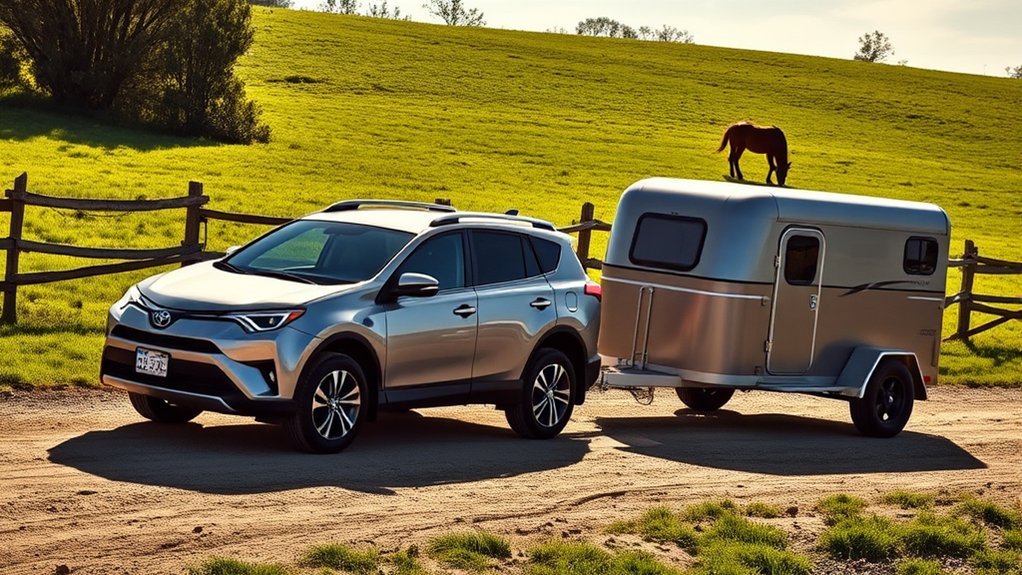
Yes, but only a small subset of horse-trailer combinations can fit within a RAV4’s ratings. Toyota’s current 2026 information lists 1,750 pounds of towing capacity for FWD configurations and the LE AWD. Selected AWD Hybrid and Plug-in Hybrid grades are rated at 3,500 pounds. Toyota also discontinued gas-only powertrains for the 2026 U.S. RAV4.
Toyota’s current grade information identifies 3,500-pound ratings for configurations including XLE Premium AWD, Woodland AWD, SE AWD, XSE AWD, and Limited AWD, plus specified AWD Plug-in Hybrid grades. Check Toyota’s 2026 RAV4 model information and the exact owner’s manual before towing because the maximum is configuration-specific.
These are maximum manufacturer ratings, not target weights. Your usable limit can also be constrained by payload, axle ratings, combined-weight limits, tongue weight, hitch hardware, tires, trailer equipment, or another lower-rated component.
| U.S. RAV4 model year/version | Maximum trailer weight | Horse-trailer takeaway |
|---|---|---|
| 2026 RAV4 FWD models and LE AWD | 1,750 lb | Below the empty weight of many conventional one- and two-horse trailers. |
| Selected 2026 AWD grades | Up to 3,500 lb | A very light one-horse combination may fit on paper, but only after the fully loaded trailer, tongue load, vehicle load, and every component rating are verified. |
| 2025 gas RAV4 | 1,500 lb | Normally too low for a loaded conventional horse trailer. |
| 2025 RAV4 Hybrid | 1,750 lb | Still below the empty weight of many conventional horse trailers. |
| 2025 RAV4 Plug-in Hybrid | 2,500 lb | Higher than other 2025 versions, but many trailers exceed this before or soon after a horse is loaded. |
| 2012 RAV4 V6 with Toyota towing package | 3,500 lb | An example of why older RAV4s must be checked individually; do not infer an older rating from a newer model or vice versa. |
Warning: Do not assign the 2026 3,500-pound maximum to every RAV4. A receiver hitch, brake controller, suspension aid, transmission cooler, or other accessory cannot raise Toyota’s published trailer, payload, axle, or combined-weight limits. The lowest applicable limit for the vehicle and towing equipment controls the setup.
Toyota’s official 2025 model information confirms that the gas-powered Adventure and TRD Off-Road grades were not offered that year. It also shows that the 2025 Hybrid lineup used standard electronic AWD, while the gas lineup offered front-wheel-drive and all-wheel-drive configurations. Check the official 2025 RAV4 model overview before applying a trim-specific number from a different model year.
Older RAV4 ratings also vary. Toyota stated that the 2012 V6 with its optional towing package could tow up to 3,500 pounds. That does not make every third-generation RAV4 a 3,500-pound tow vehicle; engine, equipment, and the exact manual still control. For a broader year-and-trim reference, see the Toyota RAV4 towing-capacity guide.
[Amazon Products Picked for You]

★ 1.Horse HITCH COVER - - Made of durable black rubber. Our hitch plug is designed to fit tightly and and durable, without deformation and falling off easily;
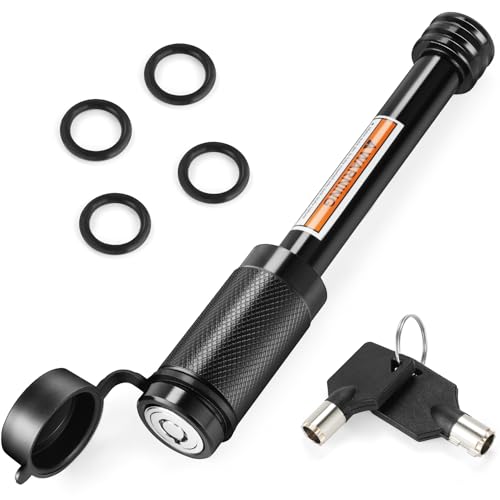
NIVERSAL COMPATIBILITY:The trailer hitch lock is designed with a 5/8"diameter hitch pin and a length of 3-1/2"of effective pin length,fits most class III IV 2" and 2-1/2" hitch receivers for towing, trailer, boat, RVs, truck, car and tractors
What Towing Numbers Must You Check?
Trailer weight is only one part of the calculation. A RAV4 and horse trailer are compatible only when the complete loaded combination stays within every applicable vehicle and equipment rating.
- TWR or towing capacity: The maximum permitted gross trailer weight under the manufacturer’s stated conditions.
- Payload or load-carrying capacity: The weight available for occupants, cargo, accessories, and loads transferred to the vehicle through the hitch.
- GVWR: The maximum permitted loaded weight of the RAV4 itself.
- GAWR: The maximum load permitted on each vehicle axle. A setup can exceed the rear-axle rating before reaching another published maximum.
- GCWR: The maximum combined weight of the loaded tow vehicle and loaded trailer when Toyota specifies one.
- Tongue weight: The downward load the trailer places on the hitch. It also consumes vehicle load capacity.
- Component ratings: The receiver, ball mount, hitch ball, coupler, tires, wheels, safety equipment, and trailer each have limits that cannot be exceeded.
For a current vehicle, start with Toyota’s 2026 RAV4 owner’s-manual page. Owners of the previous generation should use the 2025 manual page. Match the manual to the exact powertrain and market, then check the driver-door certification label, tire-information label, hitch rating, and towing-equipment instructions.
Do not compare the tow rating with the trailer’s empty weight alone. The number that matters on the road is the trailer’s actual loaded weight, including the horse, tack, feed, water, bedding, spare tire, equipment, and anything carried in a tack or dressing compartment.
The number that matters is the trailer’s actual loaded weight, not its brochure dry weight.
How Much Does a Horse Trailer Weigh Once Loaded?
Horse trailers vary widely, so there is no safe universal estimate. As a planning reference, CURT states that a small trailer designed for one or two horses typically weighs about 2,300 to 3,900 pounds before horses and cargo are added. That range alone exceeds the 1,500-pound 2025 gas rating and the 1,750-pound ratings used by the 2025 Hybrid and lower-rated 2026 configurations.
Purdue Extension illustrates how quickly the total can climb: its example uses a 3,500-pound empty trailer, two 1,250-pound horses, and 500 pounds of show gear, feed, and water. The resulting loaded trailer weighs 6,500 pounds. The example is not a universal horse-trailer weight, but it demonstrates why actual scale measurements matter.
Use the trailer’s identification plate as a starting point, then obtain a loaded scale weight with the horse and normal travel supplies aboard. An unusually light single-horse trailer may weigh less than the typical range above, but its compatibility still must be proved with its real loaded weight and the exact RAV4 ratings.
Can a RAV4 Hybrid Tow a Horse Trailer?
Sometimes, but “RAV4 Hybrid” does not identify one towing capacity across all model years. The 2025 RAV4 Hybrid is rated at 1,750 pounds. For 2026, Toyota moved the U.S. RAV4 lineup to Hybrid and Plug-in Hybrid powertrains, with towing capacity varying by drivetrain and grade.
[Amazon Products Picked for You]

Coupler lock has stainless steel components for corrosion resistance

Universal Fit: Reture trailer coupler lock is designed adjustable with 11 locking positions and fits 1-7/8”, 2”, and 2-5/16"couplers. 2 Keys are included

SECURE TRAILERS, RVS AND TOWING EQUIPMENT: This Master Lock trailer coupler lock helps deter theft by blocking unauthorized coupling, making it a dependable trailer hitch lock for parked trailers, RVs, campers, boat trailers, and utility trailers.
2025 RAV4 Hybrid and Plug-in Hybrid
The 2025 RAV4 Hybrid’s 1,750-pound maximum is only 250 pounds above the 2025 gas model’s 1,500-pound rating. All-wheel drive can improve traction, but it does not create extra payload, axle capacity, braking ability, or permission to exceed the trailer rating.
The 2025 RAV4 Plug-in Hybrid raises the maximum trailer rating to 2,500 pounds. Toyota lists it separately from the regular Hybrid, so equipment and ratings should not be transferred from one version to another. See Toyota’s official pages for the 2025 RAV4 Hybrid and 2025 RAV4 Plug-in Hybrid.
Note: AWD can improve traction when starting on a wet or loose surface. It does not increase a particular vehicle’s published rating beyond the number Toyota assigns to that exact configuration, and it does not replace adequate brakes, tires, payload, or correct trailer loading.
2026 RAV4 Hybrid and Plug-in Hybrid
For 2026, the important dividing line is configuration rather than simply “Hybrid versus Plug-in Hybrid.” Toyota lists 1,750 pounds for FWD versions and the LE AWD. Selected AWD grades are rated at 3,500 pounds. That higher number creates more possibilities for an exceptionally light one-horse setup, but it does not make a conventional two-horse trailer a typical RAV4 load.
A horse is also a live load that can move while the vehicle accelerates, corners, brakes, or reacts to wind. That movement can change how the trailer behaves even when scale weight stays the same. A setup that is already near a vehicle limit leaves less reserve for hills, heat, crosswinds, emergency maneuvers, and loading errors.
A suitable tow vehicle needs enough manufacturer-approved towing and payload capacity for the measured combination, compatible hitch and braking equipment, adequate axle and tire ratings, and stable road behavior. More capacity does not replace correct loading, but it increases the operating margin available to the combination.
Essential Safety Features for Towing With Your RAV4
Safe towing depends on the entire system rather than one electronic feature. Confirm that the vehicle, hitch, ball mount, coupler, safety chains, wiring, tires, wheels, trailer brakes, and breakaway system are compatible and correctly rated.
[Amazon Products Picked for You]
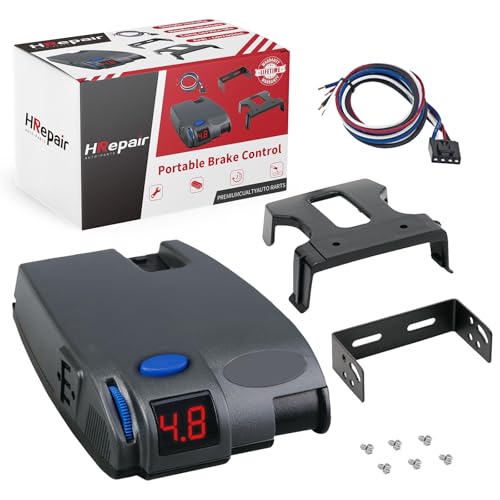
✨ Proportional Braking System: Ensures smooth, consistent stops by applying trailer brakes in proportion to your vehicle's braking intensity. Ideal for all trailer types, from light utility to heavy-duty.
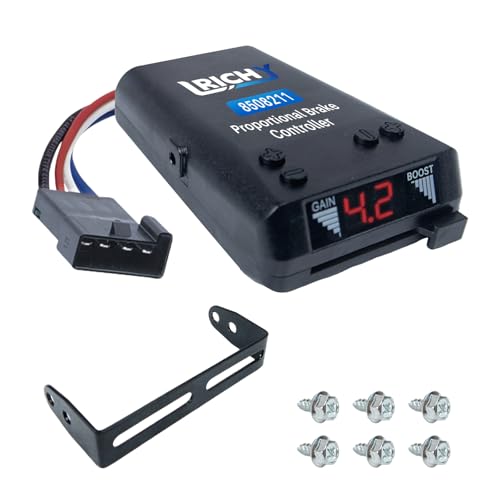
🏆【PROPORTIONAL ELECTRIC BRAKE CONTROLLER】Lrichy brake controller uses internal sensors to automatically apply trailer brakes based on your tow vehicle's braking intensity and speed. It intelligently sets the correct braking level and adjusts for hills, delivering reliable stopping power in any situation
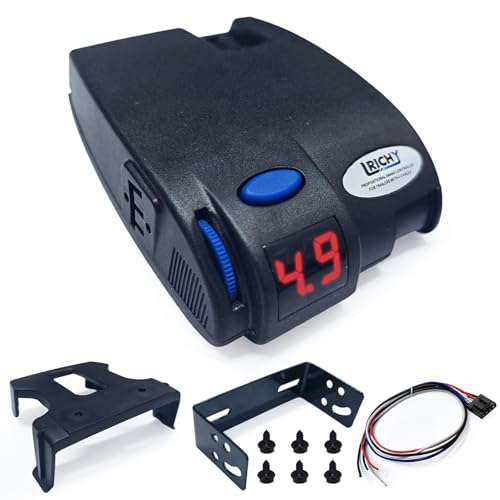
🏆【PROPORTIONAL ELECTRIC BRAKE CONTROLLER】Lrichy trailer brake controller utilizes internal inertia sensors to automatically apply trailer brakes based on your tow vehicle's braking intensity and speed, ensuring smooth and reliable stopping power in various conditions, including general and heavy-duty emergency braking.
Trailer Brakes Importance
Trailer brakes add stopping force at the trailer instead of requiring the RAV4’s brakes to control the complete combination alone. Brake requirements vary by trailer weight and jurisdiction, so check the laws for every state or area where you will travel. If the trailer uses electric brakes, its compatible controller must be installed and adjusted correctly.
Test the brake lights, turn signals, running lights, breakaway system, and trailer-brake operation before departure. Trailer brakes improve the braking system of a properly matched rig; they do not increase the RAV4’s published tow rating or make an overweight setup acceptable.
Weight Distribution and Tongue Weight
Tongue weight presses down on the hitch and becomes part of the load carried by the RAV4. It reduces the capacity available for the driver, passengers, cargo, accessories, and other vehicle loads. Excessive tongue weight can overload the rear axle or tires, while insufficient tongue load can contribute to trailer instability.
Do not install a weight-distribution hitch simply because a generic towing article recommends one. First confirm that Toyota permits that hitch type for your exact model year and configuration and that the receiver, trailer frame, coupler, and installer support it. A weight-distribution system can redistribute load, but it cannot raise the manufacturer’s vehicle, axle, hitch, or trailer ratings.
If you still need to identify the receiver and wiring options for your vehicle, see the RAV4 tow hitch guide.
Stability Control Systems
Vehicle stability and trailer-assistance systems can help in specific situations, but they cannot overcome excessive speed, incorrect loading, insufficient tongue weight, worn tires, strong crosswinds, or an overloaded trailer. Toyota’s towing and stability equipment also varies by model year and grade, so use the equipment description for your exact vehicle.
Keep both hands ready, make smooth steering inputs, leave extra following distance, and slow down before curves or downhill sections. If sway begins, avoid abrupt steering. Follow the vehicle and trailer manufacturers’ emergency guidance and have the setup inspected before towing again if instability occurs.
Top Tips for Safe and Effective Towing With Your RAV4
Complete these checks before deciding that a RAV4 and horse trailer are compatible:
- Identify the exact vehicle. Record the model year, powertrain, drivetrain, grade, tire size, and installed towing equipment.
- Read the correct manual. Find the trailer-weight rating, payload guidance, axle limits, combined-weight limit where specified, tongue-load instructions, and any prohibited equipment.
- Load the trailer as used. Include the horse, tack, feed, water, bedding, tools, spare equipment, and normal travel supplies.
- Obtain scale weights. Weigh the loaded tow vehicle and trailer and determine axle and tongue loads using an accepted method.
- Compare every limit. Check trailer weight, vehicle weight, combined weight, payload, axle ratings, tire ratings, hitch rating, and tongue weight. Staying under one number does not cancel another limit.
- Verify brakes and legal requirements. Confirm trailer-brake, controller, breakaway, lighting, registration, inspection, license, and insurance requirements for the route.
- Inspect the complete rig. Check tire pressure and condition, lug-nut torque, coupler engagement, safety-chain routing, electrical connection, mirrors, doors, dividers, and ramps.
- Plan conservative driving. Reduce speed, increase following distance, avoid severe weather, and choose a route that limits steep grades and difficult traffic when practical.
Pro Tip: Get scale tickets with the horse and the same gear, water, feed, passengers, and cargo you expect to carry. An empty-trailer ticket cannot establish whether the real travel setup stays within trailer, payload, axle, combined-weight, and hitch limits.
What Are the Risks of Towing a Horse Trailer With a RAV4?
- Exceeding the trailer rating: The loaded trailer may be heavier than the exact RAV4 is approved to tow.
- Exceeding payload or axle limits: Tongue weight plus occupants, cargo, and accessories can overload the vehicle even when gross trailer weight appears acceptable.
- Longer stopping demands: A heavier combination carries more energy that the vehicle and trailer braking systems must control.
- Heat and driveline stress: Hills, high temperatures, headwinds, and repeated acceleration increase load on the powertrain and cooling systems.
- Sway and stability loss: Speed, crosswinds, poor loading, tire problems, and movement of a live animal can destabilize the combination.
- Reduced emergency margin: A setup near a rating has less reserve for avoidance maneuvers, road defects, unexpected cargo, or difficult weather.
- Legal or insurance complications: An overweight or improperly equipped combination can conflict with applicable towing requirements and may complicate matters after a collision.
- Risk to the horse: Severe sway, hard braking, excessive heat, or a roadside failure can injure or distress the animal.
Vehicle modifications do not change Toyota’s certified ratings. Suspension helpers can reduce visible sag, and a stronger receiver may carry a higher component rating, but neither increases the RAV4’s published trailer, payload, axle, or combined-weight limits.
How to Use RAV4 Owner Experiences Responsibly
Owner reports can reveal practical issues such as rear suspension squat, energy or fuel use, wiring problems, mirror visibility, and how a trailer behaves in wind. They cannot prove that another person’s combination stayed within every required rating or that the same setup is appropriate for your vehicle.
Be especially careful with reports that mix pounds and kilograms or describe an empty “horse float” without including the animal and equipment. For example, 1,400 kilograms is about 3,086 pounds before any additional cargo. That already exceeds the 2,500-pound maximum listed for a 2025 RAV4 Plug-in Hybrid.
Use owner experience to create questions for Toyota, a qualified hitch installer, a trailer dealer, or a towing specialist. Make the final compatibility decision from manufacturer specifications, measured loaded weights, equipment ratings, and applicable law.
Frequently Asked Questions
What type of horse trailer can a RAV4 tow?
Only a trailer whose actual loaded weight and tongue load fit every limit for the exact RAV4, hitch, tires, and trailer. For 2026, U.S. RAV4 ratings are 1,750 pounds for FWD models and the LE AWD and up to 3,500 pounds for selected AWD grades. Many conventional horse-trailer combinations are heavier than those limits once loaded.
Can a 2026 RAV4 tow a one-horse trailer?
Possibly, but only with an unusually light combination and a RAV4 configuration whose ratings support it. Toyota lists 1,750 pounds for 2026 FWD models and the LE AWD and up to 3,500 pounds for selected AWD grades. Because small one- or two-horse trailers commonly weigh about 2,300 to 3,900 pounds empty, many are already too heavy before the horse and gear are added.
Can a RAV4 tow a two-horse trailer?
A conventional two-horse trailer is generally beyond RAV4 territory once two horses and normal equipment are loaded. Purdue Extension gives one example that reaches 6,500 pounds loaded. Actual trailers vary, so use the real scale weight rather than assuming every two-horse trailer weighs the same.
Does towing reduce RAV4 fuel economy?
Yes. Added mass and aerodynamic drag require more energy, especially at highway speed, on hills, or in a headwind. Actual fuel or electricity consumption depends on speed, trailer shape, weight, terrain, weather, and driving style.
Can I install a towing hitch on any RAV4 model?
Compatible receiver hitches are available for many RAV4 model years, but fitment and permitted use depend on the exact vehicle. Follow Toyota and hitch-manufacturer instructions and use a qualified installer when appropriate. Installing a higher-rated hitch does not raise the RAV4’s towing or payload rating.
What driving conditions are best for towing with a RAV4?
Dry roads, moderate temperatures, low winds, gentle grades, and lighter traffic reduce towing demands, but favorable conditions do not make an overweight combination acceptable. Slow down for poor weather, curves, grades, and other conditions that reduce stability or stopping margin.
Is a weight-distribution hitch recommended for RAV4 towing?
Do not assume it is appropriate for every RAV4. Check Toyota’s instructions for the exact model year and configuration and verify compatibility with the receiver, coupler, and trailer frame. A weight-distribution hitch cannot increase any manufacturer rating.
Did the 2025 RAV4 Adventure or TRD Off-Road tow 3,500 pounds?
No. Toyota states that the gas-powered Adventure and TRD Off-Road grades were not offered for model year 2025. Do not assign a 3,500-pound Adventure or TRD Off-Road figure from another model year to a 2025 RAV4.
How can I find my horse trailer’s true loaded weight?
Load the horse and normal travel gear, then use a suitable certified public scale to measure the loaded combination and axle weights. Determine tongue weight with an accepted scale method and compare the results with the vehicle, axle, hitch, tire, and trailer ratings.
Conclusion
A Toyota RAV4 can pull a horse trailer only when the exact vehicle and the fully loaded trailer remain within every applicable limit. For the 2026 U.S. RAV4, Toyota lists 1,750 pounds for FWD models and the LE AWD, while selected AWD configurations are rated up to 3,500 pounds. The 2025 gas, Hybrid, and Plug-in Hybrid versions were rated at 1,500, 1,750, and 2,500 pounds respectively.
The important comparison is not the trailer’s advertised empty weight. Load the horse and normal gear, obtain real weights, and compare trailer weight, tongue weight, payload, GVWR, GAWR, GCWR where applicable, hitch capacity, and tire ratings. If any limit is exceeded or the combination leaves little operating margin for the intended route and conditions, use a tow vehicle with greater manufacturer-approved capacity rather than trying to modify the RAV4 beyond its ratings.
Sources
- Toyota: The Next Adventure Begins — 2026 RAV4 — current grade, drivetrain, and towing-capacity information.
- Toyota: 2026 RAV4 Sales Consultant Guide — configuration-level towing ratings and 2026 powertrain information.
- Toyota: 2026 RAV4 owner’s manuals — operating, loading, equipment, and towing instructions for current vehicles.
- Toyota: 2025 RAV4 model-year overview — confirms the 2025 powertrain lineup, AWD availability, and absence of gas-powered Adventure and TRD Off-Road grades.
- Toyota: 2025 RAV4 Hybrid vehicle page — official Hybrid configuration and specification resources.
- Toyota: 2025 RAV4 Plug-in Hybrid vehicle page — official Plug-in Hybrid configuration and specification resources.
- Toyota: 2012 RAV4 model information — documents the 3,500-pound maximum for V6 models equipped with the optional towing package.
- CURT: Trailer Weight by Trailer Type — reference ranges for small horse-trailer empty weights.
- Purdue Extension: Understanding the Horse Trailer Rig — loaded horse-trailer weight example and towing-safety guidance.
