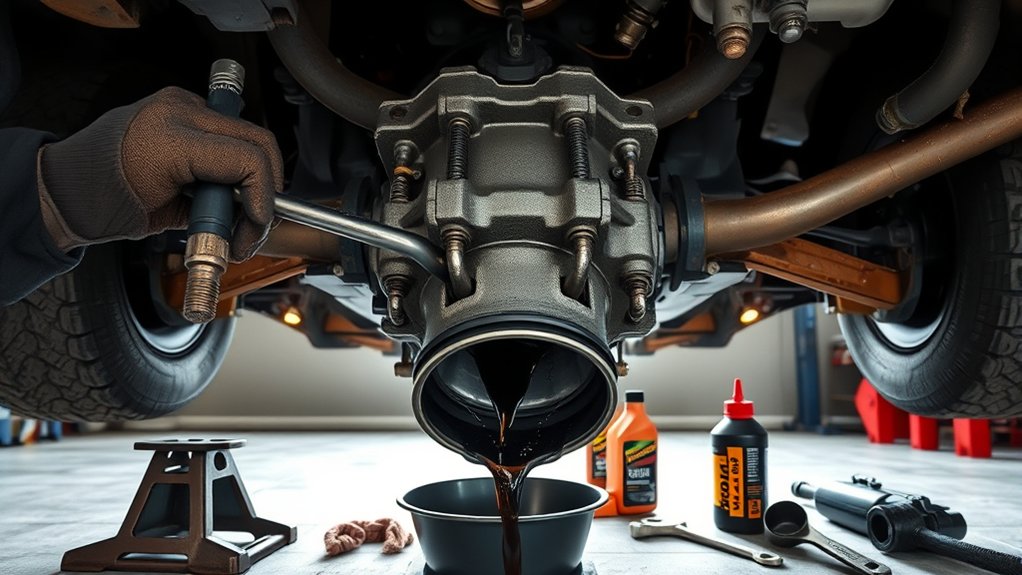
For a stock U.S.-spec 2016–2023 Toyota Tacoma, rear differential service uses Toyota Genuine Differential Gear Oil LT 75W-85 GL-5 or an equivalent that matches that specification. Keep the truck level, loosen the fill plug before draining, replace both plug gaskets, refill to the specified level at the fill opening, and torque the rear differential plugs to the applicable specification. Rear capacity varies by transmission, model code, and rear-locker configuration, so identify your truck before buying fluid.
Quick Answer
For a stock 2016–2023 Toyota Tacoma, use Toyota-specified 75W-85 API GL-5 gear oil, loosen the fill plug first, drain and inspect the old oil, clean the magnetic drain plug, install new gaskets, and refill with the truck level until the oil is within 5 mm (0.20 in.) of the bottom of the fill opening. Rear capacity ranges from about 3.1 to 4.2 quarts by configuration, so have five one-quart bottles available. Rear differential fill and drain plugs are commonly serviced to 36 ft-lb (49 N·m); verify the current Toyota service specification for your exact axle before tightening.
Last updated: September 19, 2026 — rear-fluid capacity guidance, fill-level wording, source links, and schema were rechecked.
Affiliate disclosure: This page may contain affiliate links. If you buy through them, we may earn a commission at no extra cost to you.
Key Takeaways
- This procedure is intended for stock U.S.-spec 2016–2023 third-generation Tacoma rear differentials.
- Loosen the fill plug before opening the drain plug so you know the differential can be refilled.
- Keep the truck level because the lower edge of the fill opening determines the final oil level.
- Stock Auto LSD and electronic-locker systems do not require a generic clutch-type LSD friction modifier.
- Rear capacity varies by transmission, model code, and locker configuration; some third-generation Tacomas need more than four quarts, so have five one-quart bottles available.
- Use new plug gaskets, tighten both plugs to the applicable specification, and inspect for leaks after a short drive.
At a Glance
| Time Required | Varies with access, plug condition, and cooling time; do not rush safe setup, draining, or refill |
| Difficulty | Beginner to intermediate; you must be able to support the vehicle safely and use a torque wrench correctly |
| Tools Needed | 24 mm six-point socket, ratchet or breaker bar, torque wrench, fluid pump, drain pan, wheel chocks, gloves, eye protection, and rated jack stands if lifting is necessary |
| Cost | The cost of up to five one-quart bottles of the specified gear oil, two new plug gaskets, and any tools you do not already own |
Note: Toyota introduced the 2024 Tacoma as an entirely new generation. Do not assume this article’s oil grade, plug size, capacity, or torque values apply to a 2024-or-newer truck. Verify other years through Toyota’s manuals and warranties portal.
Toyota Tacoma Rear Differential Fluid Change: Quick Procedure
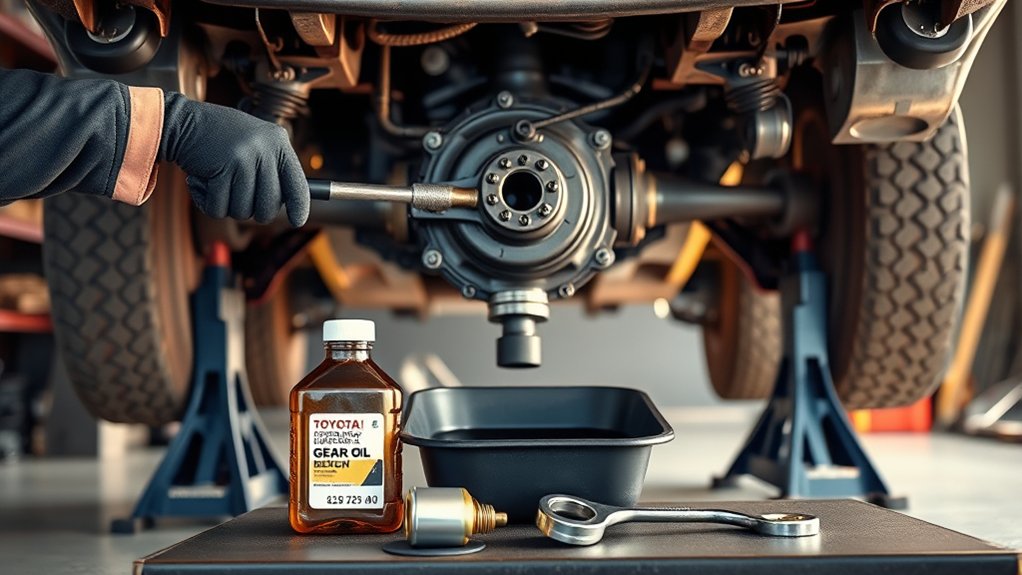
The job is straightforward when the plugs are accessible and the truck can remain level. Read the entire procedure before opening either plug, and confirm that you have enough of the correct oil and two replacement sealing gaskets.
- Drive briefly to warm the gear oil, then park on a flat, stable surface.
- Set the parking brake, shut off the engine, and chock the wheels.
- Clean around both plugs and loosen the upper fill plug first.
- Place a stable drain pan under the differential and remove the lower drain plug.
- Inspect the drained oil and clean the magnet on the drain plug.
- Install a new drain-plug gasket and torque the drain plug.
- Pump in the specified oil until the level is within 5 mm (0.20 in.) of the bottom of the fill opening; a slight seep at the opening is an easy practical indicator while the truck is level.
- Install a new fill-plug gasket, torque the plug, wipe the housing clean, and check for leaks.
Pro Tip: Place the unopened gear-oil bottles in warm water for several minutes before refilling. Warm oil pumps more easily, but keep water away from the bottle openings and differential.
Tools, Fluid, and Replacement Parts
Gather everything before you loosen a plug. Stopping halfway through the refill can leave the truck unusable until you obtain more oil.
- 24 mm six-point socket: A six-point socket grips the plug more securely than a twelve-point socket.
- Ratchet or breaker bar: Use controlled pressure to loosen tight plugs.
- Torque wrench: It must cover 36 ft-lb, equivalent to approximately 49 N·m.
- Fluid-transfer pump: The fill opening is difficult to reach with a bottle alone.
- Automotive drain pan: Use a wide, stable, oil-resistant pan rather than a food or beverage container.
- Two new plug gaskets: Match the replacements to the truck’s year and axle using the VIN or Toyota parts information.
- Gear oil: Use Toyota-specified SAE 75W-85 API GL-5 oil, or an equivalent that clearly lists the same viscosity and service category.
- Quantity: Have five one-quart bottles available so you can cover the largest stock rear-differential reference capacity in this generation. The exact amount used varies by configuration, and the final level is set at the fill opening rather than by blindly pouring in a fixed quantity.
- Safety supplies: Wear gloves and eye protection. Keep absorbent material nearby for spills.
How Much Rear Differential Fluid Does a Third-Generation Tacoma Need?
Toyota lists several rear-differential reference capacities for 2016–2023 U.S.-spec Tacomas. The variation depends on transmission, model code, and whether the truck has the factory rear differential lock. The model code is shown on the vehicle Certification Label. Use the table as a purchasing guide, then set the final level with the truck level and the fill opening as the reference.
| Configuration | Reference Capacity |
|---|---|
| Automatic transmission, without rear differential lock — most model codes | 3.1 qt. (2.9 L) |
| Automatic transmission, without rear differential lock — GRN330L-PRTSHA, GRN330L-PRTLHA, GRN310L-PRTSHA, or GRN310L-PRTLHA | 3.22 qt. (3.05 L) |
| Automatic transmission, with rear differential lock — except GRN330L-PRTSHA and GRN310L-PRTSHA | 4.0 qt. (3.8 L) |
| Automatic transmission, with rear differential lock — GRN330L-PRTSHA or GRN310L-PRTSHA | 4.2 qt. (4.0 L) |
| Manual transmission | 4.0 qt. (3.8 L) |
Capacity note: Toyota labels these as reference capacities. Do not force in a listed quantity if the oil has already reached the correct level at the fill opening. For model-year documents and your exact configuration, use Toyota’s Tacoma manuals and warranties page.
Does a Stock Tacoma Need LSD Additive?
Toyota’s listed fill specification for these stock rear axles is 75W-85 GL-5 gear oil; it does not call for a separate generic friction modifier. Auto LSD is a brake-based traction-control function, and the factory electronic locker is not a clutch-type limited-slip differential that depends on friction-modifier chemistry.
If your truck has an aftermarket clutch-type limited-slip differential, follow the differential manufacturer’s lubricant and additive instructions. The aftermarket specification takes priority over this stock-axle procedure.
Preparation and Safety: Warm Oil, Level Ground, and Fill-Plug Access
Warning: Gear oil and the differential housing can become hot enough to burn you. Never work beneath a vehicle supported only by a jack. If lifting is necessary, use the approved lifting points and properly rated jack stands on solid, level ground.
Drive the truck briefly to warm the oil, then park on a level surface. Let the housing cool until you can work around it safely. Set the parking brake, shut off the engine, and chock the wheels.
If you have enough clearance to reach the plugs without lifting the truck, leave it on the ground. If lifting is required, support the vehicle so the frame and axle remain level from front to rear and side to side. A tilted truck can produce an inaccurate fill level.
| Preparation Step | What to Check |
|---|---|
| Warm the drivetrain | Oil is warm enough to flow but not dangerously hot |
| Stabilize the truck | Parking brake set, wheels chocked, and supports secure |
| Confirm level position | Truck is level from front to rear and side to side |
| Clean the plug areas | Loose dirt cannot fall into the differential |
| Loosen the fill plug | The upper plug can be removed before the oil is drained |
Always loosen the upper fill plug before removing the lower drain plug. If the fill plug is seized, stop and correct that problem while the differential still contains oil.
Drain the Rear Differential and Inspect the Oil
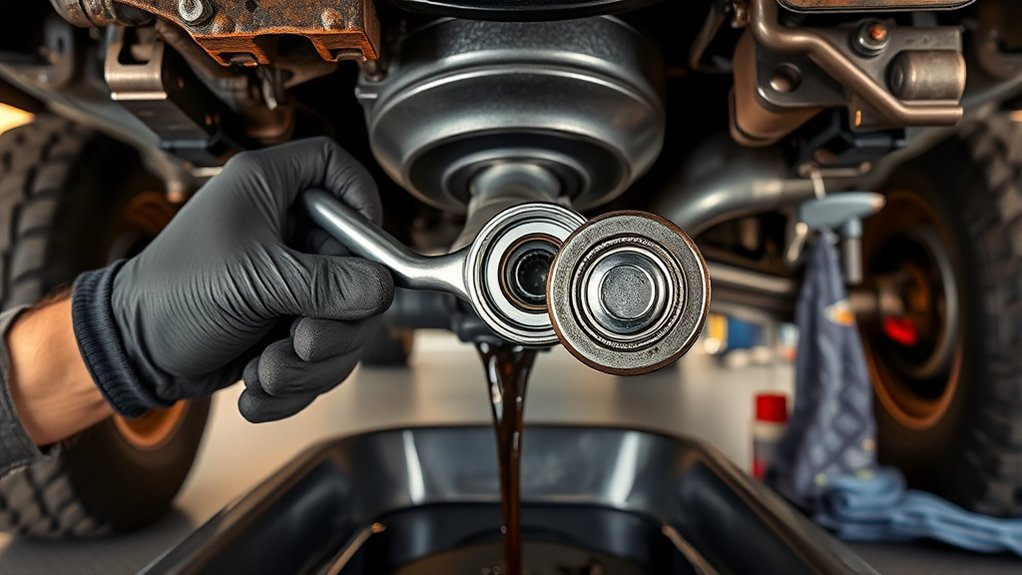
Position the drain pan beneath the lower plug. Keep your hands out of the initial oil stream because warm gear oil may flow quickly and can travel farther than expected.
- Remove the fill plug fully and set it on a clean, lint-free cloth.
- Remove the lower drain plug with the 24 mm socket.
- Allow the oil to drain until the flow slows to an occasional drip.
- Inspect the oil in good lighting for water contamination, a burnt odor, metallic flakes, or fragments.
- Wipe the magnetic drain plug clean with a lint-free cloth.
- Clean the drain-plug sealing surface without pushing dirt into the housing.
How to Read the Drain-Plug Magnet
A thin gray paste or fine metallic fuzz on the magnet can develop through normal gear wear. Sharp flakes, distinct chips, pieces of gear teeth, copper- or bronze-colored material, or a large amount of gritty debris are more concerning.
Photograph unusual material and note the truck’s mileage. If the differential also makes a new howl, rumble, clunk, or grinding noise, avoid heavy use and have the axle inspected before assuming that fresh oil will solve the problem.
Reinstall the Drain Plug
Remove the old sealing gasket from the drain plug and confirm that another gasket is not stuck to the housing. Install one new gasket with the plug, start the threads by hand, and verify that the plug turns smoothly.
For the stock rear differential covered by this 2016–2023 guide, tighten the drain plug to 36 ft-lb (49 N·m). Stop if the threads feel damaged or the plug will not seat normally. Owners of other generations, modified axles, or non-U.S. models should verify the specification through Toyota Technical Information System.
Refill with 75W-85 GL-5 Gear Oil
Insert the pump hose into the fill opening and begin adding the specified 75W-85 API GL-5 gear oil. Pump slowly near the end so you can recognize the correct level without creating a large spill.
| Step | Action | Reason |
|---|---|---|
| 1 | Confirm the truck remains level | The fill opening is the level reference |
| 2 | Pump in 75W-85 API GL-5 oil | Restores the specified lubricant |
| 3 | Slow down as oil approaches the opening | Reduces spills and overfilling |
| 4 | Stop when the oil is within 5 mm (0.20 in.) of the bottom edge of the fill hole | Matches Toyota’s service-level check while the truck is level |
Toyota’s service procedure checks for oil within 5 mm (0.20 in.) of the bottom of the fill opening while the truck is level. In practice, a slight seep or slow dribble at the opening is a simple way to confirm that level. Let a heavy stream slow, then remove the pump hose.
Do not add a separate generic friction modifier to a stock Auto LSD or factory electronic-locker axle. Do not continue pumping once the oil has settled at the specified level near the bottom edge of the opening.
Fit a new gasket to the fill plug, start it by hand, and tighten it to 36 ft-lb (49 N·m) for the stock third-generation application covered here.
Post-Fill Checks: Gaskets, Torque, and Leaks
Inspect the Plug Gaskets and Sealing Surfaces
Each plug should have one new, correctly sized sealing gasket seated flat against a clean surface. Reusing a flattened, cracked, hardened, or deeply marked gasket increases the chance of seepage.
Check that no old gasket remains stuck to the housing. Stacking a new gasket over an old one can prevent the plug from seating correctly.
Perform a Static Leak Check
Wipe the differential housing and both plug areas completely dry. Wait several minutes and inspect for a fresh wet ring, a forming drop, or oil tracking down the housing.
If a plug leaks, do not keep tightening it beyond the applicable specification. Confirm that the gasket is correct, the sealing faces are clean, and the plug or housing threads are not damaged.
Test-Drive and Recheck
Take a short drive at moderate speed, then park on a clean, level surface. Inspect both plugs and the surrounding housing again. A dry plug does not need to be loosened or retorqued after the drive.
Listen for abnormal whining, grinding, rumbling, or clunking. A new noise after service can indicate an incorrect oil level, contamination, a leak, or an unrelated internal problem that needs diagnosis.
Troubleshooting Common Problems
Stuck Fill or Drain Plug
Apply penetrating oil around the exposed plug threads and allow it time to work. Use a correctly seated 24 mm six-point socket and apply steady, controlled pressure with a breaker bar.
Keep your body balanced and make sure the vehicle cannot shift on its supports. Do not use sudden uncontrolled force. If the socket begins to slip, the plug corners deform, or the housing moves, stop before the damage becomes harder to repair.
A rounded, cross-threaded, or severely seized fill plug may require professional removal. Do not drain the axle until you have confirmed that the fill opening can be used.
Excessive Metal in the Oil
Fine gray paste on the magnetic plug is different from visible chips or fragments. Seek further inspection when you find sharp pieces, gear-tooth material, large flakes, copper-colored debris, a strong burnt smell, milky lubricant, or debris accompanied by abnormal differential noise.
Keep a photo and a sample of the drained oil in a clean, sealed container if a technician may need to examine it. Do not assume that replacing the oil will repair damaged gears or bearings.
What to Do If You Run Out of Oil
Stop refilling and do not drive the truck. Protect the fill opening from dirt, obtain more of the same specified lubricant, and finish filling until the oil reaches the lower edge of the opening.
Do not substitute engine oil, transmission fluid, an unapproved viscosity, or an unknown leftover gear oil simply to move the vehicle. Mixing incompatible products can alter the lubricant’s performance.
What to Do If the Differential Was Underfilled
If the truck was driven with a low oil level, correct the level immediately and inspect for leakage. New whining, rumbling, overheating, or metallic debris warrants professional evaluation because gears and bearings depend on adequate lubricant.
Maintenance, Disposal, and Follow-Up Checks
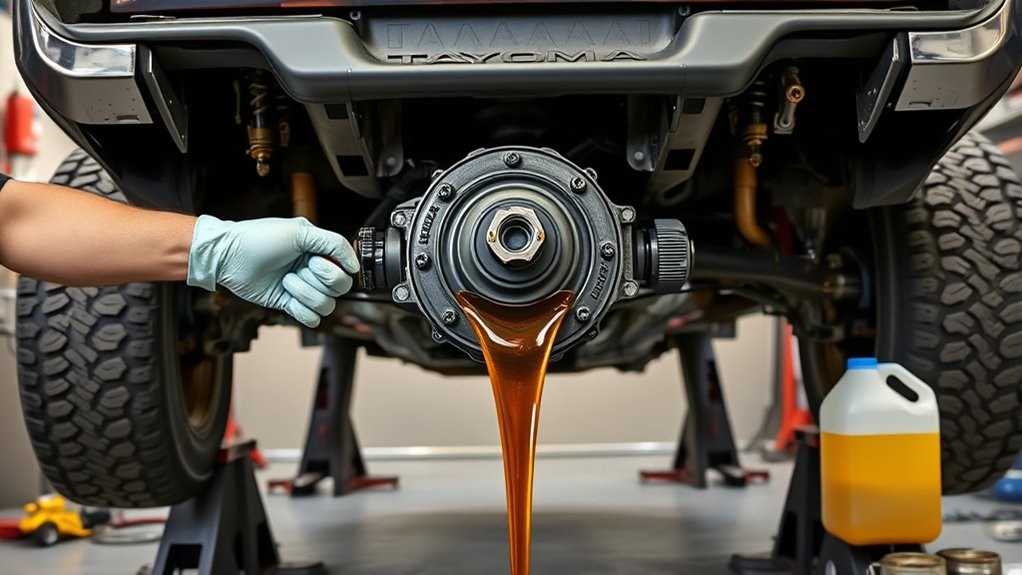
Toyota Maintenance Interval
A universal 15,000-mile replacement interval does not apply to every Tacoma. In the official 2023 Tacoma Warranty & Maintenance Guide, Toyota lists rear differential oil inspection at 15,000 miles or 18 months and again at later 15,000-mile service points such as 30,000 miles or 36 months. When the truck is driven primarily while towing, using a car-top carrier, or carrying heavy loads, the guide calls for rear differential oil replacement at those 15,000-mile service points.
Off-road use, repeated water crossings, contamination, leakage, or an aftermarket differential can justify earlier inspection or a different service schedule. Check the maintenance guide for your exact model year instead of applying one interval to every Tacoma.
Dispose of Used Gear Oil Responsibly
Transfer the drained oil into a clean, sealed, chemically compatible container. Do not mix it with coolant, brake cleaner, gasoline, solvents, or other chemicals because contamination may prevent recycling.
Take it to a local used-oil collection point, household hazardous-waste facility, or retailer that confirms it accepts used gear oil. Call before visiting because accepted materials and quantity limits vary. The U.S. Environmental Protection Agency provides additional guidance on managing and recycling used oil.
Record the Service
Record the date, mileage, oil specification, quantity purchased, gasket replacement, and anything unusual found on the magnet. Reinspect the housing during the next several drives and after towing or off-road use.
Related Tacoma Differential Guides
- Toyota Tacoma differential fluid types explained — separates front/rear differential oil from transfer-case fluid and expands the lubricant-selection question.
- Toyota Tacoma differential service interval explained — focuses on normal inspections versus replacement under towing and heavy-load conditions.
- When to service Tacoma differentials after a water crossing — covers contamination checks after deep water, mud, and off-road use.
- How to engage the Tacoma rear differential lock — covers operation of the factory locker, not fluid service.
Frequently Asked Questions
Can I change Toyota Tacoma differential oil myself?
Yes, when you can keep the truck level, support it safely, loosen both plugs, and use a torque wrench correctly. Stop and seek professional help if a plug is rounded, cross-threaded, severely seized, or the drained oil contains significant metal fragments.
How often should I change the rear differential fluid in a Toyota Tacoma?
Follow the maintenance guide for your exact year and use. Toyota’s 2023 guide lists rear differential oil inspection at 15,000 miles or 18 months and at later 15,000-mile service points. If the truck is driven primarily while towing, using a car-top carrier, or carrying heavy loads, the guide calls for rear differential oil replacement at those service points. Modified differentials or contamination can require a different schedule.
What is the best differential fluid for a 2016–2023 Toyota Tacoma?
For the stock rear differential covered here, use Toyota-specified SAE 75W-85 gear oil meeting API GL-5, or an equivalent that clearly states the same viscosity and performance category. Verify the exact specification for your model year and axle before purchasing.
How do I change the rear differential fluid in a third-generation Tacoma?
Keep the truck level, loosen the fill plug first, remove the drain plug, inspect the oil, clean the magnetic plug, install a new drain-plug gasket, and torque the plug. Refill through the upper opening until the oil is within 5 mm (0.20 in.) of the bottom edge, then install a new fill-plug gasket, torque the plug, and check for leaks.
Does a Tacoma with Auto LSD or an electronic locker need friction modifier?
Not as part of the standard stock-axle procedure. Toyota’s listed fill specification for these stock axles is 75W-85 GL-5 gear oil and does not call for a separate generic friction modifier. Follow separate instructions only when an aftermarket clutch-type limited-slip differential manufacturer requires one.
How much rear differential fluid does a third-generation Tacoma need?
Toyota lists rear-differential reference capacities from 3.1 to 4.2 quarts for third-generation U.S.-spec Tacomas, depending on transmission, model code, and rear-locker configuration. Have five one-quart bottles available. With the truck level, use the fill opening as the final reference and set the oil within 5 mm (0.20 in.) of its bottom edge.
Can I use 75W-90 instead of 75W-85?
Use the viscosity listed for your exact model and axle. This stock 2016–2023 procedure uses Toyota-specified 75W-85 API GL-5. Do not substitute 75W-90 unless Toyota service information or the manufacturer of an installed aftermarket differential specifically permits it.
Conclusion
A successful Tacoma rear differential fluid change depends on correct identification, safe vehicle support, and accurate filling rather than speed. For a stock 2016–2023 truck, loosen the fill plug first, drain and inspect the old oil, clean the magnet, use new plug gaskets, and refill with the specified 75W-85 API GL-5 oil while the truck remains level. Because rear capacity ranges from about 3.1 to 4.2 quarts by configuration, buy enough fluid for your model code and use the fill opening to set the final level.
Finish by tightening the plugs to the applicable specification, wiping the housing dry, and inspecting it before and after a short drive. Follow Toyota’s maintenance guide for your exact model year and operating conditions, and investigate unusual debris, leakage, or noise instead of assuming new oil will correct mechanical wear.
Sources
- Toyota 2023 Tacoma Warranty & Maintenance Guide — inspection and severe-use replacement schedule.
- Toyota Tacoma Manuals and Warranties — official model-year owner and maintenance publications.
- Toyota Technical Information System — factory repair procedures and model-specific service specifications.
- Toyota 2024 Tacoma Introduction — fourth-generation scope and differential-system terminology.
- U.S. Environmental Protection Agency Used-Oil Guidance — responsible handling and recycling of used oil.
