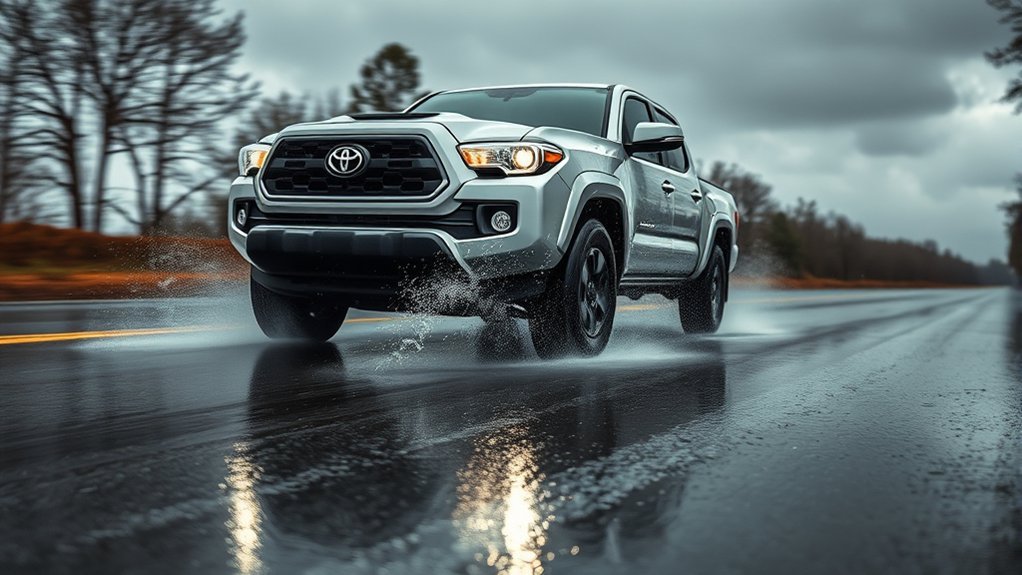
Rain can make your Toyota Tacoma harder to slow, steer, and stop, especially when water collects on the pavement. However, no single percentage or fixed number of feet describes every wet stop. Speed, tire condition, road texture, water depth, cargo, trailer weight, and driver response all affect the distance you need.
Quick Answer
Rain can lengthen a Toyota Tacoma’s stopping distance because water reduces tire-to-road friction and may cause hydroplaning. No single percentage or foot value applies to every Tacoma. Slow down, increase your following gap, use smooth inputs, keep tires properly inflated, and avoid standing or flood water.
Key Takeaways
- Wet stopping distance varies with speed, tread, tire pressure, pavement, water depth, cargo, and trailer weight.
- Two thirty-seconds of an inch is a tire replacement threshold, not a guarantee of strong wet-weather grip.
- Use smooth steering and braking, leave substantially more space, and avoid cruise control when traction is uncertain.
- Four-wheel drive can help you accelerate, but it does not create extra tire grip when you need to stop.
- Never drive into floodwater. Test wet brakes only after unavoidable shallow-water exposure and only where it is safe.
Understanding Braking Distance in Wet Conditions
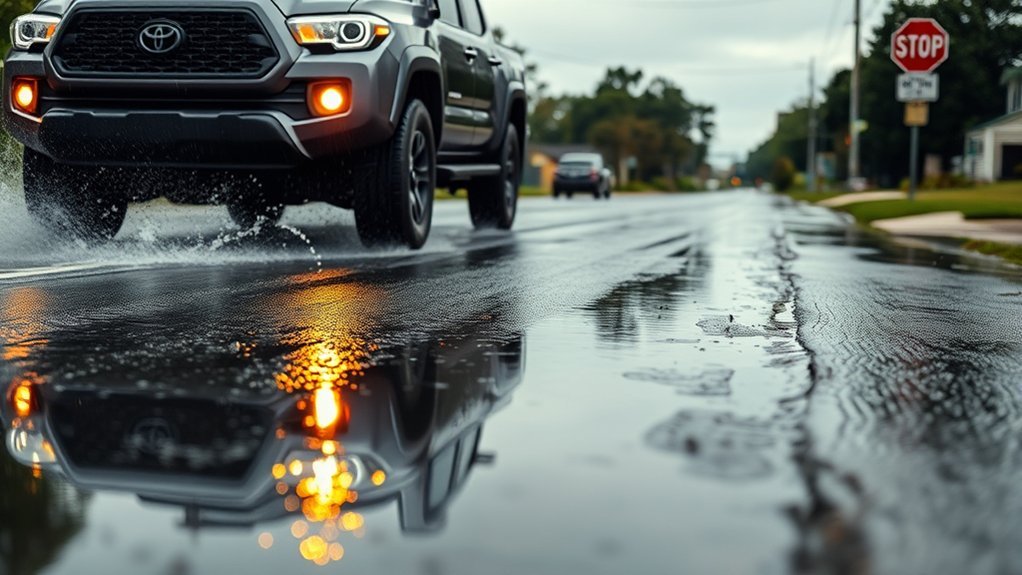
Your Tacoma’s total stopping distance includes the distance traveled while you recognize a hazard, react, and press the brake pedal, plus the distance required for the tires and brakes to stop the truck. Rain may affect both parts. Poor visibility can delay hazard recognition, while reduced tire-to-road friction can lengthen the braking portion.
The Federal Highway Administration explains that lower tire-pavement adhesion increases stopping distance. However, the increase is not a universal percentage. A Tacoma traveling slowly on fresh tires and textured pavement may behave very differently from a loaded truck traveling quickly through standing water.
A wet-road stopping distance is a changing safety margin, not a fixed number printed for every Tacoma.
Speed has an especially strong effect. As speed rises, the truck covers more ground while you react and carries more energy that the tires must manage during braking. Slowing before a curve, puddle, intersection, or traffic queue gives you more control than trying to correct your speed after traction has already dropped.
How Wet Weather Affects Tacoma’s Braking Performance
A thin film of water can reduce pavement friction. Deeper water may prevent the tire tread from clearing water quickly enough, raising the risk of hydroplaning. Oil, dust, rubber residue, wet leaves, painted lines, steel plates, bridge joints, and polished pavement can make some locations more slippery than the surrounding road.
Your Tacoma’s anti-lock braking system, traction control, and stability control can help manage available traction. They cannot create grip that the tires and road do not provide. Four-wheel drive also does not shorten the physical stopping distance simply because all four wheels can receive engine power.
Note: Tacoma equipment varies by year, trim, drivetrain, and market. Review the owner’s manual for your exact truck before relying on a driver-assistance or off-road system.
Rain can also reduce the performance of cameras and sensors used by some driver-assistance features. Water, spray, fog, dirt, or poor visibility may limit what a system detects. Stay ready to brake and steer even when an assistance feature is active.
Top Factors Affecting Tacoma’s Braking Distance in Rain
Your stopping margin depends on several connected factors. A well-maintained brake system cannot make up for bald tires, and new tires cannot overcome excessive speed or deep standing water.
Tire Condition and Tread
Tread grooves help move water away from the contact area between the tire and road. As tread wears, the tire generally becomes less able to manage water, especially at higher speeds or in deeper puddles.
- NHTSA identifies 2/32 inch, about 1.6 mm, as the point at which a tire should be replaced.
- The 2/32-inch threshold does not guarantee good wet performance up to the final fraction of tread.
- Check every main groove and inspect the tire for uneven wear, cracks, cuts, bulges, punctures, or exposed material.
- Use tires in the correct size, load rating, and type for your Tacoma and driving conditions.
Uneven wear may indicate alignment, suspension, balancing, or inflation problems. A tire can have acceptable tread in one area and unsafe wear in another, so check the full width of each tire.
Pro Tip: Check tire pressure when the tires are cold and use the pressure listed on the driver-door tire-information placard. The maximum pressure molded into the sidewall is not the normal inflation target for your Tacoma.
Brake System Performance
Brake pads, rotors, drums where equipped, brake fluid, hoses, and electronic controls must all work correctly. Worn or damaged parts can reduce braking consistency and may cause noise, vibration, pulling, or an abnormal pedal feel.
Toyota’s current Tacoma maintenance guidance is model-year specific. The 2025 Tacoma Warranty and Maintenance Guide, for example, calls for scheduled maintenance every 5,000 miles or six months and includes regular visual brake inspections. Follow the guide for your own model year rather than assuming that every Tacoma uses the same schedule.
During an emergency stop in an ABS-equipped Tacoma, press the brake pedal firmly and continuously. Pedal vibration or pulsing can occur while ABS is operating. Do not pump the pedal, because ABS already adjusts brake pressure rapidly to help limit wheel lockup. NHTSA provides the same firm, continuous-pressure guidance for ABS-equipped vehicles.
Road Surface Quality
Pavement texture, drainage, slope, contamination, and maintenance all affect wet grip. Standing water can collect in wheel tracks, depressions, outer lanes, dips, and poorly drained intersections. Wet leaves, mud, loose gravel, painted markings, and metal surfaces may provide less traction than the surrounding pavement.
- Slow before entering a curve or area of standing water.
- Avoid abrupt lane changes across puddles or slick markings.
- Watch for spray from large vehicles, which can hide lane lines and hazards.
- Expect bridges, construction plates, and shaded areas to behave differently from normal pavement.
The first part of a rainfall can be especially slippery where water mixes with accumulated oil, dust, and rubber residue. Reduce speed early instead of waiting until the truck begins to slide.
Speed, Payload, and Towing
A Tacoma carrying passengers, tools, camping gear, or construction materials has more mass to slow. A trailer adds weight and may push the truck during braking. Tire and axle loading, cargo placement, trailer brakes, brake-controller adjustment, and tongue weight can all affect stability.
Stay within the truck’s payload, axle, tire, and towing limits. Secure cargo so it cannot shift during a stop. When towing, leave more room than you would in an unloaded truck and follow the towing instructions in your owner’s manual.
Why Tire Maintenance Matters for Driving in Wet Weather
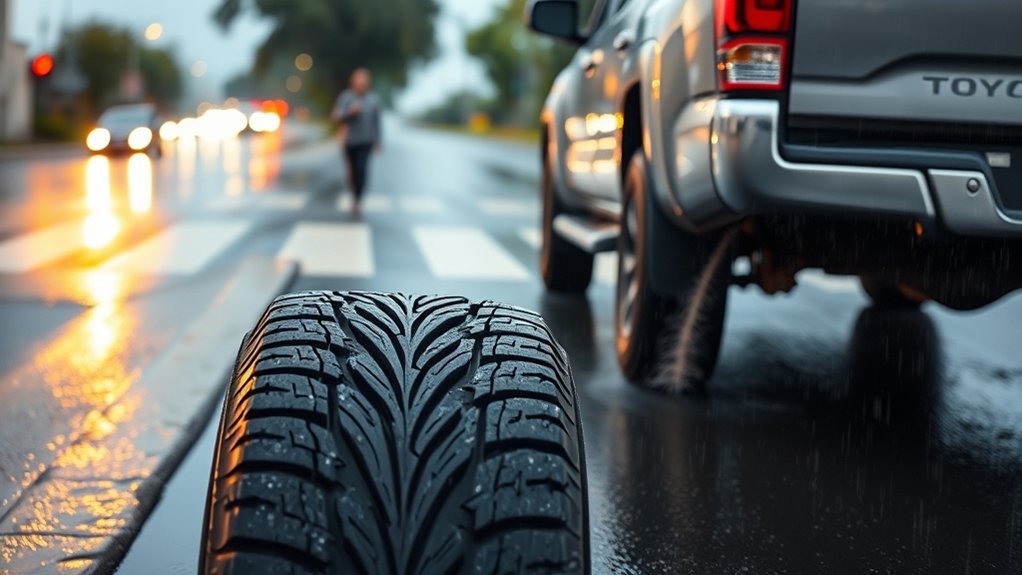
Your tires provide the contact between the Tacoma and the road. Brakes, ABS, traction control, and stability control all depend on the grip available at those four contact patches.
Check tire pressure at least monthly, before long trips, and before carrying a heavy load or towing. Use an accurate gauge when the tires are cold. Temperature changes and natural air loss can alter pressure even when no puncture is present.
Use this wet-weather tire checklist:
- Set cold pressure to the driver-door placard specification.
- Measure tread across several grooves and positions.
- Look for uneven shoulder or center wear.
- Inspect sidewalls for cracking, cuts, bulges, and impact damage.
- Confirm that the tires match the truck’s required size and load capacity.
- Have persistent vibration, pulling, or rapid wear professionally inspected.
All-season, all-terrain, highway-terrain, and winter tires can behave differently in rain. Choose a tire that fits your climate, load, road use, and Tacoma configuration rather than relying only on the category printed on its label.
[Amazon Products Picked for You]
50,000 mile warranty

Developed in conjunction with the world's leading truckmakers, the Michelin Primacy LTX is ideally suited for drivers looking to maximize fuel efficiency with a quiet and comfortable ride

The all-new Michelin Defender LTX M/S 2 is meticulously designed to cater to the demands of today’s vehicles. As modern pick-up trucks and full-size SUVs grow larger and more powerful, the Defender LTX M/S 2 delivers the extended tread life that drivers have come to expect.
Testing Your Tacoma’s Brakes After Water Exposure
Warning: Never drive into floodwater or around a road barricade. You cannot reliably judge the water’s depth, current, or the condition of the road underneath. Follow the National Weather Service advice to Turn Around, Don’t Drown.
Brake testing applies only after unavoidable shallow-water exposure, such as a normal puddle or a manufacturer-approved off-road crossing. It is not a procedure for making a flooded road safe.
Brake Testing Procedure
At the first safe opportunity, move slowly in a clear area and gently press the brake pedal to confirm that the truck responds normally. Avoid conducting the test in traffic, on a steep grade, or near pedestrians.
- Pay attention to pedal feel and stopping response.
- Check whether the truck pulls strongly to one side.
- Listen for persistent grinding, scraping, or abnormal mechanical noise.
- Stop driving if the pedal feels unusually soft, sinks, or does not produce normal braking.
A few light brake applications at low speed may help remove surface moisture after minor water exposure. Do not continue normal driving if braking remains weak, uneven, noisy, or unpredictable.
Safe Driving Techniques
Keep your speed low until normal braking has been confirmed. Leave an escape route and avoid following another vehicle closely. Do not accelerate into traffic while attempting to dry or test the brakes.
If a brake-system, ABS, traction-control, or stability-control warning remains illuminated, follow the owner’s manual. Some warning combinations may mean that part of the braking or stability system is unavailable.
Importance of Maintenance
Off-road water, mud, sand, and debris can affect more than the friction surfaces. Toyota’s Tacoma maintenance guidance includes checks of brake lines, hoses, pads, discs, drivetrain components, boots, fluids, steering parts, and chassis hardware after demanding off-road operation through deep sand, mud, or water.
Arrange an inspection after substantial water exposure if you notice:
- A soft, spongy, or sinking brake pedal
- Pulling to one side during braking
- Grinding, scraping, or persistent squealing
- Unusual vibration through the pedal or steering wheel
- A brake, ABS, or stability-system warning light
- Fluid leakage or visible damage around a wheel
Importance of Quick Reaction Time in Wet Conditions
Reaction distance is the ground your Tacoma covers between noticing a hazard and beginning to brake. It changes with speed, visibility, fatigue, distraction, traffic complexity, and driver alertness. A single “average reaction time” cannot predict how much room you will need in every situation.
| Condition | What Changes | Safer Response |
|---|---|---|
| Dry, clear road | Normal visibility and expected pavement grip | Keep a normal safe gap and continue scanning ahead |
| Light or steady rain | Lower friction, spray, glare, and less visible lane markings | Slow down and increase the following gap |
| Heavy rain or standing water | Poor visibility and greater hydroplaning risk | Reduce speed substantially, avoid puddles, or leave the road safely |
| Ice or freezing rain | Extremely limited and unpredictable grip | Avoid travel when possible and use a much larger safety margin |
Scanning farther ahead gives you time to slow gradually instead of making a sudden stop. Watch brake lights several vehicles ahead, traffic signals, merging lanes, pooled water, pedestrians, and vehicles hidden by spray.
How to Maintain Control When Roads Are Slippery
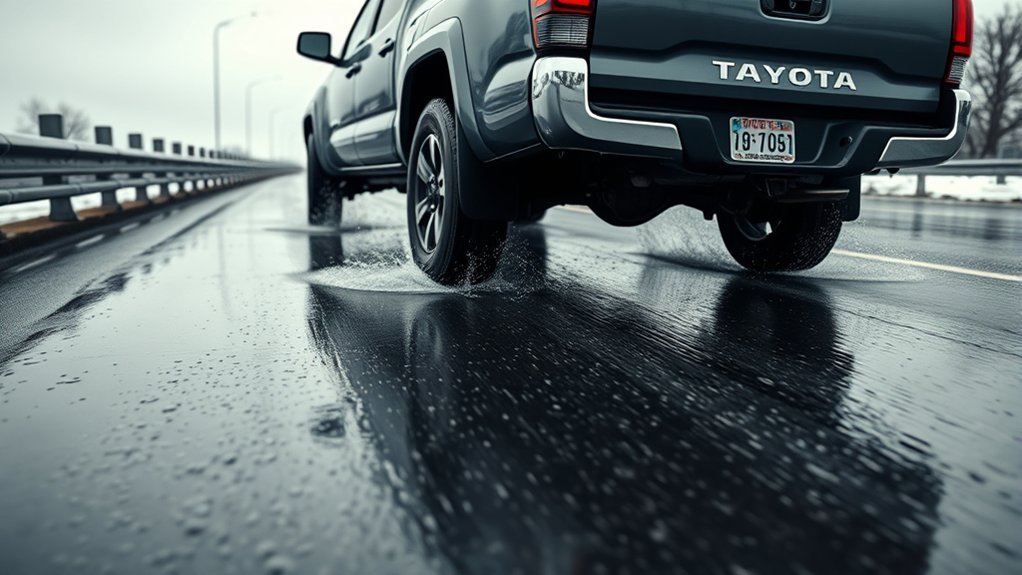
Maintaining control starts before the Tacoma begins to slide. Reduce speed early, keep a larger space cushion, and avoid inputs that ask the tires to brake, turn, or accelerate sharply at the same time.
Adjust Speed Appropriately
No fixed percentage works for every storm. Choose a speed that lets you stop within the clear distance you can see and safely respond to puddles, curves, traffic, and changing visibility.
- Slow before curves, intersections, and standing water.
- Use low-beam headlights so other drivers can see you.
- Avoid cruise control when traction is uncertain.
- Use smooth accelerator, steering, and brake inputs.
- Keep both hands ready to guide the truck without abrupt corrections.
- Pull off the road safely if rain overwhelms the wipers or hides lane markings.
California DMV wet-weather guidance also recommends slower speeds, low beams, increased following distance, and stopping within the visible clear space ahead. Headlight requirements differ by state, so follow the law where you are driving.
Maintain Safe Following Distance
A normal dry-road gap is only a starting point. Increase it whenever rain, spray, darkness, cargo, towing, worn pavement, or limited visibility reduces your margin.
A five- to six-second gap is a practical starting point in steady rain, but it is not a maximum. Add more space in heavy rain, when towing, behind a vehicle that blocks your view, or when the road contains standing water.
To measure the gap, choose a fixed object beside the road. Begin counting when the vehicle ahead passes it. If your Tacoma reaches the object too soon, ease off the accelerator and measure again.
What to Do If You Hydroplane?
Hydroplaning occurs when water separates part or all of a tire’s contact patch from the pavement. Steering and braking response may suddenly feel light, delayed, or disconnected.
If your Tacoma begins to hydroplane, stay calm, ease off the accelerator, hold the wheel steadily, and avoid sudden braking or sharp steering.
- Look where you want the truck to travel.
- Ease off the accelerator instead of lifting or braking abruptly.
- Keep the steering wheel steady and make only small corrections.
- Allow the tires to regain contact with the pavement.
- Once grip returns, slow further and move to a safe place if needed.
If a collision requires braking, apply controlled pressure and allow ABS to work. Remember that ABS cannot create traction while a tire is riding fully on water.
Warning: Four-wheel drive, all-terrain tires, traction control, and a heavier truck body do not make a Tacoma immune to hydroplaning.
Essential Safety Tips for Heavy Rain Driving
Heavy rain requires more than simply turning on the wipers. Use the following practices to protect your visibility and available traction:
- Reduce speed before entering the heaviest rain.
- Use low-beam headlights, not high beams.
- Increase the space ahead and avoid driving beside another vehicle.
- Do not use cruise control when water is collecting on the road.
- Avoid sudden braking, acceleration, and lane changes.
- Stay away from standing water when a safe alternative exists.
- Use the defroster to keep the windows clear.
- Watch for vehicles hidden by spray from trucks and buses.
- Move off the road at a safe location if visibility becomes too poor to continue.
- Never stop in an active traffic lane or under an overpass unless an emergency leaves no safer option.
Do not attempt to cross a flooded roadway, even in a lifted or four-wheel-drive Tacoma. Water may hide a washed-out surface, strong current, debris, or a drop-off.
Preparing Your Tacoma for Severe Weather Driving
A brief inspection before a storm can uncover problems that become much more serious in rain.
- Check cold tire pressure against the driver-door placard.
- Inspect tread depth and all visible tire surfaces.
- Confirm that brake, ABS, TPMS, and stability-system warning lights turn off normally.
- Test the headlights, brake lights, turn signals, and hazard flashers.
- Replace wiper blades that streak, skip, split, or leave large unwiped areas.
- Fill the windshield-washer reservoir.
- Secure tools, luggage, and other cargo.
- Confirm trailer connections and trailer-brake operation when towing.
- Carry a charged phone, flashlight, reflective warning device, first-aid supplies, and drinking water.
Postpone the trip when warnings indicate flooding, severe thunderstorms, damaging wind, or conditions beyond your experience. Preparing the truck cannot make an unsafe road safe.
[Amazon Products Picked for You]

【Things you may need】: This roadside assistance packages is a perfect gift.Contain the necessary roadside kits, snow shovel, flashing lights, reflective triangle warning signs, advanced jumpers (8.2 foot), powerful towing rope, safety hammer and seat belt cutters, life blankets, raincoats, compasses and more!

If your car is parked at the scene of an accident waiting to be rescued, you may need this car emergency kit
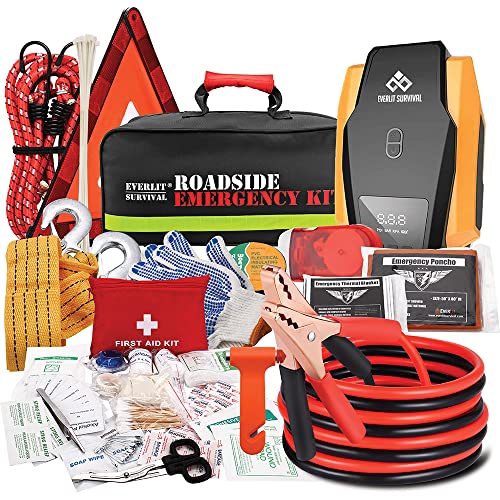
The Road Guardian- The portable roadside assistance kit is designed and hand picked by a group of experienced veterans and experts to provide every essential tools you need in roadside emergencies. The automotive safety bag contains accessories such as repair cable ties, bungee cords, electrical tape, space blanket, rain poncho, reflective warning triangle, glass breaker, seatbelt cutter, safety gloves, tow rope and more to get your vehicle back on the road and continue your travel.
Tacoma Safety Systems and Wet-Road Limitations
Depending on its model year and trim, your Tacoma may include ABS, electronic brake-force distribution, brake assist, traction control, vehicle stability control, trailer sway control, and driver-assistance technology.
- ABS helps limit wheel lockup during hard braking, but it does not guarantee a short stop.
- Traction control can reduce wheelspin during acceleration, but it cannot prevent every skid.
- Stability control may help correct some loss of directional control, but it cannot overcome excessive speed.
- Four-wheel drive can improve propulsion on a slippery surface, but it does not add tire-road friction during braking.
- Driver-assistance systems may have reduced performance when rain, dirt, spray, or fog limits a sensor’s view.
Drive as though you must complete every stop and steering action yourself. Electronic systems are backups, not substitutes for speed control, tire maintenance, and adequate space.
[Amazon Products Picked for You]

PLEASE CONFIRM YOUR FITMENT: Using the Amazon Confirmed Fit bar at the top of the page or check the Product Description to confirm your vehicle fitment. This may be delivered in multiple boxes

Compatible with: 1995 1996 1997 1998 1999 2000 2001 2002 2003 2004 2005 2006 2007 2008 2009 2010 2011 2012 2013 2014 2015 2016 Toyota Tacoma

PLEASE CONFIRM YOUR FITMENT: Using the Amazon Confirmed Fit bar at the top of the page or check the Product Description to confirm your vehicle fitment. This may be delivered in multiple boxes
When to Stop Driving and Seek Service
Move to a safe location and arrange professional help if your Tacoma shows any sign that normal braking or tire control is unavailable.
- The brake pedal feels soft, spongy, unusually hard, or sinks toward the floor.
- The truck pulls sharply to one side during braking.
- A brake-system warning remains on or appears while driving.
- Grinding, scraping, or severe vibration occurs during braking.
- Brake fluid is visibly leaking.
- A tire is flat, bulging, cut, separating, or exposing internal material.
- The truck continues to respond poorly after minor water exposure.
Do not rely on increased following distance to compensate for a suspected mechanical problem. Have the truck inspected before returning to normal traffic.
Related Guides
Frequently Asked Questions
What is a Toyota Tacoma’s braking distance in wet conditions?
No single distance applies to every Tacoma. Speed, tires, tread, inflation, pavement, water depth, cargo, trailer weight, brake condition, visibility, and driver response all affect the result. Use a larger safety margin rather than relying on a fixed number of feet.
What is the safest braking technique in wet weather?
Brake early and smoothly during normal driving. During an emergency stop in an ABS-equipped Tacoma, press the brake pedal firmly and continuously. Do not pump the pedal. Keep looking and steering toward a safe path while allowing ABS to operate.
Does stopping distance increase in the rain?
It usually can because wet pavement provides less tire-road friction and visibility may delay your response. The amount varies widely, so slow down and increase your following distance instead of assuming a universal percentage.
How much extra following distance should you leave in rain?
Increase your normal dry-road gap substantially. A five- to six-second gap is a useful starting point in steady rain, but add more space when visibility is poor, water is standing, tires are worn, or the Tacoma is loaded or towing.
Does four-wheel drive help a Tacoma stop faster in rain?
Not by itself. Four-wheel drive can help distribute engine power while accelerating, but braking still depends mainly on tire grip, speed, road conditions, vehicle load, and brake performance.
Can ABS prevent hydroplaning?
No. ABS can help manage wheel lockup when the tires have road contact, but it cannot restore grip while a tire is separated from the pavement by water. Lower speed and adequate tread are the main defenses.
Should you pump the brakes on a Tacoma in the rain?
Do not pump the pedal during an emergency stop if the Tacoma has functioning ABS. Apply firm, continuous pressure and allow the system to modulate braking. Check the owner’s manual for instructions covering your exact model year.
Conclusion
Wet roads can increase your Tacoma’s stopping distance, but no fixed percentage describes every situation. Your best protection is to slow before traction drops, maintain a generous following gap, keep the tires and brakes in good condition, and use smooth control inputs.
Remember that four-wheel drive and electronic safety systems cannot overcome standing water, excessive speed, or worn tires. Never enter floodwater, and stop driving if the brakes or tires show signs of failure.
Sources
- Toyota 2025 Tacoma Warranty and Maintenance Guide — scheduled maintenance and brake inspections.
- NHTSA TireWise — tire tread, pressure, inspection, and replacement guidance.
- Federal Highway Administration Wet-Weather Guidance — pavement adhesion and stopping-distance factors.
- NHTSA Driving and ABS Guidance — firm, continuous braking with an anti-lock braking system.
- California DMV Safe Driving Handbook — hydroplaning, low beams, speed, and following-distance guidance.
- National Weather Service Turn Around, Don’t Drown — floodwater and flooded-road safety.
