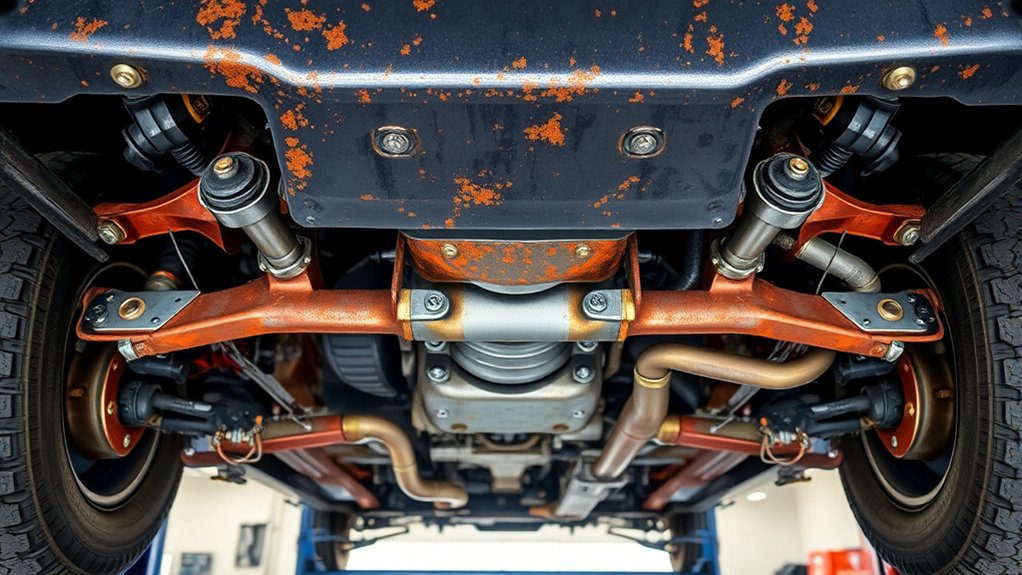
A Toyota Tacoma underbody inspection should start with a clean, dry truck and bright lighting. Follow both frame rails from front to rear, then check crossmembers, suspension and leaf-spring mounts, cab and bed mounts, brake and fuel lines, wheel wells, skid-plate areas, and the spare-tire carrier. Light surface discoloration may be cosmetic, but flaking scale, deep pitting, holes, cracks, leaking lines, distorted mounts, or corrosion at load-bearing attachment points needs professional evaluation.
Last updated: September 19, 2026 — Toyota and NHTSA frame-corrosion program references, VIN-lookup guidance, warranty wording, and inspection safety guidance were rechecked.
This page is focused on the physical inspection process and damage triage. For corrosion causes and prevention strategy, see Toyota Tacoma rust and corrosion explained. For repair pathways after significant damage is found, see Toyota Tacoma frame rust repair options.
Quick Answer
Inspect your Tacoma’s underbody on a clean, dry vehicle with bright lighting. Look for flaking scale, swelling seams, deep pitting, cracked coatings, holes, leaking lines, bent mounts, loose supports, and fresh impact marks. Surface discoloration is often manageable, but perforation or corrosion near the frame, steering, suspension, brakes, fuel system, cab mounts, or bed mounts needs professional evaluation.
Key Takeaways
- Check the frame, crossmembers, mounts, lines, wheel wells, skid-plate areas, and spare-tire carrier.
- Inspect after winter salt exposure, heavy mud, off-road impacts, flooding, or before buying a used Tacoma.
- Never crawl under a vehicle supported only by a jack, and do not perform destructive probing or an improvised hammer test during a DIY inspection.
- Treat light surface rust only after cleaning and drying; structural corrosion belongs in a qualified repair shop.
- Use your VIN to check Toyota and NHTSA records because past programs applied only to particular vehicles, conditions, and time periods.
At a Glance
| Time Required | Plan about 60 minutes for a careful visual inspection; cleaning or safe lifting can add time |
| Difficulty | Beginner for visual checks; professional skill for structural assessment or repair |
| Tools Needed | Bright flashlight, gloves, safety glasses, inspection mirror, plastic scraper, phone or camera, and optional borescope |
| Cost | Often no added cost if you own basic gear; professional inspection and rust repair vary by condition and location |
Methodology: This guide uses Toyota/NHTSA frame-corrosion documents, Toyota warranty and campaign resources, OSHA jack-safety guidance, and EPA road-salt information. It does not claim that a visual DIY check can certify structural integrity; questionable frame metal needs professional assessment.
Why Should You Inspect Your Tacoma’s Underbody?
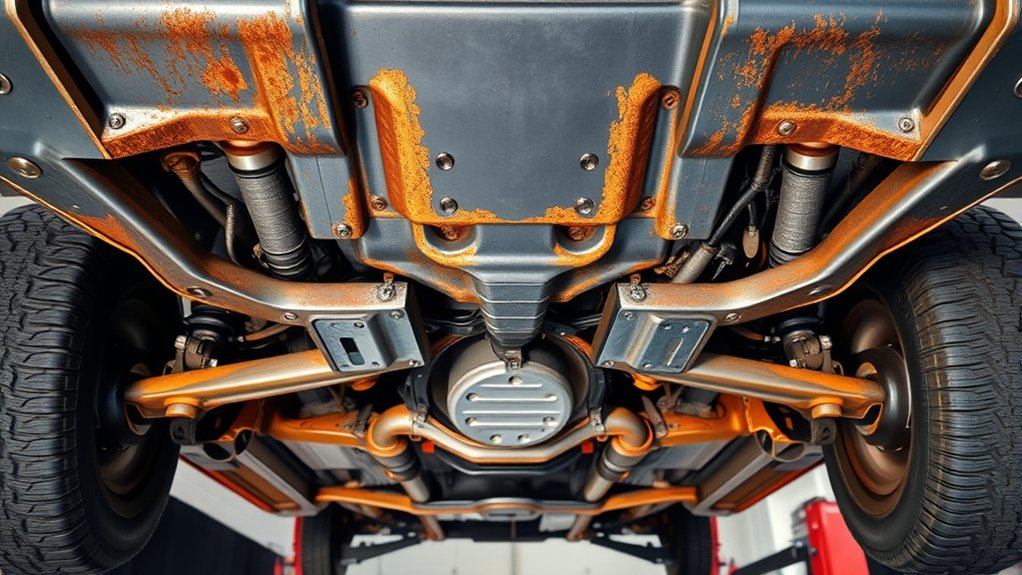
Your Tacoma’s underbody carries structural, steering, suspension, braking, fuel, and exhaust components. Corrosion or collision damage in these areas can affect alignment, handling, braking, load support, and occupant protection. Finding a small coating failure or shallow surface rust early is far easier than dealing with perforated frame metal.
Road salt deserves special attention. The U.S. Environmental Protection Agency notes that road salt has corrosive effects on cars, trucks, bridges, and roads. Mud can create a similar problem by holding salty moisture against seams, brackets, and boxed sections.
Inspection frequency should match use rather than a universal calendar. Check after the winter season in road-salt regions, after deep mud or water crossings, after a hard underbody impact, and before purchasing a used truck. For a severe-use truck, a six-month visual check is a practical routine; for a clean, dry-climate truck, a yearly inspection may be enough.
Rust color alone does not reveal severity. Location, metal loss, cracking, swelling, perforation, and the condition of nearby mounts matter more than appearance.
Where Should You Inspect a Tacoma for Rust and Underbody Damage?
Start with the load-bearing parts, then inspect lines, shields, panels, and drainage points. Use the table as a route around the truck so you do not miss a section.
| Area to Inspect | What to Look For | Why It Matters |
|---|---|---|
| Frame rails and crossmembers | Heavy scale, swelling seams, cracks, holes, crushed sections, or separated welds | These parts carry major vehicle loads |
| Leaf-spring hangers, shackles, shock mounts, and control-arm mounts | Rust around bolt holes, distortion, cracking, loose scale, or movement | Mount failure can affect wheel control and handling |
| Cab mounts, bed mounts, and body seams | Split bushings, compressed mounts, cracked brackets, swelling seams, or flaking metal | These points connect the body and bed to the frame |
| Brake and fuel lines | Pitting, wetness, kinks, abrasion, damaged clips, or swollen flexible hoses | Leaks can create an immediate safety or fire risk |
| Wheel wells, rocker panels, and cab corners | Trapped debris, bubbling paint, missing seam sealer, or perforation | These areas collect moisture and road debris |
| Skid plates, shields, drain holes, and frame openings | Packed mud, blocked drains, loose fasteners, impact damage, or hidden corrosion | Covers can hide wet debris against metal |
| Fuel-tank straps, spare-tire carrier, and exhaust | Thinned straps, broken supports, loose hangers, soot marks, holes, or rattles | Failure can release a component or allow exhaust leakage |
Surface discoloration on a thick exhaust component is not the same as a weakened frame mount. Prioritize corrosion around welds, bolt holes, spring and shock mounts, steering or suspension attachment points, brake lines, fuel-system supports, cab mounts, and bed mounts.
How Do You Inspect a Tacoma Underbody Step by Step?
Warning: Work on level, solid ground with the transmission in Park or in gear and the parking brake applied. Never place any part of your body under a vehicle held only by a jack. OSHA’s workplace jack standard states that after a load is raised it must be cribbed, blocked, or otherwise secured; for DIY work, never rely on a jack alone.
- Choose a safe location. Let the truck and exhaust cool, park on a firm level surface, remove the key, and keep children and pets away.
- Clean the underbody. Rinse off loose mud and salt, then allow the truck to dry. Avoid forcing high-pressure water into electrical connectors, breathers, seals, or damaged coatings.
- Inspect from the outside first. Turn the steering for wheel-well access and use a flashlight and mirror. Many checks can be completed without lifting the truck.
- Support the vehicle correctly if more access is necessary. Follow the Tacoma owner’s manual for approved lifting points, use equipment rated for the load, chock the wheels, and secure the raised vehicle before going underneath.
- Scan front to rear. Follow both frame rails, every crossmember, each suspension mount, the cab and bed mounts, lines, shields, and spare-tire area.
- Look at seams and openings. Check welds, drain holes, frame openings, overlapping metal, brackets, and areas hidden behind skid plates or liners.
- Use gentle DIY inspection methods. A plastic scraper or nylon brush can remove loose dirt or already-detached scale. Do not perform destructive probing or an improvised hammer test. Toyota used a prescribed hammer test in certain historical dealer frame-inspection procedures, but those procedures were model- and program-specific; leave structural probing to a qualified technician unless you are following the exact applicable Toyota service procedure.
- Check for leaks and movement. Look for fresh wetness, soot around exhaust joints, displaced clips, bent shields, torn boots, loose hangers, and shiny marks that suggest rubbing.
- Photograph every concern. Take one wide image for location and one close image with a ruler or coin for scale. Record the date, mileage, and any recent salt, flood, or impact exposure.
- Classify the finding. Separate cosmetic surface rust from scaling, metal loss, cracking, perforation, or corrosion at a safety-critical mount.
Pro Tip: Photograph the same frame sections from the same angle at each inspection. Side-by-side images make progression easier to judge than memory alone.
What Tools Do You Need for a Tacoma Underbody Inspection?
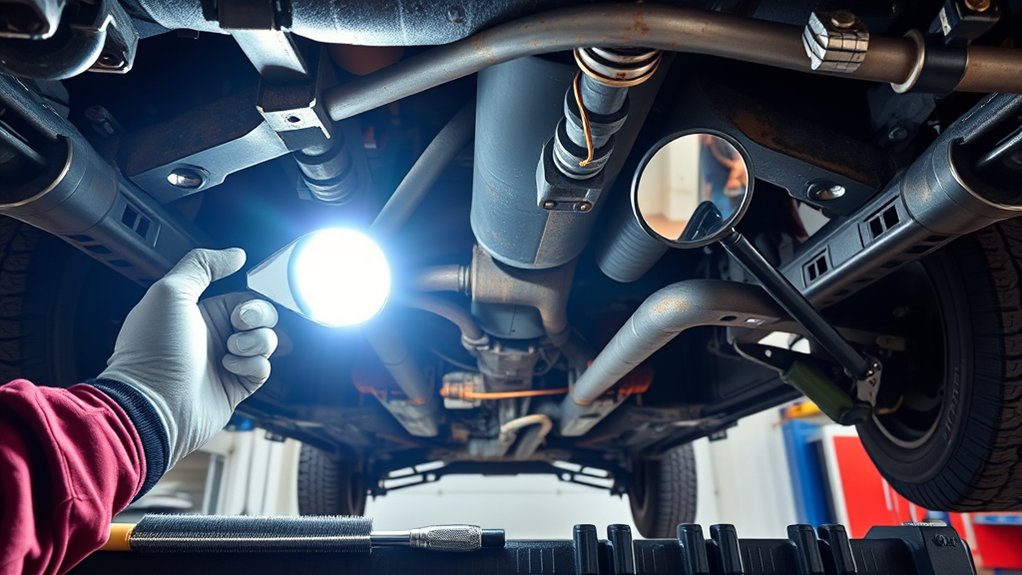
You do not need aggressive tools for a useful first inspection. Bright lighting, safe access, clean surfaces, and complete documentation matter more than forceful probing.
Essential Inspection Tools
- High-output flashlight or headlamp: Use angled light to make pitting, cracks, and swollen seams easier to see.
- Inspection mirror: Check the top and back of rails, brackets, lines, and mounts.
- Plastic scraper or nylon brush: Remove loose dirt without gouging coatings or metal.
- Phone or camera: Record location, severity, and changes over time.
- Optional borescope: View accessible frame cavities without drilling or enlarging openings.
- Wheel chocks, rated jack, and rated stands: Use only when lifting is necessary and only at approved points.
- Torque wrench: Keep it for reassembly work that has a verified Toyota torque specification. It does not prove that corroded hardware or metal is structurally sound.
Safety Gear Requirements
Wear safety glasses because dirt and rust scale can fall without warning. Use cut-resistant work gloves, long sleeves, and closed-toe shoes. A creeper or thick mat can reduce strain, but it must not place you where you cannot exit quickly.
If you use a cleaner, rust converter, primer, paint, or coating, follow its label for ventilation, skin protection, eye protection, ignition control, and drying time. Never spray a hot exhaust or work near an open flame.
How Can You Tell Surface Rust From Serious Tacoma Frame Damage?
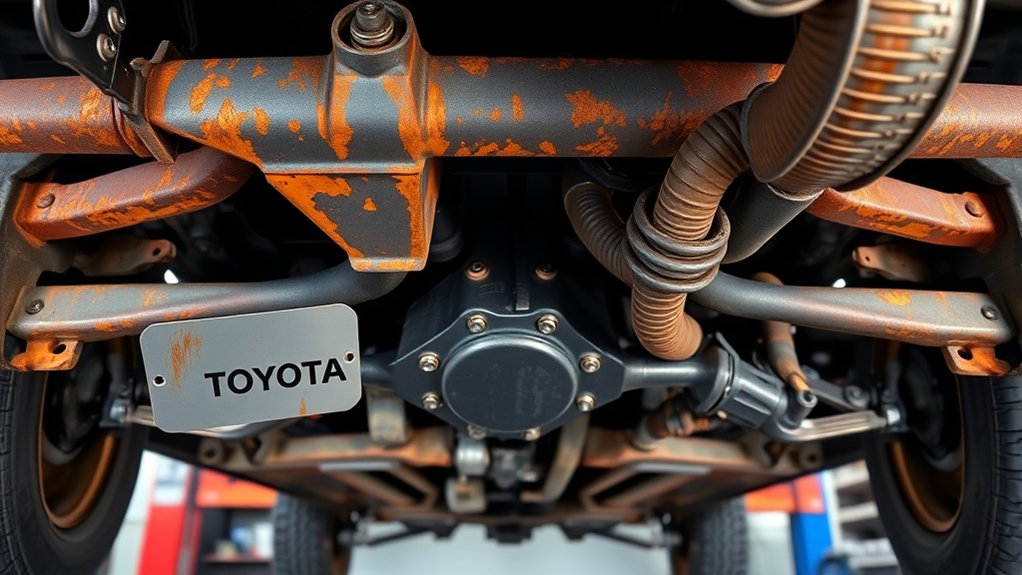
Rust severity is best judged by texture, depth, location, and metal loss. Use the following categories to decide what happens next.
Light Surface Rust
Thin orange or brown discoloration with solid metal underneath is often cosmetic. The surface may feel rough, but it has no swelling, deep pitting, cracking, or holes. After cleaning and drying, this may be suitable for careful DIY preparation and protection.
Scaling and Pitting
Layered flakes, raised scale, deep pits, and swollen seams indicate continuing metal loss. Scaling on a nonstructural shield is different from scaling around a leaf-spring hanger, crossmember, cab mount, brake line, or frame weld. Safety-critical locations need a professional assessment.
Perforation or Structural Damage
Holes, cracks, torn brackets, distorted mounts, separated seams, crushed frame sections, or metal that sheds thick layers are red flags. Stop towing, hauling, or off-road use until a qualified technician checks the truck. If steering, suspension, braking, fuel, or major frame integrity may be affected, avoid driving it.
Other Underbody Problems That Can Look Like Rust
- Fresh shiny metal, bent skid plates, or scraped fasteners from an impact
- Dark wet patches from oil, fuel, brake fluid, coolant, or gear oil
- Black soot near an exhaust joint or hole
- Cracked rubber boots, displaced clips, damaged wiring, or rubbing lines
- Loose mud packed above a skid plate or inside a frame opening
How Do You Inspect a Used Tacoma Before Buying?
A clean body or freshly black-coated frame does not prove that a used Tacoma has a sound underbody. Before buying, inspect the truck in bright light and confirm its history instead of judging it only by appearance.
- Check the VIN first: Run it through Toyota’s campaign lookup and NHTSA’s recall database, then ask a Toyota dealer about available campaign and frame-repair history.
- Ask about frame work: Request records for frame replacement, corrosion-resistant treatment, welding, patching, collision repair, or previous structural inspection.
- Look underneath fresh coating: Be cautious when new paint or undercoating covers dirt, flaky edges, hardware, seams, or obviously uneven metal.
- Inspect both sides of the frame: Check rails, crossmembers, spring and suspension mounts, cab and bed mounts, the spare-tire area, and accessible boxed sections.
- Inspect safety-related lines: Look for severe corrosion, wetness, kinks, abrasion, or damaged supports on brake and fuel lines.
- Look for undocumented repairs: Mismatched welds, plates, distorted brackets, or altered mounting points deserve professional evaluation.
- Use an independent inspection when needed: If corrosion is heavy, access is poor, the truck lived in a road-salt region, or the seller will not allow a thorough underbody check, do not rely on a quick visual inspection alone.
How Do You Reduce Future Tacoma Underbody Corrosion?
Prevention begins with removing salt and mud, keeping drainage paths open, and repairing coating damage before corrosion spreads. The EPA identifies road salt as corrosive to vehicles, so winter-driven trucks deserve extra cleaning and inspection.
| Maintenance Task | Practical Timing |
|---|---|
| Rinse salt and mud from the undercarriage | As soon as practical after heavy exposure, then allow the area to dry |
| Inspect frame, mounts, lines, and coatings | After winter, after major off-road use or impacts, and about yearly for a routine visual check |
| Clean blocked drain holes and trapped debris | Whenever buildup is found |
| Treat minor surface rust | Promptly, after confirming the metal is not structurally weakened |
| Recheck repaired or coated areas | At the product’s stated interval and after harsh exposure |
Do not apply a thick coating over wet dirt, loose scale, active leaks, or unknown structural damage. Preparation and product compatibility determine whether a coating protects metal or hides a worsening problem.
Note: Keep coatings away from brakes, rotors, friction surfaces, exhaust components, oxygen sensors, rubber parts unless the product allows it, moving joints, electrical connectors, identification labels, and factory drain holes. Follow the product label and your model-year Toyota manual.
What Should You Do After a Tacoma Rust Inspection?
Sort findings by risk instead of treating every orange spot the same. Handle clean, shallow surface rust differently from corrosion around a structural mount, brake line, or fuel-system component.
Immediate Rust Treatment Steps
For minor surface rust on confirmed sound metal, use this sequence:
- Clean the area and let it dry completely.
- Remove loose rust and failed coating with a nylon brush, hand tool, or abrasive method allowed by the repair product.
- Feather damaged paint or coating without thinning good metal.
- Apply a compatible rust treatment or primer exactly as directed.
- Finish with an automotive coating intended for that location.
- Keep the truck dry for the required cure time, then photograph the repair.
Do not use filler, thick undercoating, or paint to hide holes, cracking, soft mounting points, or severe scaling. Those conditions need structural evaluation before cosmetic treatment. For an overview of repair paths after significant damage is confirmed, see Toyota Tacoma frame rust repair options.
Schedule Follow-Up Inspection
Recheck minor repairs after the first harsh winter, off-road trip, or heavy wash, then use the coating manufacturer’s inspection interval. For untreated findings, compare photos within a few months rather than waiting a full year.
Keep a simple record with the date, mileage, location, photos, products used, and professional recommendations. This helps a technician understand progression and gives a future buyer a clearer maintenance history.
Which Tacoma Model Years Had Documented Frame-Corrosion Programs?
Toyota has documented different frame-corrosion actions for different Tacoma groups. These historical programs were not identical, and being in a listed model-year range does not prove that a particular truck is currently covered, unsafe, or defective.
| Tacoma Group | Documented Historical Action | What to Do Now |
|---|---|---|
| 2001–2004 | Toyota documented a frame rust-perforation warranty enhancement for affected trucks, including inspection and corrosion-treatment procedures under historical program terms. | Treat this as historical context, not proof of current coverage. Check the VIN, physical frame condition, and dealer records. |
| 2005–2010 | A 2017 class-action settlement and related Toyota programs included frame inspection, possible frame replacement when the specified rust-perforation standard was met, and limited CRC application under defined conditions. | Program timing and eligibility were limited. Do not assume current coverage from model year alone; verify the VIN and service history. |
| Certain 2011–2017 | Toyota Customer Support Program ZKA addressed frame corrosion perforation under defined program terms. Toyota documentation described 12 years from the Date of First Use with no mileage limitation, subject to program conditions. | Eligibility can depend on the truck’s first-use date, location, prior campaign work, and other conditions. Confirm the individual VIN with Toyota. |
For historical documentation, see Toyota’s 2001–2004 Tacoma frame inspection document, the 2005–2010 H0F frame-corrosion material, and the 2011–2017 ZKA Customer Support Program document.
How Do You Check Tacoma Recalls and Service Campaigns by VIN?
Check the 17-digit VIN with the Toyota Safety Recall and Service Campaign lookup and the NHTSA recall lookup. Toyota says its lookup provides information on open safety recalls and service campaigns released since 1999 for covered Toyota, Lexus, and Scion vehicles.
NHTSA explains that its VIN results do not show already repaired recalls, may omit some recalls older than 15 years, and do not show manufacturer customer-service or other non-safety campaigns. A result showing no unrepaired recalls therefore does not prove that an older Tacoma never had a frame-related program or repair. Use both databases and ask a Toyota dealer to review available VIN history when the record is unclear.
Use the Toyota manuals and warranties portal to select the exact model year and review lifting points, maintenance guidance, and warranty terms. Toyota’s general new-vehicle warranty summary lists rust-through coverage as 60 months with no mileage limit for corrosion perforation of sheet metal. The exact Warranty and Maintenance Guide controls, and that general statement should not be treated as blanket coverage for every frame-corrosion condition.
When Should You Seek Professional Help for Tacoma Rust?
Arrange a qualified inspection when corrosion has moved beyond light surface rust or appears near a component that controls or supports the truck.
- Deep pitting, heavy scaling, cracking, swelling, or perforation on a frame rail or crossmember
- Rust around leaf-spring, shock, control-arm, steering, cab, bed, or hitch mounting points
- Corroded brake lines, fuel lines, fuel-tank straps, or spare-tire supports
- A frame section that looks crushed, bent, torn, or poorly welded
- Clunking, steering changes, uneven ride height, alignment changes, or abnormal tire wear
- Fuel odor, fluid leakage, exhaust fumes, or soot near a suspected hole
- Damage hidden inside a boxed section or behind a mount that cannot be assessed visually
A technician can clean the area, measure metal loss, inspect hidden surfaces, compare the structure with manufacturer information, and decide whether repair is safe and permitted. Frame welding, sectioning, reinforcement, or replacement should not be improvised.
Frequently Asked Questions
How do you check a Tacoma frame for rust?
Clean and dry the underbody, use bright angled light, and follow both frame rails from front to rear. Inspect crossmembers, welds, drain openings, suspension mounts, cab and bed mounts, brake and fuel lines, and the spare-tire area. Photograph scale, pitting, cracks, swelling, holes, or impact damage. Do not perform destructive probing during a basic DIY inspection.
Will rust cause a vehicle to fail an inspection?
It can, but the result depends on your jurisdiction and the location and severity of the corrosion. Structural perforation, weakened suspension or steering mounts, damaged brake or fuel lines, and unsafe exhaust leaks are more likely to cause rejection than light cosmetic surface rust. Check your state or local inspection rules.
Do Toyota Tacomas have rust issues?
Some older Tacomas have a documented history of frame-corrosion complaints and Toyota support programs, especially for vehicles exposed to heavy road-salt conditions. That does not mean every Tacoma or every truck in a listed model year is affected. Inspect the individual vehicle and check its VIN with Toyota and NHTSA.
Which Tacoma years had documented frame-corrosion programs?
Toyota and NHTSA-hosted records document historical frame-corrosion actions involving 2001–2004 Tacomas, a 2017 settlement and related programs for 2005–2010 Tacomas, and Customer Support Program ZKA for certain 2011–2017 Tacomas. The terms, locations, deadlines, and eligibility rules differed, so model year alone cannot establish current coverage.
What was the Toyota frame rust lawsuit?
The phrase commonly refers to U.S. litigation that resulted in a 2017 settlement involving 2005–2010 Tacoma, 2007–2008 Tundra, and 2005–2008 Sequoia frame-corrosion claims. The settlement included inspection and frame-replacement provisions under defined criteria, while related corrosion-resistant-compound programs had separate conditions and deadlines.
Can you treat Tacoma surface rust at home?
You can often clean, prepare, prime, and coat shallow surface rust on sound, accessible metal. Stop if you find deep pitting, thick scale, holes, cracks, distorted mounts, leaking lines, or corrosion on a load-bearing attachment. Those findings need professional evaluation before coating.
Should you apply undercoating over existing rust?
Do not coat over wet dirt, loose scale, active leaks, or rust whose depth has not been assessed. Clean and dry the area, remove loose material, confirm the metal is sound, and use compatible products. Thick coating can hide progression when the preparation is poor.
How often should you inspect a Tacoma underbody?
Use exposure rather than a single factory-style interval. Inspect after winter road-salt use, deep mud or water crossings, a hard underbody impact, and before buying a used Tacoma. A yearly visual check is a practical baseline for many trucks, while severe salt, coastal, off-road, or wet conditions justify more frequent checks.
Conclusion
Your Tacoma’s underbody protects far more than appearance. A methodical inspection can reveal coating damage, trapped debris, corrosion, leaks, and impact damage while the problem is still manageable. Follow the frame from front to rear, focus on load-bearing mounts and safety-related lines, document what you find, and treat only confirmed surface rust yourself.
When you see heavy scale, perforation, cracking, distorted mounts, corroded lines, or uncertain frame damage, get a professional structural assessment rather than hiding the condition with coating. Combine regular cleaning, exposure-based inspections, photographs, and VIN checks to keep the truck safer and make future changes easier to identify.
Sources
- Toyota Safety Recalls and Service Campaigns — VIN-based recall and campaign lookup.
- National Highway Traffic Safety Administration Recall Lookup — recall-search scope, limitations, and owner guidance.
- Toyota Manuals and Warranties — model-year manuals, warranty guides, and corrosion-coverage information.
- OSHA Standard 1910.244: Jacks — rated equipment and securing a raised load.
- U.S. EPA: Road Salt and Corrosion — corrosive effects of road salt on vehicles and infrastructure.
- Toyota 2001–2004 Tacoma Frame Inspection for Rust Perforation — historical Toyota frame-inspection procedure.
- Toyota Limited Service Campaign H0F — 2005–2010 Tacoma frame-corrosion settlement and program information.
- Toyota Customer Support Program ZKA — certain 2011–2017 Tacoma frame-corrosion-perforation information.

