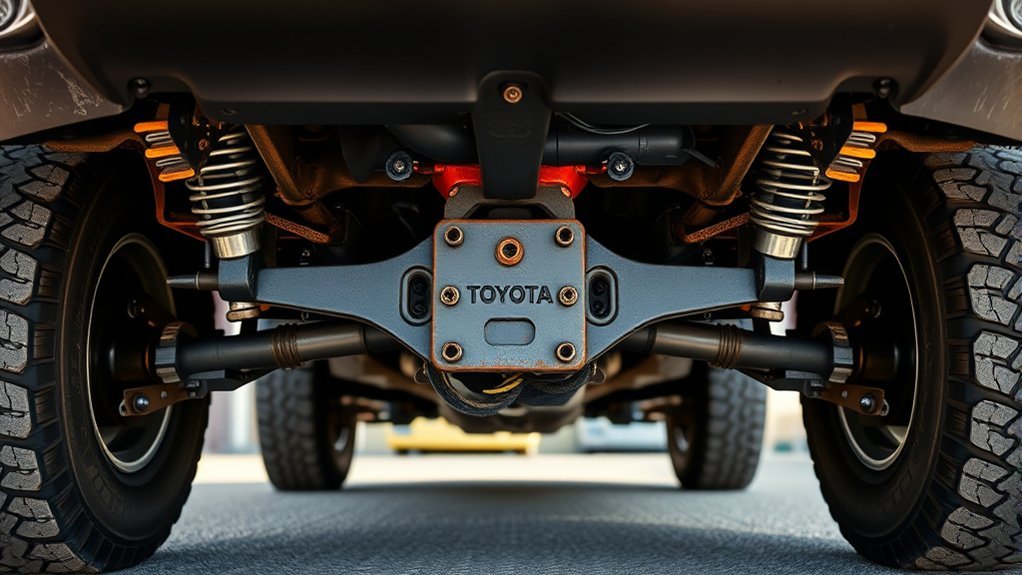
On a 3rd generation Toyota Tacoma, the front center jacking point is the reinforced center section of the front crossmember behind the front bumper. This point supports an even lift across the front end and helps prevent underbody damage. A 3-ton floor jack on level ground is typically preferred for stability and control. After lifting, jack stands must be placed at approved support points and never under suspension arms. The proper setup, stand placement, and lowering sequence matter.
Where Is the Tacoma Front Jack Point?
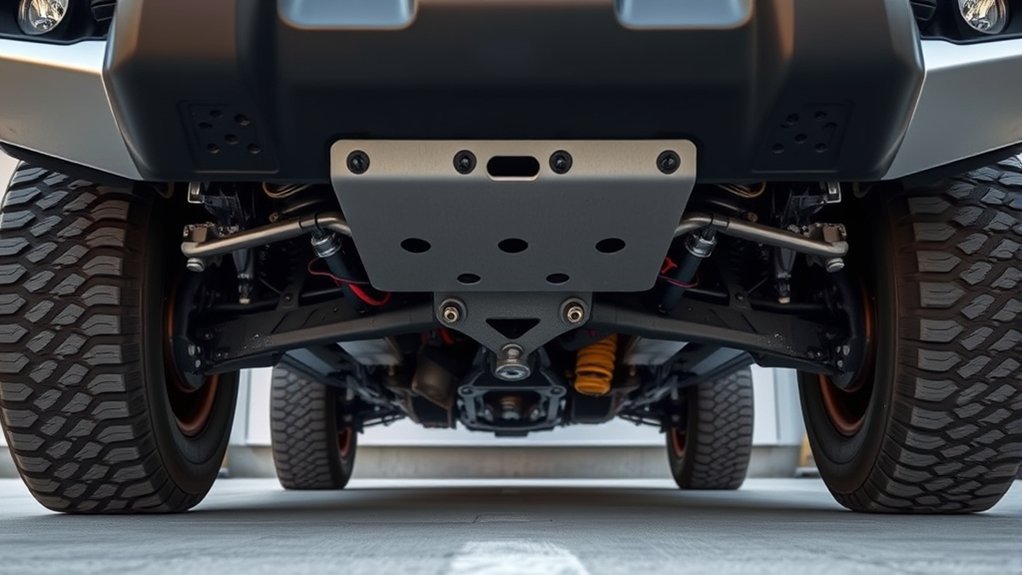
For a 2017 Tacoma TRD Sport DCSB, the front jacking point is located at the center of the front crossmember, immediately behind the front bumper. This front jack point serves as the designated lifting location for raising the vehicle’s front end without imposing unintended stress on adjacent chassis components.
Positioning the jack precisely at this center location promotes even load distribution and reduces the risk of distortion, slipping, or structural damage during elevation.
A floor jack or bottle jack may be used, provided the saddle is aligned squarely beneath the front jack point. Before lifting, the operator should confirm that both the jack and the jack stands are rated to support the Tacoma’s weight.
Once the vehicle is elevated, support must transfer to jack stands placed beneath the frame rails. This method establishes a stable working condition and gives the technician greater independence, control, and safety during inspection, repair, or routine underbody maintenance tasks.
How to Identify the Front Crossmember
On most 3rd Generation Toyota Tacoma models, the front crossmember can be identified by looking beneath the front bumper for the transverse structural member that spans the width of the chassis near the front centerline. This component sits just behind the bumper and marks the front center jacking point. Its reinforced construction distinguishes it from lighter shielding or brackets, providing a clear structural reference during maintenance.
- Locate the front crossmember at the chassis center, directly behind the bumper.
- Confirm reinforcement and width; it spans laterally and supports vehicle load.
- Verify exact jack-point guidance and capacities in the owner’s manual.
Methodical identification protects the undercarriage and supports independent, confident service. The jack must be centered on the front crossmember to avoid distortion or localized damage.
Proper alignment with the designated jacking point preserves stability during lifting operations. Consultation of the vehicle manual remains essential for model-specific confirmation, dimensional differences, and safe lifting practices before any maintenance begins.
What Jack Should You Use on a Tacoma?
With the front crossmember identified, jack selection becomes the next safety and fitment consideration. A floor jack is the preferred tool for a Tacoma because it offers superior lateral stability, controlled lift, and adequate capacity for a midsize truck platform. For a 2017 Tacoma TRD Sport DCSB, a minimum 3-ton rating is the prudent baseline. This specification creates margin, reducing strain on the hydraulic system and supporting more predictable operation.
A bottle jack remains a secondary option when space or portability governs the choice. However, its smaller contact pad benefits from a wood block to protect the chassis interface and improve stability at the saddle.
Regardless of jack type, alignment must remain exact: the jack should be centered under the bulge in the front crossmember beneath the engine before any load is applied. After lifting, jack stands are mandatory. That final support transforms temporary elevation into secure, independent working access for maintenance.
How to Lift the Tacoma Front End
Position the Tacoma on hard, level ground, then center a properly rated floor jack—typically a 3-ton unit—under the bulge in the front crossmember just behind the oil drain plug. This bulge serves as the front center jacking point on a 2017 Tacoma TRD Sport DCSB. Exact alignment matters; the saddle must sit squarely and remain centered before any load is applied.
- Verify the jack’s capacity matches the Tacoma’s weight and that the rolling surface is stable.
- Pump the handle gradually, watching the saddle stay planted on the front center jacking point.
- Raise only until the front end reaches the necessary working height, avoiding abrupt motion.
A controlled lift preserves components and grants safe access beneath the front end without compromise.
Once elevated, the vehicle should not be trusted to hydraulics alone during service. As a prudent safeguard, many operators leave the floor jack lightly loaded under the crossmember while work proceeds nearby for added confidence.
How to Place Jack Stands on a Tacoma
For a 2017 Tacoma TRD Sport DCSB, front jack stands should be placed on the shaded sections of the frame rails directly behind the front jack point.
At the rear, the stands should be positioned on the axle just inboard of the U-bolt plates and ahead of the differential pumpkin, with the castle tops seated securely against the contact surfaces.
The vehicle should then be lowered slowly onto the stands, and stand compatibility and load seating should be verified before any work begins underneath.
Front Stand Placement
Proper front stand placement on a 3rd Generation Toyota Tacoma begins after the front end has been raised at the front-center bulge with a floor jack. This front stand placement procedure relies on the frame rails at the shaded manual-designated sections, where load paths remain stable and controlled during service.
- Position each stand under the frame rail, ensuring the rail seats in the saddle valley.
- Avoid the castle-top peaks; contact there can induce shifting and compromise alignment.
- Use compatible 3-ton stands, then lower slowly, monitoring for creaks, movement, or imbalance.
Once weight transfers fully, the jack should remain lightly engaged as a secondary safeguard. This methodical setup frees the operator to work beneath the Tacoma with greater confidence, while preserving structural support and reducing the chance of unintended stand migration.
Rear Stand Positioning
After the front stands are set, rear stand positioning on a 3rd Generation Toyota Tacoma centers on the axle, with each stand placed just inside the U-bolt plate and before the differential pumpkin.
This location on the rear axle gives balanced support and keeps load paths controlled during service. Each stand should cradle the axle tube cleanly to distribute vehicle weight evenly and reduce any tendency to shift under static load.
Castle-top jack stands are preferred because their saddle shape conforms to the axle more securely and lowers slippage risk.
The surface beneath both stands must be hard and level, with stand feet fully planted. As an added safety measure, some technicians keep the rear tires resting on the ground, creating a restrained, redundant support condition while working underneath.
Common Tacoma Jacking Mistakes
Common Tacoma jacking errors typically begin with using the wrong front lift point, particularly by missing the designated center point at the bulge of the front crossmember.
Safety is also reduced when jack stands are placed on the stand peaks rather than the valleys, or when their position is not verified after the vehicle is raised.
An unstable jack setup, including insufficient jack capacity or use on an uneven or soft surface, further increases the risk of load shift, equipment failure, and vehicle damage.
Wrong Front Lift Point
Often, the most serious front-jacking error on a 3rd generation Tacoma is placing the floor jack under the oil pan, a suspension component, or the outer frame edge instead of the designated front center crossmember beneath the engine.
This wrong front lift point creates preventable risk and restricts safe, independent service. Technical discipline begins with identifying the bulged front center crossmember and centering the jack saddle precisely.
- The oil pan is not structural and may deform or crack under load.
- Suspension arms and related components are unsuitable lift points and can be damaged.
- The frame edge is easily mistaken for the correct spot, yet it promotes instability.
Methodical operators consult the vehicle manual, confirm saddle alignment, and verify stability before raising the truck.
Correct point selection preserves chassis integrity and supports confident maintenance.
Unsafe Stand Placement
Correct lift-point selection is only part of a safe setup; unstable jack stand placement can defeat an otherwise proper raise. In Tacoma service, unsafe stand placement begins when saddle contact occurs on the peaks instead of the valleys, reducing engagement and increasing collapse risk.
Stands must support designated structural points, not damaged areas created by previous lifting on control arms or the oil pan.
A methodical operator also confirms each stand’s load rating exceeds the supported axle weight. Visual inspection for bent posts, cracked welds, worn pawls, or distorted saddles is essential before loading.
Equally critical, stands belong on a flat, rigid surface that resists settling, lateral shift, and tip-over. These checks preserve component integrity, maintain predictable load paths, and give the technician greater freedom to work underneath with justified confidence.
Unstable Jack Setup
Prevent instability by centering the jack exactly at the Tacoma’s specified lift point, because placement too far forward or rearward alters load balance and can let the vehicle shift as height increases. This error often creates an unstable jack setup during routine service.
- Bottle jacks require a firm, broad contact surface; a wood pad helps prevent metal deformation and reduces slip risk.
- Jack stands must be positioned correctly and verified twice so weight transfers evenly without sudden chassis movement.
- Ground conditions matter; uneven or soft surfaces can sink under load, escalating instability and injury potential.
A Tacoma should never remain supported only by a jack after lifting.
During brake work or tire service, stands are the essential safeguard that preserves control, protects the frame, and supports independent, confident maintenance without compromising mechanical safety.
How to Lower the Tacoma Safely
Begin by confirming that the Tacoma is fully supported by properly positioned jack stands before the floor jack is removed, as this stabilizes the vehicle and reduces the risk of slip or shift.
This disciplined sequence allows the operator to lower the vehicle safely without surrendering control to haste or imbalance.
Next, the floor jack should be pumped just enough to raise the Tacoma slightly off the stands.
The floor jack should then be raised only enough to relieve the stands without unsettling the Tacoma’s balance.
With load transferred back to the jack, the stands can be removed carefully and evenly.
The surrounding area should remain clear of people, loose parts, and tools, preserving freedom of movement if the vehicle shifts unexpectedly.
Lowering should then proceed slowly, with steady release of jack pressure rather than abrupt descent.
Attention should be given to creaks, tilting, or uneven settling, since these can indicate improper weight distribution.
Once the tires are fully on the ground, all equipment beneath the truck should be removed and verified clear before operation.
Frequently Asked Questions
Where to Place Jack to Lift Front of Truck?
Place the jack under the front crossmember center beneath the engine. Jack Safety requires precise centering and adequate lift capacity. After raising the truck, support it with jack stands on the frame rails securely.
What Year Was the Worst Year for Toyota Tacoma?
By and large, 2016 is widely regarded as the worst Toyota Tacoma year. Tacoma Reliability suffered from transmission faults, excessive engine noise, infotainment failures, rust concerns, and disappointing fuel economy, prompting owners to seek freer alternatives.
Where Are the Jack Points on a 2026 Toyota Tacoma?
The 2026 Toyota Tacoma’s jack points are the front crossmember under the engine and the rear axle housing. For Jacking Safety, support with jack stands on frame rails and confirm manual guidance before lifting.
Where Is the Jacking Point on a 2017 Toyota Tacoma Located?
It is located at the bulged front-center section of the crossmember, directly behind the front bumper. For Jacking Safety, the vehicle should be lifted on level ground, verified against the owner’s manual, then secured with stands.
Conclusion
Using the 3rd-generation Tacoma’s front center jacking point correctly reduces instability during lifting, especially when the jack saddle is centered on the front crossmember and stands are placed at the frame rails. OSHA attributes roughly 39% of fatal jack-related incidents to improper support after lifting, underscoring that vehicle elevation is only half the procedure; load transfer and stand placement are equally critical. A methodical approach protects components, preserves balance, and materially lowers preventable risk during service.
