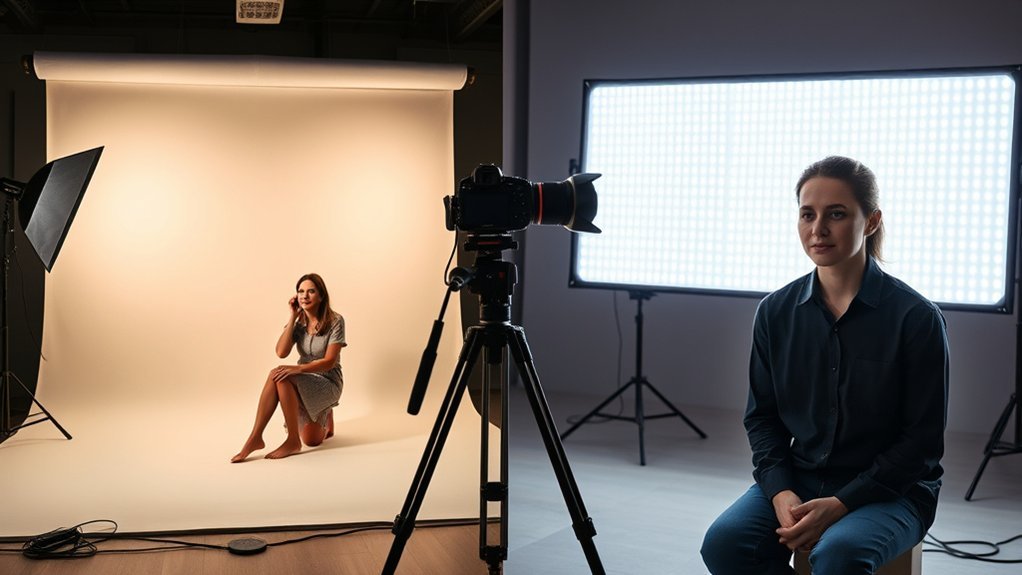
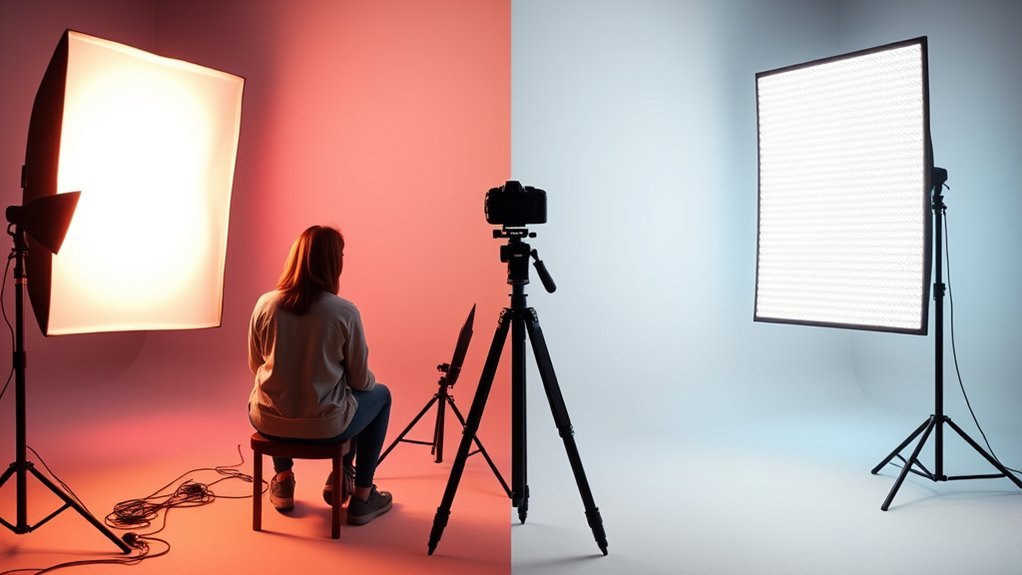
An entry softbox casts a broad, diffused glow that wraps faces, softens shadows, and flatters skin, making it ideal for interviews and tutorials. A basic Playa LED panel throws a tighter, harder beam with faster brightness and color-temperature control, better for small spaces, dramatic contrast, and mobile setups. For video, the choice depends on mood, portability, and precision, with CRI 95+ and high TLCI remaining critical. The fuller comparison reveals where each light performs best.
Softbox vs LED Panel: Which Is Better for Video?
When evaluating softbox vs LED panel lighting for video, the distinction appears first in the shape of the light itself. In a controlled frame, softbox lighting spreads soft light like a window opened at dawn, wrapping faces with flattering light, gentling skin tones, and delivering even coverage that many professional photographers and studio-based video creators trust.
LED panels enter differently: lean, direct, engineered for movement. Their strengths lie in adjustable brightness, rapid shifts in color temperature, and the freedom of portable lighting, especially where locations change and outlets disappear.
For outdoor scenes or agile setups, they offer immediate control and battery-powered independence. Yet without diffusion, their beam can read harder on skin and surfaces.
Softboxes remain the steadier choice for refined, natural-looking illumination in detailed productions, while LED panels better serve fast, dynamic shooting rhythms. The better option depends less on hype than on how freely the production must move.
What Light Quality Do You Need?
Light quality begins with the image’s intent: soft light wraps faces with window-like diffusion and gentle shadow falloff, while hard light cuts sharper edges for shape and drama.
Color accuracy sets the technical floor, with bi-color LEDs in the 3000–6500K range and a CRI above 95 helping skin tones and product hues register true on camera.
From there, shadow control defines the style, whether a softbox smooths contrast for interviews and beauty work or a direct LED panel carves depth for a more graphic frame.
Soft Vs Hard Light
A softbox turns illumination into a broad, wrapping wash that smooths skin, softens blemishes, and lets shadows fall away in gentle shifts; a bare LED, by contrast, throws a tighter, harder beam that carves sharp edges, deepens contrast, and reveals texture in skin, fabric, and background surfaces.
In practice, soft light from softboxes favors portrait photography, flattering skin tones and preserving calm, even rendering across faces. Hard light from direct LED lights creates decisive shadows, stronger highlights, and a more sculpted frame, often useful when a scene needs grit, depth, or dramatic separation.
The choice defines light quality within any lighting setup. For video production, neither approach is inherently superior; each grants different freedoms. Soft light suggests ease and accessibility, while hard light delivers intensity, structure, and visual authority onscreen.
Color Accuracy Needs
Precision matters most once the frame must reproduce skin, fabric, and product color without drift. In liberated image-making, color accuracy begins with Color Rendering Index: CRI above 95 signals dependable fidelity.
For video, LED panels also benefit from TLCI near 100, keeping tones honest on camera and freeing grading from correction.
- CRI measures how faithfully lighting equipment reveals real color.
- TLCI verifies whether video sensors interpret that light accurately.
- Bi-color LED lights span 3000–6500K for ambient matching flexibility.
- Softboxes diffuse output into flattering light for portrait photography.
RGB fixtures can paint over 16 million hues for expressive scenes, yet many lack punch as primary illumination.
When truth matters, softboxes and quality LED panels serve best, balancing technical precision with visual ease for products and people alike daily.
Shadow Control Style
Because shadow shape defines mood as much as exposure, the choice between an entry softbox and a Playa LED setup begins with the quality of illumination required.
In disciplined lighting setups, softbox lighting creates a soft quality of light, wrapping faces while preserving contour. That balance gives portrait photography more dimensionality, stronger shadow control, and cleaner skin rendition.
When Is an LED Panel Better for Video?
When video demands visible, controllable light in the moment, an LED panel often becomes the stronger choice. In motion work, LED panels deliver continuous lighting, so exposure and color can be judged live, not guessed after the take. That immediacy frees creators from delay and suits evolving lighting needs on set.
Their flat form, portable build, and low power draw make these video lights efficient for travel, cramped rooms, and integration into small setups.
- Real-time control supports precise exposure and color accuracy.
- Adjustable brightness and color temperature adapt quickly on location.
- Rapid setup benefits fast-paced video production schedules.
- Compact design allows multiple sources in tight framing.
Where soft-box lighting can demand more space and assembly, LED panels remain a versatile option for documentaries, interviews, product shots, and run-and-gun scenes.
They slip into corners, lift onto lightweight stands, and reshape the frame without slowing momentum. For filmmakers seeking mobility and command, they often answer freedom with precision.
When Is a Softbox Better for Video?
How does a frame change when the light source grows larger? In video, the answer often appears on skin first: shadows relax, texture smooths, and faces gain flattering light without losing dimension.
A softbox becomes the preferred tool when lighting must feel soft yet intentional, especially in interviews and portrait-driven scenes where natural skin tones matter. Its diffusion creates disciplined softness, while the modifier itself preserves control over direction and intensity.
That balance lets a creator sculpt mood instead of merely illuminating subjects. Across extended recording sessions, a softbox also supports stable color accuracy, avoiding distracting shifts that can fracture continuity.
A softbox shapes mood with intention while preserving color consistency, helping every shot feel unified across long recording sessions.
In larger setups, its broad face serves multiple subjects with an even light spread, keeping the frame cohesive and readable. This makes it especially effective for educational, demonstration, and tutorial video, where clarity must feel effortless.
When the goal is professional-quality imagery with freedom to shape the scene, the softbox often leads, with confidence.
How Space, Power, and Portability Affect Your Setup
Light quality may decide the look, but the room, the outlet, and the gear bag often decide the fixture. In a narrow studio, soft-boxes bloom best with breathing space, since diffusion needs distance to wrap cleanly. A compact LED panel slips into cramped corners, preserving movement and framing freedom. That simple spatial reality often becomes the real lighting choice.
- Tight space favors a compact LED panel over larger soft-boxes.
- LED power options often include outlet use or battery operation.
- Adjustable brightness and color shifts speed scene changes.
- Portability matters when setups move from room to street.
On location, power rewrites the plan. Many LED fixtures run on battery, cutting the tether to walls and granting mobility that feels liberating.
Soft-boxes commonly depend on continuous power, which can slow remote shooting. LED also brings adjustable brightness for rapid exposure control, while many panels add color temperature tuning, letting one source adapt quickly as environments change without interruption.
Best Softbox and LED Panel Picks by Budget
A practical budget ladder clarifies the field: at the low end, the Best Studio Softbox Lighting Kit 2×25W with Stands gives beginners broad, forgiving illumination for portraits and product shots, while the Godox LR150 LED Ring Light at $99.95 delivers clean, even facial fill for beauty and lifestyle frames.
Just above, the SANDMARC Prolight Series enters as budget-friendly, entry-level LED panels built for creators who move freely between street, studio, and window light. Its portable RGB and bi-color control expands mood without clutter.
In the middle tier, the Nanlite Compac 24B Colour Adjustable LED Soft Panel at $124.95 acts like a disciplined bridge between softbox diffusion and panel precision, offering versatile lighting and strong color accuracy for indoor photography.
At the top, the Nanlite Lumipad 25 Triple Kit at $799.95 opens a more liberated professional scene: affordable no longer, yet refined, reliable, and technically fluent as a complete lighting kit.
Frequently Asked Questions
Which Is Better, LED Panel Lights or Softbox Lights?
LED panel lights suit mobile creators; softboxes suit studios. Through LED advantages—portability factors, low power consumption, adjustable color temperature, long bulb lifespan, minimal heat generation—against Softbox disadvantages: slower setup time, weaker cost comparison, superior light diffusion.
What Is the Best Softbox for Video Recording?
The best softbox for video recording favors octagonal or rectangular softbox types: gentler lighting diffusion, truer color temperature, balanced light intensity. Portability factors, budget options, brand comparisons, setup tips, maintenance advice, and user reviews guide liberated creators.
What Is the Best Lighting Setup for Video Recording?
The best lighting setup for video recording uses three point lighting, precise light placement, diffusion materials, adjustable color temperature, and natural light balance, maximizing video quality, cinematic effects, equipment portability, and budget considerations through refined lighting techniques.
Are Softboxes Good for Filmmaking?
Yes, softboxes serve filmmaking well: Softbox advantages include Lighting diffusion, Color temperature accuracy, Light control, and Creative lighting for Studio setups. Filmmaking essentials balance Softbox portability, Budget considerations, and Softbox maintenance, freeing visual expression.
Conclusion
In the end, the wiser fixture is simply the one that flatters the frame. LED panels suit tighter quarters, leaner power plans, and faster-footed shoots, offering a brisk, clinical glow. Softboxes, by gentler contrast, wrap subjects in a kinder wash, easing shadows with a more forgiving hand. Space, output, diffusion, and control quietly decide the winner. When those variables are read well, the scene seldom argues; it just settles into its best light.
