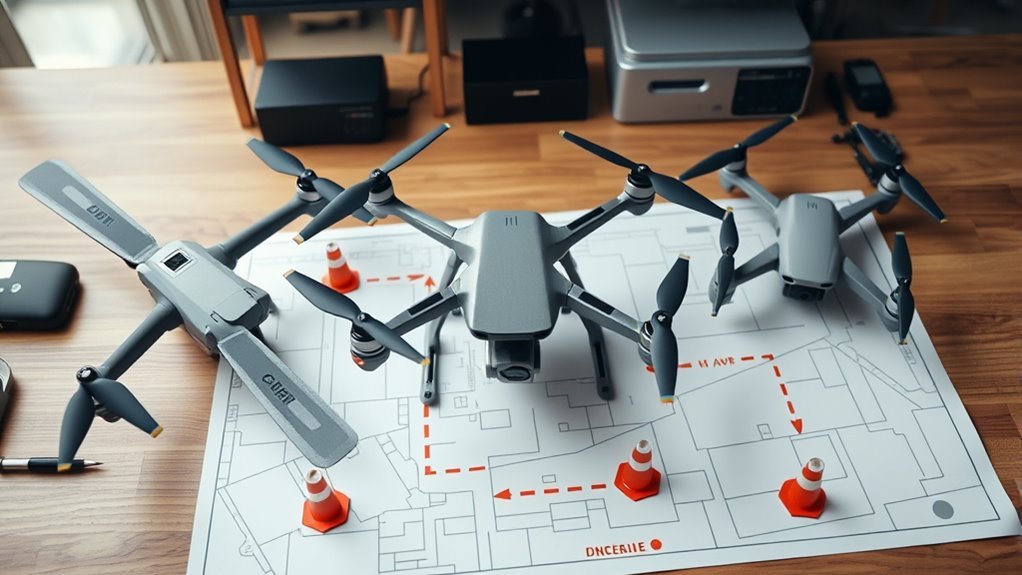
Drone Remote ID has become a core compliance layer in the National Airspace System, but the rules are not identical for every aircraft. Some drones broadcast identification natively, older models depend on add-on modules, and a limited set of FAA-Recognized Identification Areas creates an exception. The real issue is determining which path applies, because the answer changes with weight, registration status, and operation type. That distinction is where the details become important.
What Remote ID Is and Why It Matters

Remote ID is a Federal Aviation Administration requirement that compels drones to broadcast identification and location data, creating a traceable digital presence within the National Airspace System (NAS).
This rule requires identification and location information to be transmitted in near real time, allowing the FAA and authorized observers to support public safety without imposing silence on lawful flight.
For many drones, compliance is achieved through Standard Remote Identification built into the aircraft; older models may use broadcast modules, while operations inside FAA-Recognized Identification Areas provide another lawful path.
The requirement applies to registered drones within the stated weight range and took effect on March 16, 2024.
The requirement applies to registered drones within the stated weight range and took effect on March 16, 2024.
Its purpose is straightforward: enable accountability, reduce airspace ambiguity, and preserve operational freedom through visible, rule-based conduct.
Noncompliance can trigger penalties, including fines and certificate suspension, underscoring that Remote ID is not optional bureaucracy but a technical condition of responsible access to shared airspace.
Who Needs Remote ID?
Remote ID applies to most pilots and operators of registered drones weighing between 0.55 and 55 pounds, unless the aircraft is flown exclusively within an FAA-Recognized Identification Area.
Recreational operators may register multiple drones under a single registration, while Part 107 operators must register each drone individually and meet the applicable compliance deadline.
Compliance requirements also differ by operating category, with newer aircraft generally requiring built-in Remote ID and older models able to use a broadcast module.
Pilots And Operators
For nearly all pilots and operators, compliance with Remote ID is required for drones weighing 0.55 to 55 pounds, since these aircraft must broadcast identification and location data during flight.
Remote ID establishes clear accountability while preserving lawful access to the airspace. Drone pilots using aircraft without native capability may add a Broadcast Module to satisfy Remote ID requirements and maintain compliant operations.
Recreational flyers are exempt only when flying exclusively in FAA-Recognized Identification Areas, where localized freedom is preserved under defined conditions.
Commercial operators face stricter obligations: each drone must be registered individually with the FAA and carry its Remote ID Serial Number.
Enforcement becomes mandatory by March 16, 2024, and violations can trigger fines or suspension of pilot certificates, underscoring the regulatory cost of noncompliance.
Drone Weight Thresholds
Drones weighing 0.55 pounds (250 grams) through 55 pounds (25 kilograms) fall within Remote ID requirements and must broadcast identification and location data during flight, regardless of whether the operation is recreational or commercial.
These weight thresholds define who must comply with Remote ID rules, and they apply to drones manufactured for general use as well as registered fleets.
Drones less than 0.55 pounds are exempt, preserving operational freedom for lighter aircraft. An aircraft flown only inside an FAA-Recognized Identification Area may also remain outside Remote ID compliance if the site conditions are met.
Registered drones must still have the Remote ID serial number recorded. The enforcement deadline was March 16, 2024, establishing clear regulatory closure.
Recreational Vs Part 107
Who needs Remote ID depends on how the aircraft is flown and how much it weighs: recreational pilots must comply when operating drones between 0.55 and 55 pounds, while sub-0.55-pound aircraft used solely for recreation remain exempt. Recreational drone pilots and Part 107 commercial operators must align with the rule, though both may fly in FAA-Recognized Identification Areas without broadcasting ID information. | Category | Requirement |
| — | — |
|---|---|
| Recreational | Remote ID for 0.55–55 lb |
| Part 107 | Remote ID on every registered unit |
| New aircraft | Standard Remote ID drones after December |
| Older aircraft | Remote ID Broadcast Module |
Drones manufactured after December must use Standard Remote ID capability; earlier models need a Remote ID Broadcast Module unless they operate inside FRIAs. Part 107 commercial operators also register each drone separately. Enforcement is real: noncompliance can trigger fines and certificate suspension.
Standard Remote ID Drones Explained
Standard Remote ID drones, manufactured after December 16, 2022, are built with integrated broadcasting systems that automatically transmit identification and location data throughout flight.
These Standard Remote ID drones emit a Remote ID signal containing the Drone ID, latitude and longitude, altitude, velocity, and control station position, meeting FAA regulations without external equipment.
Their broadcasting capabilities support compliance from takeoff to shutdown, reducing operator burden while preserving accountability.
For pilots seeking operational freedom, this architecture enables BVLOS operations where authorized, expanding mission scope beyond close-range line of sight.
Because the data is publicly accessible, authorities and nearby observers can verify airspace activity in real time, improving safety oversight for unmanned aircraft.
Standard Remote ID status thus represents a native compliance pathway: the aircraft itself carries the required functionality, and the operator does not need to add a separate broadcast module.
This built-in design favors streamlined, lawful flight in regulated airspace, especially for advanced operations.
Broadcast Remote ID Modules Explained
For older aircraft that lack built-in Remote ID, Broadcast Remote ID modules provide a compliant retrofit by transmitting identification and position data from an external device.
These Broadcast units are designed for older drones manufactured before December 2022, enabling them to comply with FAA requirements by broadcasting Drone ID, location, and altitude.
A Remote ID module such as the Dronetag Beacon or DroneBeacon db120 must be manually attached and powered on before flight, unlike Standard Remote ID systems that activate automatically.
After installation, FAA registration details should be updated to reflect the equipped module and associated aircraft.
This pathway preserves operational access for pilots seeking autonomy without replacing hardware.
However, use remains constrained by operational limitations, and aircraft relying on a Broadcast module cannot request BVLOS waivers.
The arrangement satisfies regulatory identification needs while acknowledging that liberation in airspace management is conditional, not absolute.
FRIA Sites: Fly Without Remote ID
FAA-Recognized Identification Areas (FRIAs) allow drones to operate without Remote ID equipment, but only within designated boundaries established for recreational and educational use.
These FRIA sites are FAA-Recognized Identification Areas, and they create a lawful space where Remote ID compliance is not required for qualifying drone operations. Access is limited to designated locations established by Community Based Organizations or educational institutions approved by the FAA.
Within those boundaries, pilots may pursue recreational use under a more liberated operating framework, while still remaining inside the defined safe environment. The boundaries matter: drones must stay within the FRIA to preserve compliance with the site’s authorization and to guarantee safe, localized flight activity.
For operators seeking freedom from standard Remote ID constraints, FRIAs provide a practical path. Updated state drone maps, including California’s, help pilots locate approved FRIA areas and verify where compliant drone operations without Remote ID are permitted.
What Remote ID Broadcasts
Remote ID broadcasting is designed to make a drone’s flight identifiable and trackable in real time. Under FAA Remote ID, each message carries broadcast information that supports identification and location: the drone’s serial number or session ID, latitude and longitude, altitude, velocity, and the control station position.
Standard Remote ID refreshes this data once per second, enabling near-live monitoring rather than delayed reporting. Accuracy standards require latitude and longitude within 100 feet and altitude within 20 feet, preserving operational trust. Emergency status indicators may also appear, including lost-link or downed-aircraft conditions, whether triggered manually or automatically.
- Standard Remote ID delivers dynamic in-flight telemetry.
- Broadcast modules provide only takeoff location and elevation.
- Control station data helps separate aircraft from pilot position.
Compared with a broadcast module, Standard Remote ID offers broader, continuously updated identification and location data, reducing ambiguity and strengthening transparent airspace access for everyone.
How to Comply With Remote ID
Compliance with Remote ID begins by selecting an approved path: install built-in Remote ID on drones manufactured after December 16, 2022, add an external broadcast module to older aircraft, or obtain an FAA Letter of Authorization when an exemption is warranted.
Drones between 0.55 and 55 pounds must broadcast Remote ID data unless they are operated exclusively within FAA-Recognized Identification Areas (FRIAs).
Operators must also guarantee registration and aircraft-specific recordkeeping align with their operating category, because noncompliance after March 16, 2024, may trigger enforcement action.
Choose A Compliance Path
Operators have two primary ways to meet Remote ID requirements: use a Standard Remote ID drone with built-in broadcasting capability, or retrofit a non-compliant aircraft with a Remote ID Broadcast Module.
Either path satisfies compliance when paired with FAA registration, which applies to all drones. New drones produced after December 16, 2022, are expected to ship Standard; older aircraft may require a module or firmware update before the September 16, 2023 deadline.
FAA-Recognized Identification Areas remain an authorized option for certain operations, but they do not erase the underlying regulations. Non-compliance can trigger fines and certificate suspension, so the practical choice is disciplined adherence, not improvisation.
- Standard systems simplify operations.
- Broadcast Module upgrades preserve existing airframes.
- Registration keeps identity traceable and lawful.
Fly Within FRIA Limits
Within FAA-Recognized Identification Areas, drones may operate without broadcasting Remote ID signals, provided the aircraft remains inside the FRIA’s defined boundaries. | Condition | Effect | Result |
| — | — | — |
|---|---|---|
| FAA-recognized Community Based Organizations | Establish FRIA | Controlled access |
| Educational institutions | Establish FRIA | Approved operations |
| Drones without Remote ID | Fly inside FRIA | Exempt from broadcasting |
| Defined limits | Maintain position | Compliance preserved |
| Safety and security | Reduce risk | Lawful use |
This framework permits liberated recreational and educational operations while keeping compliance exact. A pilot must treat the FAA-Recognized Identification Area as a fixed envelope; leaving it triggers standard Remote ID obligations. Because only qualified Community Based Organizations and schools may sponsor these zones, the arrangement protects safety and security without denying flight freedom. Within the boundary, drones without Remote ID can be flown lawfully, but precision is mandatory.
Remote ID Registration Rules
FAA registration and Remote ID requirements intersect at the point of aircraft identification: any drone weighing between 0.55 and 55 pounds must be registered for a $5 fee and assigned a unique serial number.
The FAA treats registration as the baseline for compliance, whether the aircraft is flown recreationally or under Part 107. Recreational pilots may place multiple drones under one account, but each machine still needs its own serial number.
Commercial operators must register each drone separately to preserve precise identification. Drones manufactured after December 16, 2022, must include Remote ID capabilities; earlier aircraft must meet the rule by September 16, 2023, through software updates or a broadcast module.
FRIA operations remain distinct, yet registration still matters.
- One airframe, one identity.
- Broadcast modules extend lawful operation.
- Registration supports accountable flight freedom.
When You Can Apply for a Remote ID Waiver
A Remote ID waiver may be appropriate when a drone operation falls within FAA-recognized exceptions such as aeronautical research, regulatory compliance testing, or certain drone light shows conducted under approved waiver conditions.
In these cases, the FAA may authorize relief from Remote ID requirements for narrowly defined drone activities that serve a legitimate operational purpose. Applications must be submitted by email and should clearly describe the operation, the affected aircraft, and the justification for compliance relief.
Formal documentation is essential; deviations from standard rules are not presumed and must be requested through the proper channel. The FAA evaluates specific scenarios against its waiver criteria, so operators should verify current policy before filing.
A well-prepared Remote ID waiver request can preserve operational freedom while maintaining regulatory compliance. For mission-critical or experimental drone activities, timely applications improve the likelihood of approval and reduce uncertainty about lawful flight.
Remote ID Limits and Exceptions
Remote ID requirements apply broadly, but several narrow limits and exceptions shape when compliance is mandatory. Under Federal Regulations, drones weighing under 0.55 pounds are exempt, and drones used exclusively in an FAA-Recognized Identification Area may operate without Remote ID equipment.
However, Remote ID must stay active in flight, even inside that area, because the exemption concerns equipment, not safety oversight.
- Drones without built-in Remote ID may use a Broadcast Module for compliance.
- New aircraft manufactured after December 16, 2022, require built-in Remote ID.
- Existing aircraft must satisfy Remote ID requirements by March 16, 2024, through updates or modules.
These exceptions are limited, not a general release from oversight. Only Community Based Organizations and educational institutions can establish an FAA-Recognized Identification Area.
Operators seeking freedom from continuous identification should note that a Broadcast Module preserves legal operation, but it does not permit Beyond Visual Line of Sight waivers. Compliance remains the baseline rule.
Frequently Asked Questions
What Is the Best Drone Remote ID Module?
The best drone Remote ID module is generally the Dronetag Beacon, with the BlueMark db120 as a strong alternative; both offer clear Remote ID benefits and solid compliance.
Technology comparisons favor the Beacon for Bluetooth and Wi‑Fi versatility, while cost analysis may favor BlueMark.
Compliance challenges, privacy concerns, future regulations, user experiences, industry impact, and implementation strategies should guide selection, registration updates, and installation.
When Can a Person Not Use a Remote ID Broadcast Module?
A broadcast module is a key that does not fit every lock. Under Remote ID regulations, it cannot be used on drones manufactured after December 16, 2022, which require built-in Standard Remote ID.
Broadcast module limitations also bar use on limited Remote Identification UAS, BVLOS-only operations, and any aircraft illegally modified for broadcast.
Pilot responsibilities remain bound by drone flight restrictions, technology compatibility issues, Remote ID enforcement, implementation timelines, privacy concerns, and public perception challenges.
Is the Remote ID Broadcast Module FAA Approved?
Yes. A Broadcast module is FAA approved only when it appears in the FAA Declaration of Compliance, satisfying FAA regulations and compliance requirements for Remote ID types.
This Drone identification technology supports older aircraft, but pilot responsibilities still include proper registration, correct installation, and adherence to safety measures.
The implementation timeline reflects phased adoption, yet approved devices remain limited by operational rules, including BVLOS restrictions, despite broadening access through technology advancements.
Can FAA Know You Flew a DJI Drone?
Yes, the FAA can often know when a DJI drone has flown, because remote ID technology quietly leaves a trace of identity and location.
Under drone regulations, FAA enforcement can match broadcasts to aircraft records, sharpening drone safety and airspace awareness. This raises privacy concerns, yet compliance requirements remain central to pilot responsibilities.
Continued future innovations may expand oversight, but liberation in flight still depends on lawful operation and informed respect.
Conclusion
In the end, Remote ID is less a choice than a threshold. For many drones, compliance will be automatic through Standard Remote ID; for others, a Broadcast Module or FRIA access may be the only viable path. Yet the critical question remains unresolved for some operators: which aircraft, which location, and which rule applies. As enforcement matures, that answer will determine not only legality, but whether a flight can occur at all.
