
Yes, a 3-month-old can ride in a stroller when the stroller is specifically approved for an infant of that age and size. Use a manufacturer-approved bassinet or carriage mode, a compatible infant car seat, or a stroller seat that the manual explicitly allows for young infants in its approved reclined position. Do not use a regular upright seat just because it can recline; the stroller must also meet the manufacturer’s age, weight, and positioning limits. At 3 months, head and neck control is still developing, so secure harnessing and an open, well-aligned airway matter on every ride.
Last updated: September 11, 2026. Safety guidance checked against the American Academy of Pediatrics (AAP), U.S. Consumer Product Safety Commission (CPSC), and CDC developmental milestones.
Quick Answer
Yes—if the stroller configuration is approved by its manufacturer for a 3-month-old. Use an approved bassinet/carriage, compatible infant car seat, or infant-rated reclined stroller seat. Avoid a regular upright seat until your baby has steady head and trunk control and the stroller manual allows that position.
Key Takeaways
- Use only a stroller mode the manufacturer approves for your baby’s age and size; a deep recline alone does not make a seat newborn-safe.
- For a 3-month-old, the usual options are an approved bassinet/carriage, compatible infant car seat, or an infant-rated reclined stroller seat.
- Always use the harness as directed, engage the brake when stopped, and confirm the frame and seat are locked in place.
- A more upright seat requires steady head and trunk control plus manufacturer approval; there is no single birthday that fits every baby or stroller.
- If your baby was premature or has breathing, feeding, muscle-tone, or developmental concerns, ask your pediatrician about positioning before changing stroller modes.
At a Glance
| Best Stroller Setup | Manufacturer-approved bassinet/carriage, compatible infant car seat, or infant-rated reclined stroller seat |
| Avoid | Upright stroller seats without full head, neck, and trunk support |
| More Upright Seat Readiness | Steady head and trunk control, secure harness fit, no slumping, and manufacturer approval for that seat position |
| Safety Must-Haves | Harness, working brakes, stable frame, correct recline, and manufacturer-approved infant use |
Can a 3-Month-Old Use a Stroller Safely?
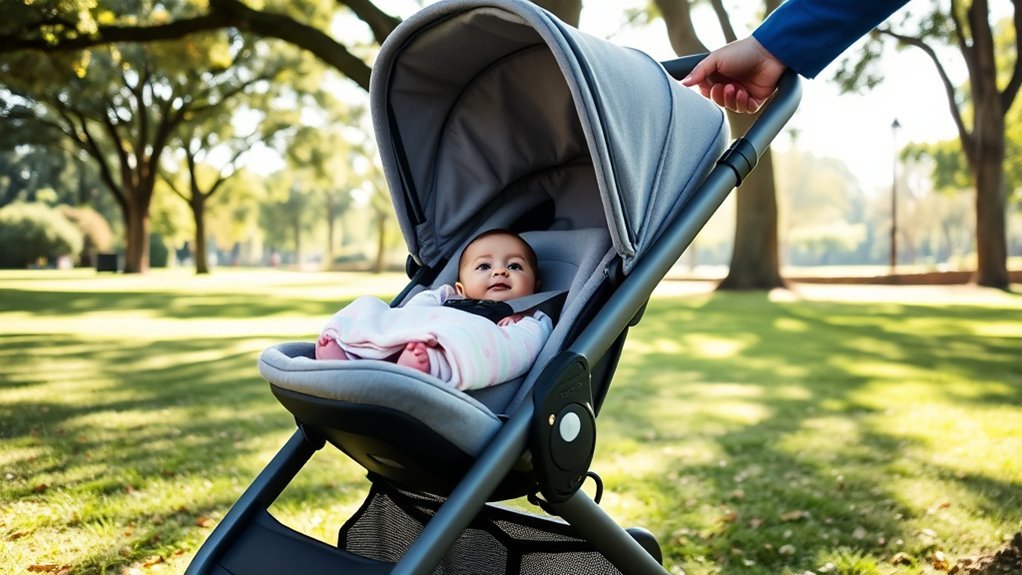
A 3-month-old can use a stroller safely only in a configuration the manufacturer approves for a young infant. The deciding factors are the stroller’s instructions, your baby’s size and development, secure restraint, and whether the baby can stay well aligned without the head falling forward or the body slumping.
Do not rely on recline angle alone. Some stroller seats recline deeply but are still labeled for older babies. Check the manual for the minimum age or developmental requirement, the weight range, the approved recline setting, and any required attachment. If the regular seat is intended only for a child who can sit or hold the head steady, use the approved bassinet/carriage or compatible infant car seat instead.
The CPSC stroller standard addresses hazards involving stability, brakes, restraint systems, latches, folding mechanisms, structural integrity, and wheels. The AAP also advises using the stroller harness on every ride and engaging the brake whenever the stroller is stopped. See the CPSC carriage and stroller guidance and the AAP stroller safety guidance.
Warning: Do not place a 3-month-old in a stroller position that lets the head fall forward, the chin press toward the chest, or the body slump. Infants younger than 4 months are especially vulnerable to unsafe positioning in sitting devices. If the setup does not keep your baby well aligned, stop and use a manufacturer-approved infant configuration.
Recommended Stroller Types for Infants

For a 3-month-old, choose by approved infant configuration, not by stroller style alone. A bassinet/carriage, compatible infant car seat, or reclined stroller seat can all be appropriate when the manufacturer specifically permits that setup for your baby’s age and size. A seat that merely looks flat or supportive is not enough if its manual sets a later minimum age.
Prioritize a secure harness, reliable parking brake, stable frame, locking fold mechanism, and an approved recline or attachment. Before the first ride, check the minimum age, weight range, recline instructions, and compatibility list in the manual.
Suitable Stroller Types
For a 3-month-old, these are the three common stroller configurations to check:
- Bassinet or carriage mode: Use it only within the manufacturer’s stated age and weight limits. This option keeps a young infant in a supported, more horizontal position during a walk.
- Infant-rated reclined stroller seat: Some stroller seats are approved for young infants at a specific recline. Confirm that approval in the manual; do not assume every “near-flat” or “full-recline” seat is suitable from birth.
- Compatible infant car seat on the stroller frame: Use only the stroller/car-seat combination and adapters approved by the manufacturers. A car seat remains a sitting device and should not become a routine sleep space.
Before buying or changing modes, check the minimum-use requirements, harness fit, recline instructions, adapter compatibility, and whether any insert is specifically approved for that model.
Safety Features Required
Although a 3-month-old is generally too young for a regular upright stroller seat, stroller use can be appropriate when the product has a manufacturer-approved infant configuration. Look for a clearly approved bassinet/carriage, infant-rated recline or compatible car-seat setup, plus secure harnessing, strong brakes, and explicit age and weight guidance.
| Safety Feature | Importance |
|---|---|
| Infant-Approved Recline or Bassinet | Provides an age-appropriate position when used exactly as the manufacturer directs |
| Secure Harness System | Helps prevent slipping, sliding, and unsafe movement |
| Regular Inspections | Keeps the stroller safe, stable, and functional |
Before each outing, make sure the stroller opens fully, locks in place, rolls smoothly, and brakes correctly. Confirm that the approved infant attachment or recline is locked in its intended position and that the harness fits according to the manual.
Pro Tip: Before buying a stroller, test the recline, buckle, brake, and fold mechanism in person if possible. A stroller that looks safe online should also feel stable and easy to use with one hand when you are holding baby gear.
Developmental Milestones for Stroller Use

Development gives useful context, but it does not override the stroller manual. CDC milestones show why a 3-month-old should not be treated like an older sitter: by 4 months, most babies can hold the head steady without support while being held; by 6 months, most can lean on their hands for support while sitting; and by 9 months, most can sit without support. These are population milestones, not stroller clearance tests.
| CDC Milestone Age | Movement Milestone | What It Means for Stroller Decisions |
|---|---|---|
| 4 months | Holds head steady without support while being held | Head control is emerging, but use only stroller positions approved for your baby’s age and development. |
| 6 months | Leans on hands to support sitting | Many babies have more trunk control, but a more upright stroller still depends on the manual and stable posture. |
| 9 months | Sits without support | Independent sitting is common by this milestone age, but stroller limits still apply. |
Sources: CDC milestones by 4 months, CDC milestones by 6 months, and CDC milestones by 9 months. If your baby slumps, slides, loses head control, or cannot maintain a clear airway in the approved seat position, return to a more supportive manufacturer-approved configuration.
Signs Your Baby Is Ready for an Upright Stroller

Move toward a more upright stroller position only when both the baby and the stroller are ready. First, the stroller manual must allow your baby’s age, weight, and developmental stage in that seat position. Second, your baby should keep the head steady, stay centered in the seat, and maintain a secure harness fit without slumping.
Watch posture during the ride, not only before it. If the chin drops toward the chest, the head repeatedly falls to one side, the body slides down, or the harness no longer sits correctly, use a more supportive approved position.
Do not use independent sitting as a rigid age deadline. CDC lists supported sitting with the hands as a 6-month milestone and sitting without support as a 9-month milestone for most babies. Your stroller’s instructions may set different minimum-use criteria, and those product-specific rules should control the transition.
Note: If your baby was born more than 3 weeks prematurely, CDC milestone materials advise using corrected age when tracking development. Ask your pediatrician if prematurity or any breathing, feeding, muscle-tone, or developmental concern makes stroller positioning uncertain.
Transitioning From Bassinet to Stroller Seat

When your baby demonstrates steady head and trunk control, you can consider moving from the bassinet or infant setup toward a more upright stroller position—but only if the stroller manual permits it. Do not make the switch based on age alone.
Here are three key considerations for a smooth change:
- Monitor Comfort: Observe how your baby reacts to the new seating arrangement. Some infants may still prefer the bassinet’s lying position at first.
- Choose the Right Stroller Position: Use only a reclined or semi-reclined position the manufacturer approves for your baby’s age and size. Avoid moving more upright if your baby cannot stay stable.
- Follow the product instructions: Confirm the minimum age or developmental requirement, weight limit, approved recline, and harness setup before changing positions. Ask your pediatrician for individualized advice if development or health concerns affect positioning.
Prioritize infant comfort and safety during this change. A gradual transition is often best. Start with shorter walks in a slightly raised position, then watch your baby’s posture, breathing, mood, and head control.
Importance of Head and Neck Support
At 3 months, head and neck control is still developing. The goal is not to prop the baby upright with extra padding; it is to use the stroller’s approved infant configuration so the baby stays aligned and securely restrained. Use only manufacturer-approved inserts or accessories, because aftermarket padding can change harness fit and positioning.
Head Control Development Timeline
As your baby approaches the 3-month mark, you may notice that head control is still developing. This makes proper support crucial during stroller rides. At this stage, your little one may not have enough head and neck strength for safe upright seating. Here is what you should know about head control during these developmental stages:
- Development timeline: CDC lists holding the head steady without support while being held as a milestone most babies reach by 4 months.
- Support recommendation: At 3 months, use only the stroller configuration the manufacturer approves for that age and size, such as an approved bassinet/carriage, compatible infant car seat, or infant-rated reclined seat.
- Safety monitoring: Before and during any transition toward upright seating, make sure your baby stays centered, keeps the head steady, and does not slump.
If your baby’s head drops forward or the chin presses toward the chest, stop and change to a more supportive approved configuration. Do not solve slumping by adding an unapproved pillow, insert, or rolled padding.
Safe Stroller Features
A stroller’s design plays a vital role in your baby’s safety and comfort, especially for a 3-month-old who still lacks steady head and neck control. To support infant comfort, look for strollers that provide a secure, reclined, and stable position.
| Feature | Importance | Stroller Accessories |
|---|---|---|
| Infant-Approved Position | Matches the stroller’s age, size, and recline instructions for young infants | Manufacturer-approved inserts only |
| Infant Car Seat Compatible | Supports young babies during short transfers and walks | Approved adapters only |
| Age and Weight Specifications | Confirms whether the stroller is suitable for infant use | Safety harness systems |
| Regular Inspections | Maintains stroller safety and stability | Basic cleaning and maintenance tools |
| Secure Harnessing | Reduces the risk of slipping or injury | Correctly adjusted straps |
Importance of Supportive Seating
Supportive seating for a 3-month-old means using the stroller exactly as designed for a young infant. Do not try to turn an older-baby seat into an infant seat with loose blankets, pillows, or third-party padding.
Use this three-part check:
- Approved configuration: The manual specifically permits your baby’s age, size, and the selected bassinet, car-seat attachment, or seat position.
- Stable posture: Your baby stays centered, the head remains aligned, and the chin does not collapse toward the chest.
- Correct restraint: The harness is routed and tightened according to the stroller or car-seat instructions, with no unapproved padding interfering with the fit.
If any part of this check fails, use a different manufacturer-approved configuration and consult the product manual or your pediatrician before trying a more upright position.
Evaluating Stroller Features and Compatibility
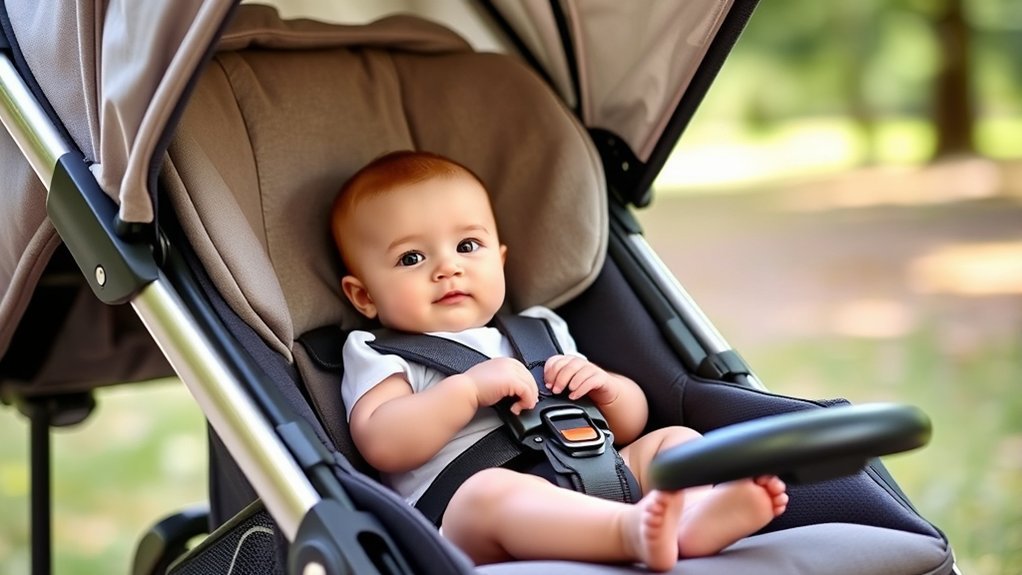
When evaluating a stroller for a 3-month-old, start with infant compatibility in the manual. A bassinet option, car-seat adapter, or deep recline is useful only when the manufacturer approves that exact configuration for your baby’s age and size.
Always review the weight and age limits specified by the manufacturer. Do not assume every stroller seat is safe from birth. Some stroller frames accept an infant car seat from birth but do not allow use of the regular toddler seat until later. This difference matters.
Look for strollers with snug inserts only when the insert is approved by the stroller or car seat manufacturer. Unapproved padding, pillows, or rolled blankets can shift and create unsafe positioning. Modular strollers are a great option because they allow you to move between bassinet, car seat, and upright seating as your baby grows. Your baby’s head and neck control should guide the setup you choose now and in the future.
How to Position a 3-Month-Old in a Stroller
Correct positioning starts with the stroller’s instructions. Use the infant-approved position or attachment specified for your baby’s age and size. Make sure your baby’s head stays aligned with the body, the face remains visible, and the chin does not collapse toward the chest.
- Use the approved infant setup: Use the bassinet/carriage, compatible infant car seat, or stroller-seat recline only if the manufacturer approves it for a 3-month-old.
- Fasten the harness: The harness should be snug enough to prevent sliding but not so tight that it restricts breathing or movement.
- Check the airway: Your baby’s chin should not be pressed into the chest. You should be able to see that your baby is resting comfortably.
- Keep the stroller stable: Avoid hanging heavy bags on the handle. Store items in the basket if the stroller allows it.
- Watch for discomfort: Fussing, slumping, sliding, or head flopping can mean your baby needs a different stroller position.
Safety Precautions When Using a Stroller
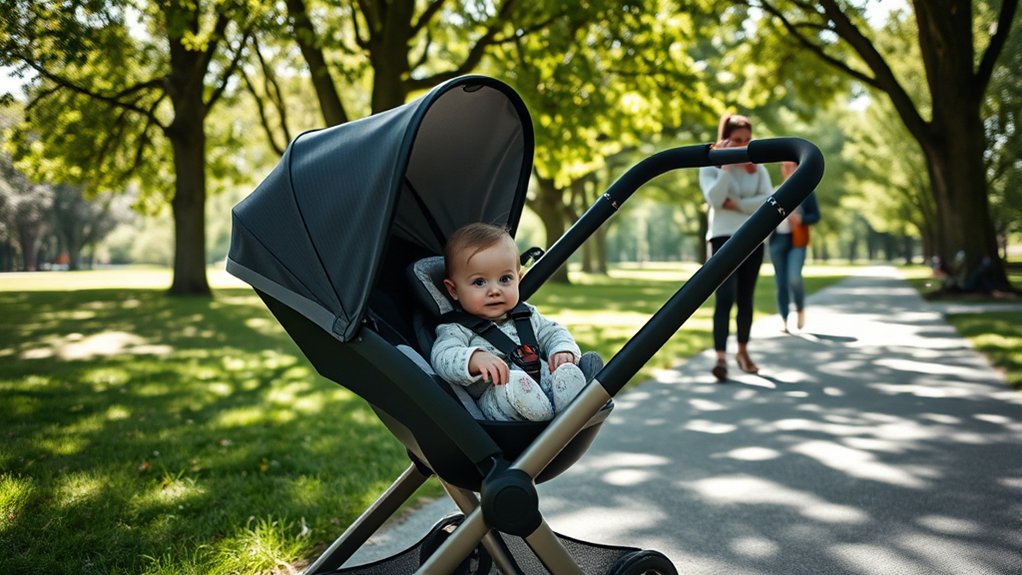
The CPSC’s stroller rules focus on hazards involving restraints, brakes, stability, latches, folding mechanisms, structural integrity, wheels, and openings. For everyday use, these three checks matter most:
- Harness Safety: Always secure your baby with the harness system. This helps prevent slipping or falling and keeps your little one properly positioned.
- Parking Brake: Use the parking brake whenever the stroller is stopped or unattended. This helps prevent accidental rolling.
- Stroller Maintenance: Regularly inspect the stroller for wear and tear. Make sure all components work correctly to maintain safety and reliability.
Also avoid hanging heavy items from the handles because they can increase tipping risk. Keep hot drinks away from the stroller, stay alert at curbs and uneven surfaces, and do not leave your baby unattended. Before using a second-hand stroller, check the model and any recall information through the CPSC recalls database.
Common Stroller Mistakes to Avoid
Even a safe stroller can become risky if it is used the wrong way. Avoid these common mistakes when strolling with a 3-month-old:
- Using the upright seat too early: A young baby may slump or lose head control in a seat that is too vertical.
- Skipping the harness: Even calm babies can wiggle, slide, or shift during a walk.
- Adding unapproved padding: Extra pillows, inserts, and blankets can change the stroller’s fit and may affect breathing or stability.
- Ignoring the manual: Age, weight, recline, and car seat adapter rules vary by stroller model.
- Overloading the handlebar: Heavy bags can make the stroller tip backward.
- Treating a stroller or car seat as a routine sleep space: The AAP advises that sitting devices, including car seats and strollers, should not be used for routine sleep, especially for infants younger than 4 months. If your baby falls asleep in a sitting device, move them to an appropriate firm, flat sleep surface as soon as it is safe and practical.
What Current Safety Guidance Says

Three evidence-backed points are more useful than unsourced parent anecdotes. First, the AAP’s HealthyChildren stroller guidance recommends a five-point harness, using the brake whenever stopped, a wide stable base, and keeping bags off the handle.
Second, the CDC 4-month milestone guidance lists holding the head steady without support while being held as a milestone most babies reach by 4 months. That does not mean every 4-month-old is cleared for an upright stroller; the stroller manual and the baby’s posture still decide the safe position.
Third, the AAP advises against using sitting devices—including strollers and car seats—as routine sleep spaces, particularly for infants younger than 4 months. If a baby falls asleep in a sitting device, move them to an appropriate firm, flat sleep surface as soon as it is safe and practical. See the AAP safe-sleep evidence base.
Supporting Your Baby’s Growth With the Right Stroller
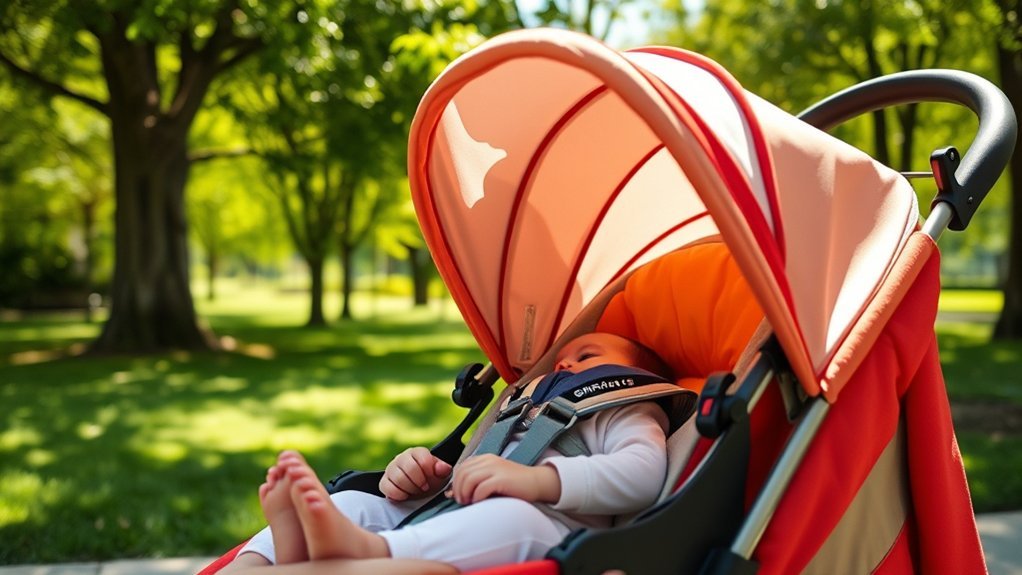
For a 3-month-old, make decisions in this order: (1) manufacturer approval, (2) secure posture and airway, (3) correct harness fit, and (4) your baby’s developmental control. A deep recline, bassinet, or car-seat attachment is useful only when that exact setup is approved for your baby.
Importance of Head Control
Head control matters because a young baby cannot reliably correct a poor seated position. Use these three checks:
- Head stays aligned: The head does not repeatedly fall forward or sharply to the side during normal stroller movement.
- Body stays centered: Your baby does not slide down, twist, or collapse against the harness.
- Manual allows the position: Even strong head control does not override a stroller’s minimum-age, weight, or developmental requirements.
If any check fails, return to the approved infant configuration rather than adding extra padding or forcing a more upright angle.
Choosing Appropriate Stroller
Use the stroller manual as the final product-specific authority. Confirm whether the regular seat itself is approved for a 3-month-old or whether infant use requires a bassinet, carriage conversion, car seat, adapter, or approved insert.
Also check the minimum and maximum weight, harness routing, recline limits, attachment compatibility, and any warnings about sleep or unattended use. If the manual is missing, search the manufacturer’s official support page by the exact stroller model rather than relying on a retailer description.
For related age stages, see how to use a stroller for a newborn safely and when a baby can sit forward in a stroller.
Stroller Readiness Checklist
Before taking your 3-month-old out in a stroller, use this simple checklist:
- The exact stroller configuration is approved for your baby’s age, weight, and developmental stage.
- You are using the manufacturer-approved bassinet/carriage, compatible infant car seat, or infant-rated stroller-seat position.
- Your baby’s head and neck are supported.
- The harness is snug and correctly placed.
- The stroller frame is locked open.
- The brakes work before you leave home.
- No heavy bags are hanging from the handlebar.
- Your baby is dressed for the weather without bulky layers that affect harness fit.
- You can see your baby’s face, and the chin is not collapsed toward the chest.
- You stop and reposition your baby if they slump, slide, lose head control, overheat, become too cold, or seem uncomfortable.
- You do not use the stroller or car seat as a routine sleep space; if your baby falls asleep in a sitting device, move them to an appropriate firm, flat sleep surface as soon as it is safe and practical.
Related Guides
Frequently Asked Questions
Can a 3-Month-Old Sit in a Stroller?
A 3-month-old can ride in a stroller, but usually should not use a regular upright seat. Use only a manufacturer-approved infant setup, such as a bassinet/carriage, compatible infant car seat, or stroller-seat position specifically approved for that age and size. Secure the harness and make sure the baby does not slump or let the chin fall toward the chest.
What Are the Risks of Using an Upright Stroller Too Early?
Using a seat that is too upright can let a young baby slump, slide, or lose head control. If the head falls forward and the chin presses toward the chest, the position can compromise the airway. Use the manufacturer-approved infant configuration until your baby has the required control and meets the stroller’s instructions for a more upright seat.
How Long Can a 3-Month-Old Stay in a Stroller?
There is no universal evidence-based stroller time limit that applies to every 3-month-old and every stroller. Follow the product instructions, monitor your baby’s posture, temperature, feeding needs, and comfort, and stop if they slump or seem distressed. If the baby is in a car seat or another sitting device and falls asleep, the AAP advises moving them to an appropriate firm, flat sleep surface as soon as it is safe and practical.
Can I Use a Stroller Without a Car Seat for My Baby?
Yes, if the stroller has a bassinet/carriage or stroller-seat configuration that the manufacturer specifically approves for a 3-month-old. A deep recline by itself is not enough; check the minimum age, weight, and position requirements in the manual.
What Age Is Safest for Transitioning to an Upright Stroller Seat?
There is no single safest age for every stroller. A more upright seat should be used only when the stroller manual allows it and your baby can keep the head and trunk steady without slumping. CDC milestones provide context: most babies hold the head steady while being held by 4 months, lean on their hands while sitting by 6 months, and sit without support by 9 months.
Is a Bassinet Stroller Better Than an Infant Car Seat Stroller?
Neither option is automatically “better” for every family. Use the configuration approved by the manufacturer for your baby. A bassinet/carriage keeps a young infant in a more horizontal position, while a compatible infant car seat can simplify car-to-stroller transfers. A car seat is a sitting device and should not be used as a routine sleep space.
Is It Safe for a 3-Month-Old to Sleep in a Stroller?
A stroller or infant car seat should not be used as a routine sleep space. The AAP specifically advises against routine sleep in sitting devices, particularly for infants younger than 4 months. If your baby falls asleep in a sitting device, move them to an appropriate firm, flat sleep surface as soon as it is safe and practical.
Can I Put Extra Pillows or Blankets Around My Baby in the Stroller?
Avoid adding loose pillows, thick blankets, or unapproved inserts around your baby. These items can shift and create unsafe positioning. Use only the stroller or car seat manufacturer’s approved inserts, and dress your baby in safe layers instead.
Conclusion
A 3-month-old can ride in a stroller when the exact configuration is approved by the manufacturer for that baby’s age and size. For many families, that means an approved bassinet/carriage, compatible infant car seat, or infant-rated reclined stroller seat—not a regular upright seat.
Before each outing, confirm the manual, lock the frame and attachment, use the harness correctly, check the brake, and watch your baby’s head and body position. If the baby slumps or the chin falls toward the chest, stop and switch to a more supportive approved setup. If your baby falls asleep in a sitting device, follow AAP safe-sleep guidance and move them to an appropriate firm, flat sleep surface as soon as it is safe and practical.
