
A Baby Jogger City Select-family stroller can recline to support a child comfortably during travel, but a stroller seat should not be treated as a regular infant sleep space. If a baby falls asleep while riding, keep the safety harness correctly fastened, watch the baby’s head and airway, and move the baby to a firm, flat, level sleep surface as soon as practical.
Quick Answer
There is no stroller-seat position that turns a City Select into a routine safe-sleep space for an infant. Recline the seat according to the stroller manual, keep the harness fastened, prevent chin-to-chest slumping, and transfer a sleeping baby to an approved firm, flat sleep surface as soon as practical.
Key Takeaways
Key Takeaways
- A reclined stroller seat can improve positioning during travel, but it is not a substitute for an approved infant sleep surface.
- Always use the stroller’s safety harness exactly as the manufacturer instructs.
- Watch for chin-to-chest slumping, a covered face, overheating, or any change in breathing or color.
- Do not add pillows, sleep positioners, loose blankets, cushions, or extra padding.
- If an infant falls asleep in the stroller, move the baby to a firm, flat, level crib, bassinet, portable crib, or play yard as soon as practical.
- Use an infant car seat for transportation, not as a routine sleep space outside the vehicle.
Warning: Reclining a stroller seat does not make it an approved infant sleep surface. Young babies can slump forward in seated or semi-reclined products, placing the chin toward the chest and potentially interfering with breathing.
What Sleep Position Is Safe in a Select Stroller?
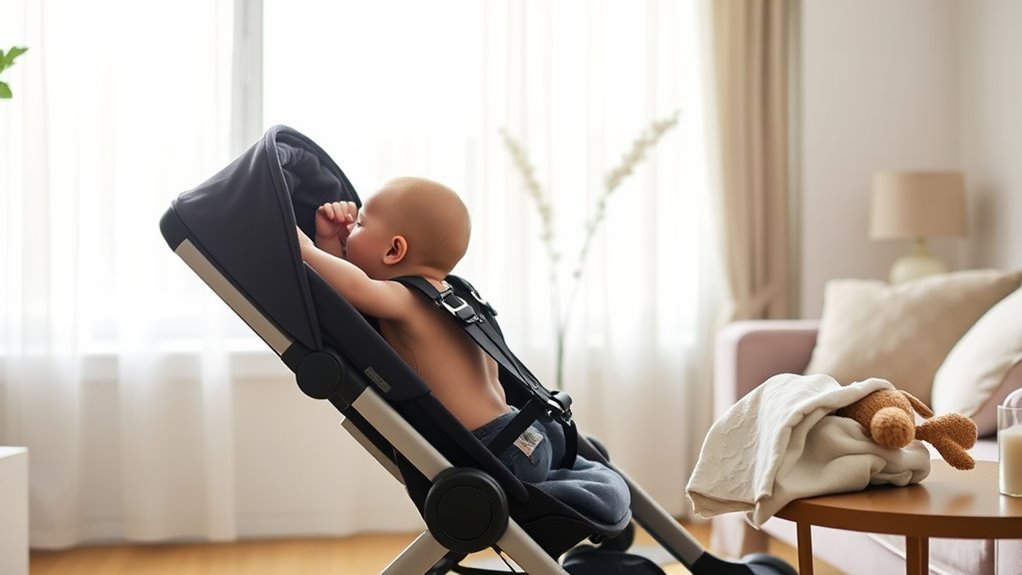
For travel in a Baby Jogger City Select-family stroller, use the seat position required by the manual for your child’s developmental stage. On the City Select 2, Baby Jogger instructs caregivers to use the seat in its most reclined position until the child can sit up unaided, roll over, or push up on hands and knees.
That instruction is about safe stroller positioning; it does not mean the stroller becomes a crib or other dedicated sleep space. Baby Jogger also states that the stroller does not replace a cot or bed and that a child who needs to sleep should be placed in a suitable pram body, cot, or bed.
During stroller use, the child’s head should not be allowed to slump forward with the chin pressed toward the chest. Keep the face uncovered and make sure nothing blocks the nose or mouth.
The stroller’s safety harness should remain correctly adjusted and fastened. Do not loosen or remove it because the child falls asleep.
No pillow, rolled blanket, head positioner, cushion, or other unapproved accessory should be placed around the baby to hold the head in position. Added soft objects can introduce suffocation or entrapment hazards.
A more reclined stroller position can help reduce slumping during travel, but the safest place for routine infant sleep remains a firm, flat, level surface designed and approved for sleep.
Can the Select Stroller Recline for Naps?
Yes. City Select-family strollers have reclining seats, and the current City Select 2 includes an adjustable seat recline and calf support. Recline is useful when a child needs a more comfortable riding position or when a young child requires the most-reclined setting under the manufacturer’s instructions.
However, the recline feature should not be interpreted as approval for planned or extended infant naps in the stroller. A baby may naturally doze while a caregiver is walking or traveling, but once a suitable sleep space is available, the baby should be transferred.
- Use the recline position required for the child’s developmental stage.
- Keep the safety harness correctly fastened.
- Watch for forward head slumping or an obstructed face.
- Do not cover the stroller with a heavy blanket to make it darker.
- Transfer a sleeping infant to a firm, flat sleep surface as soon as practical.
The stroller’s canopy and peekaboo opening can help with shade and visibility, but they do not change the safe-sleep recommendation.
Note: City Select, City Select LUX, and City Select 2 are different models. Recline positions, child-age guidance, accessories, and weight limits can differ, so check the manual that matches the model number and manufacture date on your stroller.
How to Adjust the Seat for Naps
On the Baby Jogger City Select 2, the seat recline button is located at the top of the seat behind the canopy. Squeeze the button, lower or raise the seat, and let it click securely into the desired position.
- Park the stroller safely. Engage the parking brake before making adjustments while the stroller is stopped.
- Check the child’s position. Make sure the harness is correctly fastened and adjusted.
- Use the recline control. Move the seat to the position required by the stroller manual and the child’s developmental stage.
- Confirm that the seat locks. Make sure it clicks securely into place.
- Check the head and airway. The baby should not be folded forward with the chin pressed into the chest.
- Transfer for sleep. If an infant remains asleep, move the baby to an approved flat sleep surface when practical.
The adjustable footwell can be positioned for comfort, but it should not be used with extra padding or accessories that Baby Jogger has not approved.
Pro Tip: Take a photo of your stroller’s model-number label and keep the correct manual on your phone. This makes it easier to check the approved recline position, weight limit, compatible accessories, and warnings while traveling.
When a Bassinet or Car Seat Is Better
A sleep-approved bassinet and an infant car seat serve different purposes. A bassinet that meets applicable infant-sleep standards provides a firm, flat, level sleeping surface. An infant car seat is designed primarily to restrain and protect a baby during transportation.
If your stroller accepts a bassinet or pram body, confirm in the manufacturer’s instructions whether that exact accessory is approved for sleep. A stroller attachment that merely looks flat should not automatically be assumed to be a safe sleep product.
A compatible infant car seat can make vehicle-to-stroller transfers convenient, but it should remain properly attached and used only as instructed. Once travel is over and a baby is sleeping, transfer the infant to a proper sleep surface rather than leaving the baby in the car seat for routine sleep.
Bassinet For Newborns
For newborn sleep, an approved bassinet is generally more appropriate than a stroller seat because a sleep-approved bassinet provides the firm, flat and level surface recommended for infants.
- Place the baby on the back for sleep.
- Use only the mattress or pad supplied or approved for that bassinet.
- Keep pillows, toys, loose blankets and positioners out.
- Follow the bassinet’s weight, age and developmental limits.
- Stop using the bassinet when the manufacturer’s stated limit or developmental milestone is reached.
If using a City Select-compatible pram or bassinet attachment, verify that the exact accessory is approved for sleep in your country and follow its separate manual.
Car Seat For Travel
An infant car seat is the appropriate restraint for vehicle travel when correctly installed and used according to its instructions. Compatible adapters may also allow an infant car seat to attach to a City Select-family stroller.
That convenience does not make the car seat a routine sleep surface outside the vehicle. Babies commonly fall asleep during car travel, but after reaching the destination they should be moved to a firm, flat sleep surface as soon as practical.
Always verify stroller-and-car-seat compatibility using the current Baby Jogger compatibility information. Do not assume an adapter is safe merely because the car seat appears to fit.
How to Keep Naps Safe on the Go
The safest approach to on-the-go sleep is to plan for a proper sleep surface whenever possible. If an infant unexpectedly dozes in the stroller during a walk or errand, continue to use the stroller exactly as the manufacturer instructs and transfer the baby when you can.
- Keep the safety harness correctly fastened.
- Use the appropriate seat recline for the child.
- Keep the baby’s face uncovered and visible.
- Watch for chin-to-chest slumping.
- Do not add pillows, head supports, loose blankets or padding.
- Avoid overheating; use suitable clothing instead of covering the stroller with a heavy blanket.
- Never leave a child unattended in the stroller.
- Use the parking brake whenever the stroller is stopped.
- Move a sleeping infant to a firm, flat sleep surface as soon as practical.
For routine naps and nighttime sleep, place the infant on the back in a crib, bassinet, portable crib, play yard, or other sleep product that meets applicable safety standards.
Note: If your baby was born prematurely or has breathing, airway, muscle-tone, neurological, or other medical concerns, follow the positioning and sleep instructions provided by the baby’s pediatrician or specialist.
Common Sleep Mistakes
The biggest mistake is treating a stroller like a crib. Recline, a secure harness, and supervision are important during stroller travel, but they do not turn the seat into a dedicated infant sleep environment.
| Mistake | Risk | Safer practice |
|---|---|---|
| Unattended nap | Position can change without the caregiver noticing | Keep the child supervised and transfer for sleep |
| Loose harness system | Sliding, slumping or falling | Adjust and buckle the harness correctly |
| Heavy blanket cover | Reduced airflow and overheating | Use the stroller canopy and suitable clothing |
| Poor seat back angle | Forward slumping and poor positioning | Follow the exact stroller manual |
| No breathing or position checks | Changes may go unnoticed | Check the face, head and posture regularly |
| Adding pillows or positioners | Suffocation or entrapment hazard | Use only manufacturer-approved equipment |
| Leaving baby asleep after reaching the destination | Prolonged sleep in a sitting device | Transfer to a firm, flat sleep surface |
Regularly checking the baby’s face, posture and breathing is sensible whenever the child is riding in the stroller. If the baby looks unusually pale or blue, has abnormal breathing, becomes difficult to wake, or appears to be in distress, remove the baby from the stroller and seek emergency medical help.
When to Move Baby to a Crib
You do not need to wait until a baby reaches 4 to 6 months, starts rolling, or outgrows the stroller before using a crib for sleep. A suitable crib, bassinet, portable crib or play yard is the preferred sleep location from infancy whenever the baby is sleeping.
If the baby falls asleep while riding in the stroller, transfer the baby to a firm, flat, level sleep surface as soon as practical. Place the baby on the back when putting them down to sleep.
Rolling is a separate safe-sleep issue. Babies should still be placed on their backs at the start of every sleep. Once a baby can independently roll both from back to stomach and from stomach to back, caregivers generally do not need to repeatedly turn the baby back over after the baby changes position independently in an otherwise safe sleep space.
- Do not use rolling as the trigger for switching from stroller sleep to crib sleep.
- Use a proper sleep surface from the beginning.
- Always start infant sleep on the back.
- Keep the sleep area free of loose bedding, pillows, toys and positioners.
Frequently Asked Questions
Do City Select Seats Recline?
Yes. City Select-family stroller seats recline, although the mechanism and approved positions depend on the exact model. On the City Select 2, the recline control is located at the top of the seat behind the canopy. Recline the seat according to the manual and make sure it locks into position.
What Are the Key Differences Between the City Select and City Select Lux Strollers?
They are separate Baby Jogger models with different manuals, features, accessories and model-year specifications. Do not apply the age, weight, recline or accessory instructions from one model to another. Check the model label on your stroller and use the matching Baby Jogger manual.
What Are People Saying About the Baby Jogger City Select Double Stroller?
Owner feedback varies by City Select generation. Families often value the modular seating and ability to expand the stroller, while some owners mention weight, maneuverability, accessory cost or accessory availability. User reviews can help with convenience and ownership questions, but the manufacturer’s manual should be the source for safety limits and approved configurations.
How to Position Baby in Stroller?
Fasten and correctly adjust the safety harness, use the recline position required by the stroller manual, support the child with only manufacturer-approved equipment, and keep the face and airway clear. Do not add pillows or positioners. If an infant falls asleep, transfer the baby to a firm, flat sleep surface as soon as practical.
Is a Fully Reclined Stroller Safe for Infant Sleep?
A fully reclined stroller seat may provide better positioning during travel, but it should not automatically be considered an approved infant sleep surface. For routine sleep, use a firm, flat, level crib, bassinet, portable crib or play yard that meets applicable safety standards.
What Should I Do If My Baby Falls Asleep During a Walk?
Keep the stroller harness correctly fastened, watch the baby’s head and airway, and avoid adding soft items. When a suitable sleep space is available, transfer the baby to a firm, flat surface and place the baby on the back.
Conclusion
In a Baby Jogger City Select-family stroller, proper recline, correct harness use and close supervision help keep a child positioned safely during travel. They do not make the stroller seat a substitute for a crib or sleep-approved bassinet. If an infant falls asleep while riding, keep the face and airway clear, avoid loose bedding or positioners, and transfer the baby to a firm, flat, level sleep surface as soon as practical.
Sources
- American Academy of Pediatrics / HealthyChildren.org — safe infant sleep recommendations, including transfer from strollers and car seats.
- U.S. Consumer Product Safety Commission — safe sleep guidance for cribs, bassinets and infant products.
- NICHD Safe to Sleep — guidance on firm, flat, level sleep surfaces and sitting devices.
- Centers for Disease Control and Prevention — infant safe-sleep recommendations supporting the AAP guidance.
- Baby Jogger City Select 2 Instruction Manual — harness, recline, developmental-position and sleep warnings.
- Baby Jogger City Select 2 product information — current recline, calf-support and stroller specifications.
